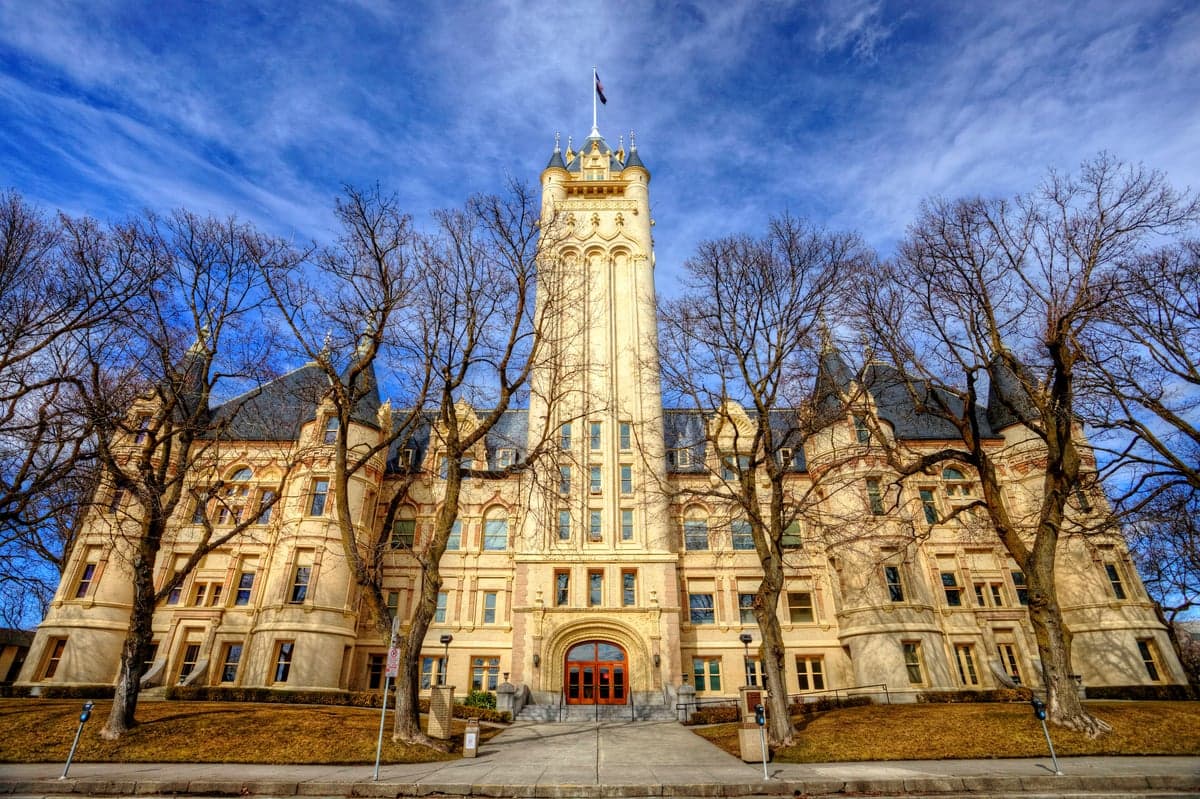
Photo: Wikipedia
Demographics of Spokane County
Affluence Level in Spokane County
A middle-class area roughly in line with national averages across income, home values, education, and employment.
People of Spokane County
Spokane County today is a predominantly white, family-oriented community of 544,323 residents where traditional values and self-reliance remain strong. With a foreign-born population of only 2.2%—among the lowest for any metropolitan county in the United States—and a college attainment rate of 32.1%, the county retains a blue-collar, rural-influenced character even as suburban growth accelerates around Spokane Valley, Liberty Lake, and Airway Heights. The population is 81.6% white, 6.9% Hispanic, 2.1% East/Southeast Asian, 1.9% Black, and 0.2% Indian subcontinent, making it one of the least ethnically diverse counties in the Pacific Northwest despite steady domestic in-migration.
Settlement & growth (pre-1960)
The original inhabitants of the region were the Spokane people, a Salish-speaking tribe who lived along the Spokane River for thousands of years, relying on salmon, camas roots, and game. Trappers from the Hudson’s Bay Company passed through in the 1820s, and missionaries including C. M. Walker established a Presbyterian mission among the Spokane in the late 1830s. The first permanent American settlement came in 1871 when trader James N. Glover purchased a plot near the Spokane Falls, laying out what would become the city of Spokane.
The completion of the Northern Pacific Railway through Spokane in 1881 triggered the county’s first major immigration wave. Thousands of white settlers from the Midwest and Northeast arrived, drawn by railroad construction, timber milling, and the promise of cheap farmland in the Palouse. By 1890 Spokane was a boomtown of 19,922 residents, the region’s railroad, mining, and agricultural hub. German, Irish, and Scandinavian immigrants—especially Swedes and Norwegians—formed distinct farming communities in outlying areas. Swedish families clustered around the towns of Latah and Fairfield, where their Lutheran churches and log homes still stand. German immigrants settled the agricultural valleys near Deer Park and Rockford, raising wheat and dairy cattle.
Chinese laborers, who had helped build the Northern Pacific, numbered several hundred in Spokane in the 1880s, but anti-Chinese violence in 1885–86 drove most of them out; by 1900 only a handful remained. The Dust Bowl of the 1930s brought a modest flow of displaced farmers from the Great Plains to Spokane and Cheney, though far fewer than to central Washington. World War II brought the decisive demographic event of the mid-20th century: the construction of Fairchild Army Airfield (now Fairchild Air Force Base) in 1942 in Airway Heights. The base drew thousands of military personnel and their families, many of whom stayed after the war, reshaping the county’s economy and giving it a lasting military-connected identity. Meanwhile, the town of Medical Lake grew as a service center for the base and for Eastern State Hospital, the region’s psychiatric facility founded in 1891. By 1960 the county’s population reached 278,437, overwhelmingly white and native-born.
Modern era (post-1965)
The 1965 Hart-Cellar Act, which opened immigration from outside Europe, had a muted effect on Spokane County. The foreign-born share never climbed above 3%; it stands at 2.2% today, a figure comparable to rural Nebraska counties. Instead, domestic migration drove population growth. Families and retirees from California, Oregon, and Washington’s coastal counties began arriving in the 1970s and 1980s seeking cheaper housing and a slower pace. Liberty Lake, a master-planned community built around a 1970s-era flood-control reservoir, became the preferred destination for these transplants, growing from a handful of residents to over 12,000 today. Spokane Valley, a formerly unincorporated strip of suburban sprawl, incorporated as a city in 2003 and now holds 103,000 residents, many of them second- and third-generation families from the city of Spokane itself.
The Hispanic population, now 6.9% of the county, grew slowly after 1965 through agricultural labor in the orchards and potato fields of the Cheney-Plaza corridor and through service-industry jobs in Spokane. This growth is almost entirely domestic—migrants from Texas, California, and the Southwest—rather than directly from Latin America. The East/Southeast Asian community (2.1%) includes a small but stable Vietnamese cohort that arrived as refugees after 1975, with families settling in Spokane Valley and the Hillyard neighborhood of northeast Spokane. The Indian subcontinent population (0.2%) is negligible, almost entirely professionals in healthcare and tech at Spokane’s two major hospital systems. The Black population (1.9%) has been slow to grow; a small historic community rooted in railroad and military service still lives in east-central Spokane, but most new Black residents are military families posted to Fairchild. Suburbanization and white flight from Spokane’s core accelerated after 1970: middle-class families moved to Mead, Colbert, and Nine Mile Falls, sought-after school districts that remain overwhelmingly white and politically conservative.
The future
Spokane County’s population is projected to reach roughly 600,000 by 2040, driven by organic growth and continued domestic in-migration from the West Coast. The foreign-born share will remain extremely low by national standards, perhaps rising to 3% through limited refugee resettlement and H-1B professionals in Spokane’s expanding medical and tech sectors. The Hispanic share is expected to approach 10% by 2040, but this growth will occur almost exclusively through births and domestic movement, not international migration. The East/Southeast Asian and Black shares will grow only marginally, while the Indian subcontinent population will remain a footnote.
Rather than tribalizing into distinct ethnic

* Values derived from national, state, county, city and local statistics and may differ in a specific area. Last updated: 2026-06-03T01:58:47.000Z
Narrative content on this page is AI-generated and may contain mistakes. Verify any details that matter before acting on them.
ReloMaps may earn a commission from affiliate links at no extra cost to you.

