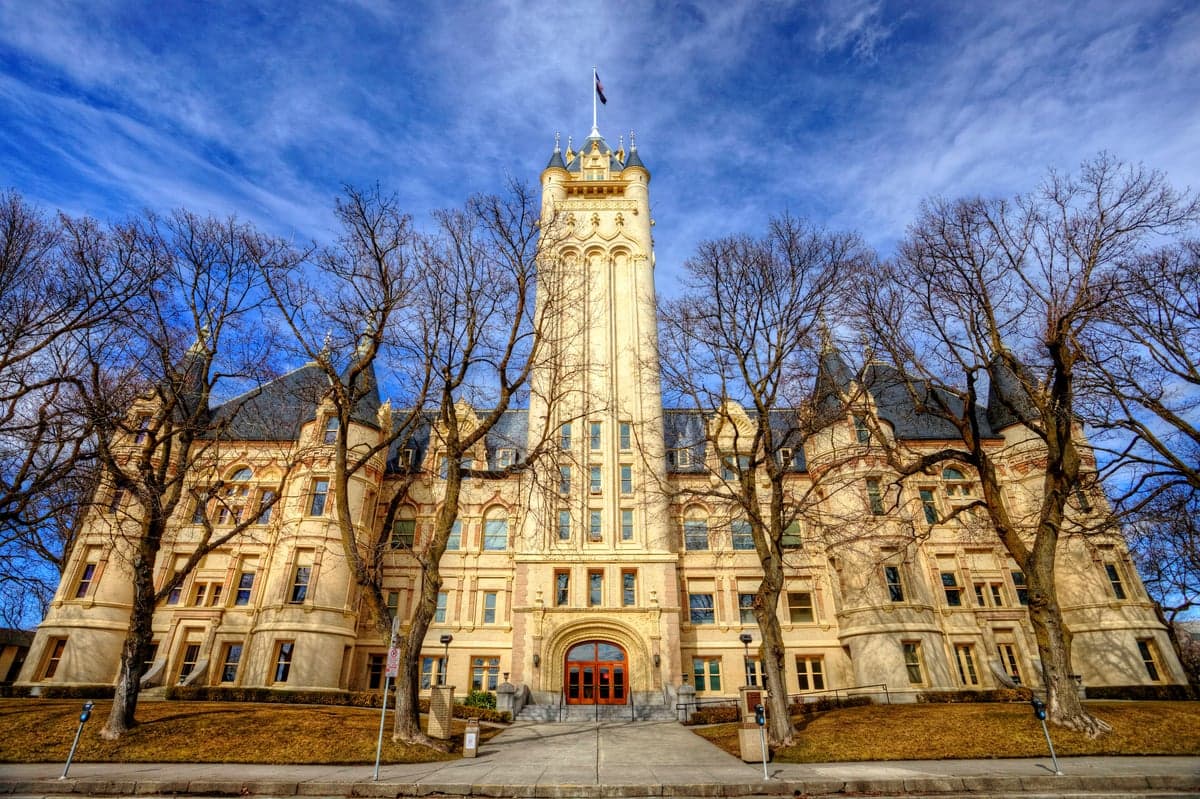
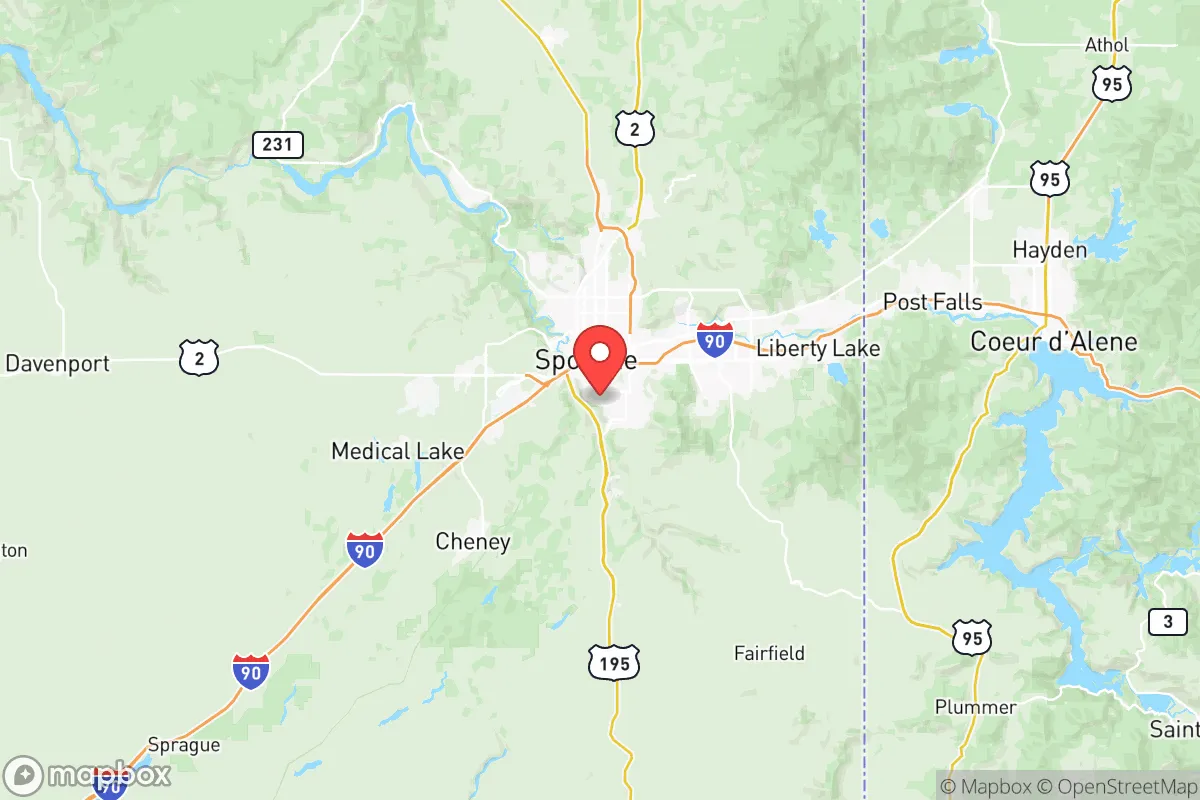
Photo: Wikipedia
Political ClimatePolitical Climate in Spokane County
Showing district-level results — no local-only data available.
Local Political AnalysisPolitical Analysis of Spokane County
Spokane County leans reliably Republican with a Cook PVI of R+5, but that's been slipping lately — especially inside Spokane city limits. If you've lived here as long as I have, you've watched the city proper trend bluer each cycle while the suburbs and exurbs hold the line. The county went for Trump by about 10 points in 2024, but four years earlier it was closer to 12. Meanwhile, neighborhoods in the South Hill and Perry District now regularly elect progressive city council members, and the mayor's office flipped to a Democrat in 2023. Out in Spokane Valley and Liberty Lake, it's a different story — those precincts routinely deliver 60%+ for Republican candidates. Deer Park and Medical Lake are even redder. Cheney is a mixed bag thanks to Eastern Washington University; the student vote gives it a slight blue lean, but the surrounding ranch country counters it. The swing precincts are along the I-90 corridor in what used to be reliable red areas — places like the newer subdivisions south of Sprague where transplants from the west side have started to shift things. That migration is the biggest wildcard for the next decade.
How it compares
Compared to Washington state as a whole, Spokane County is a conservative island in a blue ocean. The state's Cook PVI isn't officially calculated, but every statewide race since 2004 has gone Democratic by 10–20 points. Olympia passes gun restrictions, cap-and-trade fuel taxes, and mandatory composting programs that land like a lead balloon east of the Cascades. Spokane County residents routinely feel ignored or worse — actively legislated against — by a majority in King County that doesn't share their values on property rights, gun ownership, or school choice. The county's legislative delegation in the statehouse is mostly Republican, but they're perpetually outvoted. What we have here is a local government that tries to push back, but state preemption is real. The only real leverage is the county's role as a regional economic hub — if Spokane County slows down, the whole state notices.
What this means for residents
For folks who value personal freedom and limited government, Spokane County offers one of the better mixes in Washington. The county sheriff has flatly refused to enforce certain state gun laws, and the county commission has sued over statewide land-use mandates. That said, you still pay the state's high sales tax and deal with its ever-rising gas prices thanks to the Climate Commitment Act. Property taxes are moderate compared to Seattle-area suburbs, and the housing market remains more affordable — for now. The influx from California, Oregon, and western Washington is bringing progressive political donations along with higher home prices. If you move here, expect the culture to feel more like inland Montana than Seattle; neighbors wave, people shoot in their backyards (legally), and church attendance is visible. But the political future depends on how many newcomers keep voting like they did back home. A decade from now, a 3-2 Republican majority on the county commission could easily flip to 3-2 Democratic. That's the trajectory I'm watching.
The real cultural divide in Spokane County isn't between red and blue — it's between the city and everything else. Inside the urban growth boundary, you've got bike lanes, farm-to-table restaurants, and a city council that talks about "equity." Drive fifteen minutes outside town and you're in farm country where the biggest

State Political ClimatePolitical Climate in Washington
State Political AnalysisPolitical Environment in the State
Washington has been a reliably blue state in presidential elections for over three decades, but its partisan lean is deceptive—the state is really two political countries separated by the Cascade Range. The Seattle metro area (King, Snohomish, Pierce counties) now drives roughly 60% of the vote, and as those counties have shifted further left over the past twenty years, the statewide margin has moved from competitive (1992 Clinton by 5 points) to solidly Democratic (2024 Harris by 12 points). A conservative considering a move here needs to understand that while parts of the state still feel like the old West, the political center of gravity is firmly in the urban crescent.
Urban vs. rural divide
The sharpest political line in Washington is the Cascade crest. West of the mountains, King County (Seattle, Bellevue) votes 70-75% Democratic, and the I-5 corridor from Bellingham down through Everett, Seattle, Tacoma, and Olympia forms a contiguous blue wall. Over the past decade, once-purple suburbs like Redmond, Kirkland, and even parts of Snohomish County have flipped decisively blue. East of the Cascades, the story flips: Yakima, Spokane, Wenatchee, and the Tri-Cities (Kennewick, Pasco, Richland) are solidly Republican—Spokane County went +11 for Trump in 2024, and Yakima +14. The rural counties like Ferry, Stevens, and Garfield are among the reddest in the nation (Garfield voted 79% Trump). But here's the rub: the urban crescent is growing faster. King County alone adds more new residents each year than all eastern Washington combined. Every redistricting cycle, the political power shifts westward. For a family looking for like-minded neighbors, Spokane County or the Tri-Cities are still viable red islands, but you're living in a state where state-level control is now permanently out of reach for conservatives.
Policy environment
The policy landscape reflects that urban dominance. Washington has no state income tax—that's the one bright spot—but property taxes and sales taxes are among the highest in the nation (average combined state+local sales tax around 9.3%). The state recently enacted a capital gains tax (7% on gains over $250k), which was sold as a "wealth tax" for the rich but is already being expanded. Regulatory posture is heavy: the state has its own environmental policy act (SEPA) that can delay or kill development, a strict low-carbon fuel standard, and a ban on new natural gas hookups in many new buildings. Education policy is a flashpoint—the state moved to universal "gender inclusive" policies in schools without parental opt-out, and library materials are shielded from removal under the state's "Freedom to Read" law. Election law is vote-by-mail with same-day registration, which conservatives argue creates security concerns; the state was an early adopter of ballot harvesting. Permissive ballot initiatives exist (a rare center-right tool), but they've been gasoline: I-976 (car tab tax cap) was gutted by the legislature, and I-2117 (anti-cap-and-trade) is being fought. Parental rights, property rights, and gun rights are all under sustained pressure from Olympia.
Trajectory & freedom
Freedom is trending negative in Washington, and the pace is accelerating. The 2023 legislative session was a wrecking ball for Second Amendment rights: HB 1240 banned the sale of over 50 types of semi-automatic rifles, HB 1143 added a 10-day waiting period and mandatory training for all firearm purchases, and HB 1903 imposed a no-carry restriction on "sensitive places" so broad it covers public transit, libraries, and hospitals. Emergency powers have expanded: the governor held unilateral authority for over 800 days during COVID, and the legislature hasn't tightened those reins. Medical autonomy took a hit with the "Right to Harm" (HB 1155, 2022) that allowed state action against doctors who refused to perform gender-transition procedures on minors. Property rights are eroding: the state's Growth Management Act is used to block rural development, and "missing middle" housing bills preempt local zoning but only in high-density corridors—favoring urban living. On the plus side, the state still has no income tax and a well-funded transportation system, but the direction is unmistakably toward bigger government and fewer individual choices.
Civil unrest & political movements
Washington's political activism is loud and visible, especially in the west. The 2020 CHOP/CHAZ experiment in Seattle—weeks of police-free autonomous zone that ended in shootings and a death—radicalized a lot of moderates and drove suburban voters like those in Issaquah and Sammamish to reconsider the Democratic machine. But the city still has a "defund the police" legacy: the Seattle police department has lost hundreds of officers through attrition and morale, and property crime rates in downtown Seattle, Tacoma, and Spokane's University District remain elevated. Conservative activism is mostly confined to small-government groups east of the mountains and a network of Second Amendment sanctuaries (over 30 counties have passed resolutions). Immigration politics are active: Washington is a "sanctuary state" (HB 2335 prohibits local law enforcement from cooperating with ICE), and there is an ongoing tension between King County's open-border policies and eastern counties' complaints about fentanyl trafficking. The secession movement (the "Liberty State" proposal for eastern Washington) gets media attention but has zero chance of passing—it's a protest vote. Election integrity remains a sore point: the 2020 and 2022 cycles saw record late-night ballot dumps in King County, and the state's vote-by-mail system does not require a photo ID. New residents from red states often find the lack of transparency unnerving.
Projection
Over the next five to ten years, expect Washington to become more like Oregon: a single-party state dominated by the I-5 corridor. In-migration from California (the top state of origin) is bringing people who are culturally comfortable with higher taxes and more regulation. The urban counties are growing younger and more ethnically diverse, which historically translates to Democratic votes. Red counties in eastern Washington are holding steady, but they are losing population share—by 2030, the combined vote of King, Pierce, Snohomish, and Thurston counties could approach 65% of the electorate. That means more aggressive climate mandates, more erosion of gun rights (magazine limits coming next), more tax experiments (mention of a statewide wealth tax), and less space for conservative families in school and housing policy. A move to Spokane or the Tri-Cities still gives you a local community that votes like you, but state-level politics will be increasingly hostile. The best-case scenario for freedom-minded residents is a split legislature via the governor's veto power, but that requires winning back suburban seats that flipped after 2020—a tall order.
If you're considering Washington as a conservative family, the practical reality is this: you can carve out a good life east of the mountains (Spokane, Colville, Walla Walla) or in a rural enclave like Goldendale, but you'll be living under a state government that taxes you heavily, restricts your gun rights, and runs schools by Seattle's values. The red spots on the map are shrinking, not growing. You'll need to be willing to fight for your local school board, your property rights, and your sheriff's ability to say "no." It's not West Coast California—yet—but the arc is bending that way. Many long-time residents are already looking at Idaho or Montana as their next move. Know what you're signing up for.
* Values derived from national, state, county, city and local statistics and may differ in a specific area. Last updated: 2026-06-03T01:58:47.000Z
Narrative content on this page is AI-generated and may contain mistakes. Verify any details that matter before acting on them.
ReloMaps may earn a commission from affiliate links at no extra cost to you.

