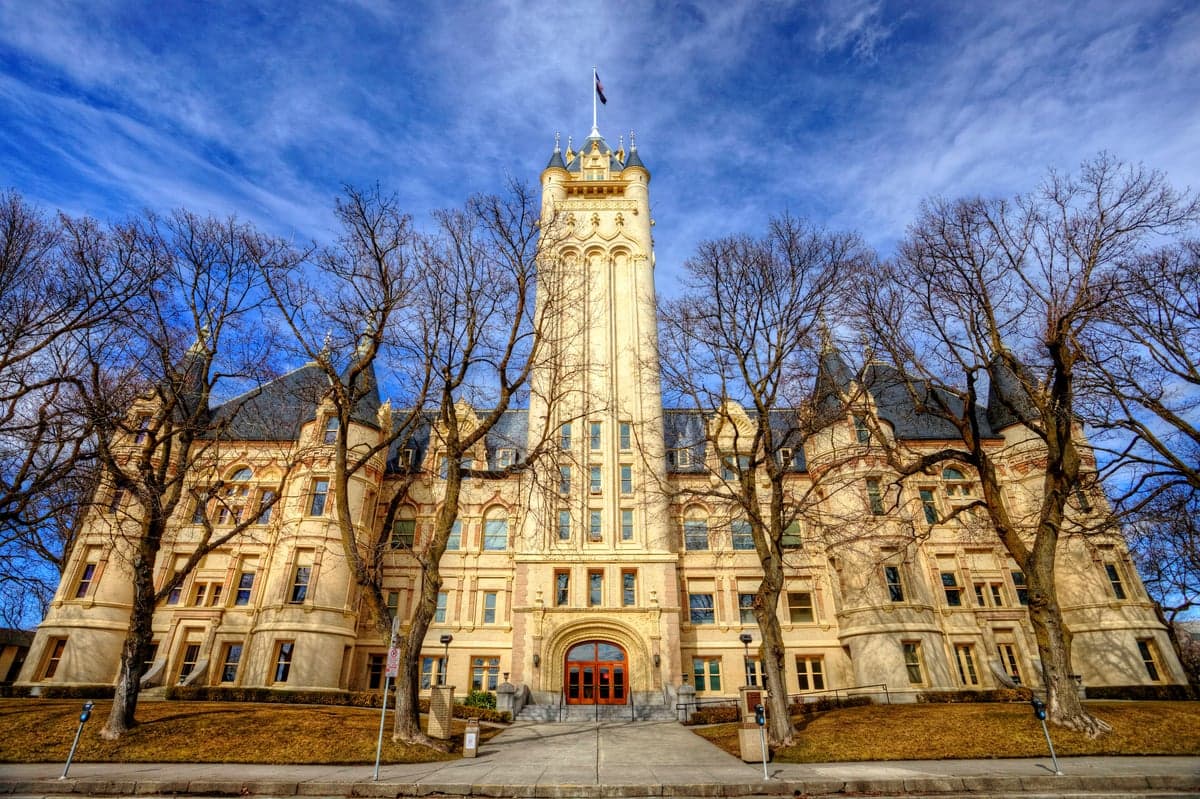
Photo: Wikipedia
Personal Sovereignty in Spokane County
Viable for self-reliance. Generally workable, though some barriers may limit total independence.
What does Personal Sovereignty tell us?
Personal Sovereignty measures your capacity for self-reliance and independence with minimal government friction. Higher scores mean fewer barriers between you and the way you want to live... but it assumes you have the space you need and good neighbors.
What does this tell us?
Personal Sovereignty measures your capacity for self-reliance and independence with minimal government friction. Higher scores mean fewer barriers between you and the way you want to live... but it assumes you have the space you need and good neighbors.
State Policy
Energy independence: Importer (55% of energy produced in-state)
Personal Liberty
Homesteading

Personal Liberty Analysis
For the individual who values personal sovereignty and sees government overreach as the primary threat to liberty, Spokane County occupies a complicated but promising middle ground. The state of Washington imposes a top-down regulatory apparatus—tightened gun laws, aggressive environmental mandates, and a public-health establishment that leaned heavily on emergency powers—but Spokane County’s geography, political culture, and land-use patterns still give a determined person room to maneuver. Whether you’re a single prepper in Deer Park or a family looking to keep the state out of your parenting decisions in Chattaroy, the key is understanding where local autonomy actually exists and where you’ll be fighting the Olympia machine.
Tax burden and regulatory posture in Spokane County compared to western Washington
Washington’s lack of a personal income tax is often touted as a freedom win, but it masks a punishing sales tax (8.7% in Spokane city, slightly lower in unincorporated areas) and property taxes that have climbed steadily as school levies and county bonds accumulate. More critical for the sovereignty-minded is the regulatory posture: the Washington State Building Code Council, Growth Management Act, and Department of Ecology impose uniform land-use restrictions across the state. However, Spokane County’s conservative commissioners have pushed back against Olympia’s zoning mandates more than their counterparts in King or Snohomish counties. In rural towns like Deer Park and Fairfield, the county’s planning department is far more lenient with building permits for workshops, storage sheds, and accessory dwelling units than inside the Spokane city limits. If you want to put a 40-foot container building on your land without a year of permit fights, unincorporated Spokane County is a better bet than Spokane Valley or Liberty Lake, both of which have stricter municipal codes. Still, property taxes in rural areas run about $12–$15 per $1,000 of assessed value—lower than western Washington but higher than a free-state alternative like Idaho.
Self-defense environment and Washington’s gun restrictions on the ground in Spokane County
Washington’s gun laws have become a poster child for overreach: Initiative 1639 (2018) raised the purchase age for semi-automatic rifles to 21, imposed enhanced background checks, and created a storage requirement that critics view as an infringement with no enforcement mechanism. The 2023 magazine ban and the 2024 ban on certain semi-automatic firearms sales further tightened the noose. Yet Spokane County remains one of the most gun-friendly strongholds in the state. Sheriff John Nowels (elected 2024) has publicly stated he will not enforce magazine bans that he considers unconstitutional, continuing a tradition set by predecessor Ozzie Knezovich. In Deer Park, Cheney, and rural areas east of Newman Lake, concealed carry permits are issued without harassment, and private firearms sales between individuals remain common despite state attempts to regulate them. The practical reality: if you live in unincorporated Spokane County, you can own the firearms you need with minimal local interference, but you must still comply with state registration and purchase requirements at the point of sale. The trade-off is clear: you get a sheriff who respects the Second Amendment, but you live under a state government that does not. For the serious prepper, storing a compliant rifle in a way that satisfies the state while remaining quickly accessible is a line you’ll have to walk—or choose to ignore at your own risk.
Homesteading viability and off-grid living options across Spokane County’s rural zones
If you came here intending to raise your own food, store fuel, and live with minimal reliance on municipal infrastructure, Spokane County offers real possibilities—but only in the right pockets. Minimum lot sizes vary dramatically: in the Agricultural-10 zone (common around Elk, Chattaroy, and Fairfield) you need at least ten acres, which is perfect for a serious homestead. The Rural-5 zone (five-acre minimum) covers much of the area around Deer Park and Newman Lake. In both zones, wells are permissible and septic systems are standard, though county health regulations require a permit for the septic and a water-rights registration for the well. Off-grid solar is legally straightforward as long as you don’t connect to the grid; net metering is available if you do, but the utility requirements can be invasive. The main obstacle is Washington’s building code: the state requires a permanent dwelling to meet energy code standards (insulation, windows, heat source) that can clash with a simple cabin or yurt. However, many outbuildings (workshops, barns) can be built without a permit if under 120 square feet, and some homesteaders live in RVs while constructing a small permitted cabin. The county’s enforcement reputation is uneven—Deer Park and Fairfield rarely see inspectors nosing around unless a neighbor complains, while Spokane Valley and Airway Heights are stricter. Overall, the rural north and south of the county are viable for a semi-off-grid lifestyle, but you’re still under state oversight for anything considered a dwelling. Compare this to Boundary County, Idaho, just an hour east, where building codes are virtually nonexistent for owner-built homes—that contrast tells you where full sovereignty really lies.
Personal liberties in Spokane County: parental rights, medical autonomy, and property protections
Parental rights in Washington are increasingly contested. The state’s expansion of access to confidential reproductive and gender-related care for minors without parental consent (2019–2024 laws) has alarmed conservative families. Spokane County’s school districts vary widely: Deer Park and Freeman School District (rural south) have adopted policies that try to require parental notification for any significant medical or mental health intervention, while Spokane Public Schools follow the state’s mandate to keep such information confidential from parents. For homeschooling families, Washington’s requirements are moderate—annual testing and a parent declaration—and the county’s homeschool community is active, with co-ops in Cheney and Chattaroy. Medical autonomy for adults is constrained by WA’s assisted suicide law (yes, it exists) and vaccine mandates for healthcare workers and school attendance (though exemptions for personal belief were removed for MMR). On property rights, the county’s planning department is a mixed bag: it generally respects established use rights, but the Growth Management Act forces the county to update comprehensive plans that can downzone rural parcels. In 2024, the county pushed back against a state mandate to allow increased density in rural areas—a small win for those who want to keep their 10-acre homesteads from being subdivided. Free speech is protected as a constitutional matter, but the city of Spokane has a track record of using anti-camping ordinances to restrict political speech on public property—less of an issue in towns like Fairfield or Fairchild AFB area.
Spokane County is not a sovereignty sanctuary—Washington state’s regulatory claws are long. But it offers a far better personal autonomy environment than Seattle, Portland, or even Tacoma. The local culture leans survivalist, the sheriff is on your side, and the rural zoning allows you to build a resilient life if you’re willing to work around state constraints. For the single person or family who wants to own firearms without state harassment, homeschool with a strong community, and produce their own food on a decent lot, Spokane County is a reasonable choice—just keep one eye on the Idaho line for when the state goes too far.

* Values derived from national, state, county, city and local statistics and may differ in a specific area. Last updated: 2026-06-03T01:58:47.000Z
Narrative content on this page is AI-generated and may contain mistakes. Verify any details that matter before acting on them.
ReloMaps may earn a commission from affiliate links at no extra cost to you.

