
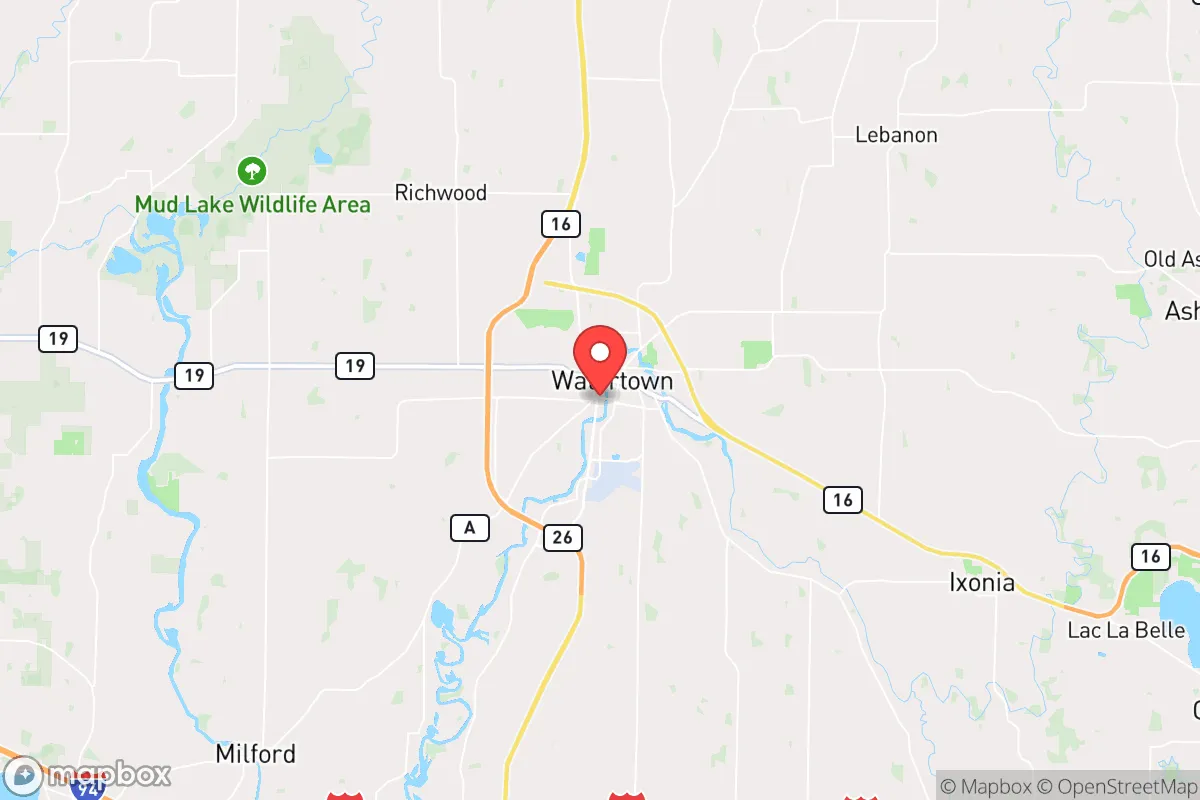
Photo: Wikipedia
Personal Sovereignty in Watertown, WI
Moderate friction. Expect trade-offs in some aspect of personal liberty and independence.
What does Personal Sovereignty tell us?
Personal Sovereignty measures your capacity for self-reliance and independence with minimal government friction. Higher scores mean fewer barriers between you and the way you want to live... but it assumes you have the space you need and good neighbors.
What does this tell us?
Personal Sovereignty measures your capacity for self-reliance and independence with minimal government friction. Higher scores mean fewer barriers between you and the way you want to live... but it assumes you have the space you need and good neighbors.
State Policy
Energy independence: Importer (15% of energy produced in-state)
Personal Liberty
Homesteading

Personal Liberty Analysis
Watertown, Wisconsin offers a notably high degree of personal sovereignty, grounded in the state’s strong tradition of local control and individual rights. For a relocation audience prioritizing autonomy, the city presents a balanced environment where state-level protections for self-defense, parental rights, and property use are robust, while local regulations remain moderate and generally non-intrusive. The overall autonomy environment in Watertown is characterized by a practical, live-and-let-live ethos, with fewer restrictions than in neighboring Illinois or the Minneapolis-St. Paul metro, but with more structured governance than in rural, unincorporated areas of the state.
Tax burden and regulatory posture for residents and small businesses
Wisconsin’s tax burden is moderate compared to the national average, and Watertown residents benefit from a relatively straightforward regulatory landscape. The state’s individual income tax is progressive, with rates ranging from 3.54% to 7.65% in 2026, and the sales tax is 5% statewide, with no additional county or city sales tax in Watertown (unlike Milwaukee or Madison). Property taxes in Watertown are a key consideration: the effective property tax rate hovers around 1.8% of assessed value, which is slightly above the national average but typical for Wisconsin, where local school funding relies heavily on property levies. For small businesses and entrepreneurs, the regulatory environment is light-touch. Watertown does not impose a local business license fee beyond the state’s basic registration, and zoning is generally permissive for home-based businesses, provided they do not generate excessive traffic or noise. The city’s regulatory posture is best described as pragmatic—permits are required for major construction or renovations, but the process is streamlined and predictable, with no overlay of excessive environmental or land-use restrictions that plague larger urban centers. This makes Watertown a favorable spot for someone seeking to start a small trade, repair shop, or consulting practice without drowning in red tape.
Self-defense and gun law specifics in Wisconsin and Watertown
Wisconsin is a strong Second Amendment state, and Watertown reflects that culture. The state is a “shall-issue” jurisdiction for concealed carry permits, meaning that any law-abiding adult who completes a training course and passes a background check can obtain a permit without discretionary denial by local authorities. Open carry is legal without a permit for anyone 18 or older, and the state preempts local governments from enacting stricter gun ordinances than state law—so Watertown cannot ban firearms in parks or impose waiting periods beyond what the state mandates. Stand-your-ground laws are in effect: Wisconsin law (Wis. Stat. § 939.48) does not impose a duty to retreat before using deadly force in self-defense, provided the person is lawfully present and not engaged in criminal activity. This is a critical distinction from states like Illinois or New York, where retreat is required. Additionally, Wisconsin has a “castle doctrine” that presumes a reasonable fear of death or great bodily harm if an intruder unlawfully enters a home or vehicle. For the relocation reader, this means that self-defense rights in Watertown are clear, legally protected, and not subject to local political whims. The city itself has a low violent crime rate (roughly 1.5 incidents per 1,000 residents in 2024), so the practical need for self-defense is modest, but the legal framework is unequivocally supportive of personal preparedness.
Self-reliance and homesteading viability: lot sizes, zoning, and off-grid feasibility
Watertown’s residential landscape offers genuine opportunities for self-reliance, especially for those willing to live on the city’s fringe or in nearby unincorporated areas. Within city limits, standard residential lots range from 0.15 to 0.5 acres in older neighborhoods, but newer subdivisions and properties along the Rock River often feature lots of 1 to 5 acres. Zoning in Watertown’s R-1 (single-family residential) districts allows for vegetable gardens, small livestock like chickens (up to 6 hens, no roosters, with a permit), and beekeeping, though pigs, goats, and cattle are generally prohibited within city limits. For serious homesteading—raising larger livestock, keeping horses, or running a small farm—the best option is to purchase land in the surrounding towns of Watertown (the township, not the city) or in adjacent Jefferson or Dodge counties, where zoning is agricultural and lot sizes of 5 to 40 acres are common and affordable (land prices range from $5,000 to $12,000 per acre as of 2026). Off-grid feasibility is moderate: Wisconsin’s climate requires reliable heating and electricity, and the state does not prohibit solar panels or rainwater collection, but grid-tied systems are the norm. Watertown’s building codes require connection to municipal water and sewer within city limits, so true off-grid living (well, septic, no grid power) is only possible in unincorporated areas. The city does not restrict composting toilets or greywater systems for non-residential use, but residential composting is allowed. For the self-reliant individual, Watertown offers a middle ground: you can have a substantial garden, keep chickens, and reduce utility dependence, but full off-grid autonomy requires moving a few miles outside the city.
Personal liberties: parental rights, medical autonomy, speech, and property
Wisconsin law provides strong protections for parental rights, medical autonomy, and free speech, and Watertown’s local governance respects these boundaries. Parental rights are explicitly protected under Wisconsin Statute § 48.01, which states that parents have the primary responsibility for the care, custody, and control of their children, and the state may only intervene in cases of abuse or neglect. This means that in Watertown, parents can make decisions about their children’s education (including homeschooling, which is regulated but not burdensome—parents must submit an annual enrollment report and ensure a “sequentially progressive curriculum”), medical treatment (including vaccine exemptions for philosophical or religious reasons), and discipline without fear of overreach. Medical autonomy is similarly robust: Wisconsin does not have a state-level vaccine mandate for adults, and the 2023 Act 101 prohibits employers from requiring COVID-19 vaccination as a condition of employment, a protection that extends to most private-sector workers. For medical freedom advocates, this is a significant advantage over states like New York or California. Free speech and assembly are protected under the Wisconsin Constitution, which has been interpreted more broadly than the First Amendment in some cases, and Watertown has no local ordinances restricting public protest or leafleting. Property rights are strong: Wisconsin is a “notice” state for recording deeds, and eminent domain is limited to public use with just compensation. Watertown’s zoning board is known for being reasonable with variance requests, and there is no rent control or burdensome landlord licensing scheme. For the relocation reader, this means that personal liberties in Watertown are not merely theoretical—they are codified in state law and respected in local practice, creating an environment where individuals can live according to their own values without excessive government interference.
Overall, Watertown’s personal sovereignty environment ranks favorably for a conservative-leaning audience, offering a blend of state-level protections and local permissiveness that is rare in the Midwest. Compared to Madison or Milwaukee, where progressive city councils have enacted stricter gun laws, higher taxes, and more regulatory oversight, Watertown feels distinctly freer. Compared to rural Jefferson County, it offers more amenities and infrastructure without sacrificing autonomy. For the individual or family seeking a place where self-reliance is respected, taxes are manageable, and personal liberties are legally protected, Watertown represents a solid, practical choice—not a libertarian utopia, but a genuinely free community within a state that values independence.

* Values derived from national, state, county, city and local statistics and may differ in a specific area. Last updated: 2026-08-11T01:35:41.000Z
Narrative content on this page is AI-generated and may contain mistakes. Verify any details that matter before acting on them.
ReloMaps may earn a commission from affiliate links at no extra cost to you.

