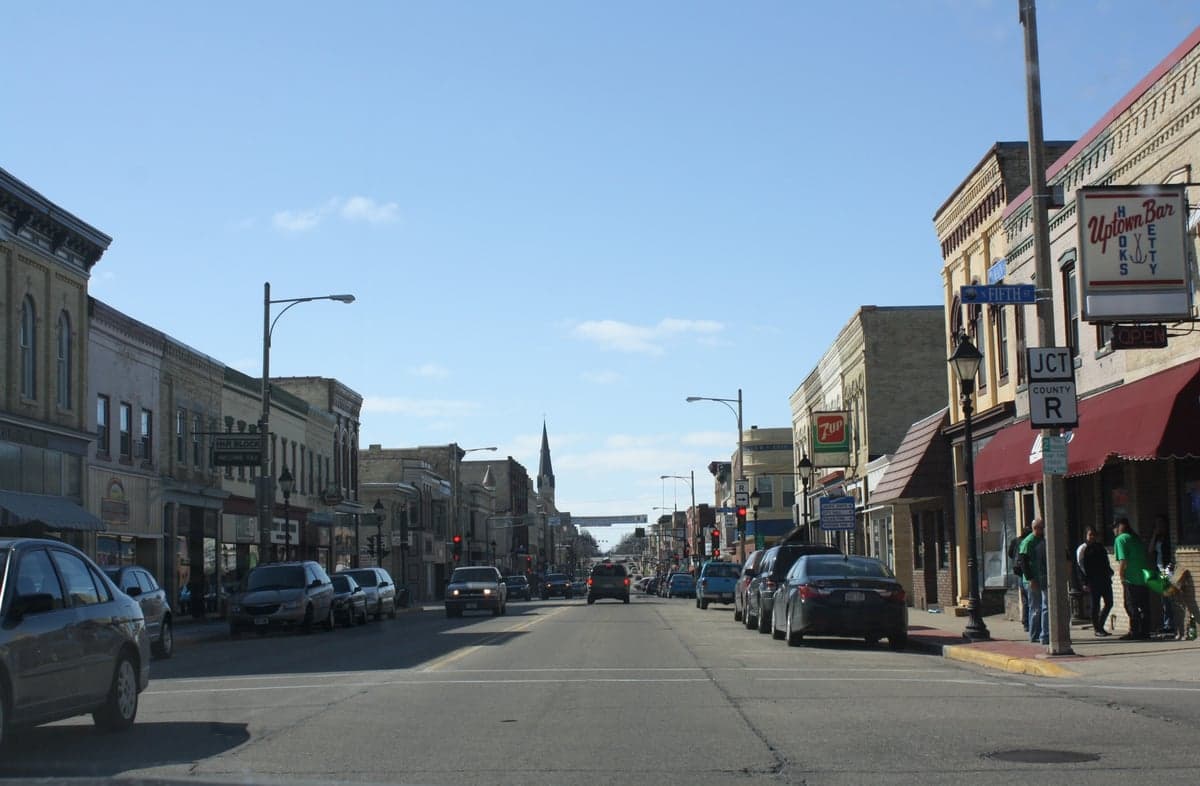
Photo: Wikipedia
Political ClimatePolitical Climate in Watertown, WI
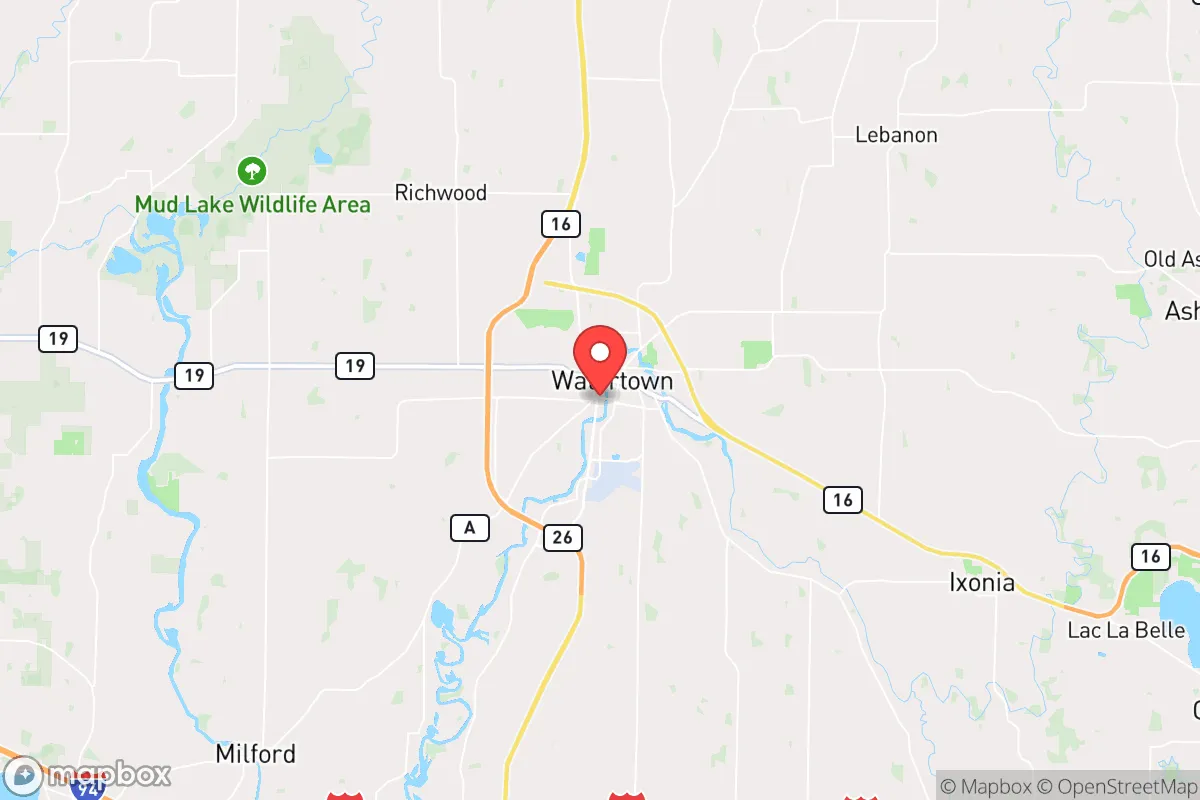
District shown is the primary district for this city’s centroid. Cities may span multiple districts.
Local Political AnalysisPolitical Analysis of Watertown, WI
Watertown, Wisconsin, is a solidly conservative community in a state that’s become the ultimate political battleground. With a Cook Partisan Voting Index (PVI) of R+11, the city leans heavily Republican, a stark contrast to Wisconsin’s statewide PVI of EVEN. This isn’t a recent shift—Watertown has been reliably red for decades, but the gap between local and state politics has widened as the rest of the state has swung more competitive. If you’re moving here, you’ll find a place where conservative values are the default, but the surrounding region offers a mix of political flavors that keeps things interesting.
How it compares
Watertown’s R+11 rating puts it in a different political universe from Wisconsin as a whole, which is a pure toss-up. To get a sense of the contrast, look at nearby cities. Madison, just 40 miles southwest, is a deep-blue stronghold with a Cook PVI around D+18—a 29-point swing from Watertown. Milwaukee, 50 miles east, leans Democratic as well, though not as heavily. Even smaller towns like Oconomowoc (R+8) and Beaver Dam (R+12) are more conservative than Watertown, but the real outlier is Jefferson, just 10 miles south, which is slightly less red at R+6. What this means in practice is that Watertown feels like a conservative island in a sea of purple—drive 20 minutes in any direction, and you’ll hit communities that are either more moderate or outright liberal. The 2024 presidential election underscored this: Watertown’s Jefferson County voted +14 for Trump, while Dane County (Madison) went +38 for Harris. The state’s EVEN rating reflects how these extremes cancel out.
What this means for residents
For conservative residents, Watertown is comfortable. Local elections are rarely competitive, and the city council and school board tend to reflect traditional values. You’ll find plenty of churches, gun shops, and “Support Our Troops” signs. For liberal residents, it’s a different story. You won’t be ostracized, but you’ll be in the minority. Progressive candidates rarely win local races, and issues like abortion access or climate policy are non-starters in city hall. That said, the proximity to Madison means you can easily access a more liberal environment for work or weekend trips. The practical effect is that Watertown’s politics are stable but not static—the city has seen modest growth, and with it, a slow trickle of newcomers from more liberal areas. I’ve watched the local Democratic Party chapter go from nearly nonexistent to holding regular meetings, though they still struggle to field candidates. The trajectory is toward a slight softening of the red, but don’t expect a flip anytime soon.
Culturally, Watertown’s conservatism shows in its policy priorities. The city has a strong emphasis on low taxes and limited government—property taxes here are about 15% lower than the state average. There’s no city income tax, and the sales tax is the standard 5.5%. Public spending is lean, with parks and libraries well-maintained but not lavish. The school district, Watertown Unified, is a point of pride for many conservatives, with a focus on traditional curriculum and local control. You won’t find the kind of progressive social programs you’d see in Madison or Milwaukee. For a liberal resident, this can feel stifling—there’s no local LGBTQ+ center, and the city’s diversity is low (about 88% white). But for a conservative, it’s a welcome respite from the culture wars playing out statewide. The bottom line: Watertown is a place where your political leanings will shape your daily experience, but the nearby blue pockets ensure you’re never more than a short drive from a different perspective.

State Political ClimatePolitical Climate in Wisconsin
State Political AnalysisPolitical Environment in the State
Wisconsin is the quintessential swing state, with a Cook PVI of EVEN that perfectly captures its knife-edge balance. Over the past 20 years, the state has shifted from a reliably blue-leaning battleground (voting for Democrats in every presidential election from 1988 to 2012) to a pure toss-up, splitting its electoral votes between Trump and Biden by razor-thin margins in 2016 and 2020. The dominant coalitions are a classic urban-rural split: the Democratic base is anchored in Milwaukee and Madison, while the GOP draws strength from the WOW counties (Waukesha, Ozaukee, Washington) and the vast rural and exurban stretches of the north and west. This isn't a state that's trending decisively red or blue—it's a state where every election is a knife fight, and the outcome depends on turnout in the suburbs and the Fox Valley.
Urban vs. rural divide
The political map of Wisconsin is a study in contrasts. Milwaukee County, home to the state's largest city, delivers massive Democratic margins—Biden won it by over 200,000 votes in 2020. Madison (Dane County) is even more lopsided, giving Democrats a 75%+ share. But the rest of the state is a sea of red. The WOW counties—Waukesha, Ozaukee, and Washington—are the GOP's suburban fortress, with Waukesha County alone providing a 60,000-vote Republican margin. The Fox Valley, anchored by Appleton and Green Bay, has been trending redder as union-aligned blue-collar voters shift right. Meanwhile, the Driftless Region in the southwest (around La Crosse and Prairie du Chien) and the Northwoods (Rhinelander, Minocqua) are deeply Republican, with some counties voting 65-70% for Trump. The key battlegrounds are the "Blue Wall" counties—Brown (Green Bay), Outagamie (Appleton), Winnebago (Oshkosh), and Racine—where suburban swing voters decide the state.
Policy environment
Wisconsin's policy environment reflects its divided government. The state has a flat income tax of 4.4% (reduced from 4.75% in 2025), a 5% sales tax (with local add-ons up to 0.5%), and property taxes that are moderate by Midwest standards—the median effective rate is about 1.6%. The regulatory posture is generally business-friendly, with a right-to-work law (passed in 2015) and a relatively low corporate tax rate of 7.9%. Education policy is a flashpoint: the state has a robust school choice program (vouchers for private schools, charter schools) that conservatives champion, but public school funding remains a perennial battle. Healthcare is dominated by two major systems (Aurora and UW Health), and the state did not expand Medicaid under the Affordable Care Act, though it operates a hybrid program. Election laws are moderately restrictive: voters must show photo ID, absentee ballots require a witness signature, and drop boxes were effectively banned by the state Supreme Court in 2022. Gun laws are permissive—Wisconsin is a shall-issue state for concealed carry, with no permit required for open carry, and no red flag law.
Recent policy direction
Over the past five years, Wisconsin has lurched rightward on several fronts. In 2023, the GOP-controlled legislature passed a flat income tax cut, a 10% reduction in the corporate tax rate, and a $2 billion surplus that funded a one-time property tax rebate. On education, the 2023-25 budget expanded school choice eligibility to all families, regardless of income, and increased voucher funding by 10%. On gun rights, the legislature passed a "constitutional carry" bill in 2024 (allowing permitless concealed carry), though Governor Tony Evers vetoed it. On abortion, a 1849 law banning the procedure (except to save the mother's life) was struck down by a Dane County judge in 2023, and the state Supreme Court (now with a 4-3 liberal majority) is expected to rule on the issue in 2025. On election integrity, the GOP passed a bill in 2024 requiring all absentee ballots to be returned by Election Day (eliminating the postmark deadline), which Evers also vetoed. On parental rights, the state enacted a "Parents' Bill of Rights" in 2023, requiring schools to notify parents of curriculum changes and medical services. On property rights, the state has no statewide rent control, and local zoning is generally weak outside of Madison and Milwaukee. On privacy, Wisconsin has a data breach notification law but no comprehensive privacy statute. The net effect: a state that is moderately conservative on taxes and guns, moderately liberal on abortion and education funding, and deeply polarized on everything else.
Civil unrest & political movements
Wisconsin has a history of intense political activism. The 2011 Act 10 protests (against public union bargaining restrictions) drew 100,000 people to the Capitol and sparked a recall election against Governor Scott Walker. The 2020 Kenosha unrest—following the Jacob Blake shooting—saw two nights of rioting and the Kyle Rittenhouse shooting, which became a national flashpoint on self-defense and vigilantism. The state has a robust grassroots right: the Wisconsin Republican Party is well-organized, with active Tea Party and Second Amendment groups in the WOW counties and the Fox Valley. On the left, the Wisconsin Democratic Party is driven by labor unions (AFSCME, WEAC) and progressive groups like the Wisconsin Alliance for Retired Americans. Immigration politics are relatively muted—Wisconsin has no sanctuary cities, and the state's foreign-born population is only 5%—but the issue flares up in rural areas over H-2A farm workers. Election integrity remains a live controversy: the 2020 election saw Trump challenge the results in Wisconsin, and a 2022 audit by the nonpartisan Legislative Audit Bureau found no widespread fraud but did identify administrative errors. The state Supreme Court race in 2023, which flipped the court to a liberal majority, was the most expensive judicial election in U.S. history, reflecting the high stakes of redistricting and abortion policy.
Projection
Over the next 5-10 years, Wisconsin is likely to remain a swing state, but the demographic trends favor the GOP. The state's population is aging (median age 40), and the fastest-growing counties are the WOW suburbs and the Fox Valley, which lean red. In-migration is modest—about 10,000 net new residents per year—and they tend to be retirees from Illinois and Minnesota who are culturally conservative. The Milwaukee and Madison metros are growing slowly, and the rural north is shrinking. The wild card is the state Supreme Court: with a liberal majority through at least 2028, the court is expected to redraw legislative maps (currently among the most gerrymandered in the country), which could give Democrats a fairer shot at the state Assembly. But the underlying partisan balance is so close that even fair maps might not flip control. The 2024 presidential election will be a test: if Trump wins Wisconsin again, the state's rightward drift will accelerate; if Biden holds it, the state will remain a toss-up. For a new resident, the practical reality is that Wisconsin will continue to be a battleground where every election matters, and where policy outcomes swing wildly depending on who controls the governor's mansion and the legislature.
For a conservative relocating to Wisconsin, the bottom line is that you'll find a state that is broadly aligned with your values on taxes, guns, and school choice, but where you'll need to fight for every inch on abortion and election laws. For a liberal, the state offers a strong labor tradition and a vibrant urban culture in Milwaukee and Madison, but you'll face a GOP legislature that is deeply hostile to your priorities. The practical takeaway: Wisconsin is not a state where you can coast on your vote—it's a state where your vote actually matters, and where the political climate will demand your engagement. If you're looking for a place where the political winds are clearly blowing one way, look elsewhere. If you want to live in a state where your voice can tip the balance, Wisconsin is it.
* Values derived from national, state, county, city and local statistics and may differ in a specific area. Last updated: 2026-08-11T01:35:41.000Z
Narrative content on this page is AI-generated and may contain mistakes. Verify any details that matter before acting on them.
ReloMaps may earn a commission from affiliate links at no extra cost to you.

