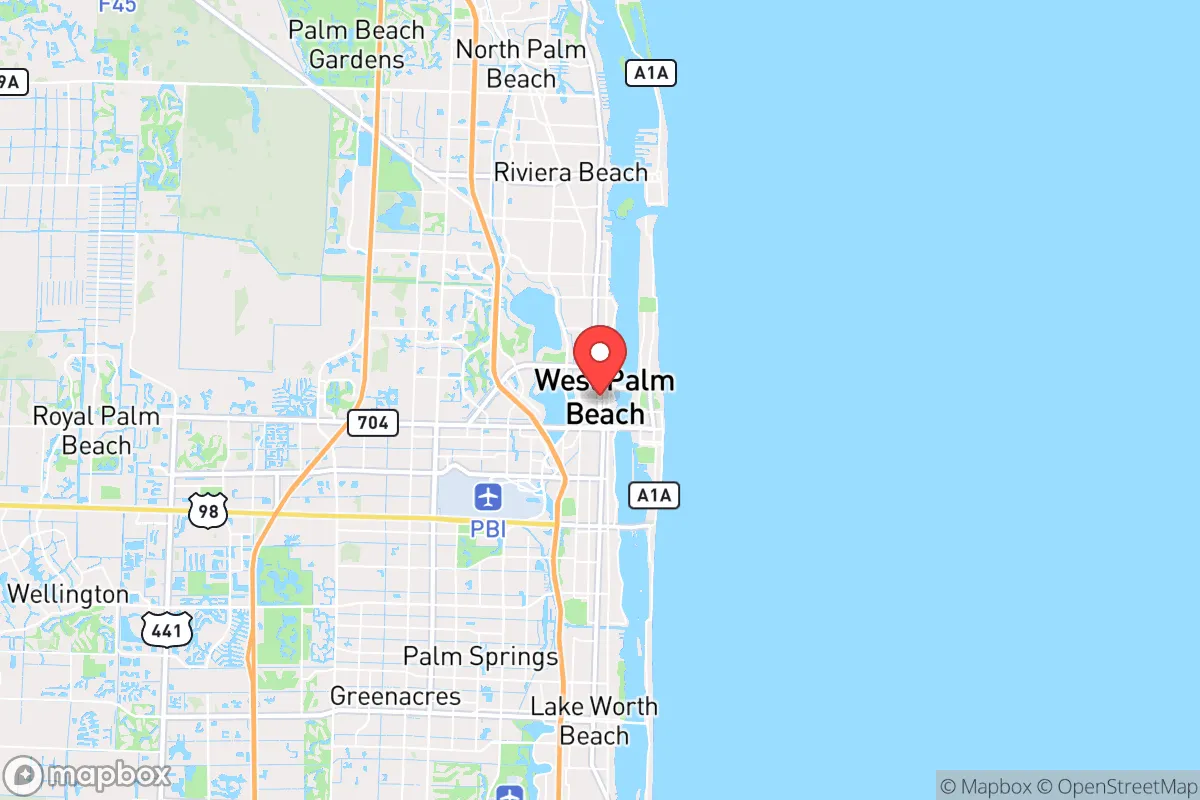
Strategic Assessment of West Palm Beach, FL
Meaningful friction. Expect exposure to either population pressure, blast zones, or natural disaster risk. Consider buying a retreat property.
What does the Strategic Assessment tell us?
Our Strategic Assessment grades tactical survivability of an area. Major population centers, military targets, fallout zones, natural disasters, and border exposure all drive risk — lower exposure means a more defensible position in a crisis.
This is heavily inspired by Joel Skousen's Strategic Relocation book. Highly recommended you checkout the book ($)What does this tell us?
Our Strategic Assessment grades tactical survivability of an area. Major population centers, military targets, fallout zones, natural disasters, and border exposure all drive risk — lower exposure means a more defensible position in a crisis.
This is heavily inspired by Joel Skousen's Strategic Relocation book. Highly recommended you checkout the book ($)Strategic Pillars

Key Distances
Regional Safe Places
Below is our recommended "safe zones" in Florida and the surrounding area based on our strategic heuristics. For most people, it's unrealistic to live in a “safe zone” full-time due to work, family or other personal reasons. They tend to be more rural. However, many of these areas are perfect for second homes and retreat properties that double as a vacation home or even a short-term rental.

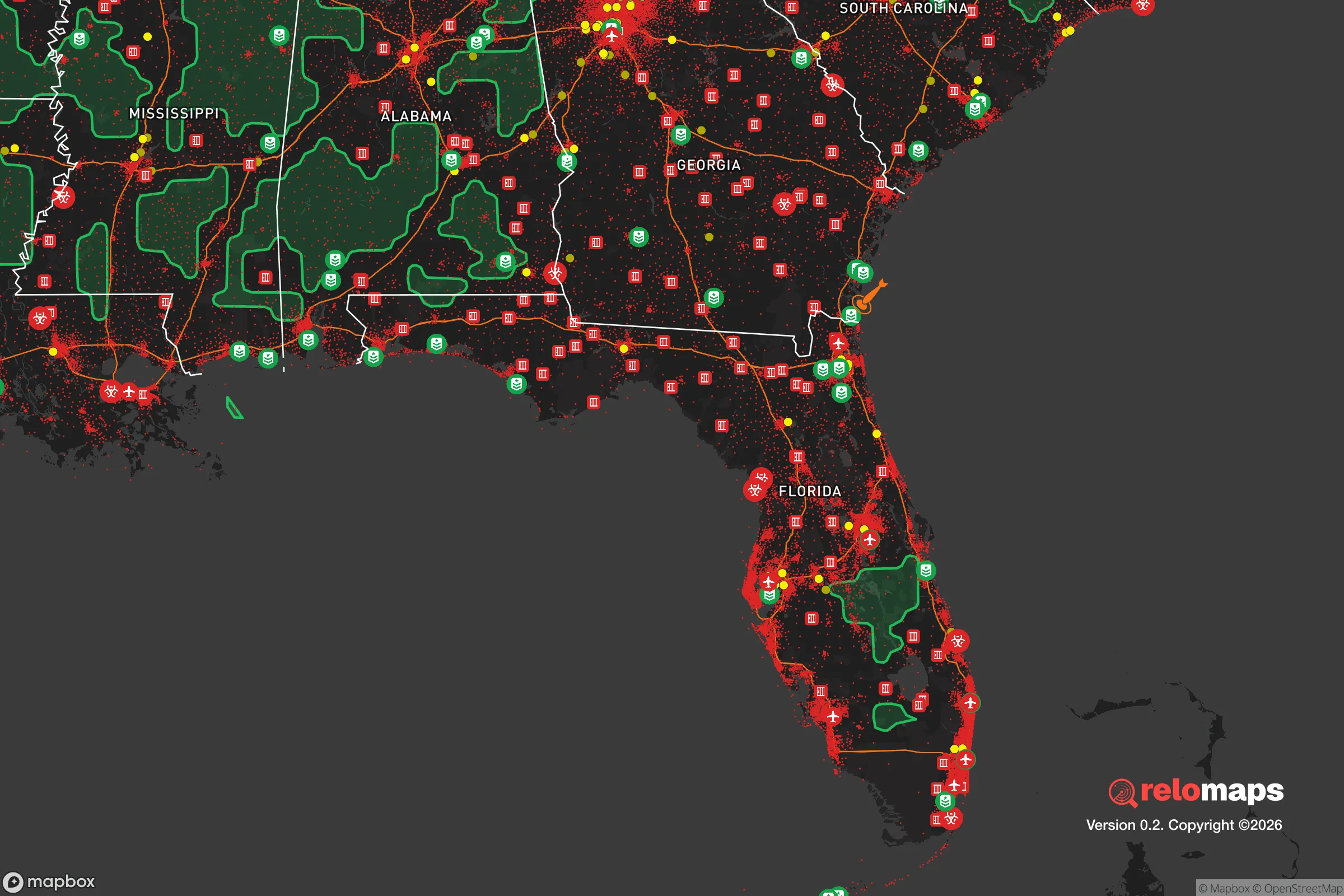


Important Note: For informational purposes only. This does not mean nothing bad ever happens in the green zones. Please use common sense. This is based on public data and modeled with AI. We tried to take a conservative approach but mistakes happen. We update this regularly as new information becomes available.
Solar Generator Recommendations
Backup power matters more here than in safer locations. We've picked three solar generators across budgets and capacity tiers — start with the budget unit if you only need a few essentials, or step up if you want to run a fridge and HVAC for days at a time.

Jackery Portable Power Station Explorer 300
Budget OptionPower on the Go: Weighing only 11 lbs, it's convenient to set up and store with book-sized foldable solar panels

BLUETTI Portable Power Station AC180
Designed for both indoor and outdoor scenarios, AC180 is highly capable as it has a robost capacity and continuous output power.

EF ECOFLOW DELTA Pro Ultra Power Station
Upgraded PickEcoFlow DELTA Pro Ultra is a whole-home energy system designed to grow with your family. Integrated with the Smart Home Panel 2, it scales to meet your evolving energy needs — keeping your home powered, intelligent, and secure through every stage of life.
We earn a commission, at no additional cost to you.
Strategic Assessment Analysis
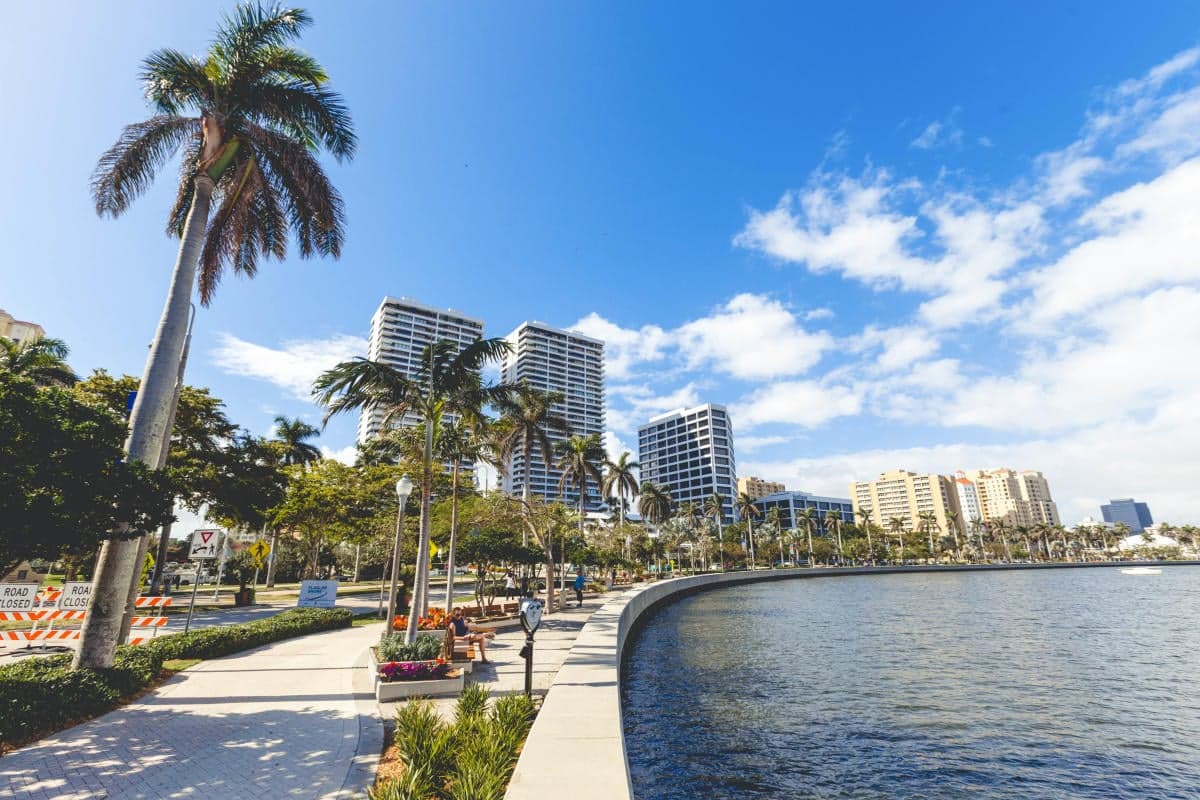
West Palm Beach occupies a strategic but complex position for a relocator prioritizing resilience and self-sufficiency. Its location on the southeast Florida coast offers immediate access to the Atlantic, the Intracoastal Waterway, and a dense network of state roads and rail, but this connectivity cuts both ways—it provides supply-chain advantages while also tying the area to the vulnerabilities of the broader South Florida metroplex. The city’s economy is anchored by finance, healthcare, and a growing logistics sector, but its long-term viability for a disaster-conscious household depends on understanding its geographic exposure, proximity to high-value targets, and the practical realities of daily life in a subtropical, hurricane-prone environment.
Geographic position and natural advantages for a resilience-minded relocator
West Palm Beach sits on a barrier island and the adjacent mainland, roughly 70 miles north of Miami and 45 miles south of the Port of Palm Beach. The area’s primary natural advantage is its elevation—most of the city sits at 10 to 15 feet above sea level, which is notably higher than Miami’s average of 6 feet. This modest elevation reduces, but does not eliminate, the risk of storm surge from a major hurricane. The city is also positioned near the head of the Everglades, which provides a natural buffer to the west, though that buffer is largely uninhabitable marshland. For a relocator, the key geographic plus is access to the Atlantic for maritime resupply and evacuation routes, as well as the proximity to Lake Okeechobee (about 40 miles west), which serves as a freshwater reservoir. However, the lake’s dike system is aging and has been a source of concern for decades; a breach during a hurricane could disrupt the regional water supply. The area’s flat terrain offers no natural defensible high ground, meaning that any serious storm event will affect the entire region uniformly.
Risks, exposures, and proximity to fallout-relevant landmarks
The most significant risk for West Palm Beach is its location within the Atlantic hurricane belt. The city has a direct hit probability of roughly once every 8-10 years, with major hurricanes (Category 3+) making landfall nearby every 20-30 years. Hurricane Wilma in 2005 and Hurricane Irma in 2017 caused widespread power outages and flooding, with some areas losing electricity for two weeks. Beyond weather, the area’s proximity to high-value infrastructure is a double-edged sword. The Port of Palm Beach, just north in Riviera Beach, is a major cargo and cruise port that could be a target for disruption. Palm Beach International Airport is a civilian hub, but it also hosts a Florida Air National Guard unit, which could make it a secondary target in a conflict scenario. The city is also within 20 miles of the Loxahatchee National Wildlife Refuge, a federal facility that could be a focus for civil unrest or resource competition. For a relocator, the density of the I-95 corridor—which runs directly through West Palm Beach—means that any evacuation or supply-chain disruption will be compounded by the sheer volume of people trying to move north or south. The area’s reliance on a single major north-south highway (I-95) and a single rail line (the Florida East Coast Railway) creates a chokepoint vulnerability.
Practical resilience for a relocator: food, water, energy, and defensibility
For a household focused on self-sufficiency, West Palm Beach presents a mixed picture. The city’s water supply comes from the Biscayne Aquifer, which is shallow and vulnerable to saltwater intrusion during droughts or storm surges. Most residents rely on municipal water treatment, which is generally reliable but can be disrupted by power outages or flooding. A private well is not a practical option for most urban lots due to shallow water tables and permitting restrictions. Food security is a concern: the area is not a major agricultural producer, with most fresh produce coming from the Everglades Agricultural Area south of Lake Okeechobee or from out of state. The city has a strong network of grocery stores and big-box retailers, but these are vulnerable to supply-chain interruptions during a hurricane or national emergency. For energy, Florida Power & Light (FPL) serves the area with a grid that has been hardened since 2005, but outages still occur regularly during storms. Solar is viable—Florida gets over 230 sunny days per year—but rooftop solar without battery storage is useless during a grid-down event, and battery systems are expensive. Defensibility is the weakest point: West Palm Beach is a dense, flat urban area with no natural chokepoints or high ground. A single-family home on a quarter-acre lot offers limited perimeter security, and the city’s high crime rate (violent crime is roughly 50% above the national average) means that property crime and home invasions are a real concern even in normal times. For a relocator, the best defensive strategy is to choose a home in a gated community or a neighborhood with a strong homeowners’ association that can coordinate neighborhood watch and resource sharing.
The overall strategic picture for West Palm Beach is one of calculated trade-offs. The city offers excellent access to maritime and air transport, a relatively high elevation for coastal Florida, and a robust local economy that can support a relocator’s income needs. However, these advantages are offset by significant exposure to hurricanes, a vulnerable water supply, a dense population that complicates evacuation, and proximity to infrastructure that could be a target in a broader conflict. For a single individual or family who is willing to invest in a hardened home, a backup power system, and a deep pantry, West Palm Beach can be a viable base—but it is not a retreat. It is a forward position, requiring constant awareness of the season and the regional situation. The relocator who treats it as a permanent bug-out location will be disappointed; the one who uses it as a hub for a broader network of resources—with a secondary location inland or north—will find it a workable, if demanding, choice.

* Values derived from national, state, county, city and local statistics and may differ in a specific area. Last updated: 2026-09-14T15:09:05.000Z
Narrative content on this page is AI-generated and may contain mistakes. Verify any details that matter before acting on them.
ReloMaps may earn a commission from affiliate links at no extra cost to you.

