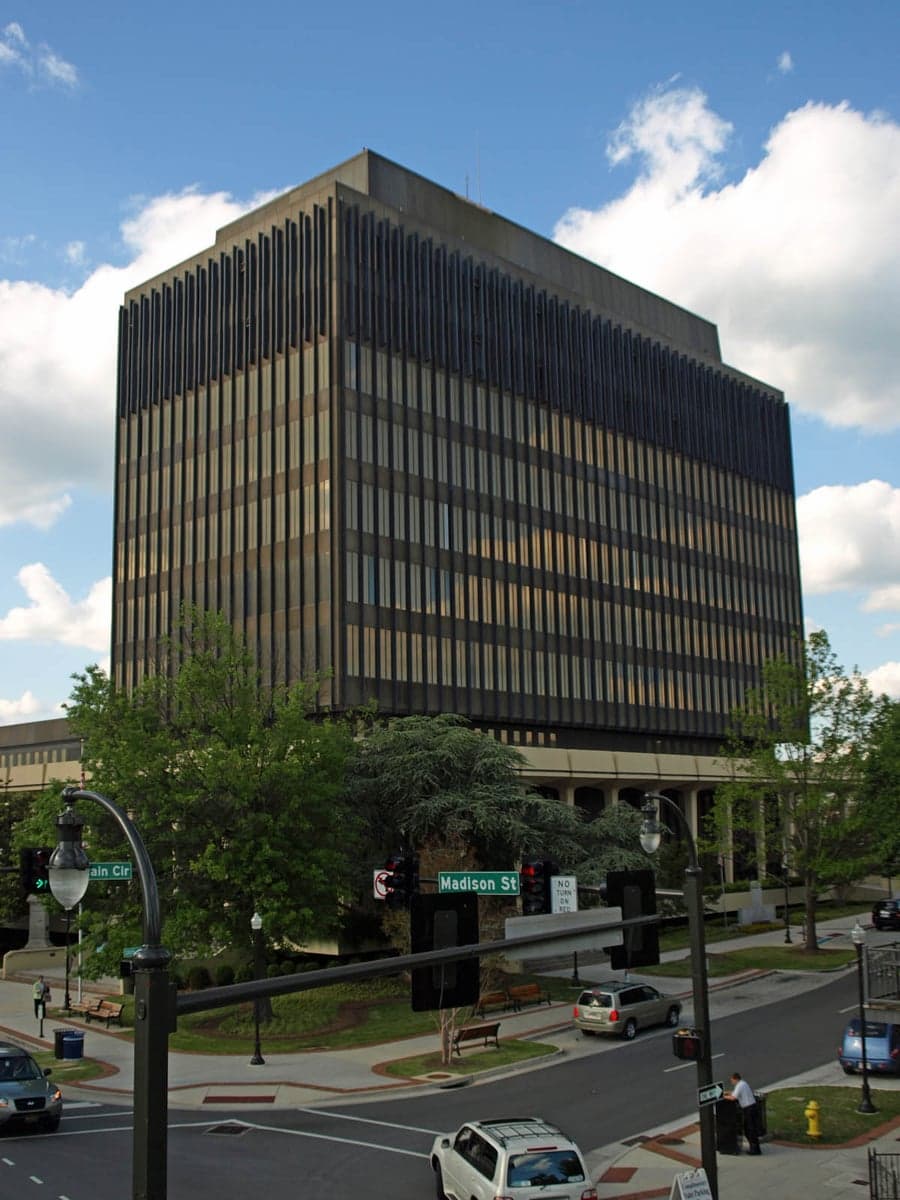
Photo: Wikipedia
Political ClimatePolitical Climate in Madison County
Showing district-level results — no local-only data available.
Local Political AnalysisPolitical Analysis of Madison County
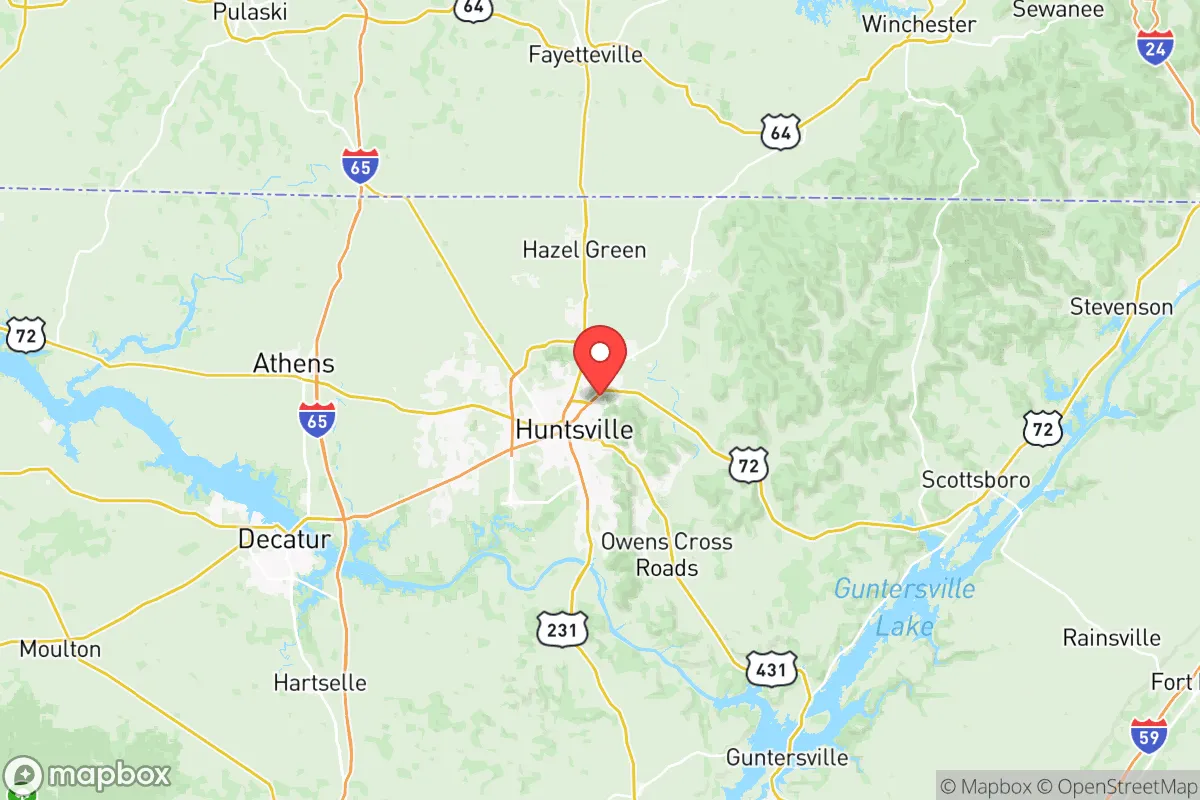
Madison County, Alabama, is a classic example of a fast-growing Southern county that is politically more purple than its deep-red surroundings, though it still leans reliably Republican with a Cook PVI of R+15. The county has been drifting rightward in presidential elections, but the presence of a large, educated workforce tied to the Redstone Arsenal and Cummings Research Park keeps Huntsville and its close-in suburbs like Jones Valley and Hampton Cove more competitive, with precincts in the City of Huntsville’s historic core actually voting Democratic in recent cycles. The farther you go from the urban core—into rural towns like Gurley, New Hope, and sleepy precincts along the Limestone County line—the redder the vote gets, often by 40-point margins. That said, the national trend of suburban women shifting left has been visible here: in 2024, Madison County’s presidential margin was slightly tighter than in 2016, driven largely by precincts in the Madison city limits and western Huntsville. I’d say the county is still solidly red in practical terms, but it’s not the kind of Republican lock you see in rural South Alabama.
How it compares to the rest of Alabama
Alabama statewide is about R+15 to R+18 in the Cook PVI (exact figure not publicly confirmed for 2025, but frequently cited around R+16), so Madison County sits right at the state’s average partisan lean. The difference is that Madison County’s Republican majorities are softer and more contingent on turnout from the Huntsville area’s upper-middle-class professionals. In places like rural Greene County or the Wiregrass, Republican margins often hit +40 or +50; in Madison County, you’re usually looking at +12 to +18 in a normal election. The county’s swing precincts tend to be in the Monrovia area and along Highway 431 north of Huntsville, where growth has been fastest—those precincts still vote Republican but with narrower margins than the rural hamlets. For context, the City of Madison itself (about 58,000 people) has a Cook PVI closer to R+8, while Huntsville’s interior (the 35801 and 35810 zip codes) leans Democrat or even left of the national average. That kind of internal variety is rare in Alabama outside Jefferson County.
What this means for residents
For conservative residents, Madison County is a comfortable place to live politically—they dominate county commission, school board, and most municipal offices, and Republican primary voters effectively decide most local races. There’s no real culture-war blowback at the county level, and concealed carry, tax-free shopping on firearms, and school choice policies are broadly popular. For liberal residents, the reality is more nuanced. Huntsville’s city government is reliably Democratic, and local nonprofits like the Rocket City Pride collective and the Huntsville Police Citizens Advisory Council have genuine influence. But state policy—on abortion, LGBTQ+ rights, voting access—comes from Montgomery, and Madison County’s statehouse delegation is solidly GOP. That means a progressive resident might find their city council responsive on park funding or zoning while feeling powerless on state-level issues like the 2024 ban on DEI programs in public universities. The practical effect is that Madison County functions like a blue city inside a red county inside a deeply red state.
Culturally, the most distinctive feature is the synergy between the federal defense workforce and the local business community. The Redstone Arsenal’s presence means a significant portion of the population has a clearance-connected worldview—national security as a priority, but also a tolerance for diverse, educated transplants from out of state. That has made Madison County more cosmopolitan than almost anywhere else in Alabama, with a focus on tech, aerospace, and biomedical policy rather than traditional rural debates over property taxes or agriculture. You’ll hear as much talk about federal budgets and SBIR grants at a local coffee shop as you will about football or politics. That said, the county’s conservative base is very culturally Southern and traditional in its values, especially in the rural precincts around New Market and Owens Cross Roads. The tension between those two cultures is what defines Madison County’s political life.

State Political ClimatePolitical Climate in Alabama
State Political AnalysisPolitical Environment in the State
Alabama is a deeply conservative state, consistently delivering around 62-65% of its vote to Republican presidential candidates over the past two decades, a trend that has only solidified since 2012. The state’s political center of gravity is heavily influenced by its rural and small-town populations, as well as the growing suburban rings around metros like Birmingham, Huntsville, and Mobile. While Democrats once held a near-total lock on state government through the 1990s, the shift to a solid Republican trifecta began in earnest after 2010 and has accelerated, with the GOP now holding supermajorities in both legislative chambers.
Urban vs. rural divide
The political map of Alabama splits cleanly along the urban-rural axis. The state’s few Democratic strongholds are concentrated in the Black Belt, a rural crescent of counties like Bullock, Greene, and Lowndes where African American populations are dense and the vote reliably goes 70-85% Democratic. In contrast, the state’s largest cities—Birmingham, Montgomery, and Mobile—are blue islands in a red sea. Birmingham’s Jefferson County, home to about 660,000 people, votes roughly 55-60% Democratic, driven by a racially diverse and economically progressive coalition. Huntsville, the fastest-growing city, is more of a purple outlier: Madison County, which includes Huntsville, voted for Trump by only about 8 points in 2020, compared to the state’s 25-point margin, as the city’s high-tech workforce and in-migration from other states pull it toward the center. The rural counties, especially the “Wiregrass” region around Dothan and the Appalachian foothills in the northeast (DeKalb, Marshall, Jackson counties), routinely deliver Republican margins of 70-80%.
Policy environment
Alabama’s policy landscape is tailored to its conservative majority. The state has no state-level income tax on Social Security benefits and caps the state income tax at 5%. Property taxes are among the lowest in the nation, averaging just 0.4% of assessed home value, though this starves many rural school districts. The regulatory posture is light: there’s no statewide building code beyond basic safety, no rent control, and Alabama is a “right-to-work” state. On education, Alabama passed its version of the “Parental Rights in Education” law in 2022 (the “Don’t Say Gay” type, though less stringent than Florida’s) and the state has robust school choice through charter schools and a new Education Scholarship Account (ESA) program enacted in 2024 that gives families $7,000 per child for private school or homeschooling expenses. Election laws are moderate among deep-red states: voter ID is required, but the state offers early voting and absentee voting without an excuse. Alabama does not allow ballot drop boxes or automatic voter registration.
Recent policy direction
The trajectory over the last five years is toward a more pronounced intervention in cultural and personal liberty issues. In 2024, Alabama enacted SB 129 (the “Vulnerable Child Compassion and Protection Act”) explicitly banning gender-transition procedures for minors and limiting bathroom access, a law that has survived initial court challenges. On the gun and self-defense front, Alabama is a “constitutional carry” state (permitless carry became law in 2022, SB 308), and there is a strong civil liability shield for self-defense shooting incidents. Property rights were strengthened with the 2022 “Alabama Landowner Protection Act,” which gives landowners broad immunity for injuries on their property during activities like hunting or ATV riding. On the surveillance and privacy front, the state passed a consumer data privacy law in 2023 (the Alabama Data Privacy Act) that applies only to companies handling 100,000+ consumers’ data, with no private right of action—enforced only by the attorney general. The most notable legislative trend is the preemption of local ordinances: in 2024, the state banned any local government from passing minimum wage increases or rent control above the state’s baseline, and a 2023 law stripped Birmingham’s ability to impose its own mask mandates during a health emergency. Medical and bodily autonomy is near total: the state bans nearly all abortions with no exceptions for rape or incest, only a “life of the mother” clause enacted after the 2022 Dobbs decision.
Civil unrest & political movements
Alabama is not a high-intensity protest state, but there are periodic flashpoints. The 2020 Black Lives Matter protests in Montgomery and Birmingham were sizable but largely peaceful, with one incident where a counter-protester drove into a crowd in Montgomery, injuring two. Immigrant politics center on Albertville (Marshall County), where a 2024 city council ordinance attempted to ban day-laborer hiring sites; the law was struck down by a federal judge but sparked bitter divisions in the town’s growing Guatemalan community. The “Greater Birmingham” area’s sanctuary city debate flared in 2023 when the state attorney general threatened to withhold grants from Birmingham for a “Welcoming City” resolution that technically does not bar cooperation with ICE. Overall, election integrity concerns are muted compared to states like Georgia or Texas; Alabama’s 2020 election saw no major lawsuits or audits, and both parties certified the results without controversy. The Alabama Sovereignty Commission, a dormant body from the 1960s, was formally abolished in 2023 after a legislative effort by Birmingham Democrats, though nullification rhetoric remains a fringe presence among a few rural county commissions.
Projection
Over the next five to ten years, Alabama’s political balance will likely shift subtly but remain comfortably Republican. The in-migration into Huntsville and the “Aerospace Ridge” (Madison, Limestone counties) is bringing a mix of out-of-state conservatives and moderates—many from California and Texas—who are slightly less hardline on social issues but still vote Republican. The state’s Black Belt will continue to depopulate (some counties lost 10-15% of residents since 2010), weakening the Democratic base. The state legislature will almost certainly move further on school choice (expanding ESAs to all families, not just those under 200% of the poverty line), and continue to preempt local progressive initiatives. On personal liberties, expect a push for additional restrictions on gender-affirming care for adults and possibly a stand-your-ground “Shall Not Be Infringed” constitutional amendment to strengthen gun protections. The state’s tax structure will likely shift toward even flatter income tax or a consumption-based system—a 2025 commission is studying elimination of the state income tax entirely. A new resident moving to, say, Auburn (Lee County, now reliably 65-70% Republican) or Fairhope (Baldwin County, the state’s fastest-growing county) will find a political culture that is stable, locally driven, and disinclined toward the kind of sharp partisan conflict seen in Nevada or Michigan. But someone moving to Tuscaloosa (Tuscaloosa County, 60-40 Republican) will find a city with a strong university presence that votes more mixed than its surrounding county, and where local politics remain focused on zoning and schools rather than national culture wars.
What this means in practice: if you are a conservative relocator, you’ll find your priorities largely reflected in state law with minimal friction. If you are a liberal relocator, you’ll find that local governance in cities like Birmingham, Huntsville, or Montgomery is your best avenue for influence—those city councils are notably liberal on housing and police reform, but they operate under tight state-level preemptions. The bottom line is that Alabama offers a predictable political environment where what you see is what you get: a stable, small-government framework with deeply entrenched cultural values, and a legal system that is likely to remain static or shift further right regardless of national mood swings.
* Values derived from national, state, county, city and local statistics and may differ in a specific area. Last updated: 2026-09-13T18:42:45.000Z
Narrative content on this page is AI-generated and may contain mistakes. Verify any details that matter before acting on them.
ReloMaps may earn a commission from affiliate links at no extra cost to you.

