
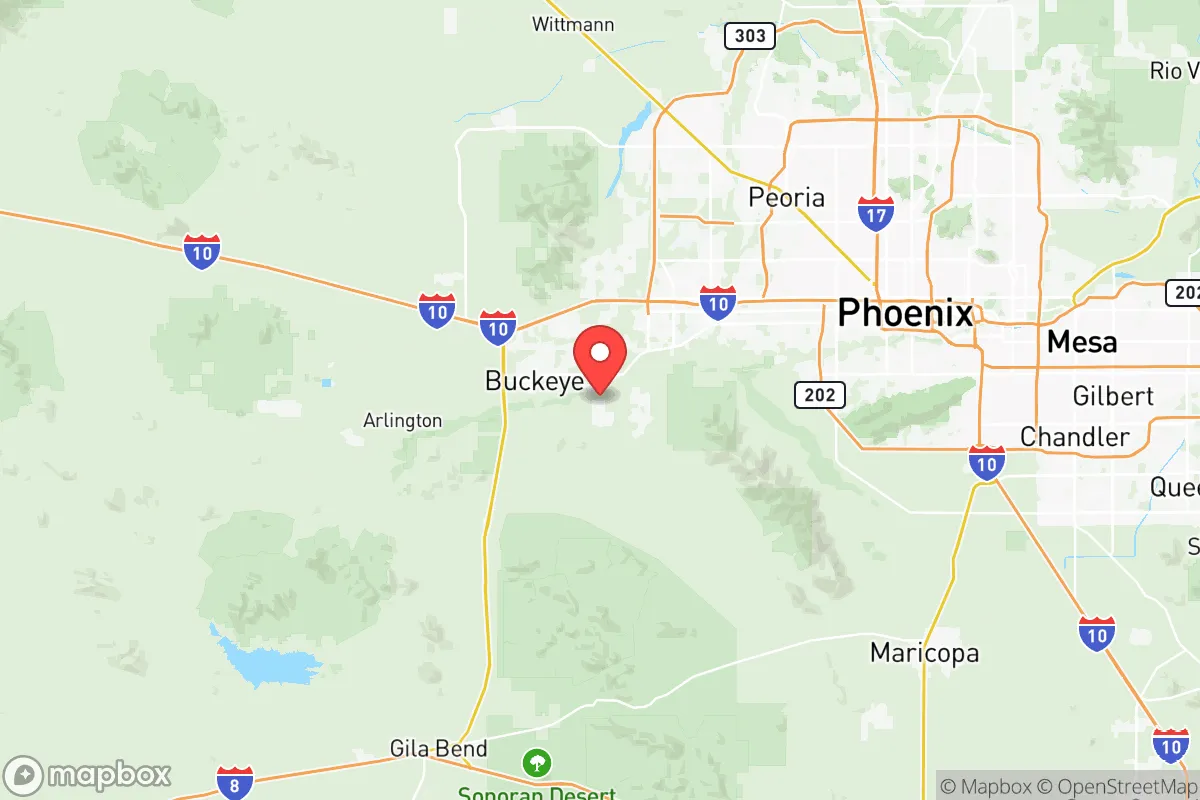
Photo: Wikipedia
Personal Sovereignty in Maricopa County
Viable for self-reliance. Generally workable, though some barriers may limit total independence.
What does Personal Sovereignty tell us?
Personal Sovereignty measures your capacity for self-reliance and independence with minimal government friction. Higher scores mean fewer barriers between you and the way you want to live... but it assumes you have the space you need and good neighbors.
What does this tell us?
Personal Sovereignty measures your capacity for self-reliance and independence with minimal government friction. Higher scores mean fewer barriers between you and the way you want to live... but it assumes you have the space you need and good neighbors.
State Policy
Energy independence: Importer (20% of energy produced in-state)
Personal Liberty
Homesteading

Personal Liberty Analysis
Maricopa County offers a notably high degree of personal sovereignty compared to many urbanized regions in the United States, largely due to Arizona’s strong preemption laws that limit local government overreach. While the county’s core—Phoenix, Scottsdale, and Tempe—leans more progressive on certain regulatory matters, the broader county, particularly its rural and exurban fringes, provides a legal environment where individual autonomy in self-defense, property use, and family decisions is robustly protected. For those concerned with preserving personal freedoms against expanding government control, Maricopa County presents a strategic middle ground: it is not a libertarian free-for-all like parts of rural Alaska or New Hampshire, but it consistently ranks among the top 10 states for gun rights, tax burden, and regulatory freedom according to the Cato Institute’s Freedom in the 50 States index.
Tax burden and regulatory posture across the county
Arizona’s flat income tax rate of 2.5% (as of 2023) and a state sales tax of 5.6% keep the overall tax burden low, but the real story for personal sovereignty lies in local variation. In unincorporated areas like Wickenburg and Tonopah, property taxes are minimal—often under 0.6% of assessed value—and zoning restrictions are far looser than in incorporated cities. For example, Queen Creek and Buckeye have aggressively pursued pro-development policies that allow for larger lot sizes (1–5 acres) without the costly impact fees seen in Phoenix proper. Conversely, Paradise Valley and Carefree impose strict HOA-style covenants that can limit everything from vehicle storage to livestock, so preppers should avoid these areas. The county’s regulatory posture is generally permissive: no county-level business licensing for home-based enterprises, no rent control, and no plastic bag bans—a stark contrast to California or Colorado. However, the Arizona Department of Environmental Quality does enforce strict groundwater management in active management areas (AMAs), which affects well drilling in Surprise and Goodyear; outside these AMAs, in places like Morristown, well permits are easier to obtain.
Self-defense and gun law specifics for daily carry
Arizona is a constitutional carry state, meaning no permit is required to carry a concealed firearm for anyone 21 or older who can legally possess a gun. This applies uniformly across Maricopa County, including within Phoenix city limits, though city parks and public transit are off-limits without a permit. The state’s preemption law (ARS 13-3108) explicitly prohibits cities from enacting their own gun ordinances, so Scottsdale and Mesa cannot impose magazine capacity limits or assault weapon bans—a critical protection for those who view firearm ownership as a bulwark against government overreach. Stand-your-ground laws are fully in effect, with no duty to retreat in any place where a person is lawfully present. For preppers, the practical implication is clear: you can legally keep a loaded rifle in your vehicle while driving through Fountain Hills or Apache Junction, and you can defend your home or property without fear of prosecution as long as you reasonably perceive a threat. The only notable restriction is a 24-hour waiting period for handgun purchases, which applies statewide but is rarely a hindrance for those who plan ahead.
Self-reliance and homesteading viability across the county
Homesteading viability varies dramatically within Maricopa County due to water availability and zoning. In the far eastern edge, Gold Canyon and Superior offer 1–5 acre parcels with minimal county oversight, where residents can keep goats, chickens, and even horses without special permits. The county’s zoning code allows for “rural residential” uses on parcels of 2.5 acres or more in unincorporated areas, meaning you can build a detached workshop, install solar panels, and dig a well (subject to AMA rules) without the bureaucratic hurdles found in Chandler or Gilbert. Off-grid feasibility is highest in the county’s northern and western deserts: New River and Black Canyon City have no municipal water or sewer, forcing residents to rely on wells and septic systems—a feature, not a bug, for those seeking independence from public utilities. However, the Arizona Corporation Commission regulates off-grid solar net metering, and the Salt River Project (SRP) has strict interconnection standards, so going fully off-grid requires careful planning. Rainwater harvesting is legal and encouraged, with no permit needed for systems under 10,000 gallons. The county’s building code does require permits for structures over 200 square feet, but enforcement is lax in remote areas—many homesteaders in Wittmann build without permits and face only fines if caught, not forced removal.
Personal liberties in family and medical decisions
Parental rights are strongly protected under Arizona law, with a 2022 statute (HB 2161) affirming that parents have the fundamental right to direct their children’s education, healthcare, and religious upbringing. This means no mandatory vaccine requirements for school attendance (only opt-out forms), and parents can withdraw children from sex education without penalty. Medical autonomy is similarly robust: Arizona does not have a state-level vaccine mandate for adults, and the 2023 ban on COVID-19 vaccine passports remains in effect. For those concerned about government overreach in health emergencies, the state’s emergency powers law (ARS 26-303) prohibits the governor from ordering mass quarantines or forced medical treatments without legislative approval. Property rights are secured by Arizona’s strong eminent domain protections—the state constitution requires “just compensation” and prohibits taking property for private economic development (a response to the Kelo case). Speech is protected by the state’s anti-SLAPP statute, which makes it difficult for local governments to sue critics. However, Phoenix and Tempe have enacted “disorderly conduct” ordinances that can be used against loud political protests, so activists should be aware of local nuance.
Overall, Maricopa County offers a sovereignty profile that is among the strongest in the Sun Belt, particularly for those willing to live outside the urban core. The combination of constitutional carry, low taxes, permissive zoning in unincorporated areas, and strong parental rights creates a legal environment where individuals can largely live as they see fit—provided they respect water laws and avoid the few progressive enclaves like Tempe and Scottsdale. For preppers and conservatives seeking a balance between economic opportunity and personal freedom, the county’s exurbs—Buckeye, Gold Canyon, New River—offer a viable alternative to the more restrictive states of the Pacific Northwest or Northeast, while still providing access to urban infrastructure. The key is choosing the right patch of desert: the county’s 9,200 square miles contain vastly different regulatory realities, and the smart relocation strategy is to target the unincorporated fringe where government footprint is lightest.

* Values derived from national, state, county, city and local statistics and may differ in a specific area. Last updated: 2026-04-21T19:05:27.000Z
Narrative content on this page is AI-generated and may contain mistakes. Verify any details that matter before acting on them.
ReloMaps may earn a commission from affiliate links at no extra cost to you.

