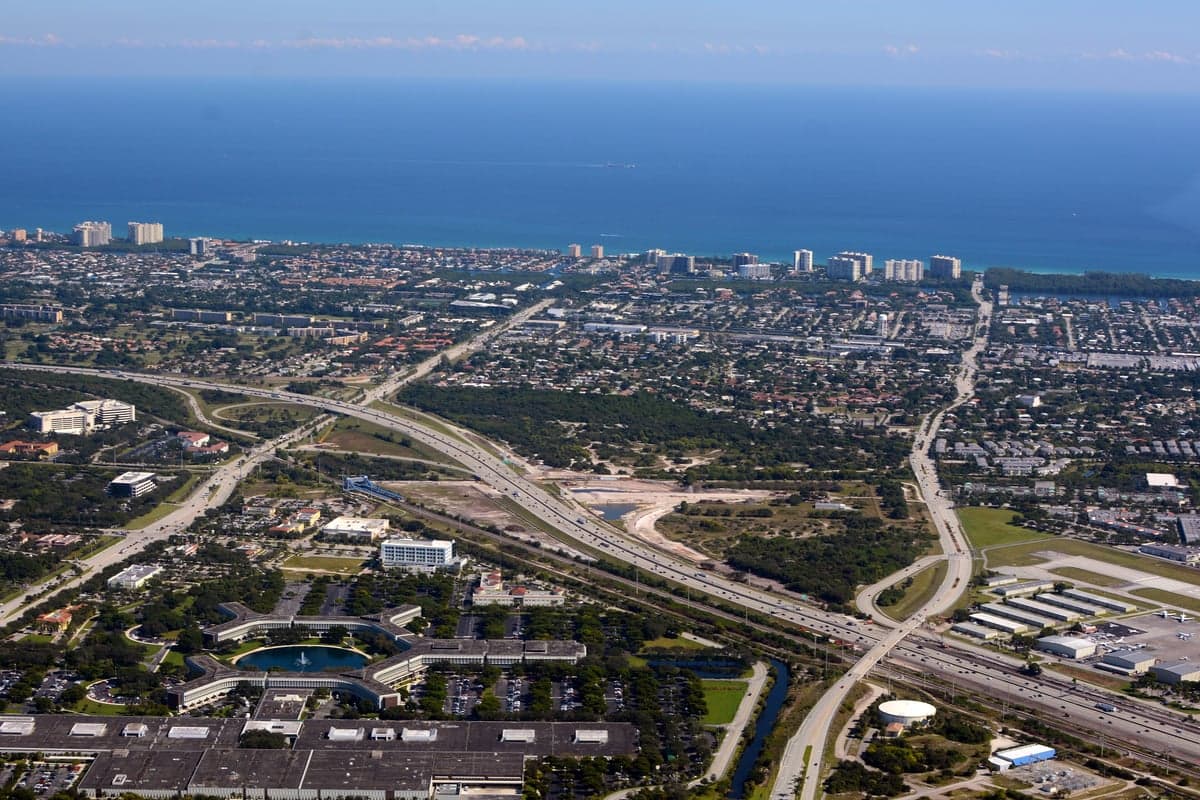
Photo: Wikipedia
Strategic Assessment of Boca Raton, FL
Multiple tactical vulnerabilities. Population density, target proximity, or disaster risk are likely compounding. A retreat property and exit planning is required.
What does the Strategic Assessment tell us?
Our Strategic Assessment grades tactical survivability of an area. Major population centers, military targets, fallout zones, natural disasters, and border exposure all drive risk — lower exposure means a more defensible position in a crisis.
This is heavily inspired by Joel Skousen's Strategic Relocation book. Highly recommended you checkout the book ($)What does this tell us?
Our Strategic Assessment grades tactical survivability of an area. Major population centers, military targets, fallout zones, natural disasters, and border exposure all drive risk — lower exposure means a more defensible position in a crisis.
This is heavily inspired by Joel Skousen's Strategic Relocation book. Highly recommended you checkout the book ($)Strategic Pillars

Key Distances
Regional Safe Places
Below is our recommended "safe zones" in Florida and the surrounding area based on our strategic heuristics. For most people, it's unrealistic to live in a “safe zone” full-time due to work, family or other personal reasons. They tend to be more rural. However, many of these areas are perfect for second homes and retreat properties that double as a vacation home or even a short-term rental.

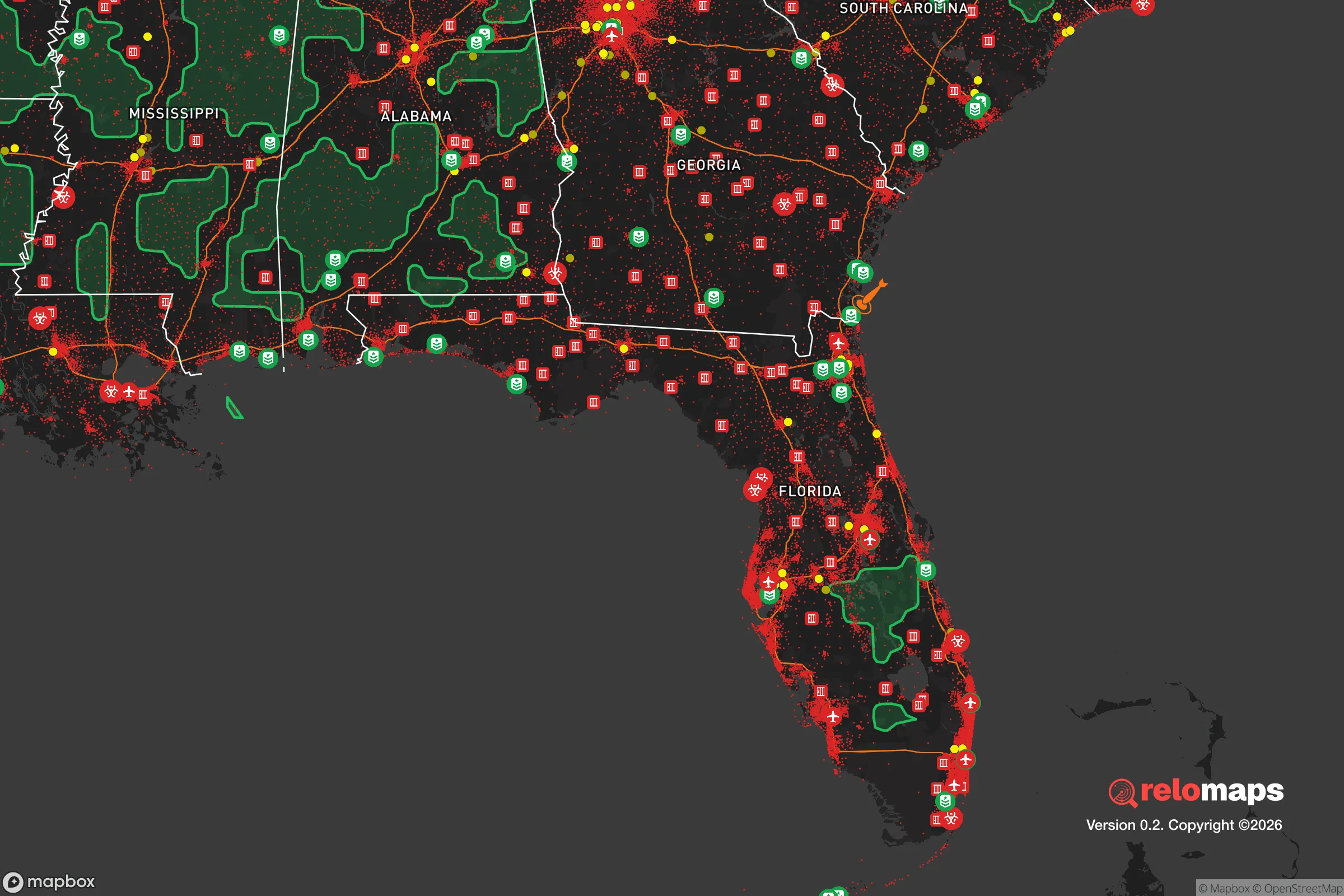


Important Note: For informational purposes only. This does not mean nothing bad ever happens in the green zones. Please use common sense. This is based on public data and modeled with AI. We tried to take a conservative approach but mistakes happen. We update this regularly as new information becomes available.
Solar Generator Recommendations
Backup power matters more here than in safer locations. We've picked three solar generators across budgets and capacity tiers — start with the budget unit if you only need a few essentials, or step up if you want to run a fridge and HVAC for days at a time.

Jackery Portable Power Station Explorer 300
Budget OptionPower on the Go: Weighing only 11 lbs, it's convenient to set up and store with book-sized foldable solar panels

BLUETTI Portable Power Station AC180
Designed for both indoor and outdoor scenarios, AC180 is highly capable as it has a robost capacity and continuous output power.

EF ECOFLOW DELTA Pro Ultra Power Station
Upgraded PickEcoFlow DELTA Pro Ultra is a whole-home energy system designed to grow with your family. Integrated with the Smart Home Panel 2, it scales to meet your evolving energy needs — keeping your home powered, intelligent, and secure through every stage of life.
We earn a commission, at no additional cost to you.
Strategic Assessment Analysis
Boca Raton presents a complex strategic picture for the conservative prepper: it offers genuine physical resilience against natural disasters and a strong local economy, but its proximity to dense urban populations and high-profile targets creates significant exposure to civil unrest and secondary fallout risks. The city’s location on Florida’s southeast coast, roughly equidistant between West Palm Beach and Fort Lauderdale, places it within a corridor that is both economically vibrant and strategically vulnerable. For a relocator prioritizing long-term stability, the trade-offs here are sharp—excellent natural defenses against hurricanes and storm surge, but a high likelihood of being caught in the ripple effects of a major event in Miami or Palm Beach.
Geographic position and natural advantages for long-term stability
Boca Raton sits on a coastal ridge that rises to roughly 20–30 feet above sea level in many neighborhoods, which is significantly higher than much of South Florida. This elevation, combined with the city’s position on the Atlantic Coastal Ridge, means that most of Boca Raton is outside the FEMA-designated high-risk flood zones that plague areas like Fort Lauderdale or Miami Beach. The city’s stormwater management system is among the most robust in the region, with over 50 drainage wells and a network of canals that can handle heavy rainfall without widespread street flooding. For a prepper, this translates to a lower probability of losing access to roads or supplies during a hurricane compared to lower-lying communities. The natural barrier of the Atlantic Ocean to the east and the Everglades to the west also limits the number of approach vectors for a large-scale evacuation or security event—there are essentially only three major north-south routes (I-95, Florida’s Turnpike, and US-1) and two east-west corridors (Palmetto Park Road and Glades Road). This chokepoint geography is a double-edged sword: it makes the area easier to defend in a grid-down scenario, but also means that any major event in Miami or Palm Beach will funnel traffic and potentially hostile elements through Boca Raton.
Risks, exposures, and proximity to fallout-relevant landmarks
The most significant strategic liability for Boca Raton is its location within the Miami–Fort Lauderdale–West Palm Beach metropolitan area, the seventh-largest in the United States. Boca Raton is less than 30 miles from the Port of Miami and Miami International Airport, both of which are high-value targets for a variety of threats—from terrorist attacks to supply chain disruptions to mass migration events during a crisis. The city is also within 15 miles of Palm Beach International Airport and the Palm Beach County Convention Center, which could serve as FEMA staging areas or refugee processing centers during a disaster. For a prepper, the risk of being overrun by displaced populations from Miami-Dade or Broward counties is real. During Hurricane Irma in 2017, the entire I-95 corridor from Miami to Boca Raton experienced gridlock for over 12 hours, with gas stations running dry and cell towers overwhelmed. A similar scenario during a civil unrest event would be far more dangerous, as the same roads would be used by both evacuees and looters. Additionally, the city’s high concentration of wealthy retirees and luxury real estate makes it a potential target for organized crime or resource-seizing operations during a breakdown of law and order. The presence of Florida Atlantic University and several large corporate campuses (including Office Depot and ADT) also means that any event targeting critical infrastructure could have local ripple effects.
Practical resilience for a relocator: food, water, energy, and defensibility
On the practical side, Boca Raton offers several advantages for a prepared individual or family. The city’s water supply comes from the Biscayne Aquifer, which is generally reliable but vulnerable to saltwater intrusion during prolonged drought or storm surge events. Most homes in Boca Raton are on municipal water, so a well is not an option, but the city’s water treatment plants have backup generators and are hardened against Category 3 hurricanes. For a prepper, this means storing at least two weeks of water per person is non-negotiable, and a Berkey or similar gravity filter is a wise investment. Food resilience is moderate: there are multiple Publix, Whole Foods, and Costco locations within a 10-minute drive, but these stores empty within hours of a hurricane warning. The city has a strong farmers’ market scene (the Boca Raton Green Market runs year-round) and several community gardens, but local food production is not sufficient to support the population in a prolonged crisis. Energy resilience is better than most of Florida: Florida Power & Light has invested heavily in underground power lines and smart grid technology in Boca Raton, so power outages are typically shorter than in rural areas. However, a determined adversary could still take out substations or transformers. Solar panels with battery storage are increasingly common in newer homes, and the city’s building codes now require impact-resistant windows and roofs, which improves defensibility against both weather and forced entry. For a relocator, the ideal property is a single-family home on a larger lot (half-acre or more) in the western part of the city, near the agricultural reserve, where you have more space for gardening, water storage, and a lower population density. The city’s police department is well-funded and has a strong reputation, but during a widespread event, they will be stretched thin—so personal security measures (reinforced doors, security cameras, a neighborhood watch network) are essential.
The overall strategic picture for Boca Raton is one of calculated risk. It is not a retreat or a bug-out location—it is a high-value target that offers genuine natural defenses and a strong local economy, but demands a high level of personal preparedness and situational awareness. For a conservative prepper who can afford the real estate and is willing to invest in hardening their home, stockpiling supplies, and building a local network of like-minded individuals, Boca Raton can be a viable long-term base. But for those seeking true isolation or a low-profile existence, the city’s density, proximity to major urban centers, and vulnerability to population surges during a crisis make it a less ideal choice. The key is to treat Boca Raton as a forward operating base—not a final redoubt—and to have a secondary plan for relocation further inland or north if the situation deteriorates beyond what the city’s infrastructure can handle.

* Values derived from national, state, county, city and local statistics and may differ in a specific area. Last updated: 2026-04-24T08:03:41.000Z
Narrative content on this page is AI-generated and may contain mistakes. Verify any details that matter before acting on them.
ReloMaps may earn a commission from affiliate links at no extra cost to you.

