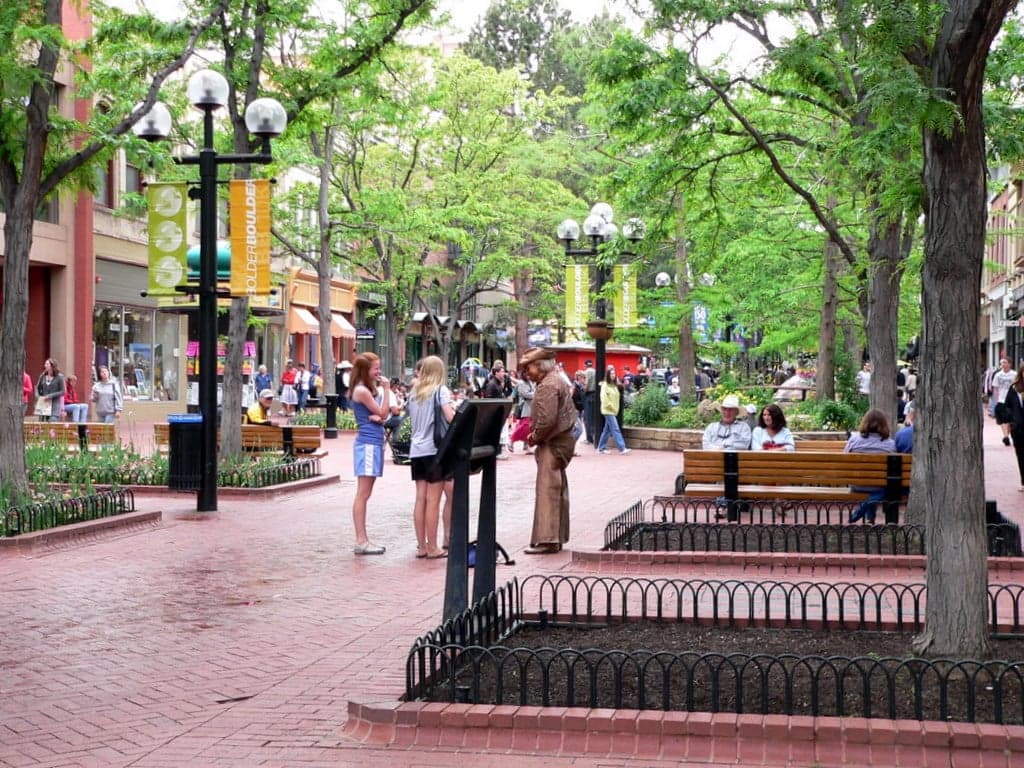
Photo: Wikipedia
Personal Sovereignty in Boulder, CO
Viable for self-reliance. Generally workable, though some barriers may limit total independence.
What does Personal Sovereignty tell us?
Personal Sovereignty measures your capacity for self-reliance and independence with minimal government friction. Higher scores mean fewer barriers between you and the way you want to live... but it assumes you have the space you need and good neighbors.
What does this tell us?
Personal Sovereignty measures your capacity for self-reliance and independence with minimal government friction. Higher scores mean fewer barriers between you and the way you want to live... but it assumes you have the space you need and good neighbors.
State Policy
Energy independence: Net exporter (110% of energy produced in-state)
Personal Liberty
Homesteading

Personal Liberty Analysis
Boulder, Colorado presents a deeply conflicted environment for personal sovereignty, one where the natural advantages of the Rocky Mountain region are systematically undermined by one of the most interventionist local governments in the nation. For the strategic relocation researcher with a conservative or survivalist mindset, Boulder represents a cautionary tale: a place of stunning geography and outdoor self-reliance potential that has been captured by a political class actively hostile to individual autonomy, property rights, and the exercise of fundamental liberties. While the state of Colorado itself offers a mixed bag of freedoms, Boulder County has aggressively carved out a regulatory fiefdom that makes personal sovereignty a constant uphill battle.
Tax burden and regulatory posture: How Boulder's local policies constrain financial autonomy
Boulder's tax and regulatory environment is designed to maximize government control over individual economic decisions. The city imposes a combined sales tax rate of approximately 8.85%, one of the highest in Colorado, which includes a local "climate action plan" tax that directly funds government-mandated environmental programs. Property taxes are comparatively moderate due to Colorado's Taxpayer's Bill of Rights (TABOR)—a state-level constitutional amendment that limits revenue growth—but Boulder's city council has repeatedly sought to circumvent TABOR through fees and special assessments. The regulatory posture is even more aggressive: Boulder has some of the strictest land-use regulations in the state, including a city-wide ban on new natural gas hookups in residential construction (effective 2024), which forces homeowners into expensive electric heat pumps and limits energy independence. For the prepper or homesteader, this means your ability to choose your own energy source, build a workshop, or even park a work truck on your property is heavily restricted by a municipal code that prioritizes aesthetic and environmental goals over personal liberty. The city's occupancy limits (no more than three unrelated adults per dwelling) further restrict the ability to share housing costs or create multi-generational living arrangements, a direct assault on traditional family and community resilience.
Self-defense and gun law specifics: Navigating Boulder's firearm restrictions
Boulder is ground zero for Colorado's most restrictive gun laws, making it a particularly challenging environment for those who view the Second Amendment as a cornerstone of personal sovereignty. In 2018, the city passed an ordinance banning "assault weapons" and large-capacity magazines, which was later struck down by a state court but has been re-litigated and remains a flashpoint. More practically, Boulder County has a de facto "may issue" concealed carry environment—while Colorado is a "shall issue" state, Boulder County sheriffs have historically been hostile to permit applications, and the city itself has banned firearms from all city-owned buildings, parks, and recreation centers. The state-level "red flag" law (HB19-1177) is aggressively enforced in Boulder, allowing family members or law enforcement to petition for temporary firearm seizure without a criminal conviction. For the survivalist, this means your ability to defend your home and family is contingent on the whims of local judges and police who are ideologically opposed to private firearm ownership. The practical reality is that Boulder is not a place to openly exercise your Second Amendment rights; any visible firearm ownership invites legal scrutiny and potential confiscation under the red flag statute. If self-defense is a priority, look to Weld County or El Paso County, where local sheriffs have publicly refused to enforce certain state gun restrictions.
Self-reliance and homesteading viability: Lot sizes, zoning, and off-grid feasibility
The dream of self-reliance in Boulder is largely a fantasy for anyone without substantial wealth. The city's zoning code is a labyrinth of restrictions designed to prevent exactly the kind of independent living a prepper values. Minimum lot sizes in the city are typically 6,000 to 7,000 square feet, but the real constraint is the Boulder Valley Comprehensive Plan, which limits development density and prohibits most forms of agricultural or commercial activity on residential lots. Raising chickens is allowed with a permit (hens only, no roosters), but keeping goats, pigs, or any livestock for meat or dairy is prohibited within city limits. Off-grid living is effectively illegal: Boulder requires connection to municipal water and sewer, and solar panel installations must be approved by the city's historic preservation board in many neighborhoods. Rainwater collection is legal under state law but heavily regulated, and any serious homesteading activity—like building a root cellar, installing a wood stove, or constructing a greenhouse—requires multiple permits and inspections. The county's wildland-urban interface (WUI) building codes further restrict construction materials and defensible space, adding cost and complexity. For the serious homesteader, the only viable option is to buy land in unincorporated Boulder County, where zoning is slightly more permissive but still subject to the county's strict environmental regulations. Even then, prices for raw land start at $200,000+ per acre, making self-reliance a luxury good.
Personal liberties: Parental rights, medical autonomy, speech, and property
Boulder's progressive governance extends deep into areas of personal liberty that conservatives hold sacred. Parental rights are under constant pressure: the Boulder Valley School District has implemented comprehensive sex education curricula that include gender identity instruction without parental opt-out, and the district has a policy of not notifying parents if a child changes their gender identity or pronouns at school. Medical autonomy is similarly constrained: Boulder County Public Health has been aggressive in mandating vaccine requirements for school attendance and has pushed for mask mandates that lasted longer than in most Colorado counties. The city has also banned the sale of flavored tobacco and nicotine products, a paternalistic move that restricts adult choice. On free speech, Boulder's city council has passed resolutions supporting hate speech restrictions and has a history of using "disorderly conduct" ordinances to silence political protesters. Property rights are the most compromised: the city's rent control-like "just cause" eviction ordinance and its inclusionary housing mandates (requiring a percentage of new units to be "affordable") effectively transfer control of private property from owners to the city. The Boulder County Land Use Department has the power to deny building permits based on subjective "neighborhood character" standards, and the city has used eminent domain to acquire private land for open space and bike paths. For the property owner, this means your land is never truly yours—it is held subject to the city's evolving political priorities.
In the broader context of Colorado and the Mountain West, Boulder stands as a stark warning about the erosion of personal sovereignty. While the state's constitutional protections (TABOR, Second Amendment sanctuary counties in rural areas) offer some buffer, Boulder has used home-rule authority to create a local government that actively discourages self-reliance, restricts firearm ownership, limits property use, and overrides parental authority. For the conservative relocation researcher, Boulder is a place to visit for the hiking and the views—not a place to build a life of freedom and independence. The sovereignty score for Boulder is low, and the only way to live there with any semblance of autonomy is to have enough money to navigate the regulatory maze or to live far enough outside city limits that the county's reach is diminished. If personal sovereignty is your priority, the Front Range offers better options in communities like Colorado Springs, Pueblo, or even rural Weld County, where the local culture still values the individual over the state.

* Values derived from national, state, county, city and local statistics and may differ in a specific area. Last updated: 2026-04-29T01:23:22.000Z
Narrative content on this page is AI-generated and may contain mistakes. Verify any details that matter before acting on them.
ReloMaps may earn a commission from affiliate links at no extra cost to you.

