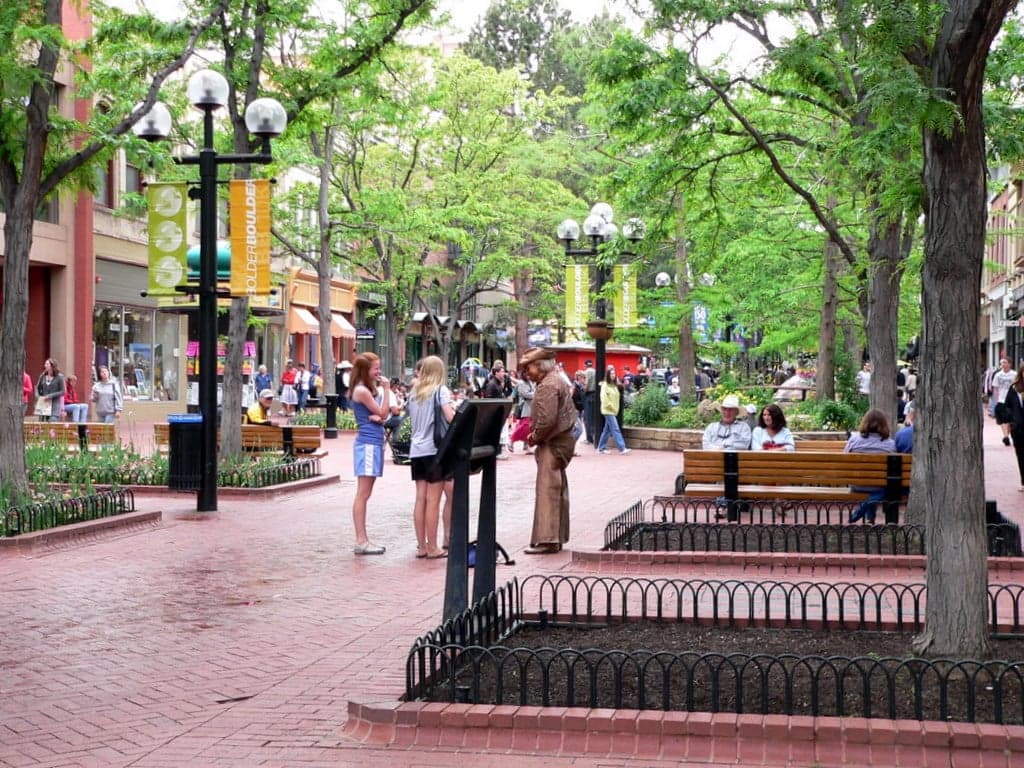
Photo: Wikipedia
Political ClimatePolitical Climate in Boulder, CO
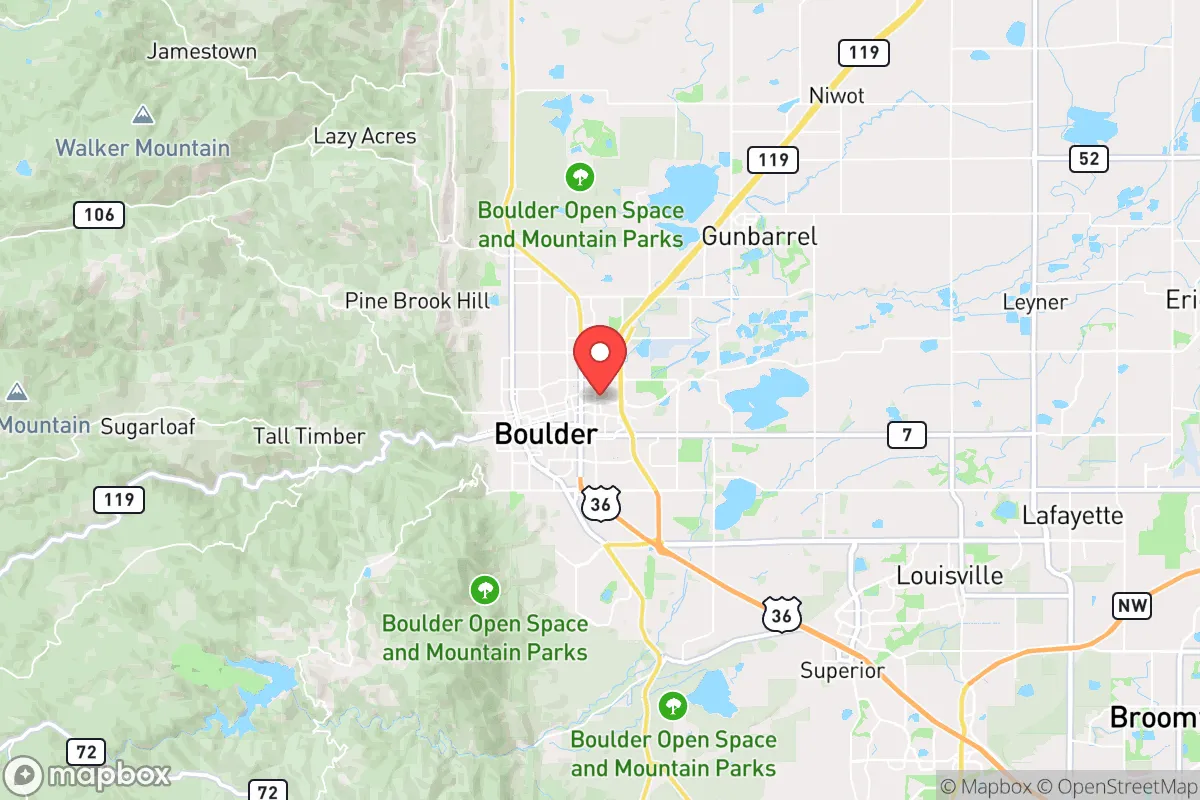
District shown is the primary district for this city’s centroid. Cities may span multiple districts.
Local Political AnalysisPolitical Analysis of Boulder, CO
Boulder has been a deep blue stronghold for decades, and if you’re looking at the numbers, it’s only gotten more pronounced. The Cook PVI of D+20 tells you everything you need to know: this is one of the most reliably Democratic cities in the entire country. But that label doesn’t capture the full story. What started as a community with a strong environmental and outdoor ethos has, over the last ten to fifteen years, shifted into something far more ideologically rigid. The local government, city council, and county commission are almost uniformly progressive, and there’s very little political diversity in day-to-day life. If you lean conservative or even moderate, you’ll feel it—not just at the ballot box, but in how the city is run.
How it compares
Drive twenty minutes east to Longmont or thirty minutes north to Loveland, and you’ll find a completely different political reality. Those communities still have a mix of libertarian-leaning independents, fiscal conservatives, and a more pragmatic approach to growth and regulation. Boulder, by contrast, has become an island of hyper-progressive policy. Even neighboring Louisville and Superior, which are also blue, don’t have the same intensity of ideological enforcement. The contrast is stark: in Boulder, you’ll see city-funded programs that push social justice initiatives into every corner of public life, while in Longmont, you can still have a conversation about property rights without being labeled a pariah. The surrounding county, Boulder County, votes similarly to the city, but the rural pockets—like Niwot or Gold Hill—hold onto a more independent, live-and-let-live spirit that’s increasingly hard to find inside city limits.
What this means for residents
For someone who values personal freedom and limited government, Boulder can feel like a slow-moving regulatory vise. The city has been aggressive on everything from banning natural gas in new construction to imposing strict short-term rental caps that limit property rights. The local government doesn’t just encourage progressive behavior—it mandates it. You’ll see it in the sugar-sweetened beverage tax, the push for rent control measures, and the constant expansion of city ordinances that tell you how to heat your home, what kind of car you can drive, and even what you can plant in your yard. The tax burden is high, and the cost of living is punishing, partly because of the regulatory environment. For a conservative, the biggest red flag is the lack of political accountability: once elected, progressive council members rarely face serious opposition, so policies keep moving in one direction without much debate.
On a cultural level, Boulder has become a place where conformity to progressive orthodoxy is expected, not just in politics but in social settings. If you’re not on board with the latest climate mandates or social justice initiatives, you might find yourself on the outside of conversations at the grocery store or your kid’s school. The city’s identity as a hub for outdoor recreation and tech innovation is still there, but it’s increasingly wrapped in a layer of ideological packaging that can feel suffocating. Long-term, I see this trend continuing—Boulder’s demographics and housing costs ensure that only those who align with the dominant political culture can afford to stay. If you’re looking for a place where your individual rights are respected and government stays out of your personal choices, Boulder is probably not the right fit. The city has traded its old libertarian-leaning character for a much more interventionist model, and there’s no sign of that changing anytime soon.

State Political ClimatePolitical Climate in Colorado
State Political AnalysisPolitical Environment in the State
Colorado’s political climate has shifted dramatically over the past two decades, transforming from a quintessential purple state into a solidly blue stronghold at the state level, while its vast rural expanses remain deeply conservative. The dominant coalition is now a progressive urban-suburban alliance centered in the Denver metro area, Boulder, and a handful of mountain resort towns, which has delivered every statewide election to Democrats since 2014. For a conservative considering relocation, the trajectory is concerning: the state has moved leftward by roughly 10 points in presidential races since 2000, with the 2024 margin settling around +13 for the Democratic candidate, a far cry from the narrow Bush win in 2004.
Urban vs. rural divide
The political map of Colorado is a tale of two worlds. The Denver-Aurora-Lakewood metropolitan area, home to nearly 60% of the state’s population, is the engine of Democratic power. Denver County itself routinely delivers 80%+ of its vote to Democrats, while suburban counties like Jefferson, Arapahoe, and Adams have flipped from swing to reliably blue over the last decade. Boulder County is an even deeper blue stronghold, with the city of Boulder often exceeding 85% Democratic margins. On the other side, the Eastern Plains, the Western Slope, and the San Luis Valley remain Republican strongholds. El Paso County, home to Colorado Springs, is the largest conservative bastion, consistently voting +15 to +20 Republican, though even that margin has eroded slightly as the city’s tech and military sectors attract a more moderate influx. Weld County, anchored by Greeley, is another reliably red area, voting +30 Republican in 2024. The mountain resort counties like Pitkin (Aspen), Summit, and San Miguel (Telluride) have become increasingly liberal, driven by wealthy second-home owners and a service economy reliant on progressive-leaning transplants. The divide is stark: drive 30 minutes east of Denver and you’re in deep red farm country; drive 30 minutes west and you’re in deep blue Boulder.
Policy environment
Colorado’s policy environment has become a cautionary tale for conservatives. The state income tax rate is a flat 4.4%, which is moderate, but the overall tax burden is rising due to aggressive local property tax increases and a state sales tax that can exceed 10% in some cities when combined with local levies. The regulatory posture is heavily pro-government: the state has some of the strictest environmental regulations in the interior West, including a 2024 law requiring all new buildings to meet net-zero energy standards by 2030, which drives up construction costs. Education policy is dominated by the teachers’ unions, with school choice limited compared to states like Arizona or Florida; the state’s charter school law is weak, and the Denver Public Schools system has seen enrollment declines amid progressive curriculum battles. Healthcare is heavily regulated, with a state-run insurance exchange and a 2023 law capping insulin prices, which sounds good but signals a willingness to intervene in private markets. Election laws have been a flashpoint: Colorado was an early adopter of universal mail-in voting (2013), automatic voter registration, and same-day registration, which conservatives argue erodes ballot security. The state also has a “red flag” law (2019) allowing temporary firearm seizure without due process, and a 2021 law requiring background checks for private firearm sales, both of which are deeply unpopular in rural areas.
Trajectory & freedom
On the freedom index, Colorado is moving in the wrong direction for conservatives. The most alarming trend is the erosion of Second Amendment rights: the 2024 legislative session saw a ban on “ghost guns” and a law raising the minimum age to purchase any firearm to 21, with a proposed assault weapons ban narrowly failing. Parental rights have taken hits, with a 2023 law requiring schools to adopt “comprehensive” sex education curricula that many parents find inappropriate, and a 2024 law prohibiting schools from notifying parents if a student changes their gender identity or pronouns — a direct assault on family authority. Medical autonomy is also under pressure: the state legalized assisted suicide in 2016, and while recreational marijuana has been legal since 2012, the regulatory framework is so burdensome that many small growers have been pushed out. Property rights are threatened by a 2023 law allowing local governments to impose rent control on mobile home parks, a slippery slope toward broader rent control. The Taxpayer’s Bill of Rights (TABOR), once a sacred cow limiting state spending, has been systematically weakened by ballot measures that allow the state to keep surplus revenue, effectively raising the tax burden without a vote. The trajectory is clear: each legislative session brings new restrictions on personal liberty, particularly for gun owners, parents, and small business owners.
Civil unrest & political movements
Colorado has seen its share of political turbulence. The 2020 protests in Denver were among the largest in the country, with the city’s “autonomous zone” lasting several days and resulting in property damage and a controversial police response that led to a consent decree with the state. The state’s sanctuary policies are a major concern: Colorado is a “sanctuary state” in practice, with a 2019 law limiting local law enforcement cooperation with federal immigration authorities, and Denver has a formal “Welcoming City” ordinance. This has led to a surge in illegal immigration, with Denver spending over $40 million on migrant services in 2023-2024, straining city budgets and public services. On the right, the “Colorado Project” and local Republican activist groups have organized around election integrity, with the 2020 and 2022 elections seeing numerous lawsuits over ballot drop box security and signature verification. The 2022 election saw a failed recall effort against Denver District Attorney Beth McCann, who was criticized for progressive criminal justice policies. The “Better Colorado” movement, a conservative coalition, has pushed for school board candidates and local ballot measures to push back against progressive policies, with some success in Douglas County and El Paso County. The most visible flashpoint for a new resident would be the homelessness crisis in Denver and Boulder, which is directly tied to progressive policies that decriminalized public camping and reduced enforcement, leading to tent encampments that have become a public safety and sanitation issue.
Projection
Over the next 5-10 years, Colorado is likely to continue its leftward drift, driven by demographic trends that favor Democrats. The state’s population growth is concentrated in the Denver metro area and the liberal mountain towns, while rural counties are losing population. The in-migration from California, Texas, and the East Coast tends to be younger and more progressive, particularly in the tech and renewable energy sectors. The Republican Party in Colorado is increasingly marginalized, with no statewide elected official and a shrinking legislative minority. The 2026 gubernatorial race is expected to be a Democratic hold, and the state’s electoral votes are likely to remain blue for the foreseeable future. However, there are some countervailing trends: the cost of living crisis, driven by housing prices and taxes, may slow in-migration, and the backlash against progressive education and public safety policies could energize conservative voters in suburban counties like Douglas and El Paso. A new resident moving in now should expect to live in a state where the political culture is increasingly hostile to conservative values, with a government that is comfortable expanding its reach into personal decisions, from gun ownership to parental rights to property use.
For a conservative considering Colorado, the bottom line is this: you can find like-minded communities in Colorado Springs, the Eastern Plains, or the Western Slope, but you will be living under a state government that is actively working against your values. The tax burden is rising, your Second Amendment rights are under constant assault, your parental authority is being undermined, and your property rights are eroding. If you value personal freedom, limited government, and a culture that respects individual responsibility, Colorado is no longer the safe bet it was 20 years ago. The state’s natural beauty and outdoor lifestyle are undeniable, but the political cost of living there is becoming too high for many conservatives. If you do move, focus on El Paso County or Weld County, and get involved in local politics immediately — the fight for freedom in Colorado is now a local one.
* Values derived from national, state, county, city and local statistics and may differ in a specific area. Last updated: 2026-04-29T01:23:22.000Z
Narrative content on this page is AI-generated and may contain mistakes. Verify any details that matter before acting on them.
ReloMaps may earn a commission from affiliate links at no extra cost to you.

