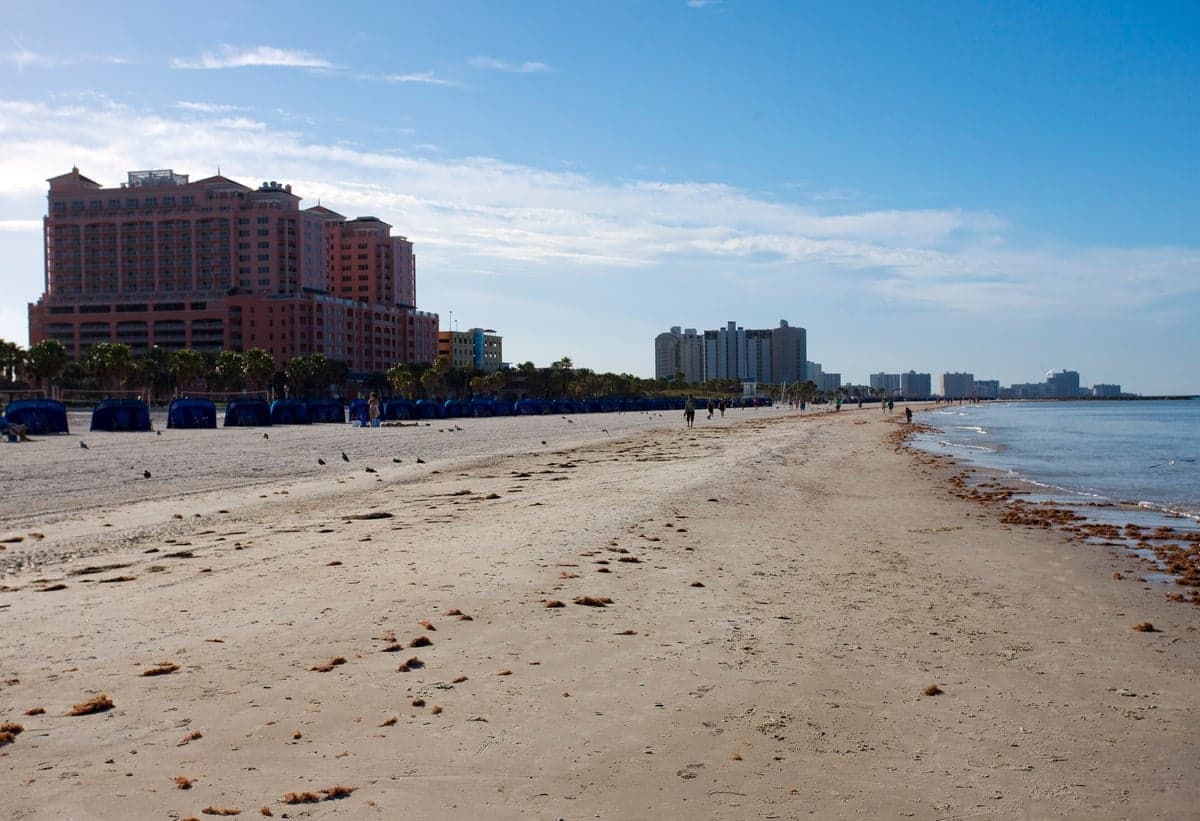
Photo: Wikipedia
Political ClimatePolitical Climate in Clearwater, FL
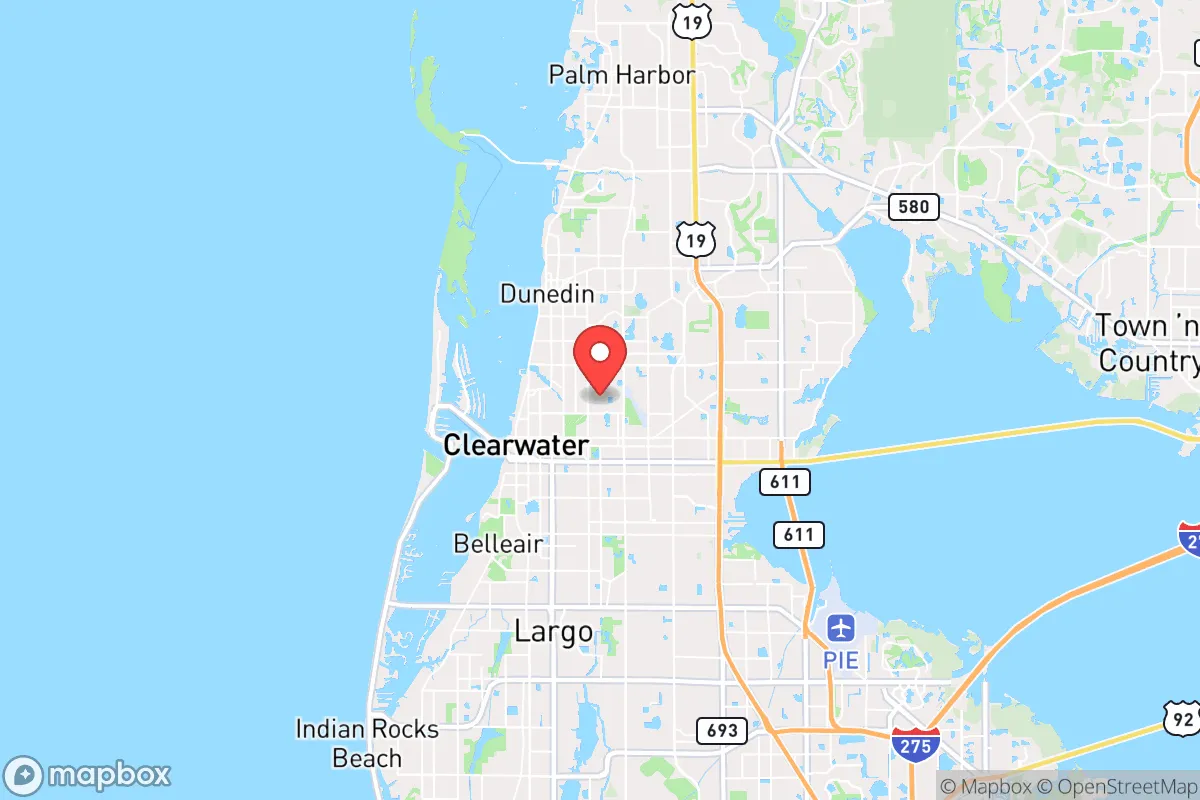
District shown is the primary district for this city’s centroid. Cities may span multiple districts.
Local Political AnalysisPolitical Analysis of Clearwater, FL
Clearwater has long been a reliably conservative stronghold in Pinellas County, with a Cook PVI of R+5 that reflects its steady Republican lean in both local and national elections. But if you've lived here as long as I have, you've watched that political identity get chipped away, year by year, as waves of new residents from blue states and a growing progressive activist class push for changes that feel more like San Francisco than the Gulf Coast. The city still votes red in most races, but the margin is shrinking, and the real story is how the local government has started to drift left on everything from zoning to public spending, often overriding the will of long-time residents who just want to be left alone.
How it compares
Drive ten miles south to St. Petersburg, and you'll find a city that's gone fully progressive—its city council openly embraces defund-the-police rhetoric and rent control experiments that have done nothing to lower housing costs. Head north to Dunedin or Palm Harbor, and you're back in more familiar territory: lower taxes, fewer regulations, and a general hands-off attitude from local officials. Clearwater sits right in the middle, but the pressure is coming from the south. The county commission has a conservative majority, but the city council has been tilting left, especially after the 2022 redistricting carved up some of the old conservative precincts. What used to be a safe bet for Republican candidates is now a battleground, and that's a direct result of the city's aggressive push to redevelop downtown and attract a younger, more transient population that doesn't share our values about limited government and personal responsibility.
What this means for residents
For those of us who've been here through the hurricanes and the housing booms, the biggest concern is how fast the political winds are shifting on everyday issues. The city council has floated proposals for mandatory inclusionary zoning—basically telling property owners they have to set aside units for government-approved tenants—and there's been a steady creep of new fees and permitting requirements that make it harder to run a small business or renovate your own home. The school board, too, has become a flashpoint, with progressive members pushing curriculum changes that sidestep parental input. If you value the freedom to live your life without a bureaucrat telling you how to use your property or what your kids can read, you're going to find yourself increasingly at odds with the direction Clearwater is heading. The silver lining is that the countywide electorate is still conservative enough to push back on the worst ideas, but it takes constant vigilance—and showing up to every city council meeting—to keep the overreach in check.
Culturally, Clearwater still feels like old Florida in many ways—the Church of Scientology's presence gives the city a unique, almost insular character that resists the kind of rapid gentrification you see in Tampa or St. Pete. But that's changing too. The city's $500 million waterfront redevelopment project, while bringing new restaurants and hotels, has also brought demands for more public housing and "equity" set-asides that would have been unthinkable a decade ago. The long-term trajectory depends on whether the conservative base can hold the line in the next few election cycles. If the current trend continues, Clearwater could look a lot more like its southern neighbor within ten years. For now, it's still a place where a handshake matters more than a government form, but you have to fight to keep it that way.

State Political ClimatePolitical Climate in Florida
State Political AnalysisPolitical Environment in the State
Florida has transformed from a classic swing state into a solidly Republican-leaning powerhouse over the past two decades, with a current partisan lean of roughly +3 to +5 points in statewide races and a GOP trifecta controlling the governorship, both legislative chambers, and both U.S. Senate seats. The dominant coalition is a blend of conservative retirees from the Midwest and Northeast, Cuban-American and Venezuelan exiles in South Florida, and fast-growing exurban families in the I-4 corridor. The trajectory has been unmistakably rightward since 2008, when Barack Obama narrowly won the state, to 2024, when Donald Trump carried it by over 3 points even as national margins tightened — a shift driven by massive in-migration from blue states and a GOP that has aggressively courted Hispanic voters.
Urban vs. rural divide
The political map of Florida is a textbook study in geographic polarization. The major Democratic strongholds are the dense urban cores of Miami-Dade County, Orlando (Orange County), and Tampa (Hillsborough County), along with college towns like Gainesville (Alachua County) and the progressive enclave of Tallahassee (Leon County). But even here, the trend is telling: Miami-Dade, once a Democratic firewall, has shifted dramatically rightward — Hillary Clinton won it by 29 points in 2016, Joe Biden by only 7 in 2020, and Trump actually flipped it in 2024. The real GOP engine is the sprawling exurban and rural landscape: Pasco County north of Tampa, Lake County northwest of Orlando, Brevard County (Cape Canaveral area), and the entire Panhandle from Pensacola to Panama City. These areas vote 65-70% Republican and have been growing fast as families flee high-tax states. The I-4 corridor between Tampa and Daytona Beach remains the ultimate battleground, but even there, fast-growing suburban counties like Polk and Volusia have trended red since 2020.
Policy environment
Florida’s policy environment is a deliberate contrast to high-regulation states like New York and California. There is no state income tax, which is the single biggest draw for relocating families and remote workers. Property taxes are moderate (around 0.8-1.0% of assessed value) and capped by the Save Our Homes amendment for primary residences. The regulatory posture is aggressively pro-business: Florida is a right-to-work state with minimal labor union influence, and Governor Ron DeSantis signed a law in 2023 banning local heat-safety mandates for outdoor workers, overriding municipal attempts to impose rest-break requirements. On education, Florida pioneered universal school choice — the Family Empowerment Scholarship and the new universal Education Savings Account program (HB 1, 2023) allow any family to use state funds for private school, homeschooling, or tutoring. Higher education has seen a conservative overhaul: the “Stop WOKE Act” (HB 7, 2022) restricts classroom instruction on race and gender, and the Board of Governors has reformed tenure policies at state universities. Election laws have been tightened: SB 90 (2021) added voter ID requirements, limited drop boxes, and restricted mail-in ballot requests to one election cycle. Healthcare policy is mixed — Florida did not expand Medicaid under the ACA, but it has relatively free-market insurance markets and a robust telehealth framework. The state also banned COVID-19 vaccine mandates for private employers (SB 252, 2023) and prohibited mask mandates in schools (SB 183, 2022).
Trajectory & freedom
On balance, Florida has become measurably freer over the past five years, particularly in areas of parental rights, gun rights, and economic liberty. The “Parental Rights in Education” law (HB 1557, 2022), which critics dubbed “Don’t Say Gay,” prohibits classroom instruction on sexual orientation and gender identity through third grade — a policy that has been expanded to all grades (HB 1069, 2023). Gun rights expanded with permitless carry (HB 543, 2023), allowing any law-abiding adult to carry a concealed firearm without a license. Medical autonomy was bolstered by a ban on COVID-19 vaccine passports (SB 2006, 2021) and a law prohibiting employers from mandating vaccines (SB 252, 2023). Property rights were strengthened by the “Live Local Act” (SB 102, 2023), which preempts local zoning to allow affordable housing development on commercial land, though this has sparked tension with local control advocates. The only notable contraction of freedom has been in the realm of speech: the Stop WOKE Act’s restrictions on workplace and classroom discussions have been partially blocked by federal courts, creating legal uncertainty. On the whole, Florida’s trajectory is toward a model of “freedom from government overreach” that attracts conservatives, but critics argue it trades one set of mandates for another.
Civil unrest & political movements
Florida has seen relatively low levels of civil unrest compared to states like Oregon or Minnesota, but flashpoints exist. The most visible organized movements are on the right: the Moms for Liberty chapter network, which originated in Brevard County, has become a national force in school board politics, pushing for book bans and curriculum transparency. On the left, the Dream Defenders (based in Miami) and Florida Rising organize around racial justice and immigrant rights, but their protests have been smaller and less frequent than in blue states. Immigration politics are uniquely charged in Florida due to its proximity to Cuba and Haiti: the state passed the toughest anti-sanctuary law in the country (SB 1718, 2023), which requires businesses with 25+ employees to use E-Verify, bans local governments from providing ID cards to undocumented immigrants, and makes transporting undocumented people into the state a felony. This law sparked some protests in Miami’s immigrant communities, but enforcement has been uneven. Election integrity remains a hot-button issue: the 2020 election in Florida was widely seen as smooth, but the GOP has since passed laws restricting mail-in voting and drop boxes, and Governor DeSantis created a new Office of Election Crimes and Security in 2022, which has prosecuted a handful of cases of double voting. A new resident would notice the absence of visible homelessness encampments in most cities — a result of local ordinances and a state law (HB 1365, 2023) that bans public camping and directs homeless individuals to shelters.
Projection
Over the next 5-10 years, Florida is likely to become more conservative, not less, driven by two powerful demographic forces. First, in-migration from blue states — roughly 1,000 people move to Florida per day, and surveys show a majority cite lower taxes and “freedom” as reasons. These newcomers tend to be center-right or libertarian-leaning, not progressive. Second, Hispanic voters, particularly Cuban-Americans and Venezuelans, are shifting rightward at a pace that surprises national analysts; Miami-Dade could become a swing county or even lean Republican by 2030. The main wild card is climate change: rising sea levels and hurricane risk could eventually slow coastal growth, but for now, inland counties like Polk, Lake, and Osceola are booming. The political implications are clear: the GOP’s hold on the state legislature and governor’s mansion is likely to strengthen, and Florida will remain a national laboratory for conservative policy — school choice, deregulation, and election integrity measures. A resident moving in now should expect a state that is increasingly self-confident in its conservative identity, with a growing economy and a political culture that rewards individual responsibility over collective mandates.
Bottom line for a new resident: If you’re moving to Florida for lower taxes, parental rights, and a lighter government touch, you’re arriving at the right time — the state is doubling down on those values. But be prepared for a political environment that is actively hostile to progressive policies, and expect that the culture wars you thought you left behind in your old state will follow you here, just with the roles reversed. The schools, the job market, and the housing policies are all designed to attract families who want more control over their own lives — and that’s exactly what you’ll get.
* Values derived from national, state, county, city and local statistics and may differ in a specific area. Last updated: 2026-05-01T11:27:35.000Z
Narrative content on this page is AI-generated and may contain mistakes. Verify any details that matter before acting on them.
ReloMaps may earn a commission from affiliate links at no extra cost to you.

