
Photo: Wikipedia
Demographics of Broomfield County
Affluence Level in Broomfield County
An upper-middle-class area. Household wealth, education levels, and homeownership run ahead of national benchmarks.
People of Broomfield County
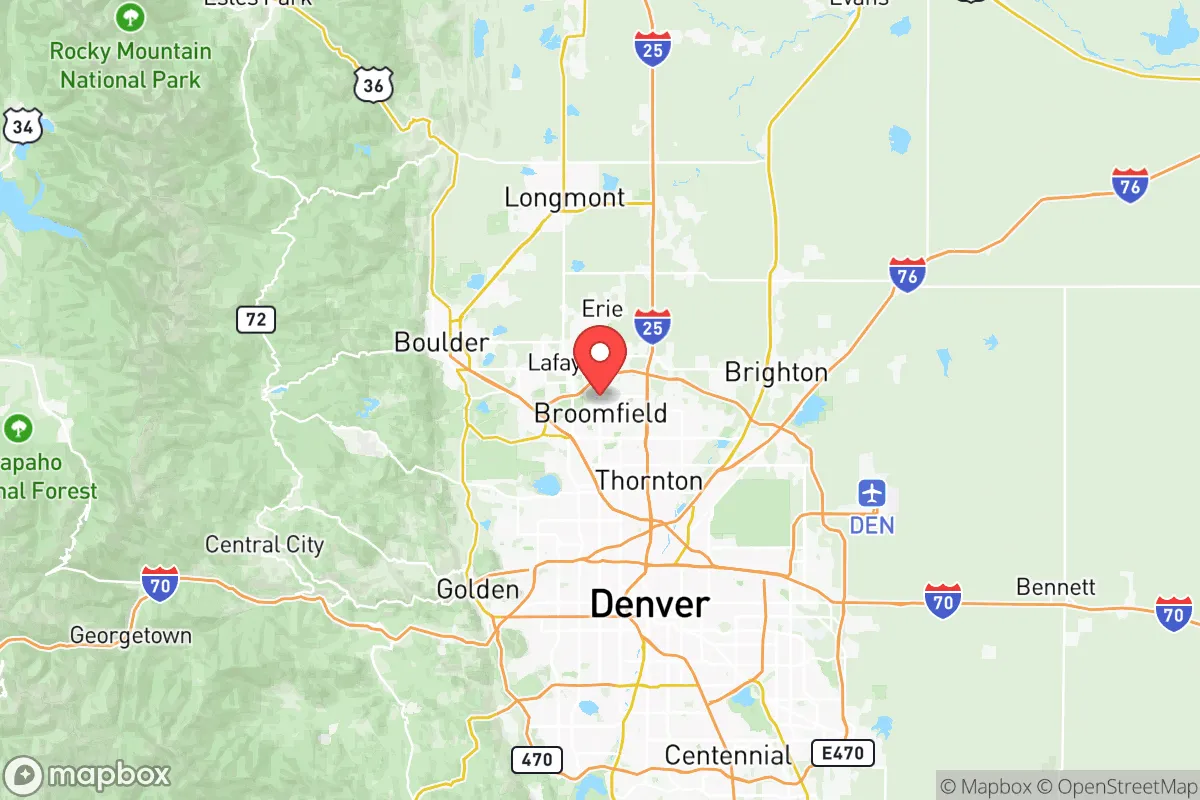
Broomfield County, Colorado, is a relatively young, highly educated, and predominantly white suburban community of 75,110 residents, characterized by its blend of master-planned neighborhoods and preserved open space. With a foreign-born population of just 4.6% and a college attainment rate of 58.6%, the county stands out as an affluent, family-oriented enclave along the Front Range urban corridor. Its population is notably less diverse than neighboring Denver or Aurora, with a strong white majority of 73.2%, a Hispanic population of 13.8%, and smaller but growing East/Southeast Asian (4.2%) and Indian subcontinent (2.5%) communities. The county’s identity is shaped by its recent incorporation as a consolidated city-county in 2001, a status that reflects a desire for local control and efficient governance among its largely professional-class residents.
Settlement & growth (pre-1960)
Before European settlement, the area now known as Broomfield County was part of the traditional territory of the Arapaho and Cheyenne nations, who followed bison herds across the high plains and camped along the seasonal creeks that drain into the South Platte River. The Ute people also used the foothills to the west for seasonal hunting. The 1851 Treaty of Fort Laramie formally recognized Arapaho and Cheyenne claims to this region, but the discovery of gold in the Rocky Mountains in 1858 and the subsequent Colorado Gold Rush brought a flood of Anglo-American settlers that quickly overwhelmed Native land rights. By the 1860s, the U.S. government had forcibly removed the Arapaho and Cheyenne to reservations in Oklahoma and Wyoming, opening the Front Range to homesteaders.
The first permanent non-Native settlers arrived in the 1860s and 1870s, drawn by the promise of cheap land under the Homestead Act of 1862. These early pioneers were overwhelmingly native-born Americans from the Midwest and Upper South—farmers from Illinois, Iowa, Missouri, and Kentucky seeking 160-acre parcels on the dry plains. They established small farming communities such as Zuni (later absorbed into Broomfield) and Baseline, named for the principal meridian used in surveying Colorado. The arrival of the Colorado Central Railroad in the 1870s spurred the founding of Broomfield itself in 1884, named after the broomcorn fields that supplied the region's broom-making industry. The town served as a shipping point for wheat, sugar beets, and livestock, and its early population was a mix of Midwestern farm families and a small number of German and Swedish immigrants who worked the railroad and the fields.
Through the first half of the 20th century, Broomfield remained a tiny agricultural hamlet, never exceeding a few hundred residents. The Dust Bowl of the 1930s and the Great Depression drove some Plains families westward into Colorado, but Broomfield itself saw little growth. World War II brought the Rocky Mountain Arsenal and the Denver Ordnance Plant to nearby Adams County, drawing some workers to the broader region, but Broomfield remained a quiet crossroads. The post-war suburban boom that transformed much of the Front Range largely bypassed Broomfield until the 1960s, as Denver's growth initially pushed south and east rather than north. As late as 1960, the population of the unincorporated area that would become Broomfield County was barely 6,000, scattered among farms and the small commercial core along U.S. Highway 287.
Modern era (post-1965)
The 1965 Hart-Cellar Act, which abolished national-origin quotas, had a limited direct effect on Broomfield because the county's population was overwhelmingly native-born and remained so for decades. Instead, the demographic transformation of Broomfield was driven by domestic migration—specifically, the relocation of middle-class white families from Denver and other parts of the Front Range seeking newer housing, better schools, and lower taxes. The 1970s and 1980s saw the construction of master-planned subdivisions such as Greenbriar and Broadlands, which attracted professionals working at the growing number of corporate campuses along the U.S. 36 corridor, including StorageTek (later acquired by Sun Microsystems) and Ball Aerospace. This wave of newcomers was predominantly white, college-educated, and politically moderate to conservative, establishing the county's character as a family-oriented, fiscally conservative suburb.
The 1990s and early 2000s brought a second wave of domestic migration, this time from out of state. The technology boom drew engineers and managers from California, Texas, and the East Coast to companies like Level 3 Communications and Vail Resorts' corporate headquarters, both of which located in Broomfield. These newcomers settled in newer developments such as Anthem and McKay Landing, attracted by the county's open-space preservation policies and its reputation for efficient local government. The consolidation of Broomfield into a city-county in 2001 was driven by this growing population's desire to control land use and avoid annexation by surrounding counties, reflecting a strong localist and anti-tax sentiment that remains central to the county's political identity.
Immigration to Broomfield has been modest compared to the rest of the Denver metro area. The Hispanic population, at 13.8%, is concentrated in older neighborhoods near the original downtown core and in the Brandeis area, where many families have roots in the agricultural labor that persisted through the 1970s. The East/Southeast Asian community (4.2%) includes a mix of Chinese, Korean, and Vietnamese professionals who work in the technology and aerospace sectors, and they tend to live in newer subdivisions like Willow Park and Lac Amora. The Indian subcontinent population (2.5%) is a more recent arrival, largely composed of engineers and IT professionals who moved to the area after 2010, drawn by jobs at companies like Oracle and Vail Resorts; they are dispersed throughout the county rather than concentrated in a single enclave. The Black population remains very small at 1.1%, reflecting Broomfield's historical lack of the industrial and service-sector jobs that attracted Black migrants to other parts of the Front Range.
The future
Broomfield County is projected to continue growing slowly, with the Colorado State Demography Office estimating a population of roughly 85,000 by 2035. The county is becoming slightly more diverse, driven primarily by the growth of the Hispanic and East/Southeast Asian populations, though the white share is expected to remain above 65% for the foreseeable future. The Indian subcontinent community is likely to grow as the technology sector expands along the U.S. 36 corridor, but Broomfield's high housing costs—median home prices exceed $600,000—will limit in-migration to relatively affluent professionals. New development is concentrated in the North Park and FlatIron Crossing areas, where mixed-use projects are attracting younger families and some empty-nesters, but the county's strict growth-management policies will prevent the kind of rapid expansion seen in neighboring Adams and Weld counties.
Culturally, Broomfield is likely to remain a moderately conservative, family-focused suburb with a strong emphasis on outdoor recreation, local schools, and low taxes. The county's political leanings have shifted slightly toward the center as the population has grown and diversified, but it still reliably votes Republican in statewide elections. The biggest demographic challenge facing Broomfield is its aging population: the share of residents over 65 is rising faster than the national average, and the county will need to attract more young families to maintain its tax base and school enrollment. The planned expansion of the RTD N Line commuter rail into Broomfield may bring some additional density and diversity, but the county's fundamental character as a low-density, high-amenity suburb is unlikely to change dramatically.
For someone moving to Broomfield today, the county offers a stable, safe, and well-managed community with excellent schools and easy access to Denver and Boulder. The population is less diverse than the national average but is slowly becoming more varied, particularly in the professional and technical fields. The dominant culture remains that of the white, college-educated, fiscally conservative homeowner—a group that values local control, open space, and a high quality of life. Newcomers who fit that profile will find Broomfield welcoming; those seeking a more urban, diverse, or politically progressive environment may find it too homogeneous. The county's trajectory is one of slow, managed growth that preserves its existing character rather than transforming it.

* Values derived from national, state, county, city and local statistics and may differ in a specific area. Last updated: 2026-08-08T16:14:43.000Z
Narrative content on this page is AI-generated and may contain mistakes. Verify any details that matter before acting on them.
ReloMaps may earn a commission from affiliate links at no extra cost to you.

