
Photo: Wikipedia
Political ClimatePolitical Climate in Broomfield County
Showing district-level results — no local-only data available.
Local Political AnalysisPolitical Analysis of Broomfield County
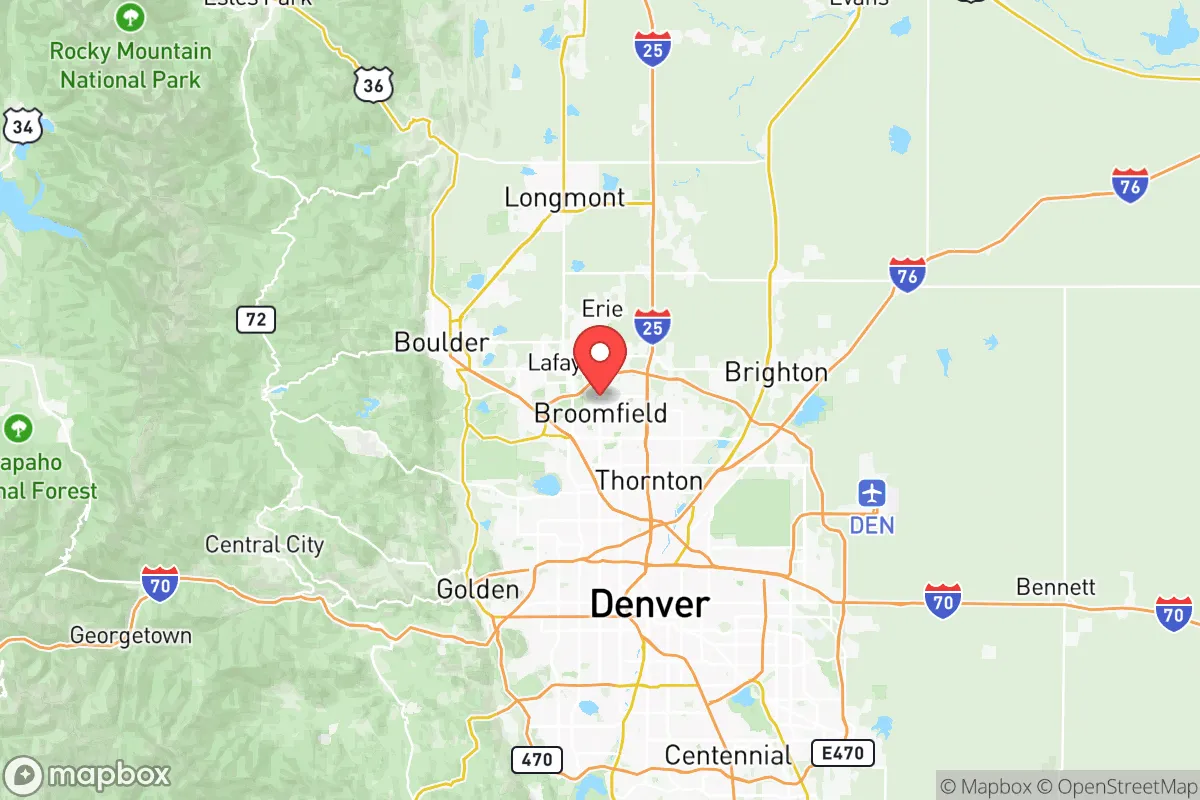
Broomfield County, Colorado, is a solidly Democratic-leaning area with a Cook Partisan Voting Index (PVI) of D+8, meaning it votes about 8 points more Democratic than the national average. This isn't a deep-blue stronghold like Denver or Boulder, but rather a reliably blue county in a state that has shifted from a classic purple swing state to a solidly blue one over the past two decades. The county's trajectory has been steadily leftward, driven by the same forces reshaping much of Colorado's Front Range: an influx of younger, college-educated professionals and a growing tech and aerospace sector that pulls in talent from across the country.
How it compares
While Colorado's statewide PVI isn't officially calculated in the same way, the state as a whole is widely considered a D+4 to D+6 lean, making Broomfield County noticeably more Democratic than the state average. This is a significant shift from the 2000s, when Broomfield was a classic swing county that could go either way in a close election. Today, the county's politics more closely resemble those of neighboring Boulder County (D+27) and Jefferson County (D+5) than the more conservative Weld County (R+16) to the north. Within Broomfield County itself, the political geography is fairly uniform—there are no incorporated towns or cities with distinct political identities, as the county is coterminous with the city of Broomfield. However, precinct-level data shows that the older, more established neighborhoods near the original town center (around Main Street and the Broomfield County Commons) tend to be more moderate, sometimes even leaning slightly Republican in local races, while the newer master-planned communities like Anthem and the Broadlands area, filled with younger families and tech workers, are where the Democratic margins are strongest. The swing precincts are largely in the central part of the city, around the 1st Bank Center and the FlatIron Crossing mall area, where a mix of longtime residents and newer arrivals create a more competitive environment.
What this means for residents
For liberal residents, Broomfield's D+8 lean means their votes are usually on the winning side in county and state races, and local policies tend to reflect progressive priorities like investment in public transit (the RTD Broomfield Park-n-Ride and the planned FasTracks expansion), open space preservation (the Broomfield Open Space and Trails program), and climate action initiatives. For conservative residents, the reality is that they are a clear minority in county politics, but not an invisible one. The county's Republican Party remains active, and local races for city council and school board are often competitive, with conservative candidates winning seats in districts that cover the older, more moderate parts of town. The practical effect is that Broomfield avoids the most extreme versions of either party's agenda—you won't see the kind of aggressive progressive policies found in Denver (like rent control or defunding police debates) nor the hardline conservative stances of Weld County (like Second Amendment sanctuary resolutions). Instead, the county tends toward a pragmatic, business-friendly centrism that still leans left on social issues.
Culturally, this political balance means Broomfield has a distinct identity as a "purple-ish blue" suburb. The county's policy distinctions are most visible in its approach to growth and development: it has a strong urban growth boundary and a reputation for careful planning, but it also aggressively courts corporate relocations (like the massive Vail Resorts headquarters and the Sierra Nevada Corporation's aerospace facility). The local school district, Boulder Valley School District (which serves parts of Broomfield), reflects the county's politics—well-funded and progressive on curriculum, but with enough parental pushback to keep things from going too far left. For anyone moving here, the takeaway is simple: if you're liberal, you'll feel at home; if you're conservative, you'll find your people but you'll need to engage locally to have your voice heard. The county's trajectory suggests it will only get bluer as the tech and aerospace sectors continue to expand, but the pace of change is slow enough that the old-timers and newcomers have learned to coexist, mostly by focusing on the things everyone agrees on: good schools, safe neighborhoods, and easy access to the mountains.

State Political ClimatePolitical Climate in Colorado
State Political AnalysisPolitical Environment in the State
Colorado has shifted from a classic purple swing state to a solidly blue-leaning state over the past two decades, driven primarily by explosive growth in the Denver metro and Front Range corridor. While the state voted for Democratic presidential candidates in every election since 2008, it remains a deeply divided place where the urban core's progressive tilt is constantly checked by a vast, conservative rural expanse. For a relocator, this means you're moving into a state where the political reality depends almost entirely on which county you choose to call home.
Urban vs. rural divide
The political map of Colorado is a story of two distinct Colorados. The Front Range urban crescent — Denver, Boulder, Aurora, and the northern suburbs like Westminster and Thornton — is the engine of the state's Democratic majority. These areas are dense, diverse, and increasingly progressive, with Boulder County routinely delivering 70%+ margins for Democrats. The I-25 corridor from Fort Collins down to Colorado Springs is where the election is decided, and it's trending left as younger, out-of-state transplants fill new apartment complexes and subdivisions. In contrast, the Eastern Plains, the Western Slope, and the San Luis Valley remain deeply conservative. El Paso County (Colorado Springs) is the state's largest red stronghold, reliably Republican but not as overwhelmingly so as rural counties like Weld or Mesa. The real flashpoint is the suburban ring of Jefferson and Arapahoe counties — once reliably red, these areas have flipped blue over the last decade as educated, moderate voters have shifted away from the GOP.
Policy environment
Colorado's policy environment reflects its split personality. The state has a flat income tax rate of 4.4% (recently reduced from 4.55% via Proposition 116), and the Taxpayer's Bill of Rights (TABOR) still constrains government spending growth, a legacy of the state's more libertarian past. Property taxes are among the lowest in the nation, which is a major draw for homeowners. However, the regulatory posture has shifted left: the state has a robust renewable energy mandate, strict oil and gas setback rules (SB 19-181), and a growing list of environmental regulations that have frustrated the energy industry on the Western Slope. On education, Colorado funds schools primarily through local property taxes, leading to wide disparities between wealthy Front Range districts and rural schools. The state has also expanded Medicaid under the Affordable Care Act and operates its own health insurance exchange. Election laws are among the most accessible in the country: Colorado mails every registered voter a ballot automatically, same-day registration is available, and voting by mail is the norm.
Recent policy direction
The last five years have seen Colorado's legislature push aggressively on several fronts that relocators should weigh carefully. On gun policy, the state passed universal background checks and a red flag law (Extreme Risk Protection Orders) in 2019, and in 2023 raised the purchasing age to 21 for all firearms. Self-defense law remains relatively strong — Colorado is a shall-issue concealed carry state with no permit required for open carry in most areas — but local preemption was weakened, allowing cities like Denver and Boulder to enact their own bans on certain firearms. On education and parental rights, the state has moved left: a 2023 law requires schools to adopt policies supporting transgender students, and a 2024 law expanded access to abortion on public university campuses. Medical and bodily autonomy is fully protected — Colorado codified abortion rights into state law in 2022 and has no parental notification requirement for minors seeking the procedure. Property rights have been a battleground: the state's oil and gas setback law effectively banned new drilling near homes and schools, and a 2024 "right to repair" law for agricultural equipment was a rare win for rural landowners. On privacy, Colorado passed one of the nation's strongest data privacy laws (CPA) in 2021, giving residents control over how companies use their personal data. Ballot access remains wide open, with no voter ID requirement at the polls (though you need one to register) and automatic voter registration through the DMV.
Civil unrest & political movements
Colorado has seen its share of political flashpoints. The 2020 protests in Denver were large and occasionally violent, leading to ongoing debates about police reform and public safety. The state has a significant organized activist presence on both sides: the Colorado Democratic Party is well-funded and professional, while conservative grassroots groups like the Colorado Republican Party and various county-level "Moms for Liberty" chapters are active in school board races and local elections. Immigration politics are tense — Denver is a sanctuary city, and the state has limited cooperation with federal immigration enforcement, which has led to friction with rural counties that want stricter enforcement. There have been periodic secession movements in rural areas — Weld County and the Eastern Plains have floated the idea of forming a separate "North Colorado" state, though these efforts have never gained serious traction. Election integrity has been a recurring controversy: despite Colorado's mail-in ballot system being widely regarded as secure and efficient, conservative activists have raised concerns about ballot harvesting and voter roll maintenance, leading to a 2024 law requiring more frequent voter list cleaning.
Projection
Over the next 5-10 years, Colorado's political trajectory points further left at the state level, but with significant caveats. The Denver metro and Front Range will continue to grow, bringing in more out-of-state transplants who tend to vote Democratic. The state's Republican Party is currently fractured between moderates and a more populist, Trump-aligned wing, making it difficult to win statewide races. However, the rural-urban divide is likely to widen, not narrow. Expect continued fights over energy policy (especially as the Western Slope's oil and gas industry contracts), water rights (a perennial issue that will intensify with drought), and housing policy (the state is pushing for denser development in urban areas, which rural conservatives oppose). The most likely scenario is a Colorado that looks like Illinois or New York — a blue state with a few deep-red rural pockets, where statewide policy increasingly reflects Denver's priorities. For a conservative relocator, this means state-level elections will be an uphill battle, but local control in conservative counties will remain strong.
For a new resident, the bottom line is simple: Colorado's political climate is a geography question. If you're moving to Denver, Boulder, or the inner suburbs, you'll be in a progressive environment where your vote is unlikely to change the outcome. If you're looking at Colorado Springs, the Western Slope, or the Eastern Plains, you'll find a conservative community where your vote matters more and local politics feel more responsive. The state's overall lean means that statewide policies will continue trending left on guns, education, and social issues, but TABOR and local control provide meaningful buffers. Choose your county carefully, and you can find a political home that fits — just don't expect the state as a whole to reflect your views if you're on the conservative side of the spectrum.
* Values derived from national, state, county, city and local statistics and may differ in a specific area. Last updated: 2026-08-08T16:14:43.000Z
Narrative content on this page is AI-generated and may contain mistakes. Verify any details that matter before acting on them.
ReloMaps may earn a commission from affiliate links at no extra cost to you.

