 Popular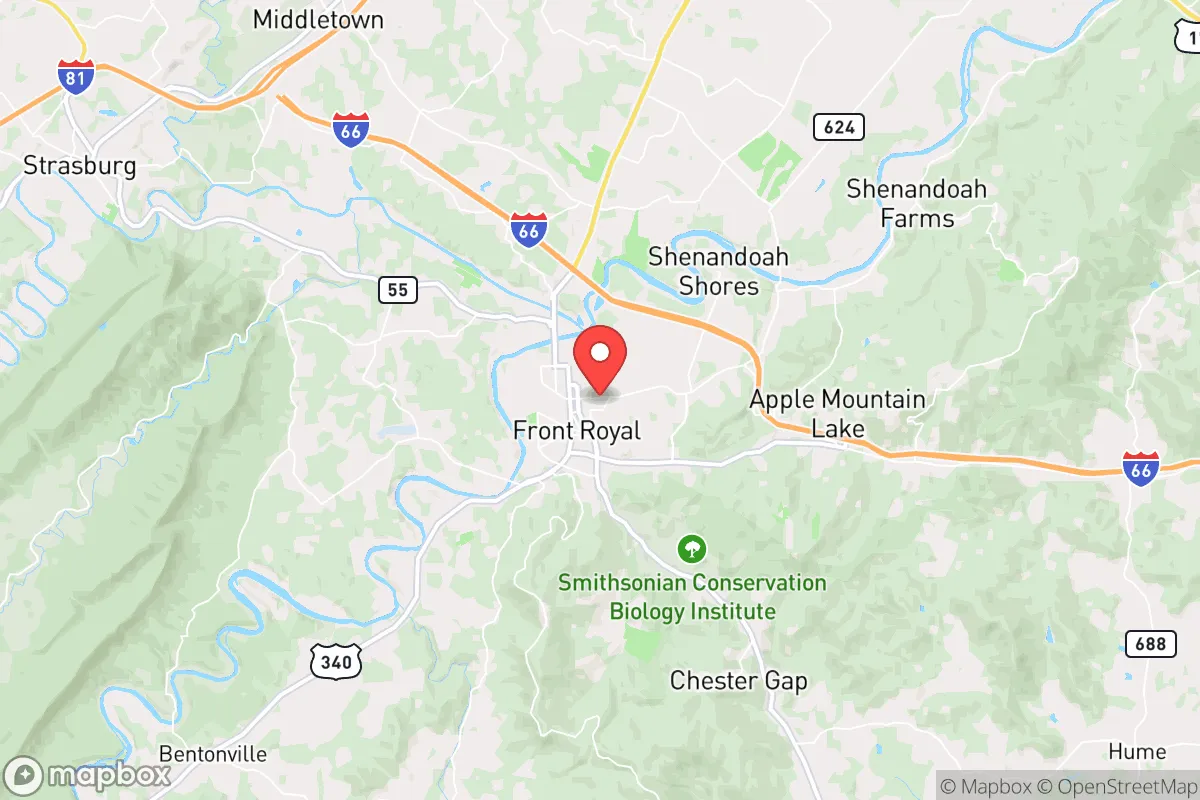

Photo: Wikipedia
Political ClimatePolitical Climate in Front Royal, VA
District shown is the primary district for this city’s centroid. Cities may span multiple districts.
Inherited from parent state — no local data available.
Local Political AnalysisPolitical Analysis of Front Royal, VA
Front Royal has long been a solidly conservative community, and that hasn't changed much despite the influx of folks from Northern Virginia. The Cook PVI sits at R+12, which tells you the math is still heavily in our favor, but you can feel the cultural pressure building as more people move out from the D.C. suburbs. The local elections and school board races are where you really see the fight—it's not about whether we're red, but how red we stay as the county grows.
How it compares
Drive 20 minutes east to Linden or down to the northern edge of Warren County, and you'll start seeing more of those "In this house we believe" signs and the occasional Harris-Walz yard sign from 2024. That's the spillover from the D.C. exodus. Compare that to the core of Front Royal itself—especially around the historic downtown and the rural stretches toward Bentonville—where you'll still find Trump flags flying and a strong Second Amendment presence at the local gun shops. The contrast is real: Warren County as a whole voted +12 points Republican in the 2024 presidential race, but the town of Front Royal itself was closer to +8, while the unincorporated areas west of town hit +18. That split matters because the newcomers tend to settle in the subdivisions near the interstate, and they bring a different set of priorities—more focus on bike lanes, historic district overlays, and zoning changes that feel like government overreach to those of us who've been here.
What this means for residents
For a longtime resident, the biggest concern is watching local government inch toward the kind of regulatory creep we moved here to escape. The town council has debated everything from short-term rental restrictions to noise ordinances that would limit your right to work on your own property after 9 p.m. The school board has become the frontline, with battles over library book policies and whether to teach critical race theory in a county that's 85% white. If you value personal freedom—the right to keep and bear arms without a permission slip, the right to run a small business from your garage without a dozen permits—then you need to stay engaged. The good news is that the county supervisors are still largely conservative, and the sheriff's office hasn't bent to state pressure on things like "red flag" laws. But the trend line is concerning: every election cycle brings a few more candidates who talk about "equity" and "inclusion" in ways that sound a lot like government telling you how to live.
On the cultural side, Front Royal still feels like a place where you can be left alone. The annual Apple Blossom Festival isn't politicized, the churches are full on Sunday, and the local diners don't have pronoun pins on the staff. But the long-term trajectory depends on who shows up to vote in the primaries. If you're thinking of moving here, understand that the political climate is still friendly to traditional values, but it's not immune to the progressive wave washing over the rest of the state. The key is to get involved early—join the local Republican committee, attend a planning commission meeting, and make sure your voice is heard before the zoning board decides that your backyard shed needs a permit. That's the Front Royal way: keep your head down, live your life, but don't let the government forget who pays the taxes.

State Political ClimatePolitical Climate in Virginia
State Political AnalysisPolitical Environment in the State
Virginia has transformed from a reliably conservative Southern state into a competitive purple battleground, with Democrats now controlling the governorship, both U.S. Senate seats, and both chambers of the General Assembly as of 2026. Over the past two decades, the state has shifted leftward by roughly 10 points in presidential elections, driven primarily by explosive population growth in the Washington, D.C. suburbs. While rural and exurban areas remain deeply red, the state’s overall partisan lean now tilts slightly Democratic, with Joe Biden winning by 10 points in 2020 and Governor Glenn Youngkin’s 2021 victory representing the only recent statewide Republican win—a narrow 1.9-point margin that many attribute to a backlash against COVID-era school closures.
Urban vs. rural divide
The political map of Virginia is a tale of two Virginias. The blue stronghold is Northern Virginia, anchored by Arlington, Alexandria, and Fairfax County, where federal employees, tech workers, and recent transplants from blue states have turned these suburbs into Democratic machines. Fairfax County alone cast more votes for Biden than the entire city of Richmond. The second blue engine is the Richmond metro area, including Henrico County and the city itself, which has trended left as young professionals and university students have moved in. Hampton Roads (Norfolk, Virginia Beach) is a swing region, with Virginia Beach’s military-heavy population leaning conservative but the urban core of Norfolk trending blue. The red heartland is Southside and Southwest Virginia, including Roanoke, Lynchburg, and the coal country around Bristol, where Trump won by 30-40 points in 2020. The Shenandoah Valley (Harrisonburg, Staunton) is a mixed bag—rural areas are deep red, but the college towns are blue. The key battleground is the exurban crescent of Loudoun, Prince William, and Stafford counties, where rapid growth from D.C. spillover has flipped these areas from red to blue over the past decade. Loudoun County, once a Republican stronghold, now votes Democratic by double digits, a shift that has reshaped state politics.
Policy environment
Virginia’s policy environment has swung sharply left since Democrats took full control in 2020. The state income tax is a flat 5.75%, but property taxes vary wildly—Loudoun County’s effective rate is around 1.1%, while rural counties like Grayson County are closer to 0.5%. Sales tax is 5.3% statewide, but Northern Virginia adds an extra 1% for transportation. The regulatory posture is increasingly burdensome: the Virginia Clean Economy Act mandates a 100% carbon-free grid by 2050, driving up energy costs. Education policy has been a flashpoint—the state eliminated its Standards of Learning (SOL) graduation requirements in 2022, replacing them with a “profile of a graduate” that critics say dilutes academic rigor. Parental rights took a hit when the General Assembly passed a law in 2021 requiring schools to adopt policies on transgender students that many parents felt sidelined their input. Election laws are moderately restrictive: Virginia has no-excuse absentee voting and same-day registration, but also requires photo ID. The state’s gun laws have tightened significantly—the 2020 “one handgun a month” law and the 2023 ban on “assault weapons” in certain localities have drawn sharp criticism from Second Amendment advocates. Healthcare is dominated by Medicaid expansion, which passed in 2018 under a Republican governor, and the state has a robust Certificate of Public Need (COPN) system that limits new hospital construction.
Trajectory & freedom
Virginia is becoming less free by any objective measure, particularly on economic and personal liberty. The 2021 repeal of the right-to-work law was a major blow to economic freedom, making Virginia the first Southern state to allow union security agreements. On gun rights, the 2020 “red flag” law and the 2023 ban on carrying firearms in certain public buildings have eroded Second Amendment protections. Parental rights took a hit with the 2021 “model policies” on transgender students, which many parents argued bypassed their authority. The state’s COVID response was among the most aggressive in the South—Governor Ralph Northam’s stay-at-home order and school closures lasted longer than neighboring states, and vaccine mandates for state employees were enforced until 2023. On the positive side, the 2022 repeal of the grocery tax and the 2023 elimination of the car tax on personal vehicles were modest wins for taxpayers. However, the trend is clear: the General Assembly has passed 15 new gun control measures since 2020, and the state’s regulatory burden has increased by an estimated 12% in the same period. The 2024 passage of a data privacy law, while well-intentioned, adds compliance costs for small businesses.
Civil unrest & political movements
Virginia has been a national flashpoint for political conflict. The 2017 “Unite the Right” rally in Charlottesville remains a defining moment, with the violent clashes between white nationalists and counter-protesters leading to a state of emergency and the death of a counter-protester. Since then, left-wing activism has been more visible—Black Lives Matter protests in Richmond in 2020 led to the toppling of Confederate statues on Monument Avenue, and the city’s mayor later ordered their removal. Immigration politics are contentious: Alexandria and Arlington have declared themselves “sanctuary cities,” refusing to cooperate with ICE detainers, while rural counties like Loudoun have passed resolutions opposing sanctuary policies. Election integrity remains a hot-button issue—the 2020 election saw no major fraud cases, but the 2021 gubernatorial race was decided by just 65,000 votes out of 3.3 million cast, fueling ongoing debates about voter ID laws and mail-in ballot security. The “Parents Matter” movement, which mobilized against critical race theory and transgender policies in schools, was particularly strong in Loudoun County, where school board meetings became national news. Secession rhetoric is rare, but some Southwest Virginia counties have floated joining West Virginia, citing cultural and political alienation from the Northern Virginia-dominated state government.
Projection
Over the next 5-10 years, Virginia will likely continue its leftward drift, driven by demographic trends that show no sign of reversing. Northern Virginia is projected to add 400,000 new residents by 2035, most of whom will be young professionals and immigrants who lean Democratic. The exurban counties of Loudoun, Prince William, and Stafford are expected to become even bluer as their populations become more diverse and educated. Rural Virginia, meanwhile, is aging and shrinking—Southwest Virginia has lost population every year since 2010. This means the state’s political center of gravity will shift further north and east. Republicans may win occasional statewide races like Youngkin’s 2021 victory, but the structural advantage for Democrats in the General Assembly is growing. The state’s tax burden is likely to increase as the cost of the Virginia Clean Economy Act and expanded Medicaid are passed on to residents. Gun rights will continue to erode, and parental rights battles will intensify as the state’s education bureaucracy becomes more progressive. The wild card is in-migration from blue states—if the trend of Californians and New Yorkers moving to Virginia accelerates, the state could become as blue as Maryland within a decade. For conservatives, the realistic outlook is that Virginia will become a state where they can win occasional elections but will struggle to hold power long enough to reverse the policy trajectory.
For a conservative individual or family considering a move to Virginia, the bottom line is this: you can still find strong communities in the Shenandoah Valley, Southside, or Southwest Virginia where your values are shared, but you will be fighting an uphill battle at the state level. The state’s tax burden is moderate but rising, gun rights are under constant assault, and the education system is increasingly aligned with progressive priorities. If you’re looking for a state where your vote will meaningfully shift the political balance, Virginia is a battleground worth engaging—but be prepared for a long-term fight. If you want a state where conservative policies are secure, you’re better off looking at Tennessee, Florida, or Texas. Virginia is a beautiful state with great outdoor recreation and strong job markets in certain regions, but its political trajectory is clear: it’s moving left, and it’s not turning back anytime soon.
* Values derived from national, state, county, city and local statistics and may differ in a specific area. Last updated: 2026-10-10T16:27:31.000Z
Narrative content on this page is AI-generated and may contain mistakes. Verify any details that matter before acting on them.
ReloMaps may earn a commission from affiliate links at no extra cost to you.

