Photo: Wikipedia
Political ClimatePolitical Climate in Garland, TX
District shown is the primary district for this city’s centroid. Cities may span multiple districts.
Local Political AnalysisPolitical Analysis of Garland, TX
Garland, Texas, has long been a solidly conservative community, and the numbers back that up with a Cook PVI of R+13, meaning the district votes about 13 points more Republican than the national average. But if you've lived here as long as I have, you've seen the winds start to shift, and not necessarily for the better. The city itself has a history of being a reliable red stronghold in Dallas County, but as the Metroplex grows and diversifies, we're starting to see some of those progressive ideas creep in from the more liberal parts of Dallas and Richardson. It's not a full-blown takeover, but it's a slow erosion of the values that made this place feel like a safe, sensible place to raise a family.
How it compares
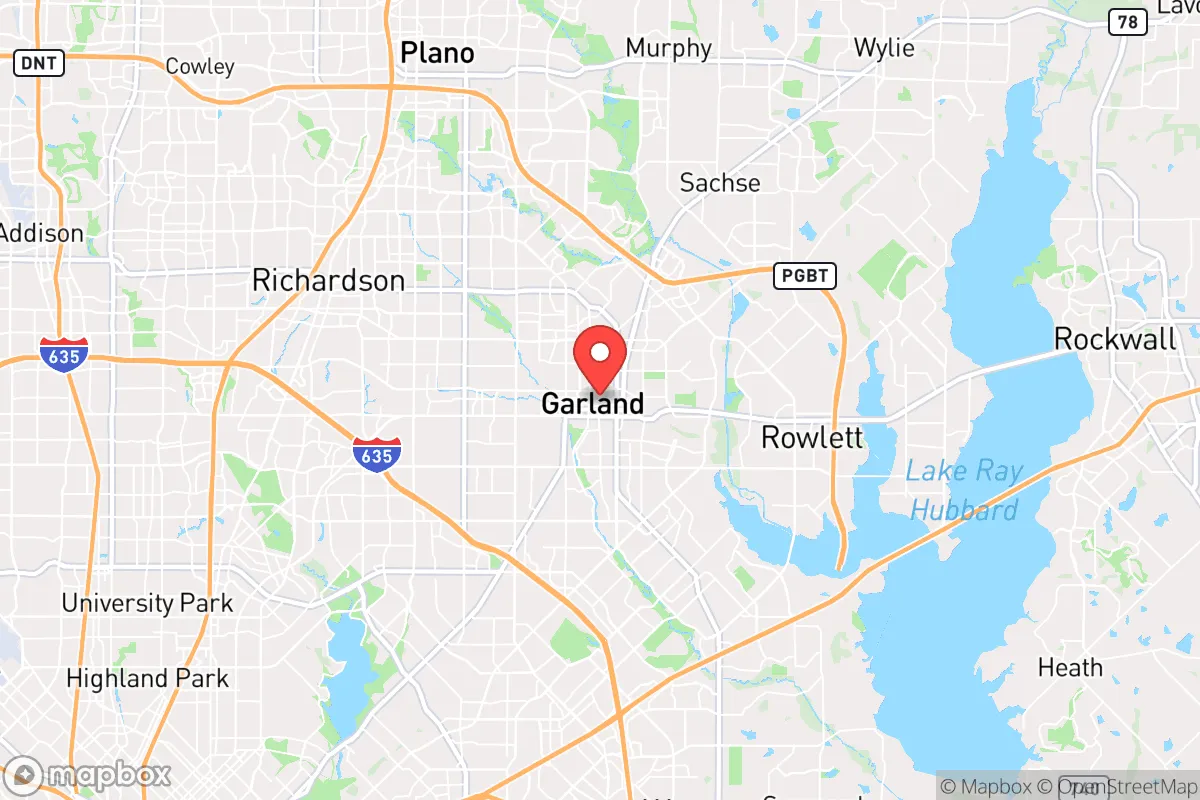
To really understand Garland's politics, you have to look at the neighbors. Head west into Dallas proper, and you're in a deep blue urban machine where taxes are high and government feels like it's in every aspect of your life. Go north to Richardson or Plano, and you'll find a mixed bag—some conservative pockets, but also a growing progressive influence, especially in school board and city council races. Garland, though, has historically been the buffer zone, the place where folks who wanted affordable homes and less nonsense settled down. Compare us to Rockwall or Forney to the east, and you'll see the difference: those areas are still reliably red, with lower taxes and a more hands-off approach from local government. Garland is caught in the middle, trying to hold onto its conservative roots while the county and state politics pull in different directions.
What this means for residents
For the average family here, the political climate directly affects your wallet and your freedoms. The biggest red flag I see is the slow creep of government overreach—things like zoning restrictions that make it harder to run a small business from your home, or school policies that seem more focused on social experiments than on teaching kids to read and do math. We've seen school board meetings get heated over curriculum and library books, and that's a sign that some folks want to bring the same kind of top-down control you see in Austin or Dallas. Property taxes are already a burden, and when local officials start spending on pet projects instead of keeping the streets paved and the cops funded, it's a problem. The good news is that the majority of residents still push back. Voter turnout in local elections is decent, and there's a strong network of conservative groups that keep an eye on city hall. But you have to stay engaged, because if you don't, the progressive agenda will fill the void.
One thing that sets Garland apart culturally is its strong sense of community and self-reliance. You don't see the same kind of "we need a new government program for everything" attitude here. People take care of their own yards, their own families, and their own neighborhoods. That's the Garland I grew up in, and it's still the backbone of the place. But I'd be lying if I said I wasn't worried about the next decade. If the trend continues, we could see more of the same policies that have driven up costs and reduced personal freedoms in other parts of the Metroplex. For now, Garland remains a place where conservative values still hold the line, but it's a fight we can't afford to lose. Keep your eyes on the local elections, and don't let anyone tell you that your voice doesn't matter—because it does, more than ever.

State Political ClimatePolitical Climate in Texas
State Political AnalysisPolitical Environment in the State
Texas remains a solidly Republican state, but the margin has tightened noticeably over the past decade. In 2024, Donald Trump carried the state by about 9 points, down from 15 points in 2012, as explosive growth in the urban core metros of Austin, Dallas-Fort Worth, and Houston has injected a steady stream of new voters from blue states. The dominant coalition is still conservative — anchored by rural and exurban voters, the oil and gas industry, and a strong evangelical base — but the state’s political identity is increasingly contested, with Democrats now competitive in a handful of state House districts and the U.S. Senate race in 2024 being the closest in decades.
Urban vs. rural divide
The political map of Texas is a textbook case of the urban-rural split. The big metros — Dallas, Houston, San Antonio, and especially Austin — are now reliably Democratic. Travis County (Austin) gave Biden 71% in 2020, and Harris County (Houston) went 56% for Biden. Meanwhile, the vast rural expanse — places like Lubbock, Midland, and the Panhandle — votes 75-80% Republican. The real battleground is the suburban ring around these cities. Collin County (north of Dallas) was once a GOP stronghold but has shifted from +30 R in 2012 to +15 R in 2024. Fort Bend County (southwest of Houston) flipped to Biden in 2020 and stayed blue in 2024. The I-35 corridor from San Antonio to Dallas is the state’s political spine, where the fastest-growing suburbs — like Kyle, Buda, and Celina — are increasingly split, with younger families and remote workers bringing more moderate or left-leaning views. The rural counties, however, still outvote the cities in statewide primaries, which is why the GOP remains dominant at the state level.
Policy environment
Texas has no state income tax, which remains a massive draw for conservatives and businesses alike. The property tax burden is high — around 1.6% effective rate — but the state legislature has passed multiple rounds of compression and appraisal caps, most notably SB 2 (2023), which cut school property taxes by over $12 billion. The regulatory posture is famously business-friendly: no state-level OSHA, no certificate-of-need laws for healthcare, and a right-to-work law that keeps unions weak. On education, the state passed HB 3 (2019) to boost teacher pay and school funding, but the 2023 legislative session saw a bitter fight over school vouchers — SB 8 — which failed in the House due to rural Republican opposition. On healthcare, Texas has not expanded Medicaid, and the state’s uninsured rate remains the highest in the nation at 16.6%. Election laws tightened after 2020 with SB 1 (2021), which banned 24-hour and drive-thru voting, added ID requirements for mail ballots, and gave poll watchers more access. The state also passed a near-total abortion ban (SB 8 in 2021, triggered by Roe’s reversal) and a permitless carry law (HB 1927 in 2021).
Trajectory & freedom
On balance, Texas has moved more free on gun rights, parental rights, and tax policy, but less free on medical autonomy, speech, and local control. The permitless carry law (HB 1927) means any adult who can legally own a gun can carry it without a license — a clear expansion of personal liberty. The Save Women’s Sports Act (SB 15, 2023) and the Parental Bill of Rights (HB 900, 2023) restricted transgender athletes and required parental consent for school medical services, which conservatives see as protecting family authority. On the other hand, SB 8 created a private enforcement mechanism for abortion bans that effectively deputizes citizens to sue anyone who “aids or abets” an abortion — a novel and controversial expansion of state power. The state also passed HB 20 (2023), which requires age verification for porn sites and allows civil suits against platforms that expose minors to harmful content — a free speech flashpoint. The Texas Heartbeat Act (2021) banned abortion after six weeks, and the state’s near-total ban since 2022 has made it one of the most restrictive in the country. Property rights saw a win with SB 1050 (2023), which limited the ability of homeowners associations to ban solar panels, but eminent domain battles over the Texas Bullet Train project remain contentious.
Civil unrest & political movements
Texas has seen significant protest activity, particularly in Austin, where the 2020 Black Lives Matter protests were among the largest and most sustained in the country, leading to the Austin Police Department budget cut (later partially restored). The state legislature responded with HB 1 (2021), which made it a felony to bail out more than three people in 30 days — aimed at “bail fund” activists. Immigration politics are a constant flashpoint. Governor Greg Abbott’s Operation Lone Star (2021) deployed state troopers and National Guard to the border, bused migrants to blue cities, and led to the arrest of thousands for trespassing. The state passed SB 4 (2023), which makes illegal entry a state crime — currently tied up in federal court. Secession rhetoric, while fringe, has a real presence: the Texas Nationalist Movement has pushed for a 2024 primary ballot referendum on secession (which failed to qualify). Election integrity remains a hot-button issue, with Attorney General Ken Paxton leading investigations into voter fraud (mostly low-level cases) and the state’s 2020 lawsuit to overturn results in other states. A new resident would notice the “Don’t Mess with Texas” bumper stickers and the ubiquity of political signage — especially in rural areas — but the actual day-to-day friction is low outside of Austin and El Paso.
Projection
Over the next 5-10 years, Texas will likely remain Republican at the state level, but the margin will continue to shrink. The 2024 election results showed the GOP losing ground in the suburbs of Dallas and Houston, while gaining in the Rio Grande Valley — a net wash. The demographic shift is the key: the state adds about 1,000 new residents a day, many from California and New York, and they tend to be more moderate or left-leaning. However, the 2023 redistricting gave Republicans a strong structural advantage in the state House and congressional delegation, and the voter ID laws and SB 1 have made it harder for Democrats to turn out their base. The school voucher fight will likely be resolved in the next session, with Abbott pushing hard for a universal program. The border crisis will remain a top issue, and the state will continue to test the limits of its authority against the federal government. For a conservative moving in now, expect a state that is still red but increasingly purple in the cities — and a political environment where your vote matters more than it did a decade ago.
Bottom line: If you’re moving to Texas for conservative governance, you’ll find it in the statehouse and the rural counties, but you’ll also find a growing progressive presence in the urban cores and suburbs. The state’s low taxes, gun-friendly laws, and parental rights protections are real and durable, but the culture war battles over education, immigration, and medical freedom will only intensify. Pick your county carefully — Collin County is still safe for conservatives, Travis County is not, and the exurbs of San Antonio are the new frontier. Texas is still freer than most states, but it’s no longer a lock — and that’s exactly why it’s worth paying attention to.
* Values derived from national, state, county, city and local statistics and may differ in a specific area. Last updated: 2026-05-03T20:32:46.000Z
Narrative content on this page is AI-generated and may contain mistakes. Verify any details that matter before acting on them.
ReloMaps may earn a commission from affiliate links at no extra cost to you.

