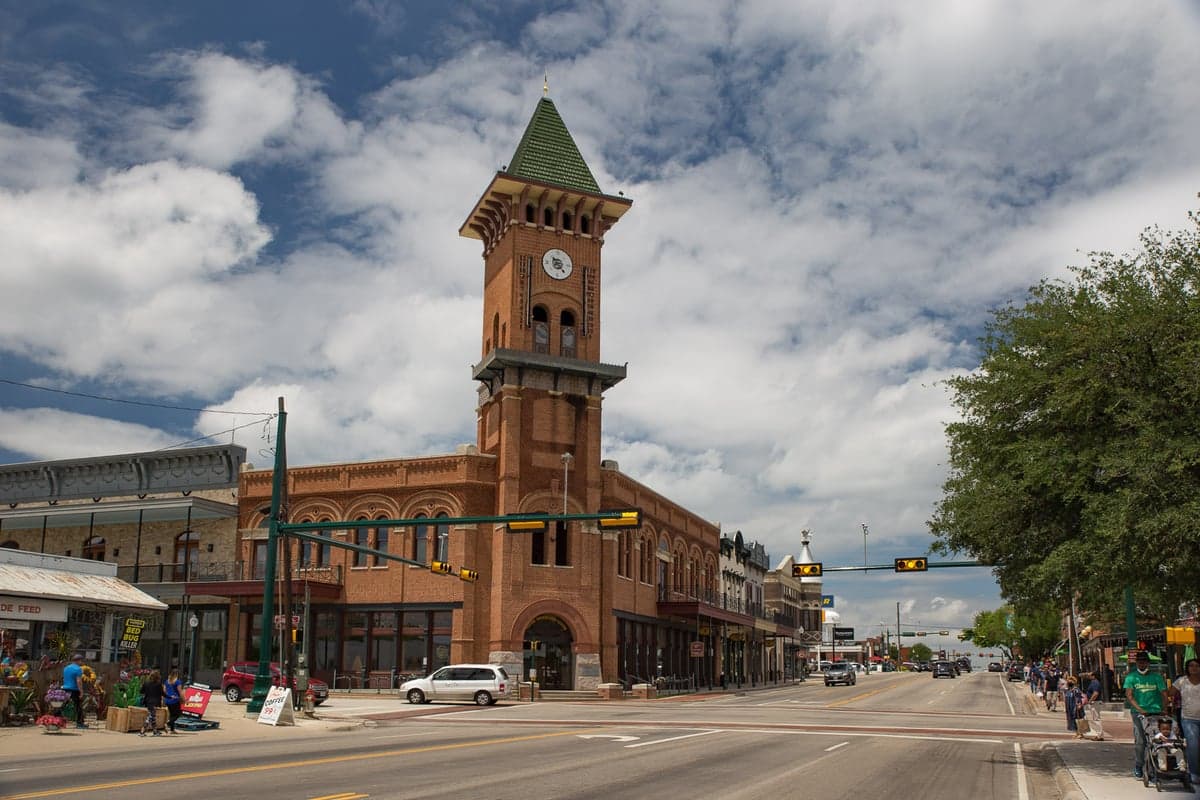
Photo: Wikipedia
Personal Sovereignty in Grapevine, TX
Strong independent fundamentals that actively favor personal liberty and low regulation.
What does Personal Sovereignty tell us?
Personal Sovereignty measures your capacity for self-reliance and independence with minimal government friction. Higher scores mean fewer barriers between you and the way you want to live... but it assumes you have the space you need and good neighbors.
What does this tell us?
Personal Sovereignty measures your capacity for self-reliance and independence with minimal government friction. Higher scores mean fewer barriers between you and the way you want to live... but it assumes you have the space you need and good neighbors.
State Policy
Energy independence: Net exporter (220% of energy produced in-state)
Personal Liberty
Homesteading

Personal Liberty Analysis
Grapevine, Texas offers a notably high degree of personal sovereignty compared to most of the United States, largely due to Texas’s constitutional framework and the city’s own restrained municipal governance. For a survivalist or prepper mindset, the key takeaway is that Grapevine sits within a state that explicitly limits government overreach—no state income tax, strong preemption laws on firearms and local regulations, and a legal culture that generally favors individual liberty over collective mandates. While Grapevine is not a rural homesteading haven, its position in the Dallas-Fort Worth metroplex provides a strategic balance: access to economic resources and community infrastructure without the heavy-handed regulatory environment found in cities like Austin or Portland. The city’s zoning and permitting processes are business-friendly and relatively transparent, meaning fewer bureaucratic hurdles for those seeking to modify property or start a small-scale operation. However, residents should be aware that Grapevine is a suburban city with homeowners’ associations (HOAs) in many neighborhoods, which can impose covenants that limit certain expressions of self-reliance, such as visible gardening or vehicle storage. Overall, the sovereignty environment here is strong at the state level but requires careful navigation of local HOA rules and city ordinances to fully realize personal autonomy.
Tax burden and regulatory posture for individuals and families
Texas’s lack of a state income tax is the single most impactful factor for personal sovereignty in Grapevine, as it directly reduces the government’s claim on your earnings and savings. The state funds itself through a high property tax system—average effective property tax rates in Grapevine hover around 2.1% to 2.3% of assessed home value, which is above the national average but typical for Texas. For a $400,000 home, that translates to roughly $8,400 to $9,200 annually, a significant but predictable cost. The city itself maintains a relatively low municipal tax rate (around 0.44 per $100 valuation), with most of the burden going to the Grapevine-Colleyville Independent School District. Sales tax in Grapevine is 8.25%, which includes state, county, and city portions, but essential items like groceries and prescription drugs are exempt. From a regulatory posture, Grapevine is generally permissive: there are no city-level rent control laws, no local minimum wage ordinances above the state’s $7.25, and no burdensome business licensing requirements beyond standard permits. The city’s zoning code is straightforward, with residential, commercial, and industrial districts clearly defined, and variances are obtainable with reasonable effort. For those concerned about government overreach, the absence of a state income tax and the city’s limited regulatory footprint mean fewer avenues for the state to intrude into daily financial decisions. However, property taxes remain a recurring obligation that can feel like a form of forced savings for local services, so preppers should factor this into long-term cost-of-living projections.
Self-defense rights and gun law specifics in Grapevine
Texas is a constitutional carry state, meaning that as of September 2021, any law-abiding adult 21 or older can carry a handgun in public without a permit. Grapevine fully respects this state preemption, and the city has no local ordinances that restrict the possession, carrying, or storage of firearms beyond state law. This is a critical advantage for those prioritizing self-defense: you can legally carry openly or concealed in most public spaces, including parks, sidewalks, and commercial establishments unless they post 30.06 (concealed) or 30.07 (open carry) signage. Grapevine’s police department is generally supportive of lawful gun ownership, and there are no “red flag” laws or waiting periods at the state level. For home defense, Texas law provides a strong Castle Doctrine and Stand Your Ground statute, meaning you have no duty to retreat before using deadly force in your home, vehicle, or workplace if you reasonably believe it’s necessary to prevent imminent harm. The city’s gun culture is robust, with multiple gun ranges and firearms retailers within a 15-minute drive, including the popular DFW Gun Range in nearby Dallas. One practical consideration: Grapevine’s proximity to DFW Airport means that carrying in certain transit areas (like the airport terminal) is restricted, but this is a federal limitation, not a local one. For preppers, the ability to legally stockpile ammunition and maintain a personal arsenal without local interference is a major plus, though HOAs may have rules about visible storage or shooting on residential property—so check your specific subdivision’s covenants.
Self-reliance and homesteading viability: lot sizes, zoning, and off-grid feasibility
Grapevine is a fully developed suburban city, so traditional homesteading with large acreage is not realistic within city limits. Most residential lots range from 0.15 to 0.5 acres, with newer subdivisions offering even smaller plots. The city’s zoning code permits backyard chickens (hens only, no roosters) on lots of at least 7,500 square feet, and beekeeping is allowed with a permit. Vegetable gardens are generally unrestricted, but HOAs often impose aesthetic standards that limit visible raised beds or compost piles. Off-grid living—such as solar panels with battery storage, rainwater collection, or well water—is technically feasible but subject to city codes. Grapevine follows the International Residential Code, which requires grid-tied electrical connections for new construction, though solar panels are allowed and net metering is available through the local utility, TXU Energy. Rainwater harvesting is legal and encouraged by the state, but the city requires that any system be installed by a licensed plumber and meet backflow prevention standards. Composting toilets are not permitted as primary sanitation; all homes must connect to municipal sewer. For those seeking true self-reliance, the surrounding unincorporated areas of Tarrant County (e.g., near Lake Grapevine or toward Roanoke) offer larger lots—1 to 5 acres—with fewer restrictions. In those areas, you can install a private well, septic system, and off-grid solar without city interference. Grapevine itself is best viewed as a base for economic activity and community access, with homesteading activities limited to small-scale gardening and hobby livestock. Preppers should consider purchasing a secondary property in a rural county (like Wise or Parker) for serious food production and storage, while using Grapevine as a primary residence for work and logistics.
Personal liberties: parental rights, medical autonomy, speech, and property
Texas has some of the strongest protections for parental rights in the nation, and Grapevine residents benefit directly from state law. The Texas Parental Bill of Rights (HB 4549, 2023) affirms that parents have the fundamental right to direct their children’s education, healthcare, and moral upbringing. In Grapevine-Colleyville ISD, this translates to transparent curriculum policies, opt-out options for sex education, and no mask or vaccine mandates for students (state law prohibits such mandates). Medical autonomy is similarly robust: Texas does not require COVID-19 vaccinations for employment or public access, and the state has banned vaccine passports. For adults, there are no state-level restrictions on purchasing supplements, herbal remedies, or over-the-counter medications, and telemedicine is widely available. Speech protections are strong under the Texas Religious Freedom Restoration Act and the state’s anti-SLAPP laws, which shield individuals from frivolous lawsuits aimed at silencing criticism. Property rights are protected by Texas’s strong eminent domain laws, which require just compensation and public necessity, and by the state’s prohibition on rent control. Grapevine does not have any local ordinances that restrict political signage or yard displays beyond standard HOA rules, so homeowners in non-HOA areas can fly flags, post signs, or express political views freely. For those concerned about government overreach into medical decisions or family matters, Grapevine’s legal environment is among the most permissive in the country, though residents should remain vigilant about federal overrides (e.g., FDA regulations on supplements or CDC guidance on schools).
In the broader context of personal sovereignty, Grapevine ranks highly among Texas suburbs and exceptionally well compared to blue-state metros. The combination of no state income tax, constitutional carry, strong parental rights, and limited local regulation creates a legal framework that respects individual autonomy. The main trade-offs are the suburban constraints—HOAs, smaller lots, and municipal codes that limit full off-grid living—but these are manageable with strategic property choices. For a survivalist or prepper seeking a base with economic opportunity, community resilience, and legal freedom, Grapevine offers a solid foundation. The city’s proximity to DFW Airport and major highways also provides an evacuation corridor if needed. While no location is perfect, Grapevine’s sovereignty profile is significantly better than 90% of U.S. cities, and with careful planning, residents can achieve a high degree of self-reliance within the existing legal and regulatory structure.

* Values derived from national, state, county, city and local statistics and may differ in a specific area. Last updated: 2026-04-19T07:18:58.000Z
Narrative content on this page is AI-generated and may contain mistakes. Verify any details that matter before acting on them.
ReloMaps may earn a commission from affiliate links at no extra cost to you.

