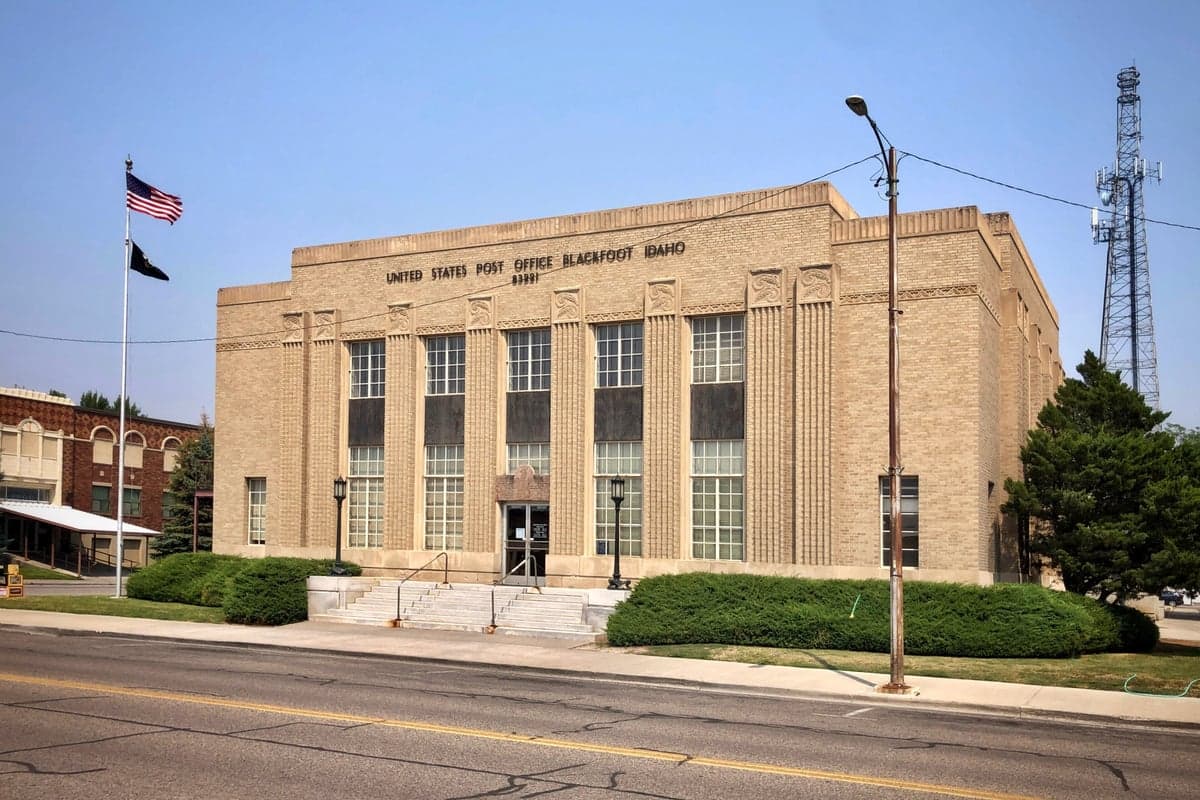
Photo: Wikipedia
Demographics of Bingham County
Affluence Level in Bingham County
A middle-class area roughly in line with national averages across income, home values, education, and employment.
People of Bingham County
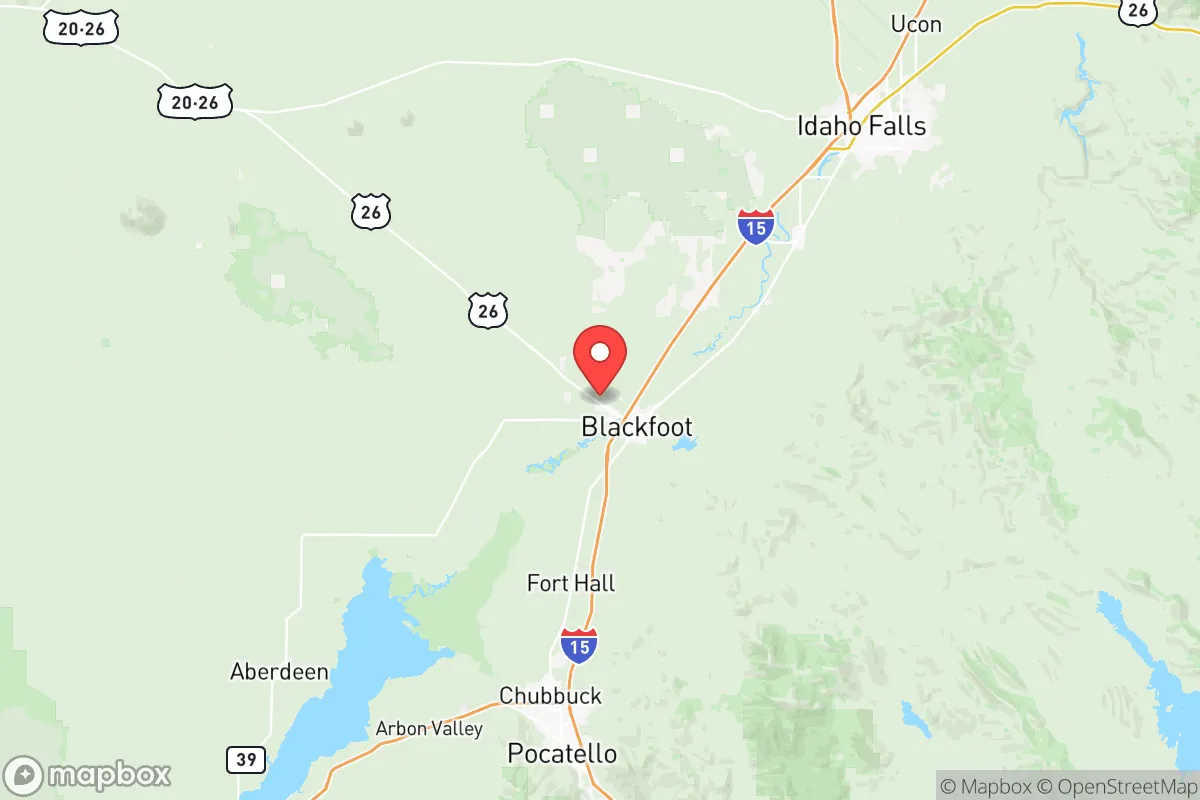
Bingham County, Idaho, is a predominantly rural, family-oriented community of 48,993 residents, characterized by a strong agricultural and Mormon pioneer heritage. The population is overwhelmingly white (74.1%) with a significant and growing Hispanic minority (17.6%), a very small foreign-born population (2.7%), and a below-average college attainment rate (20.8%). This is a place where LDS Church culture, farming rhythms, and a conservative political outlook shape daily life, centered on the county seat of Blackfoot and the smaller communities of Shelley, Firth, and Aberdeen.
Settlement & growth (pre-1960)
The area now known as Bingham County was originally inhabited by the Shoshone and Bannock peoples, who followed the seasonal migrations of bison and fish along the Snake River. The first American presence came with fur trappers in the 1820s, followed by the Oregon Trail emigrants who passed through the region in the 1840s and 1850s. Permanent settlement did not begin until the 1860s, when Mormon pioneers from Utah, sent by Brigham Young, established farming communities along the Snake River and its tributaries. These settlers were almost exclusively of English, Scottish, and Scandinavian descent, and they brought with them a tightly organized irrigation system, a cooperative economic model, and a theocratic social structure that remains influential today.
The first major settlement was Blackfoot, founded in 1878 as a railroad town on the Utah and Northern Railway. It quickly became the county seat and the commercial hub for the surrounding agricultural region. The arrival of the railroad in the 1880s spurred a second wave of settlement, bringing non-Mormon merchants, railroad workers, and homesteaders of German and Irish descent to towns like Shelley (founded 1893) and Firth (founded 1900). These communities were built around sugar beet processing, potato farming, and small-scale livestock operations. The completion of the Minidoka Dam and irrigation project in 1909 opened up the dry sagebrush plains south of the Snake River to intensive farming, leading to the founding of Aberdeen (1907) and Springfield (1910).
The Dust Bowl and Great Depression of the 1930s brought a small influx of displaced farmers from the Great Plains, but Bingham County's population growth remained modest through the mid-20th century. The county's economy was dominated by agriculture—potatoes, sugar beets, wheat, and dairy—supplemented by the Idaho National Laboratory (INL), established in 1949 just west of the county line. The INL brought a small but steady stream of engineers, scientists, and technicians to the area, many of whom settled in Blackfoot or commuted from Idaho Falls in neighboring Bonneville County. By 1960, the county's population was roughly 23,000, overwhelmingly white, native-born, and LDS.
Modern era (post-1965)
The post-1965 era brought two significant demographic shifts to Bingham County: the growth of the Hispanic population and the slow diversification of the white population through domestic in-migration. The 1965 Hart-Cellar Act had a limited direct effect on Bingham County, as the foreign-born population remains tiny (2.7%). However, the act's expansion of family-based immigration from Mexico and Central America indirectly fueled the growth of a Hispanic labor force that began arriving in the 1970s and 1980s to work in the region's potato and sugar beet fields. These workers initially came as seasonal migrants, but many settled permanently, forming small but stable communities in Blackfoot, Shelley, and especially Aberdeen, where the Hispanic share of the population is now estimated at over 40%. The Hispanic population in Bingham County is overwhelmingly Mexican-American, with smaller numbers from Guatemala and El Salvador. They are concentrated in agricultural labor, food processing, and construction, and their presence has become a permanent feature of the county's economy and social fabric.
Domestic migration since 1965 has been more modest than in Idaho's booming urban corridors like Boise or Coeur d'Alene. The county has attracted a steady trickle of retirees, outdoor recreation enthusiasts, and families seeking a lower cost of living and a conservative, rural lifestyle. Many of these new residents come from California, Oregon, and Washington, drawn by the area's relatively affordable housing, low crime rates, and strong sense of community. They tend to settle in the county's larger towns—Blackfoot and Shelley—or on small acreages in the unincorporated areas between them. The East/Southeast Asian population (0.4%) and Black population (0.3%) remain negligible, and there is no measurable Indian subcontinent population. The county's white population has declined slightly as a share of the total (from over 90% in 1980 to 74.1% today), but this is almost entirely due to Hispanic growth, not out-migration of whites.
The suburbanization that reshaped much of the American West has been limited in Bingham County. The towns of Blackfoot and Shelley have grown outward with new subdivisions, but the county lacks the large-scale master-planned communities and exurban sprawl seen in Ada County or Kootenai County. The INL remains a major employer, but its workforce is increasingly concentrated in Idaho Falls, leaving Bingham County as a bedroom community for some workers while retaining its agricultural base.
The future
Bingham County's population is projected to grow slowly but steadily over the next 10-20 years, driven by natural increase (the county has a relatively high birth rate, particularly among LDS families) and continued domestic in-migration from the West Coast. The Hispanic population is likely to continue growing as a share of the total, both through higher birth rates and ongoing immigration, though the pace may slow if national immigration policy tightens. The county is not experiencing the rapid diversification seen in urban Idaho; instead, it is becoming a place with a clear white majority and a substantial, culturally distinct Hispanic minority. These two groups are not strongly integrated—Hispanic residents are concentrated in agricultural labor and lower-income brackets, while white residents dominate professional, managerial, and political life—but there is little overt tension. The LDS Church, which has a growing Spanish-language branch in Blackfoot, serves as a bridge institution for some families.
The county is unlikely to tribalize into distinct enclaves in the way that some larger metropolitan areas have. The small-town scale and shared agricultural identity create a baseline of interaction, even if social circles remain largely separate. The white population is culturally homogeneous—overwhelmingly LDS, conservative, and native-born—and new domestic migrants tend to be absorbed into this existing culture rather than changing it. The Hispanic population is slowly assimilating, with younger generations becoming fluent in English and adopting many local customs, but retaining a distinct identity through language, food, and family networks.
For a conservative-leaning individual or family considering a move to Bingham County, the bottom line is this: you will find a stable, safe, and culturally cohesive community where traditional values, church life, and outdoor recreation are central. The county is not becoming more liberal or diverse in a way that would challenge its conservative character. The Hispanic population is growing but remains economically and socially separate, and the county's political and cultural institutions are firmly in the hands of the white LDS majority. If you are looking for a place where your children can grow up in a small-town environment with strong schools (by rural standards), low crime, and a shared sense of community, Bingham County offers that—provided you are comfortable with a population that is culturally and religiously uniform, and with a pace of life that is slower and more insular than the booming suburbs of the Wasatch Front or the Treasure Valley.

* Values derived from national, state, county, city and local statistics and may differ in a specific area. Last updated: 2026-05-28T09:33:10.000Z
Narrative content on this page is AI-generated and may contain mistakes. Verify any details that matter before acting on them.
ReloMaps may earn a commission from affiliate links at no extra cost to you.

