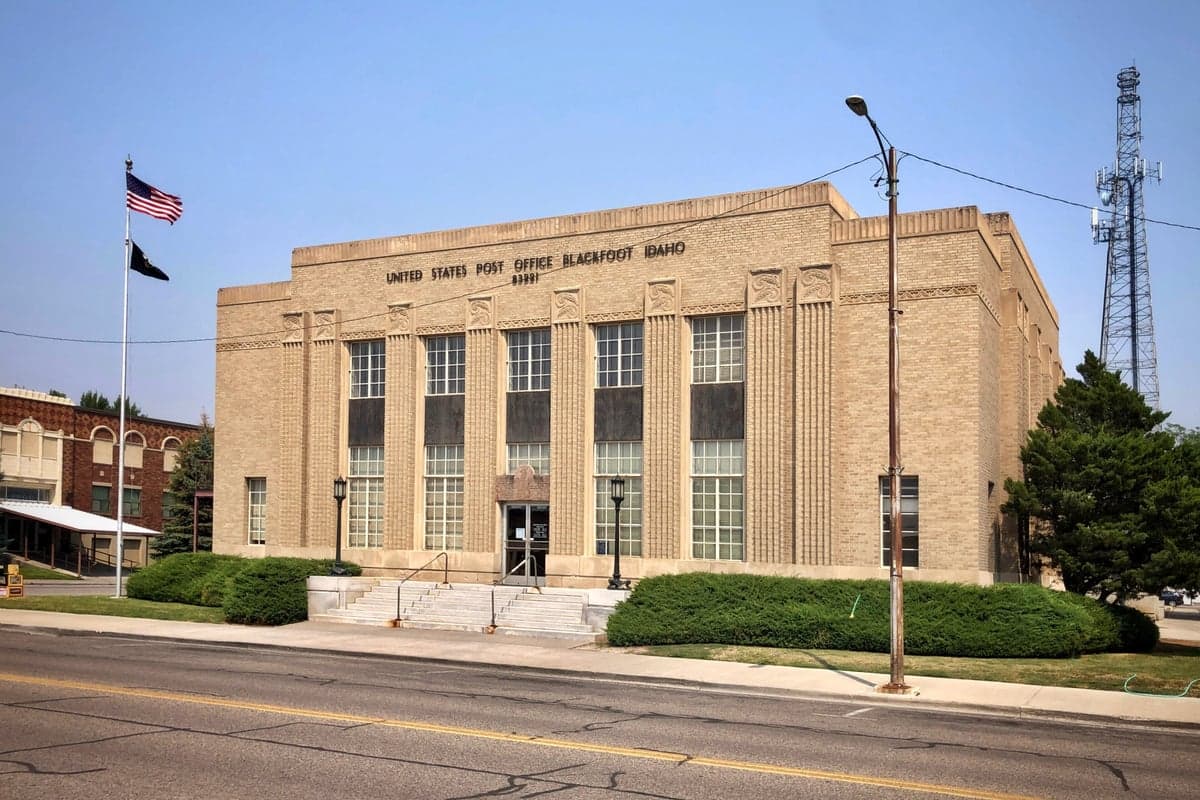
Photo: Wikipedia
Political ClimatePolitical Climate in Bingham County
Showing district-level results — no local-only data available.
Local Political AnalysisPolitical Analysis of Bingham County
Bingham County, Idaho, has long been a solidly conservative stronghold, but like many rural areas, it's feeling the pressure of shifting political winds. With a Cook PVI of R+13, it's reliably red, but that's a noticeably lighter shade than the state's overall R+18 rating, which tells you there's more ideological diversity here than you might expect. The real story isn't just about party registration; it's about the quiet, creeping shift in local culture and governance that has a lot of folks who've lived here for decades feeling a bit uneasy about where things are headed.
How it compares
The difference between Bingham County's R+13 and Idaho's R+18 is significant. It means our county is a bellwether for the state's conservative base, but with a few more cracks in the foundation. You see it most clearly in the towns. Blackfoot, the county seat, is the heart of the traditional, no-nonsense conservative vote—think strong Second Amendment support, low taxes, and a general distrust of federal overreach. But drive a few miles west to Shelley, and you'll find a more mixed bag. Shelley has a growing population of younger families and some folks commuting to Idaho Falls for tech-adjacent jobs, and you can see that reflected in local school board races and city council elections, where more progressive ideas about spending and curriculum sometimes gain a foothold. The swing precincts aren't in the rural farmlands; they're in these bedroom communities where the old values of self-reliance are bumping up against new, more collectivist thinking. Compared to the state as a whole, Bingham County is a bit more of a battleground for the soul of Idaho conservatism, not between Republicans and Democrats, but between the old guard and the new.
What this means for residents
For a long-time resident, the most concerning trend is the slow erosion of local control. We've always prided ourselves on handling our own business—from water rights to school policies—without the state or federal government butting in. But lately, you see more pressure from Boise and even national groups to adopt uniform policies that don't fit our way of life. The push for "equity" initiatives in schools, for example, is a direct threat to the merit-based, individual-focused culture that built this community. It's not just about politics; it's about the government telling us how to raise our kids and run our farms. The real worry is that these small, seemingly minor policy shifts—a new zoning rule here, a diversity training mandate there—are a form of government overreach that chips away at our personal freedoms. It's a slow, steady march away from the principles of limited government that made this a great place to live.
Cultural and policy distinctions
One thing that still sets Bingham County apart is its fierce independence on land use and property rights. While the state has moved toward more centralized planning in some areas, our county commissioners have held the line, fighting against federal land grabs and state-level mandates that would restrict how we can use our own property. You see this in the strong opposition to any form of "30x30" conservation plans or federal wilderness designations that would lock up our land. The culture here is still deeply rooted in the idea that a man's home is his castle, and his land is his to manage. That said, the influx of new residents from California and Washington is slowly changing the conversation. They bring a different set of expectations about government services and community planning, and it's creating a quiet tension. The long-term future of Bingham County depends on whether we can hold onto that core principle of personal liberty, or if we'll let the creeping tide of progressive governance wash away what makes this place special. It's a fight worth having, and one that every resident should be paying close attention to.

State Political ClimatePolitical Climate in Idaho
State Political AnalysisPolitical Environment in the State
Idaho is one of the most reliably Republican states in the nation, with a Cook PVI of R+18, meaning it votes about 18 points more Republican than the national average in presidential elections. The dominant coalition is a blend of rural conservatives, Mormon cultural conservatives in the southeast, and a growing wave of out-of-state transplants fleeing blue states, which has actually deepened the red hue over the last 10-20 years. While the state was already solidly red in the 2000s, the last decade has seen a sharp rightward shift on cultural and liberty issues, even as the Boise metro area has grown more diverse and slightly more purple.
Urban vs. rural divide
The political map of Idaho is starkly divided between its few urban centers and the vast rural expanse. The Treasure Valley, anchored by Boise, Meridian, and Nampa, is the state’s population engine and the only region where Democrats can be competitive. Ada County (Boise) has trended leftward in recent cycles, with Biden winning 51% of the vote there in 2020, a flip from Trump’s narrow win in 2016. However, the surrounding counties—Canyon, Gem, Payette—remain deeply red, and the state legislature has aggressively gerrymandered Ada County to dilute its influence. Outside the Treasure Valley, the political landscape is overwhelmingly conservative. Idaho Falls and Rexburg in the east are Mormon strongholds that vote 80%+ Republican, while the northern panhandle, including Coeur d’Alene and Sandpoint, has become a magnet for conservative refugees from California and Washington, turning what was once a swing region into a reliably red one. The rural-urban split is less about a "blue island" and more about a "purple puddle" in Boise surrounded by a sea of deep red.
Policy environment
Idaho’s policy environment is among the most conservative in the nation, with a strong emphasis on limited government and low taxation. The state has a flat income tax rate of 5.8% (down from 6.5% in 2023), no corporate income tax on pass-through entities, and a sales tax of 6% that exempts groceries. Property taxes are relatively low, though they vary by county. The regulatory posture is aggressively pro-business, with no state-level minimum wage above the federal $7.25 and a right-to-work law that weakens union power. On education, Idaho has a robust school choice movement, with a new Education Savings Account (ESA) program passed in 2024 that allows parents to use state funds for private school or homeschooling expenses. Healthcare policy is limited: the state did not expand Medicaid until 2020 (via ballot initiative, not legislative action), and there are strict abortion laws in place, with a near-total ban after six weeks (the "Fetal Heartbeat Bill," HB 370, passed in 2023). Election laws are secure: voter ID is required, and the state has no same-day registration, though mail-in voting is available with an excuse. The legislature has also passed laws restricting ballot drop boxes and limiting third-party ballot collection.
Trajectory & freedom
Idaho is becoming more free in many respects, particularly on gun rights, parental rights, and property rights. The state has constitutional carry (permitless concealed carry) since 2016, and in 2023, the legislature passed a "Second Amendment Sanctuary" law (HB 124) that prohibits state and local law enforcement from enforcing any future federal gun bans. On parental rights, Idaho passed the "Parental Rights in Education" law (HB 93) in 2023, which requires schools to notify parents of any curriculum involving sexuality or gender identity and prohibits instruction on these topics in K-3. Property rights have been strengthened by the "Private Property Protection Act" (HB 220, 2024), which limits the use of eminent domain for economic development. However, there are concerning trends on medical autonomy: the state has banned nearly all abortions and restricted access to gender-affirming care for minors (HB 71, 2023), which some see as government overreach into private medical decisions. On taxation, the trend is positive: the income tax rate has been cut from 6.5% to 5.8% over the last two years, with a path to a flat 5.5% by 2026. Overall, the state is moving toward more personal liberty on guns and education, but with a heavy hand on medical and social issues.
Civil unrest & political movements
Idaho has a history of fringe political movements, but in recent years, the mainstream conservative movement has absorbed much of that energy. The "People’s Rights" network, founded by Ammon Bundy (of the 2016 Malheur occupation), has a strong presence in the Treasure Valley and has organized protests against mask mandates, vaccine requirements, and library books. In 2022, Bundy’s group staged a weeks-long protest at the Idaho State Capitol against a "critical race theory" bill, which ultimately failed. The state has also seen significant immigration politics: in 2024, the legislature passed a bill (HB 420) allowing state law enforcement to enforce federal immigration laws, a response to the Biden administration’s border policies. There have been no major sanctuary city movements; instead, Boise and Moscow have seen small, left-leaning protests for racial justice and LGBTQ rights, but they are dwarfed by the conservative counter-mobilization. Election integrity is a hot topic: the state has a Republican Secretary of State who has implemented voter roll purges and signature verification, but there have been no major fraud controversies. A new resident would notice a palpable sense of political activism, especially around school board meetings and county commission hearings, where parental rights and library content are frequent flashpoints.
Projection
Over the next 5-10 years, Idaho will likely become more conservative, not less, despite in-migration from blue states. The newcomers are overwhelmingly conservative refugees from California, Oregon, and Washington, who are fleeing high taxes and progressive policies. This is evident in places like Kuna and Star (suburbs of Boise), which have seen explosive growth and vote 70%+ Republican. The Democratic Party in Idaho is weak and fractured, with no statewide elected officials and a shrinking base outside of Boise and a few college towns like Moscow (home to the University of Idaho). The state’s population is projected to grow by 20-30% by 2035, with most of that growth in the conservative suburbs and exurbs. However, there is a risk: if Boise continues to grow and attract tech workers from California, it could become a blue island that influences state politics. But the legislature has already taken steps to limit Boise’s power, such as preempting local minimum wage and housing ordinances. The realistic projection is that Idaho will remain a deep red state, with the legislature continuing to push the envelope on school choice, gun rights, and tax cuts, while maintaining a hard line on immigration and social issues.
Bottom line for a new resident: If you’re moving to Idaho for freedom from government overreach, you’ll find a state that largely delivers on that promise, especially on guns, taxes, and education. But be prepared for a political culture that is intensely engaged and sometimes combative, particularly around school boards and local government. The state is not a libertarian paradise—it has a strong moral conservative streak that regulates medical and social choices—but for a conservative-leaning individual or family, it offers a policy environment that is among the most aligned with traditional values in the country. Just know that the political battles are far from over, and your vote and voice will matter more here than in a deep blue state where your side has already lost.
* Values derived from national, state, county, city and local statistics and may differ in a specific area. Last updated: 2026-05-28T09:33:10.000Z
Narrative content on this page is AI-generated and may contain mistakes. Verify any details that matter before acting on them.
ReloMaps may earn a commission from affiliate links at no extra cost to you.

