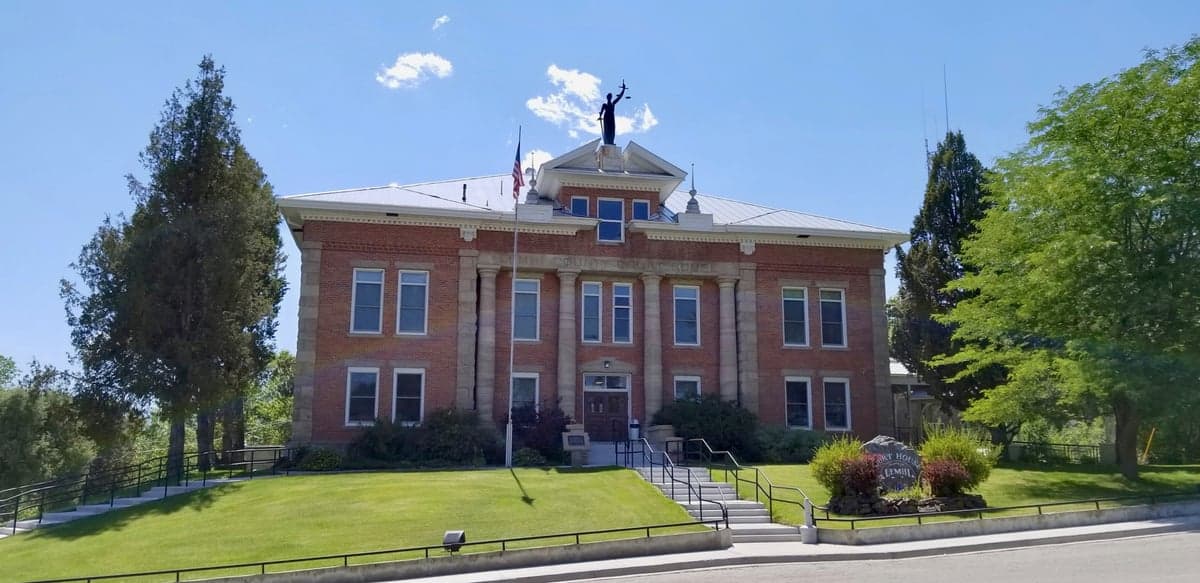
Photo: Wikipedia
Political ClimatePolitical Climate in Lemhi County
Showing district-level results — no local-only data available.
Local Political AnalysisPolitical Analysis of Lemhi County
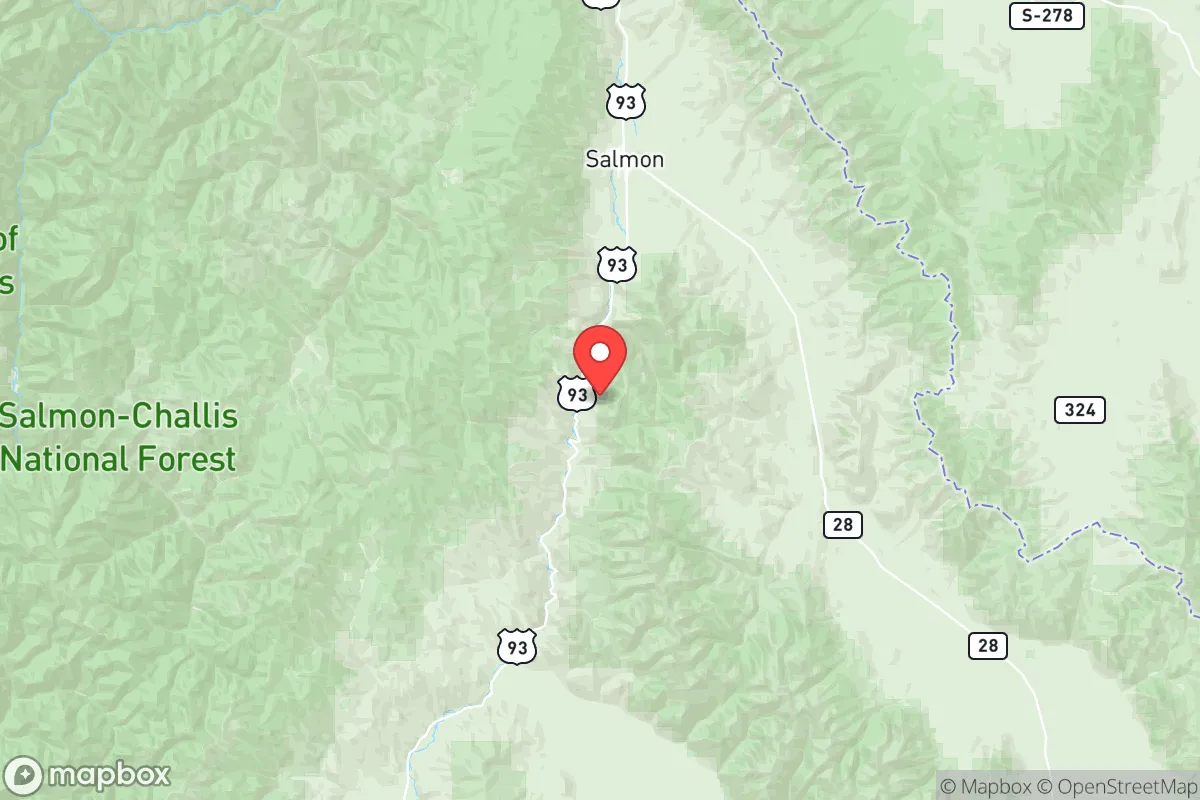
Lemhi County, Idaho, is a deeply conservative area with a Cook PVI of R+13, though it is slightly less Republican than Idaho as a whole (R+18). The county has trended reliably red for decades, with no Democratic presidential candidate carrying it since 1964, but local voting patterns reveal subtle variations—Salmon, the county seat and largest town, tends to be the most moderate precinct, while smaller communities like Tendoy and Shoup lean heavily Republican. The political trajectory here is steady: expect continued GOP dominance, but with a growing libertarian streak that sometimes bucks party orthodoxy on land use and federal oversight.
How it compares
Lemhi County’s R+13 rating places it to the left of Idaho’s statewide R+18, a gap that reflects the county’s unique economic and demographic mix. While Idaho’s urban centers like Boise and Coeur d’Alene have seen an influx of out-of-state transplants shifting some precincts purple, Lemhi remains insulated from that trend—its population of roughly 8,000 is stable, with few newcomers. The county’s Republicanism is more rooted in ranching, mining, and outdoor recreation than the religious conservatism found in eastern Idaho’s Magic Valley. For example, Salmon’s precincts occasionally split tickets on local bond measures, while Leadore and Carmen vote straight-ticket red by margins exceeding 80%. This makes Lemhi a classic “Western conservative” area: pro-gun, anti-regulation, but skeptical of corporate land grabs and federal land management, a stance that aligns more with Idaho’s libertarian fringe than its mainstream GOP.
What this means for residents
For conservative residents, Lemhi County offers a political environment where their values are the default—local officials are almost uniformly Republican, and policy debates center on how to limit government, not whether to. The county commission, sheriff’s office, and school board are reliably conservative, and issues like Second Amendment rights and property taxes dominate local elections. For liberal residents, the reality is more isolating: there is no organized Democratic presence, and progressive viewpoints are rarely voiced in public forums. However, the county’s small size means personal relationships often override political differences—neighbors help each other regardless of party, and the “live and let live” ethos tempers ideological conflict. The practical impact is that policy decisions, from zoning to school funding, are made with minimal dissent, but also with limited debate on alternative approaches.
Culturally, Lemhi County stands apart from Idaho’s more populous regions by its fierce independence and distrust of outside influence. The county’s economy relies heavily on federal lands—over 70% of its area is managed by the U.S. Forest Service and Bureau of Land Management—which creates a paradoxical relationship: residents resent federal control but depend on it for grazing permits, timber sales, and tourism. This tension fuels a distinct political identity that is more pragmatic than ideological, often leading to bipartisan cooperation on local issues like wildfire management and road maintenance. In contrast to Idaho’s fast-growing cities, Lemhi’s politics are slow-moving and consensus-driven, reflecting a community that values stability over change. For anyone moving here, understanding this balance—between deep red politics and a practical, neighborly culture—is key to fitting in.

State Political ClimatePolitical Climate in Idaho
State Political AnalysisPolitical Environment in the State
Idaho is one of the most reliably Republican states in the country, with a Cook Partisan Voting Index of R+18, meaning it votes about 18 points more Republican than the national average. The state has shifted sharply rightward over the past two decades, driven by explosive growth in the conservative-leaning Boise metro area and an influx of out-of-state transplants, many of whom moved here specifically for the state’s political and cultural alignment. While Democrats once held competitive statewide races as recently as the early 2000s, the GOP now holds a supermajority in both legislative chambers, and no Democrat has won a statewide office since 2006.
Urban vs. rural divide
The political map of Idaho is a textbook case of urban-rural polarization, but with a twist: the state’s largest city, Boise, is itself center-right, not liberal. Ada County (Boise) votes Republican by about 10-15 points in most elections, making it the most conservative major metro in the Pacific Northwest. The real blue dots are tiny: Blaine County (Sun Valley/Ketchum) and Latah County (Moscow, home to the University of Idaho) are the only reliably Democratic counties, each voting about 15-20 points left of the national average. The rest of the state — from the Idaho Panhandle (Coeur d’Alene, Post Falls) down through the Magic Valley (Twin Falls, Jerome) and into the southeast (Idaho Falls, Rexburg) — is deeply red, often voting 30-40 points more Republican than the nation. The rural-urban divide here isn’t Boise vs. the rest; it’s the small liberal enclaves of Sun Valley and Moscow vs. everything else. That said, the Boise suburbs — Meridian, Eagle, and Nampa — are where the real political action is: they’re growing fast, reliably conservative, and increasingly influential in state primaries.
Policy environment
Idaho’s policy environment is defined by low taxes, limited regulation, and a strong emphasis on local control. There is no state income tax on corporate or personal income — a major draw for relocators — and the state sales tax is a flat 6%. Property taxes are relatively low, though they vary by county and are a common local complaint. The regulatory posture is business-friendly: Idaho is a right-to-work state, has no statewide zoning mandates, and permits open carry of firearms without a permit. Education policy is a flashpoint: the state funds schools primarily through local property taxes, leading to wide disparities between wealthy suburbs (like Boise’s West Ada School District) and rural areas. The state has a school voucher-like program (the Idaho Education Savings Account) that allows parents to use public funds for private or homeschool expenses, passed in 2023. Healthcare policy is limited: Idaho did not expand Medicaid until 2020 (via ballot initiative), and the state has some of the nation’s strictest abortion laws — a near-total ban with exceptions only for rape, incest, and life of the mother, enacted in 2023. Election laws are moderately restrictive: voter ID is required, same-day registration is not allowed, and mail-in voting is available only with an excuse. The state has no automatic voter registration.
Recent policy direction
The last three years have seen a cascade of legislation that pushes Idaho further into the national spotlight as a testbed for conservative governance. On gun and self-defense law, Idaho passed a constitutional carry law in 2016 and has since added preemption laws that block local governments from enacting their own firearm restrictions — meaning Boise cannot pass its own gun ordinances. On parental and education rights, the 2023 “Parents’ Bill of Rights” (HB 93) requires schools to notify parents of any curriculum changes and prohibits instruction on gender identity or sexual orientation in grades K-3. On speech and privacy, the state passed a law in 2024 banning public libraries from carrying materials deemed “harmful to minors,” with civil liability for librarians — a direct response to conservative concerns about LGBTQ+ content. On medical and bodily autonomy, the near-total abortion ban is the headline, but the state also passed a law in 2023 prohibiting gender-affirming care for minors, with criminal penalties for providers. On property rights, Idaho has strong eminent domain protections and has resisted statewide rent control, though housing affordability is a growing crisis in Boise and Coeur d’Alene. On taxation, the state cut the corporate income tax rate from 6.5% to 5.8% in 2023 and has discussed eliminating it entirely. On voting and ballot access, the 2024 legislative session saw a bill to ban ballot drop boxes, though it failed; the state has not moved toward ranked-choice voting or other election reforms.
Civil unrest & political movements
Idaho has a long history of anti-government and militia movements, dating back to the Ruby Ridge standoff in 1992 in Boundary County. Today, the state is a hub for the “constitutional sheriff” movement, with several sheriffs publicly refusing to enforce federal gun laws. The Ammon Bundy-linked People’s Rights network has a strong presence in the Treasure Valley, and the state saw a high-profile protest in 2022 when Bundy’s supporters occupied the Idaho Statehouse over COVID-19 mandates. On the left, the Idaho Democratic Party is small but active, with protests in Boise over abortion rights and LGBTQ+ legislation drawing thousands. Immigration politics are relatively quiet — Idaho has no sanctuary cities, and the state passed a law in 2023 requiring local law enforcement to cooperate with federal immigration authorities. Election integrity controversies have been minimal compared to states like Arizona or Georgia, though the 2022 primary saw a failed attempt to audit Ada County’s election results. The most visible flashpoint for a new resident would likely be the annual “Idaho Freedom Rally” at the Statehouse, which draws armed protesters and counter-protesters, and the ongoing debate over library book bans in suburban communities like Meridian and Eagle.
Projection
Over the next 5-10 years, Idaho’s political trajectory is likely to remain deeply conservative, but with increasing internal tension between traditional libertarian-leaning Republicans and a newer, more culturally conservative faction. The in-migration wave — roughly 50,000 new residents per year — is disproportionately conservative, drawn by low taxes and gun-friendly laws, but it’s also bringing more moderate suburbanites who may push back on the most extreme legislation, particularly around education and library bans. The Boise metro area will continue to grow and could become more politically competitive in local races, but statewide offices will remain safely Republican. The real wildcard is the Idaho Panhandle, where rapid growth in Coeur d’Alene and Post Falls is shifting the region from deep red to a more moderate conservative bent, potentially creating a new swing region in state politics. Expect continued fights over education funding, property taxes, and the scope of local control — the state’s political future is less about flipping blue and more about which flavor of Republicanism wins out.
For a new resident, the bottom line is straightforward: if you’re conservative, you’ll find a state that largely aligns with your values on taxes, guns, and education, with a government that moves quickly on those priorities. If you’re liberal, you’ll be in a clear minority, but you’ll find like-minded communities in Boise’s North End, Moscow, and Sun Valley — and you’ll have a front-row seat to a state that is actively shaping the national conservative agenda. Either way, expect the political climate to be a defining feature of daily life, from the signs in your neighbors’ yards to the laws that govern your kids’ schools. Idaho is not a purple state, and it’s not trending that way — it’s a red state that’s getting redder, but with enough internal diversity to keep things interesting.
* Values derived from national, state, county, city and local statistics and may differ in a specific area. Last updated: 2026-08-20T10:55:19.000Z
Narrative content on this page is AI-generated and may contain mistakes. Verify any details that matter before acting on them.
ReloMaps may earn a commission from affiliate links at no extra cost to you.

