Photo: Wikipedia
Demographics of Cook County
Affluence Level in Cook County
A middle-class area roughly in line with national averages across income, home values, education, and employment.
People of Cook County
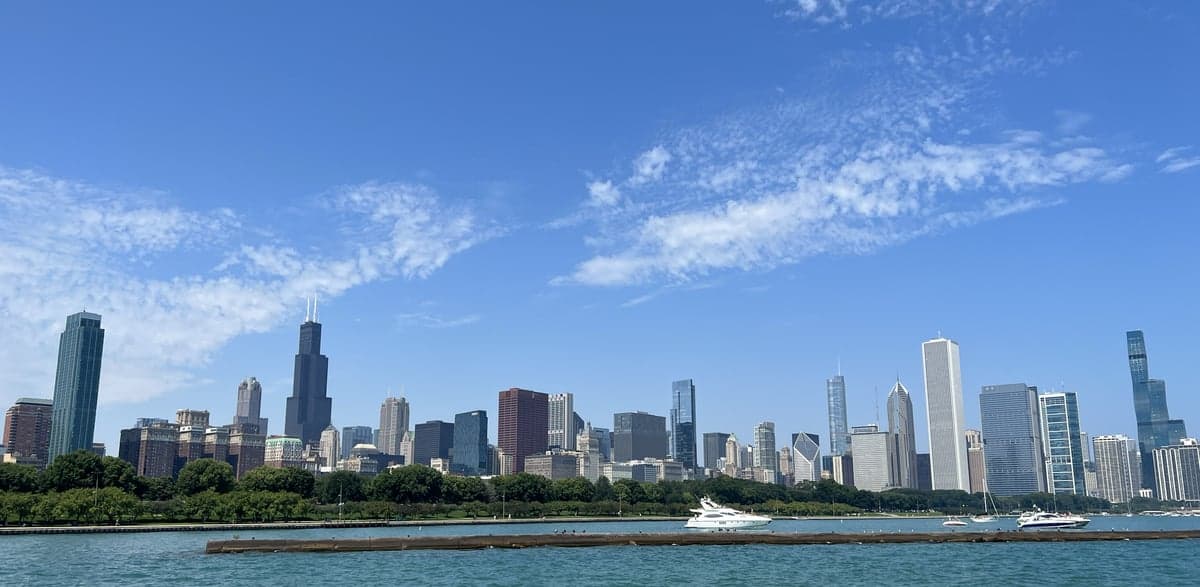
Cook County, Illinois, is home to 5,185,812 people, making it the second-most populous county in the United States. Its population is a dense, diverse mosaic: 40.5% White, 26.5% Hispanic, 22.1% Black, 4.8% East/Southeast Asian, and 2.8% Indian (subcontinent), with 10.0% foreign-born and 41.9% college-educated. The county’s identity is defined by the stark contrast between the global city of Chicago and its sprawling, often politically conservative suburbs, creating a region where urban liberalism and suburban pragmatism coexist uneasily.
Settlement & growth (pre-1960)
Before European contact, the area now known as Cook County was inhabited by the Potawatomi, Ojibwe, and Odawa nations, who used the Chicago Portage—a vital waterway link between the Great Lakes and the Mississippi River system—as a trade route. French explorers Louis Jolliet and Jacques Marquette passed through in 1673, and a small French mission and fur-trading post were established, but permanent European settlement did not begin until after the 1795 Treaty of Greenville, which ceded the Chicago area to the United States.
The first major American wave arrived in the 1830s and 1840s, driven by the construction of the Illinois and Michigan Canal and the promise of fertile farmland. Yankees from New England and upstate New York founded the village of Chicago in 1833, and by 1840, the city had 4,470 residents. The canal, completed in 1848, turned Chicago into a transportation hub, attracting Irish immigrants who dug the canal and later worked in the stockyards. German immigrants followed in the 1840s and 1850s, settling in what became the North Side neighborhoods of Lincoln Park and Lake View, as well as the town of Evanston, where they established breweries and churches.
The post-Civil War industrial boom transformed Cook County. From 1870 to 1920, massive waves of Southern and Eastern European immigrants arrived: Poles, Italians, Czechs, and Jews. Poles concentrated in the Pulaski Park and Avondale neighborhoods on Chicago’s Northwest Side, while Italians settled in Little Italy near the University of Illinois at Chicago and in Taylor Street corridor. The 1880s and 1890s also saw the arrival of Swedish immigrants in Andersonville (a neighborhood still bearing their cultural imprint) and Norwegian immigrants in Norwood Park. By 1900, Chicago was the nation’s second-largest city, and Cook County’s population had exploded to over 1.8 million.
The Great Migration (1915–1970) brought hundreds of thousands of Black Americans from the rural South to Cook County, fleeing Jim Crow and seeking industrial jobs in steel mills, stockyards, and factories. They settled primarily in Chicago’s South Side neighborhoods like Bronzeville, Woodlawn, and Englewood, as well as the west side’s Lawndale. This wave fundamentally reshaped the county’s racial and cultural landscape, creating a vibrant Black middle class and a powerful political base. Meanwhile, the Dust Bowl of the 1930s drove white “Okies” and “Arkies” to the county, though in smaller numbers than in California.
Suburbanization began in earnest after World War II. The 1950s saw white flight from Chicago’s inner city to new suburbs like Park Ridge, Arlington Heights, and Oak Park, fueled by the GI Bill, highway construction (especially the Eisenhower Expressway), and the Federal Housing Administration’s redlining policies that excluded Black families. By 1960, Cook County’s population had reached 5.1 million, with the suburbs growing faster than the city for the first time.
Modern era (post-1965)
The 1965 Hart-Cellar Act abolished national-origin quotas, triggering a new wave of immigration that transformed Cook County’s ethnic composition. From the 1970s onward, large numbers of Mexican immigrants arrived, drawn by industrial and service jobs. They settled in Chicago’s Pilsen and Little Village neighborhoods, as well as suburban Cicero and Berwyn. Today, the Hispanic population stands at 26.5%, making it the county’s largest minority group and a powerful political and cultural force.
East/Southeast Asian immigration surged after 1965, particularly from China, Korea, and the Philippines. Chinese immigrants concentrated in Chicago’s Chinatown on the South Side and in the northern suburbs of Skokie and Evanston, where they formed professional and entrepreneurial communities. Korean immigrants established a strong presence in Northbrook and Glenview, while Filipino communities grew in Chicago’s Edgewater neighborhood and suburban Mount Prospect. Today, East/Southeast Asians make up 4.8% of the population.
Indian (subcontinent) immigration began in Cook County began in earnest after 1965, with a second wave accelerating in the 1990s and 2000s driven by the tech boom. Indian professionals—engineers, doctors, and IT workers—settled in the affluent northern and western suburbs: Naperville (partly in DuPage County but with a major hub), Hoffman Estates, and Palatine. Indian communities are also growing in Chicago’s West Ridge neighborhood, home to the city’s largest Indian enclave. The Indian population now stands at 2.8%, a share that has doubled since 2000.
Domestic migration since 1970 has been dominated by Black suburbanization and white flight to the exurbs. Many Black families moved from Chicago’s South and West Sides to suburbs like Harvey, Dolton, and South Holland, while white families pushed further out to Orland Park, Tinley Park>, and Barrington. The county’s Black population, now 22.1%, is increasingly suburban, with majority-Black suburbs like East Hazel Crest and Country Club Hills emerging. Meanwhile, the white population has declined from 70% in 1970 to 40.5% today, driven by both suburban flight and low birth rates.
The future
Cook County’s population is projected to remain stable or decline slightly over the next decade, as Chicago’s slow population loss is offset by continued suburban growth. The county is tribalizing into distinct ethnic enclaves rather than homogenizing: Hispanic neighborhoods in Pilsen and Cicero are expanding geographically, while Indian and East/Southeast Asian communities in the northern suburbs are becoming more concentrated and institutionally established. Black suburbs in the south are aging, with younger Black families increasingly moving to exurbs or other metro areas.
Immigrant communities are growing but plateauing in growth, as birth rates among foreign-born populations fall and new immigration slows due to national policy shifts. However, the Indian population is still growing rapidly, driven by H-1B visa holders and their families, and is likely to surpass 4% by 2035. The white population will continue to shrink, but the county’s overall diversity will remain high, with no single group approaching a majority.
In-migration from other U.S. regions is minimal; Cook County is a net domestic loser, with people moving to the Sun Belt and lower-cost Midwest states. The cultural identity of the county is being absorbed into a pragmatic, multiethnic suburbanism, where local politics focus on school quality, property taxes, and public safety rather than the old urban-versus-suburban divide. For a conservative-leaning family moving in, the county offers a wide range of choices—from dense, walkable suburbs like Oak Park to low-tax exurbs like Orland Park—but the overall trajectory is toward a more diverse, more educated, and more politically fragmented population.
Cook County is becoming a region of distinct, self-governing enclaves, each with its own demographic character and political leanings. For a new resident, the key is choosing the right enclave: the county’s strength is its variety, but its challenge is the growing distance between its communities. The bottom line is that Cook County remains a place of opportunity for those who can navigate its complexity, but it is no longer a single melting pot—it is a mosaic of separate, often self-contained worlds.

* Values derived from national, state, county, city and local statistics and may differ in a specific area. Last updated: 2026-05-17T15:00:35.000Z
Narrative content on this page is AI-generated and may contain mistakes. Verify any details that matter before acting on them.
ReloMaps may earn a commission from affiliate links at no extra cost to you.

