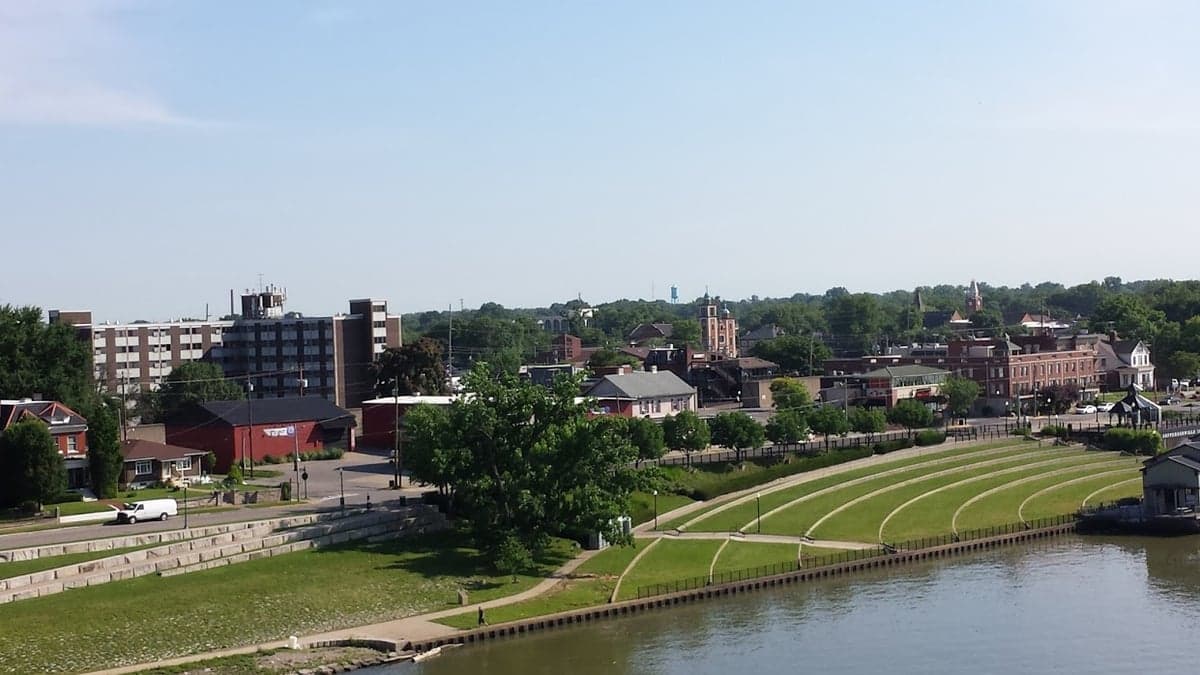
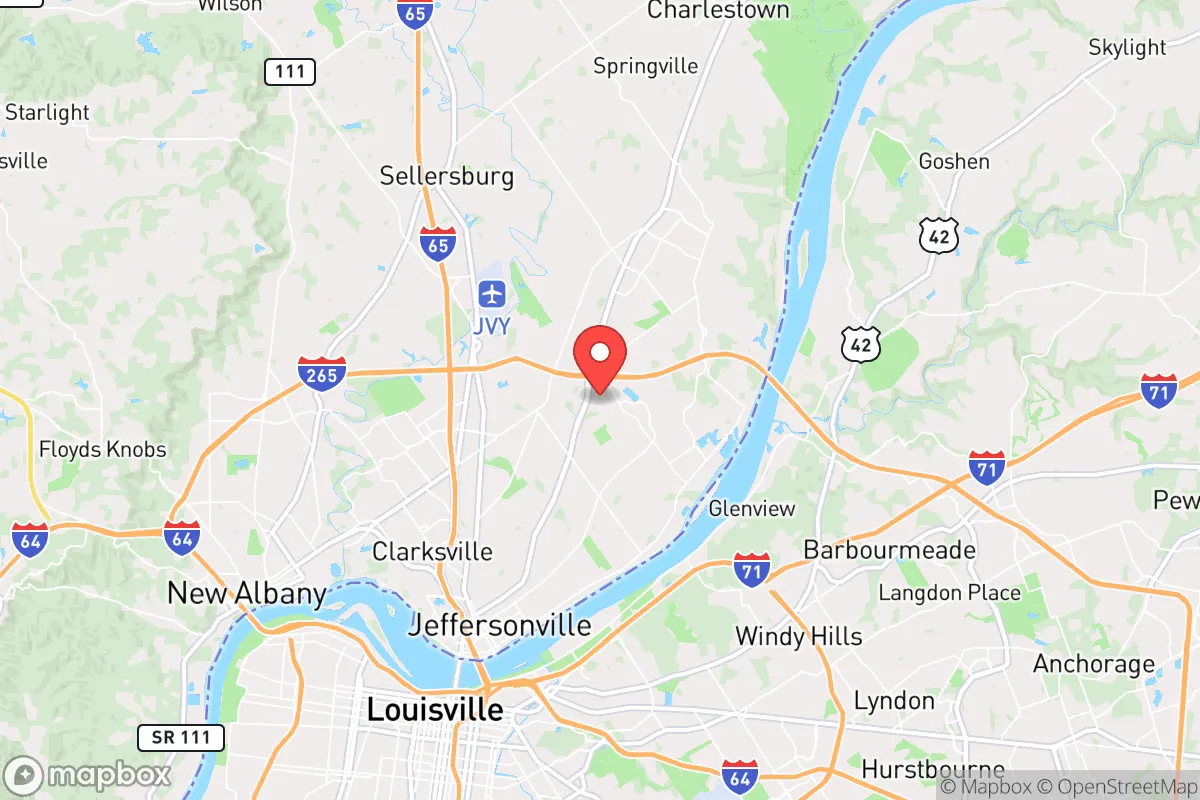
Photo: Wikipedia
Political ClimatePolitical Climate in Jeffersonville, IN
District shown is the primary district for this city’s centroid. Cities may span multiple districts.
Local Political AnalysisPolitical Analysis of Jeffersonville, IN
Jeffersonville, Indiana, sits solidly in the red, with a Cook Partisan Voting Index of R+15, meaning the area votes about 15 points more Republican than the national average. That’s not just a number on a map—it reflects a community that has, for decades, valued personal responsibility, limited government, and a “live and let live” approach to daily life. But if you’ve been around here long enough, you’ve noticed the winds shifting, and not necessarily for the better. The core of Jeffersonville still leans conservative, but the growing influence from Louisville, just across the bridge, is starting to nudge local politics in a more progressive direction, and that’s got a lot of folks watching the city council meetings a little closer.
How it compares
Drive ten minutes north into the more rural parts of Clark County, and you’ll find a political landscape that’s even more reliably Republican—think R+20 or higher, with fewer contested races and a stronger emphasis on gun rights and lower taxes. Head south across the Ohio River into Louisville, and you’re in a completely different world: a deep-blue urban center where progressive policies on housing, policing, and public spending are the norm. Jeffersonville sits right in the middle, acting as a kind of buffer zone. It’s not as conservative as, say, Sellersburg or Charlestown, but it’s a far cry from the politics of Louisville. That proximity to a big, liberal city means Jeffersonville residents are constantly exposed to ideas about “equity” initiatives and expanded government programs that many locals see as overreach. The contrast is stark: you can live in a neighborhood where the HOA barely enforces anything, yet still have a city council member floating a proposal for a new diversity committee or a “complete streets” plan that prioritizes bike lanes over car traffic.
What this means for residents
For the average Jeffersonville resident, the political climate translates directly into how much the government sticks its nose into your business. Right now, the city still has a relatively light touch—property taxes are manageable, zoning is fairly permissive, and there’s no city income tax. But the creeping influence of progressive ideology is real. You see it in the push for more affordable housing mandates, which sound nice but often mean more government control over what you can do with your own property. You see it in the school board, where debates about curriculum and parental rights are heating up. The long-term concern is that Jeffersonville could follow the path of other Indiana towns that have adopted “livability” policies that end up raising costs and reducing personal freedoms. The good news? The R+15 lean means any major shift to the left is still a tough sell. Most residents here still believe that the best government is the one that stays out of your garage, your backyard, and your kids’ education.
Culturally, Jeffersonville has a distinct identity that sets it apart from both the rural counties and the Louisville metro. There’s a strong sense of local pride—people know their neighbors, and the “small town” feel persists even as the population grows. One notable policy distinction is the city’s relatively relaxed approach to firearms: no extra local restrictions beyond state law, and open carry is common. That’s a direct reflection of the community’s values. But the biggest cultural marker is the annual Jeffersonville Riverstage concerts and the Indiana State Fair events that draw families from all over—events that feel wholesome and uncomplicated, without the political baggage you’d find in larger cities. If the progressive wave ever fully hits Jeffersonville, it won’t just change the voting patterns; it’ll change the character of the place. For now, the old guard is still holding the line, but the next few election cycles will tell you everything about whether this town stays true to its roots or starts drifting toward the Louisville model.

State Political ClimatePolitical Climate in Indiana
State Political AnalysisPolitical Environment in the State
Indiana has been a reliably red state for decades, but its conservatism is more of a steady, Midwestern pragmatism than the fiery brand you see out West. The state hasn’t voted for a Democratic presidential candidate since 2008 (when Barack Obama narrowly won it), and that was an anomaly driven by the financial crisis and a massive ground game. Since then, Republicans have held supermajorities in both chambers of the state legislature, and the governor’s mansion has been red for all but four of the last 20 years. The overall lean is about +11 to +16 points Republican in statewide races, though the margins have tightened slightly in the last two cycles as suburban voters have drifted left. The long arc is one of slow, steady consolidation: the rural and exurban areas are getting redder, while the urban cores are becoming deep blue islands.
Urban vs. rural divide
The political map of Indiana is a classic tale of three distinct regions. Indianapolis (Marion County) is the blue anchor, voting about 60-40 Democratic in recent elections, driven by a growing professional class, a sizable African American population, and a influx of younger transplants. Lake County (Gary and the Chicago suburbs) is another deep blue stronghold, reliably delivering 60-65% Democratic margins thanks to union-heavy industrial towns and a large minority population. Monroe County (Bloomington, home to Indiana University) is the third blue pocket, voting about 65% Democratic. Everything else—the vast majority of the state’s 92 counties—is red. The real action is in the suburban ring around Indianapolis (Hamilton, Hendricks, Johnson counties). Hamilton County (Carmel, Fishers, Noblesville) was once a GOP fortress, but it’s shifted from +40 Republican to about +15-20 in the last decade as educated professionals have moved in. That’s the biggest swing in the state. Meanwhile, rural counties like Knox, Daviess, and Jay are now voting 75-80% Republican, a sharp increase from the 60-65% they posted in the 1990s. The divide isn’t just geographic—it’s cultural. A farmer in Kokomo and a tech worker in Fishers live in different political worlds, even though they’re only 45 minutes apart.
Policy environment
Indiana’s policy environment is broadly conservative, but with a pragmatic, business-first twist. Taxes: The state has a flat income tax of 3.15% (down from 3.23% in 2022), and the legislature is phasing it down to 2.9% by 2027. Property taxes are capped at 1% of assessed value for owner-occupied homes, which is a major selling point. There is no inheritance tax. Regulation: Indiana is a right-to-work state (passed in 2012), and it has a very business-friendly regulatory climate. Occupational licensing is relatively light compared to neighboring states. Education: The state has a robust school choice program—vouchers (the Choice Scholarship Program) are available to most families, and charter schools are plentiful. In 2023, the legislature expanded the voucher program to near-universal eligibility, a major win for parental rights. Healthcare: Indiana did not expand Medicaid under the ACA in the traditional way; instead, it created the Healthy Indiana Plan (HIP), a conservative alternative that includes personal responsibility requirements like monthly contributions. Election laws: Indiana has strict voter ID laws (among the earliest in the nation, passed in 2005), and the state has not gone the way of universal mail-in voting. Early voting is available but not aggressively promoted. The overall posture is one of limited government, but the state is not a libertarian paradise—it still has a strong regulatory hand in areas like alcohol sales (no Sunday carryout until 2018) and gambling (tightly controlled).
Trajectory & freedom
Indiana has been moving in a decidedly more freedom-oriented direction over the last decade, but the pace is uneven. Gun rights: In 2022, Indiana became a constitutional carry state (no permit required to carry a handgun), a major expansion of the Second Amendment. The state also has a strong preemption law that prevents local governments from enacting their own gun restrictions. Parental rights: The 2023 legislative session saw the passage of a Parents’ Bill of Rights (HEA 1608), which requires schools to notify parents about curriculum changes and gives them the right to opt their children out of certain materials. This was a direct response to the critical race theory and LGBTQ+ curriculum debates. Medical autonomy: Indiana passed one of the strictest abortion bans in the nation in 2022 (Senate Enrolled Act 1), banning the procedure at conception with narrow exceptions. This was a major win for the pro-life movement. Property rights: The state has not gone as far as some Western states in limiting eminent domain, but it does have a strong right-to-farm law that protects agricultural operations from nuisance lawsuits. Taxation: The income tax cuts are real, but property taxes have crept up in fast-growing areas like Hamilton County as assessments rise. The overall trajectory is toward more personal liberty, but the state still has a heavy hand in areas like alcohol regulation and cannabis (no medical or recreational marijuana, despite neighboring Michigan and Illinois legalizing it). The biggest concern for freedom-minded residents is the state’s willingness to use its police power in areas like drug enforcement and traffic stops—Indiana has a reputation for aggressive policing.
Civil unrest & political movements
Indiana has not seen the kind of large-scale civil unrest that has rocked cities like Portland or Seattle, but there have been flashpoints. 2020 protests: Indianapolis saw several nights of protests and some looting after the murder of George Floyd, concentrated downtown and along the Mass Ave corridor. The response from then-Governor Eric Holcomb was measured—he called in the National Guard but did not deploy them aggressively. Immigration politics: Indiana is not a border state, but there have been localized tensions. In 2019, the town of Logansport (a meatpacking hub) saw a surge in ICE raids that divided the community. The state has no sanctuary cities, and several counties have passed resolutions declaring themselves “Second Amendment sanctuaries.” Election integrity: After the 2020 election, there was a push in the legislature to tighten election laws, resulting in a 2021 law that limited absentee ballot drop boxes and required more stringent ID for mail-in voting. There were no major fraud scandals, but the issue remains a live one in conservative circles. Activist movements: On the right, the Indiana Family Institute and the Hoosier Freedom Alliance are active in pushing parental rights and school choice. On the left, the Indiana Democratic Party is weak, but groups like Indivisible and the Indiana chapter of the ACLU are active in litigation. The most visible political flashpoint in recent years has been the debate over transgender athletes in school sports—Indiana passed a ban in 2022 (HEA 1041), which drew national attention and some protests at the Statehouse.
Projection
Over the next 5-10 years, Indiana is likely to remain a solidly red state, but the margins will continue to tighten in the suburban counties around Indianapolis. The in-migration pattern is key: people are moving to Indiana from Illinois and California for lower taxes and housing costs, but they are not uniformly conservative. Many are moderate or even left-leaning professionals who will vote for Republicans on economic issues but drift left on social issues. This will make places like Carmel, Fishers, and Zionsville more competitive, potentially flipping them to blue in state legislative races by 2030. The rural areas will get redder, but they are losing population, so their electoral weight is shrinking. The biggest wildcard is the state’s demographic stagnation—Indiana’s population growth is slow (about 0.5% annually), and it is aging. The state does not have a large immigrant population to offset the decline, so the political future will be shaped by who stays and who leaves. The legislature will likely continue to push conservative policies on education, guns, and abortion, but the pressure from the suburbs may force compromises on issues like marijuana legalization (medical at least) and gambling expansion. A new resident moving in now should expect a state that is still reliably conservative, but with a growing urban-suburban tension that will make state politics more interesting and less predictable than the supermajority suggests.
Bottom line for a new resident: If you’re moving to Indiana for lower taxes, strong gun rights, and school choice, you’re getting exactly that—but don’t expect a libertarian paradise. The state government is conservative, but it’s also interventionist in areas like alcohol, drugs, and policing. The best bet for a freedom-minded family is to settle in a red-leaning suburb like Noblesville or Greenwood, where the schools are good, the taxes are low, and the local politics still reflect the state’s conservative majority. Avoid the urban cores of Indianapolis and Gary unless you’re prepared for the blue politics that come with them. The state is a solid bet for the next decade, but keep an eye on the suburbs—that’s where the future of Indiana politics will be decided.
* Values derived from national, state, county, city and local statistics and may differ in a specific area. Last updated: 2026-04-24T19:31:33.000Z
Narrative content on this page is AI-generated and may contain mistakes. Verify any details that matter before acting on them.
ReloMaps may earn a commission from affiliate links at no extra cost to you.

