
Photo: Wikipedia
Political ClimatePolitical Climate in Niles, IL
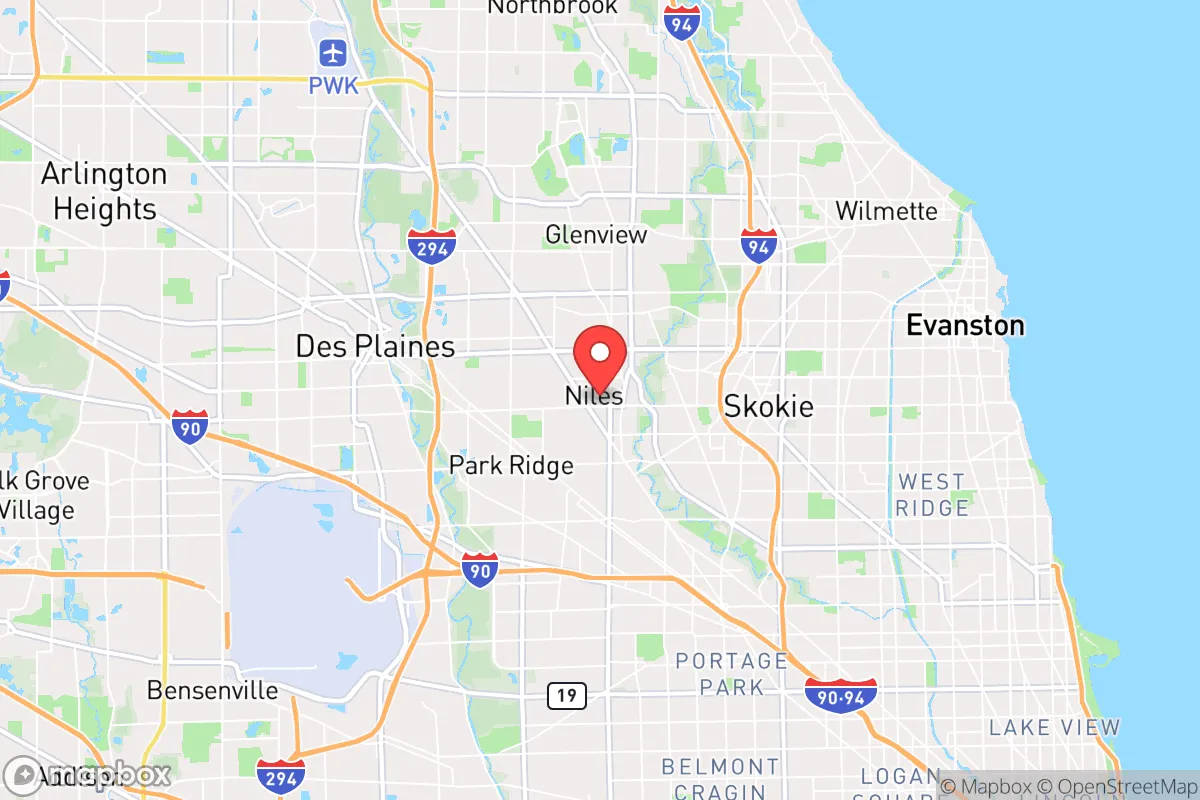
District shown is the primary district for this city’s centroid. Cities may span multiple districts.
Local Political AnalysisPolitical Analysis of Niles, IL
Niles, Illinois, is a solidly Democratic stronghold, and it’s been that way for as long as anyone can remember. The Cook Partisan Voting Index (PVI) here is D+19, meaning the area votes about 19 points more Democratic than the national average. That’s a deep blue shade, even by Illinois standards—the state as a whole sits at D+7. If you’re looking at a map of Cook County, Niles is right in the heart of the reliably Democratic suburban ring, and it’s not budging. The trajectory has been stable for decades; you won’t see wild swings here, just a consistent, comfortable Democratic majority in local, state, and federal elections.
How it compares
To really get the picture, you have to look at the contrast with the rest of Illinois. The state’s D+7 PVI is driven by Chicago and its inner suburbs, but outside of Cook County, things get red fast. Drive 20 minutes northwest to Arlington Heights or Mount Prospect, and you’ll find a more moderate, sometimes competitive mix—those areas have a stronger Republican presence, especially in local races. Go further out to places like McHenry or Lake County’s more rural pockets, and you’re in solidly Republican territory. Niles, though, is a different animal. It’s a classic inner-ring suburb with a large population of older, working-class families and a significant Orthodox Jewish community, both of which lean heavily Democratic. The D+19 PVI here isn’t just a number; it means Democratic candidates routinely win by double digits, and Republican campaigns are largely symbolic. For a conservative living in Niles, you’re in the minority, but you’re not alone—there are plenty of folks who vote Republican, especially in local school board or village trustee races, where party labels matter less than individual platforms.
What this means for residents
For liberals, Niles is a comfortable place to live politically. You’ll find your values reflected in local policy—things like strong public school funding, support for affordable housing initiatives, and a generally progressive stance on social issues. The village government is pragmatic, not ideological, but the Democratic tilt means you’re unlikely to see major conservative pushes on things like tax cuts or deregulation. For conservatives, the reality is that you’re in a blue bubble. You’ll hear more liberal viewpoints in casual conversation, and your vote in national elections won’t change the outcome locally. But that doesn’t mean you’re shut out. Local politics in Niles is still about potholes, zoning, and library budgets—issues where a conservative voice can be effective, especially if you’re willing to work with the majority. The key is that the political climate here is stable, not volatile. You won’t see the kind of partisan gridlock that plagues state or national politics; most decisions are made by consensus, because the Democratic majority is so large that internal disagreements are rare.
One thing that sets Niles apart from other blue suburbs is its cultural and policy distinctiveness. The large Orthodox Jewish population gives the village a unique flavor—you’ll see kosher markets, synagogues, and a strong emphasis on community-based social services. This influences local policy in subtle ways, like support for religious accommodations in public schools or zoning that allows for eruvim. It’s a reminder that political leanings here are tied to real, lived communities, not just abstract party labels. If you’re moving to Niles, you’re getting a place where the politics are predictable, the government is stable, and the biggest debates are usually about how to spend the surplus, not whether to cut taxes. It’s a good fit for anyone who values consistency over drama, regardless of which party you vote for.

State Political ClimatePolitical Climate in Illinois
State Political AnalysisPolitical Environment in the State
Illinois is a solidly Democratic state, with a Cook PVI of D+7, but that number tells only part of the story. The state’s political reality is a tale of two worlds: a massive, vote-rich Chicago metro that anchors the Democratic coalition, and a vast rural expanse that votes just as heavily Republican. Over the last 20 years, the state has drifted leftward on social policy and taxation, but the map itself has barely moved—the blue has gotten bluer in the cities, the red has gotten redder in the country, and the suburbs have become the decisive battleground.
Urban vs. rural divide
If you draw a line from Rockford down through Peoria and Springfield to the Metro East area across from St. Louis, you’ve roughly split the state’s political geography. Everything east and north of that line, dominated by Chicago and its collar counties, is where statewide elections are won. Cook County alone casts about 40% of the vote, and it delivers margins of 60-70% for Democrats. The city of Chicago itself is the engine, but the real shift has been in the suburbs—places like Naperville, Schaumburg, and Arlington Heights that were once reliably Republican now routinely send Democrats to the legislature. The 2018 "blue wave" in DuPage County, once the heart of suburban GOP strength, was the moment this shift became permanent.
Meanwhile, downstate Illinois is a different country politically. The rural counties south of Interstate 80—places like Effingham, Marion, and Carbondale—vote 70-80% Republican. The "Little Egypt" region at the state’s southern tip is as conservative as any place in Missouri or Kentucky. The Republican base is also strong in the western Illinois river towns like Quincy and the farm country around Bloomington-Normal. The result is a state where the two parties barely compete for the same voters; they compete for turnout in their respective strongholds, with the suburbs as the only true swing territory.
Policy environment
Illinois’s policy environment is defined by a few hard realities. The state income tax is a flat 4.95%, which is moderate by national standards, but the property tax burden is among the highest in the country—the average effective rate hovers around 2.0%, roughly double the national average. This is the single biggest complaint you’ll hear from newcomers, especially those coming from Texas or Florida. The state also has a sales tax that, with local add-ons, can push past 10% in Chicago. On the regulatory side, Illinois is a union-friendly state with a $15 minimum wage (indexed to inflation) and strong tenant protections. It’s also a sanctuary state, with the TRUST Act prohibiting local law enforcement from cooperating with federal immigration detainers.
Education is a mixed bag. Chicago Public Schools remains a chronic problem, but the state’s suburban districts—like New Trier, Stevenson, and Hinsdale Central—are nationally ranked. The state funds education through a formula that sends more money to poorer districts, but the reliance on local property taxes means wealthy suburbs still outspend poor rural districts by wide margins. Healthcare is heavily regulated, with the state running its own insurance marketplace and expanding Medicaid aggressively under the Affordable Care Act.
Recent policy direction
The last five years have seen Illinois move decisively in one direction on the issues that matter most to relocators weighing personal liberty. On guns, the state passed the Protect Illinois Communities Act in 2023, banning the sale of assault weapons and high-capacity magazines—a law that is currently being challenged in federal court but remains in effect. Illinois also requires a Firearm Owners Identification (FOID) card for all gun owners and a concealed carry permit that requires 16 hours of training. On parental rights, the state passed the Keeping Youth Safe and Healthy Act, which allows minors 12 and older to consent to mental health and substance abuse treatment without parental notification. The state also mandates that schools adopt policies supporting transgender students, including allowing them to use facilities matching their gender identity.
On taxes, the state made a failed attempt in 2020 to switch to a progressive income tax, which voters rejected. That defeat has left the flat tax in place, but the state’s pension obligations—unfunded liabilities exceed $140 billion—mean pressure for future tax increases is constant. On voting, Illinois has some of the most expansive ballot access laws in the country: automatic voter registration, same-day registration, and no-excuse mail-in voting. On property rights, the state has been aggressive in using eminent domain for economic development, particularly in Chicago’s South Loop and the proposed transit-oriented developments around the city.
Civil unrest & political movements
Illinois has a long history of political activism, and the last decade has been no exception. The 2020 George Floyd protests in Chicago were among the largest in the country, and they were followed by a wave of progressive organizing that pushed the state to pass criminal justice reform—the SAFE-T Act—which eliminated cash bail in 2023. That law remains a flashpoint; downstate sheriffs have loudly opposed it, and some counties have tried to opt out, though the state Supreme Court has upheld it. On the right, the movement is quieter but organized, centered on gun rights advocacy and opposition to the SAFE-T Act. The Illinois State Rifle Association and local gun clubs are active, and the 2023 assault weapons ban has energized them.
Immigration politics are a live wire. Chicago is a designated sanctuary city, and the state has poured resources into welcoming migrants bused from Texas—a policy that has strained budgets and created tension in working-class neighborhoods. The city’s response to the migrant influx has been chaotic, with temporary shelters in police stations and park districts becoming a visible symbol of the strain. Election integrity has also been a recurring theme; Republicans have filed numerous lawsuits over the state’s mail-in voting expansion, though none have succeeded in changing the rules.
Projection
Looking ahead five to ten years, Illinois’s political trajectory is likely to continue on its current path, but with some important caveats. The state’s population has been flat or slightly declining since 2020, with losses concentrated in rural counties and the city’s South and West Sides. The growth is happening in the collar counties and the "Chicagoland" exurbs, which are trending more Democratic. This means the state’s PVI is unlikely to shift dramatically, but the internal dynamics will keep moving left on social issues. The pension crisis is the wild card; if the state is forced into a fiscal reckoning, it could trigger a political realignment, but that’s a slow-moving problem.
For a conservative moving in, the realistic expectation is that Illinois will remain a state where your vote is a minority position in statewide races, but where local government—especially in downstate counties—can still reflect your values. For a liberal, the state will continue to be a policy laboratory for progressive governance, with the caveat that the fiscal constraints are real and will limit how much can be done.
Bottom line: Illinois is a state where your political experience depends almost entirely on where you live. If you’re a conservative, you can find a comfortable, affordable life in the rural south or the western river counties, but you’ll be living under a state government that is actively hostile to your priorities on guns, taxes, and education. If you’re a liberal, the state offers a robust safety net and progressive governance, but you’ll pay for it in property taxes and a cost of living that is higher than most of the Midwest. The state is not a place for political moderates looking for a middle ground—it’s a place where you pick your county and your community, and accept the trade-offs that come with it.
* Values derived from national, state, county, city and local statistics and may differ in a specific area. Last updated: 2026-10-21T01:28:21.000Z
Narrative content on this page is AI-generated and may contain mistakes. Verify any details that matter before acting on them.
ReloMaps may earn a commission from affiliate links at no extra cost to you.

