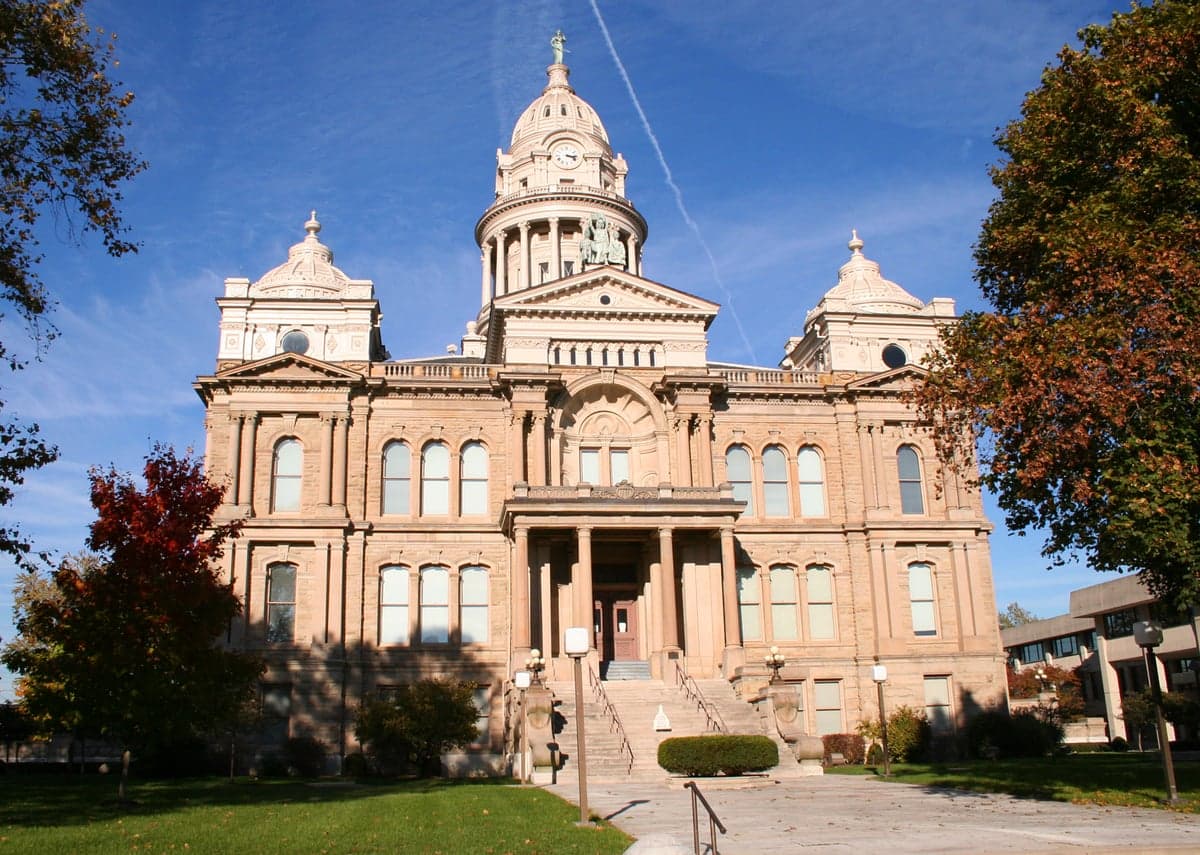
Photo: Wikipedia
Political ClimatePolitical Climate in Miami County
Showing district-level results — no local-only data available.
Local Political AnalysisPolitical Analysis of Miami County
Miami County, Ohio, leans reliably Republican, with a Cook PVI of R+4 that puts it slightly to the right of the state as a whole (R+5). This isn't a deep-red stronghold like some neighboring counties, but it's a solidly conservative area where Republican candidates typically win by comfortable margins. The political trajectory here has been fairly stable over the past decade, with no dramatic shifts toward either party, though the county has inched a bit redder in presidential races since 2016, mirroring trends across rural and suburban Ohio.
How it compares
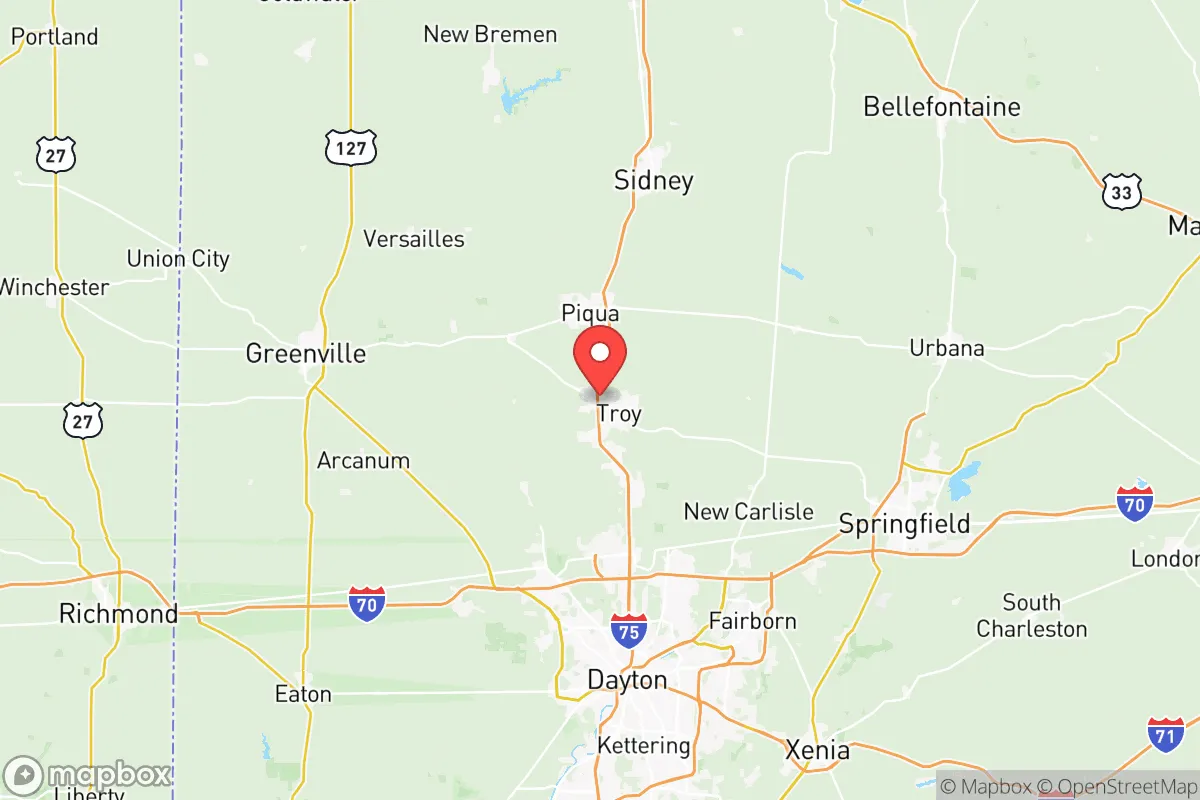
Miami County's R+4 PVI is a shade more moderate than Ohio's overall R+5, but that small difference masks real internal variation. The county's political geography breaks down along familiar lines: the northern and eastern parts, including Troy (the county seat) and Piqua, tend to be more conservative, with precincts routinely voting 65-70% Republican. Tipp City, in the southwest near the Montgomery County line, is the county's most competitive area—its precincts often swing within 5-8 points, making it a bellwether for the county's overall mood. West Milton and Covington lean red but with less intensity, while the rural townships—especially those along the Shelby County border—are the most reliably Republican. The only precincts that consistently vote blue are in a handful of neighborhoods in Troy and Piqua near the downtown cores, where a mix of union households and younger professionals create small Democratic pockets. Compared to Ohio as a whole, Miami County is less polarized than the state's urban centers (Cuyahoga, Franklin) but more conservative than the suburban swing counties (Delaware, Warren).
What this means for residents
For conservative residents, the political climate is comfortable and familiar. Local government, from the county commission to the school boards in Troy and Tipp City, is dominated by Republicans, and policy decisions—on taxes, zoning, and public spending—tend to reflect that majority. The county's Republican Party is active but not factionalized; there's no bitter infighting between establishment and MAGA wings, which keeps local politics relatively low-drama. For liberal residents, the reality is more about finding community than winning elections. There are active Democratic clubs in Troy and Piqua, and the county's few Democratic officeholders (mostly in township trustee roles) are respected locally. Statewide issues like abortion rights and marijuana legalization have seen competitive votes here—Issue 1 in 2023 (abortion) got about 44% support in Miami County, close to the state average—so it's not a place where progressive views are completely marginalized. The practical effect is that conservative residents see their values reflected in local ordinances and school curricula, while liberal residents navigate a system where they're a clear minority but not silenced.
Culturally, Miami County's politics are shaped by its manufacturing and agricultural roots. The county is home to large employers like Hobart Brothers (welding equipment) and Evenflo (baby products) in Piqua, and BASF in Tipp City, which means union influence is present but not dominant. The area's politics are less culturally conservative than deep-red counties like Mercer or Darke—there's less emphasis on social issues and more on economic pragmatism. Property taxes are a perennial local flashpoint, with voters often splitting tickets to support school levies while voting Republican for partisan offices. The county's proximity to Dayton (20 minutes south) also moderates its politics somewhat, as many residents commute to the more diverse and Democratic-leaning city for work or entertainment. In short, Miami County offers a stable, center-right political environment where the biggest debates are about local services and taxes, not national culture wars.

State Political ClimatePolitical Climate in Ohio
State Political AnalysisPolitical Environment in the State
Ohio is a classic swing state that has shifted rightward over the past decade, now carrying a Cook PVI of R+5 after voting for Donald Trump by 8 points in both 2016 and 2020 and by 11 points in 2024. The state’s political center of gravity has moved from the old Reagan Democrat strongholds of the Mahoning Valley and southeast Ohio toward the reliably red exurbs of Cincinnati, Columbus, and Cleveland, while the three big Cs—Cleveland, Columbus, and Cincinnati—remain the only major Democratic anchors. Over the last 20 years, Ohio has gone from a pure toss-up (voting for the winner in every election from 1964 to 2016) to a solidly Republican-leaning state, driven by rural depopulation, union member realignment, and the collapse of the Democratic brand in small-town and Appalachian counties.
Urban vs. rural divide
The political map of Ohio is a textbook example of the urban-rural split. The three major metros—Cuyahoga County (Cleveland), Franklin County (Columbus), and Hamilton County (Cincinnati)—cast about 40% of the state’s vote and lean Democratic, with Cuyahoga delivering a 2-to-1 margin for Biden in 2020. But outside those islands, the state is deeply red. The rural northwest (Lima, Findlay, Defiance) and the Appalachian southeast (Zanesville, Marietta, Steubenville) vote Republican by 30 to 50 points. The most dramatic shift has been in the Mahoning Valley around Youngstown and Warren, once a union-heavy Democratic bastion that flipped to Trump in 2016 and has stayed red; Mahoning County itself went from +20 Obama in 2012 to +2 Trump in 2024. The Cincinnati suburbs—like Warren County (Mason, Lebanon) and Butler County (West Chester, Oxford)—are among the most reliably Republican in the nation, while the inner-ring Cleveland suburbs (Shaker Heights, Cleveland Heights) remain deep blue. The I-71 corridor between Columbus and Cincinnati is a political fault line, with Delaware County (north of Columbus) swinging from purple to solid red as new subdivisions filled with conservative-leaning transplants.
Policy environment
Ohio’s policy environment is a mix of conservative governance on fiscal and regulatory matters with occasional moderate-to-liberal outcomes driven by ballot initiatives. The state has a flat income tax rate of 3.5% (phased down from 4% in 2023), a 5.75% sales tax, and no tax on Social Security benefits—a clear draw for retirees. Property taxes are locally set but average about 1.5% of home value, slightly above the national median. The regulatory posture is business-friendly: Ohio is a right-to-work state in practice (though not by statute), with a Republican legislature that has consistently cut red tape for manufacturers and energy producers. Education policy is a battleground: the state funds a private school voucher program (EdChoice) that has expanded significantly since 2020, now covering most families regardless of income, while public school funding remains a perennial lawsuit issue. Healthcare policy is mixed—Medicaid expansion was accepted under Governor John Kasich in 2013 and remains in place, but the legislature has passed abortion restrictions including a six-week ban (SB 23, 2019) that was later overturned by a 2023 ballot measure enshrining abortion rights in the state constitution. Election laws are moderately restrictive: voter ID is required (photo ID only, effective 2023), early voting is available for 28 days, and absentee voting requires a request for each election. The state purges inactive voters regularly, a practice upheld by the Supreme Court in 2018.
Recent policy direction
Ohio’s recent legislative direction is unmistakably conservative on most fronts, with notable exceptions from the ballot box. On gun rights, Ohio became a permitless carry state in June 2022 (HB 99), allowing any adult who can legally possess a firearm to carry it concealed without a license; the law also eliminated the duty to retreat in self-defense situations. On parental and education rights, the legislature passed the Parents’ Bill of Rights (HB 8) in 2023, requiring schools to notify parents of any changes to a student’s health or well-being and restricting instruction on sexual orientation and gender identity in grades K-3. On speech and privacy, Ohio has no broad surveillance law, but local police use of automated license plate readers is widespread and largely unregulated. Medical and bodily autonomy saw a major shift in November 2023 when voters passed Issue 1, amending the state constitution to protect abortion access up to fetal viability, overriding the legislature’s six-week ban. Property rights are strong: Ohio has no statewide rent control and limits eminent domain to public use. On voting and ballot access, the legislature passed HB 458 in 2023, shortening the absentee ballot application window and requiring stricter ID, though a 2024 attempt to eliminate early voting on the Monday before Election Day failed. The overall trajectory is a legislature pushing right on social and election issues while voters have pushed back on abortion and, in 2024, on a marijuana legalization initiative (Issue 2) that passed with 57% support.
Civil unrest & political movements
Ohio has seen its share of political flashpoints. The 2020 protests in Columbus and Cleveland over George Floyd’s death were large but largely peaceful, though Columbus saw property damage and a curfew. The state has a visible but small “Ohio secession” movement—mostly online chatter about forming a “State of Ohio” separate from federal control—but no serious legislative traction. Immigration politics are relatively quiet compared to border states, but the 2023 influx of Haitian migrants in Springfield (Clark County) became a national story after local officials claimed the population had strained social services; the city council passed a resolution welcoming immigrants, while the state legislature considered bills to restrict refugee resettlement. Election integrity controversies flared in 2020 and 2022, with Republican Secretary of State Frank LaRose tightening voter roll maintenance and pushing for post-election audits, though no widespread fraud was ever found. The most visible political movement is the growing influence of the “Moms for Liberty” and parental rights groups in suburban school board races, particularly in fast-growing counties like Delaware and Warren. On the left, the Ohio Organizing Collaborative and local Democratic parties have focused on ballot initiatives (abortion, marijuana, minimum wage) as a workaround to the Republican legislature.
Projection
Over the next 5-10 years, Ohio is likely to become more Republican at the state level, but with a ceiling. The rural population is shrinking and aging, while the Columbus metro (Franklin County) is growing and diversifying—Franklin County added 150,000 residents between 2010 and 2020, and its Democratic margins are increasing. But the exurbs are growing even faster: Delaware County grew 40% in the same period and is now solidly red. The net effect is that Ohio will probably stay R+5 to R+7 for the foreseeable future, making it competitive only in wave years for Democrats. The legislature will continue to pass conservative social legislation (transgender sports bans, school choice expansion, further election restrictions), but voters will likely continue to use ballot initiatives to moderate on specific issues like abortion and marijuana. The biggest wild card is in-migration: Ohio is attracting remote workers from the coasts to cities like Columbus, Cincinnati, and Cleveland, and if those newcomers lean Democratic, the urban-rural divide could narrow. But for now, anyone moving to Ohio should expect a state that is reliably Republican in statewide races, with pockets of deep blue in the cities and a policy environment that favors low taxes, gun rights, and school choice.
For a new resident, the bottom line is that Ohio offers a conservative-leaning policy environment with a pragmatic streak. You’ll find low taxes, strong gun rights, and a business-friendly climate, but also a state where voters have repeatedly used ballot measures to protect abortion access and legalize marijuana. The political culture is less polarized than in the Deep South or the Northeast—people in Columbus and Cincinnati coexist across party lines, and the state’s swing-state history means both parties still compete here. If you’re conservative, you’ll feel at home in the exurbs and rural areas; if you’re liberal, you’ll find your community in the cities and inner suburbs. Just don’t expect the state to flip blue anytime soon—the rural vote is too large and too reliable.
* Values derived from national, state, county, city and local statistics and may differ in a specific area. Last updated: 2026-08-19T02:46:19.000Z
Narrative content on this page is AI-generated and may contain mistakes. Verify any details that matter before acting on them.
ReloMaps may earn a commission from affiliate links at no extra cost to you.

