
Photo: Wikipedia
Political ClimatePolitical Climate in Rhome, TX
District shown is the primary district for this city’s centroid. Cities may span multiple districts.
Inherited from parent state — no local data available.
Local Political AnalysisPolitical Analysis of Rhome, TX
Rhome, Texas, is about as solidly conservative as it gets, and that’s not changing anytime soon. This little town in Wise County has always leaned hard right, and the 2024 election results just confirmed it—Wise County went +72 for the Republican candidate, a number that dwarfs even the statewide R+4 Cook PVI for Texas. You don’t see much hand-wringing over politics here; folks are more concerned with keeping their property rights intact and the government out of their business. The trajectory is steady: Rhome is getting a little more populated as people flee the chaos of Dallas-Fort Worth, but the newcomers are mostly looking for the same small-government, low-regulation lifestyle that’s always defined this place.
How it compares
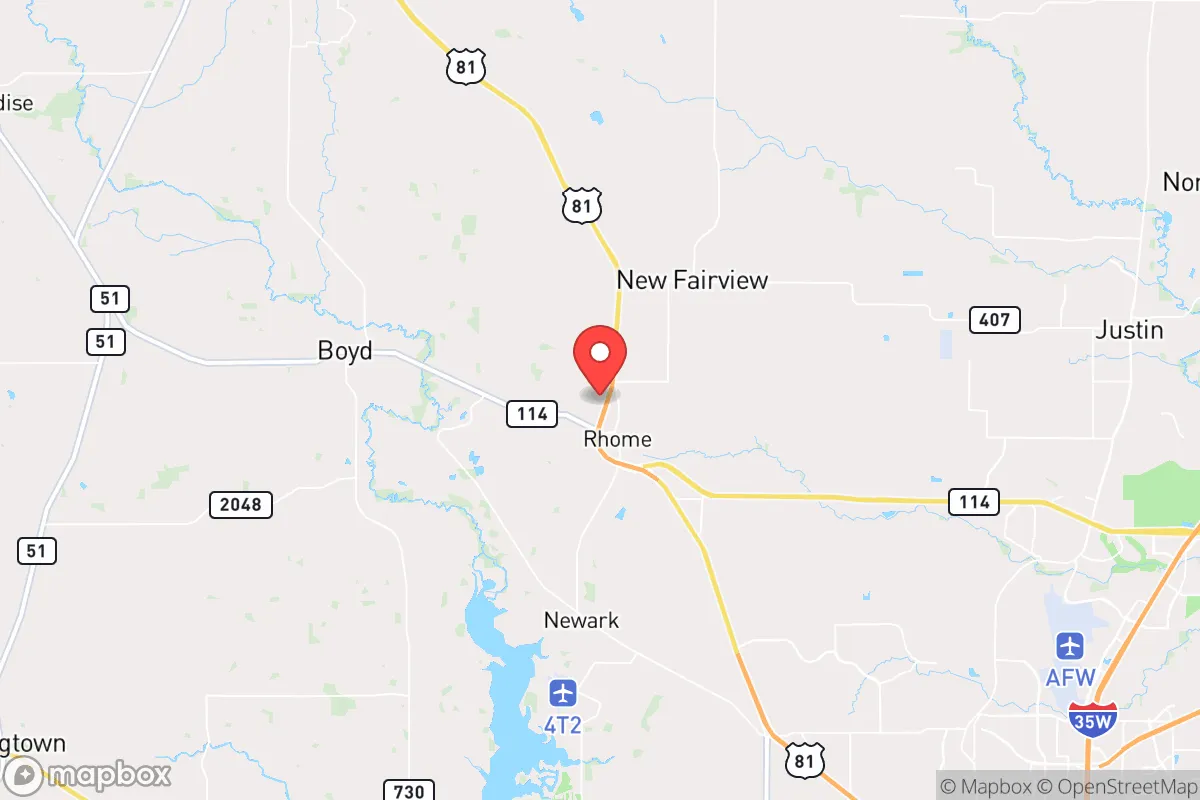
Compared to the rest of Texas, Rhome is a fortress of traditional values. The state as a whole has a Cook PVI of R+4, which means it’s still Republican-leaning, but you’ve got major cities like Austin and Dallas pulling it toward progressive policies—think higher taxes, more zoning, and a general tolerance for government overreach. Rhome, on the other hand, sits in Wise County, which is one of the most reliably red counties in North Texas. Drive 20 minutes south to Fort Worth, and you’ll feel the shift toward a more moderate, sometimes liberal vibe, especially in the city limits. Even nearby Decatur, the county seat, is a bit more establishment Republican, while Rhome keeps it raw—less bureaucracy, fewer regulations, and a strong distrust of any politician who talks about “equity” or “sustainability” as a priority. The contrast is stark: Texas might be trending purple in some suburbs, but Rhome is doubling down on red.
What this means for residents
For the people living here, the political climate means a lot of freedom from the nonsense you see in bigger cities. You don’t have to worry about the city council trying to dictate what kind of lightbulbs you use or how many chickens you can keep in your backyard. Property rights are taken seriously, and there’s a general understanding that your home is your castle—no one’s coming to tell you how to live. The downside is that services are minimal; if you want something done, you’re probably doing it yourself or organizing with neighbors. But for most residents, that’s a feature, not a bug. The concern is that as more people move in from places like Dallas or California, they might bring their big-government ideas with them. So far, though, the local elections have kept that at bay, and the school board and city council remain firmly conservative.
The cultural and policy distinctions in Rhome are a breath of fresh air if you’re tired of the progressive creep elsewhere. There’s no talk of defunding the police or implementing “equity” programs in the schools. Instead, you’ll find a strong emphasis on self-reliance, with a local economy built around agriculture, small businesses, and a few industrial jobs. The biggest political fights here are usually about water rights or property taxes, not social experiments. Looking ahead, the long-term trend is cautiously optimistic: as long as the newcomers respect the local way of life, Rhome will stay a place where personal freedoms come first and government stays in its lane. But if you see a shift toward progressive ideology—like more zoning laws or diversity initiatives—that’s when you know the soul of the town is at risk. For now, it’s still the kind of place where you can wave at your neighbor without worrying about what the city thinks.

State Political ClimatePolitical Climate in Texas
State Political AnalysisPolitical Environment in the State
Texas has been a reliably Republican state for decades, with a Cook PVI of R+4, but the political landscape is far more complex than a simple red-state label. The dominant coalition has long been a mix of suburban conservatives, rural voters, and business interests, but rapid demographic shifts and massive in-migration from blue states are reshaping the map. Over the last 10-20 years, the GOP’s grip has tightened in rural areas and exurbs while slipping in fast-growing suburbs and major metros, creating a state that’s still conservative but increasingly contested.
Urban vs. rural divide
The political map of Texas is a tale of two worlds. The major metros—Houston, Dallas-Fort Worth, San Antonio, and Austin—are the engines of Democratic growth, with Austin being the most liberal city in the state. Harris County (Houston) and Dallas County have flipped from red to blue over the past decade, while Tarrant County (Fort Worth) only narrowly went for Trump in 2020 after decades of GOP dominance. Meanwhile, rural West Texas, the Panhandle, and East Texas remain deeply Republican. Lubbock, Midland, and Tyler are GOP strongholds where Democrats rarely crack 30%. The real battleground is the suburbs: places like Collin County (north of Dallas) and Denton County are shifting left as educated professionals move in, though they still lean red. The Rio Grande Valley, once a Democratic bastion, has been trending right, with counties like Starr and Hidalgo giving Trump larger shares in 2020 and 2024. This urban-rural split means statewide races are decided by which side turns out more in the suburbs.
Policy environment
Texas’s policy environment is defined by a low-tax, low-regulation posture that appeals to conservatives. There is no state income tax, and property taxes are high but capped by law. The regulatory climate is business-friendly, with no state-level minimum wage above the federal $7.25 and right-to-work laws that weaken unions. On education, the state has expanded school choice through Education Savings Accounts (ESAs) and charter schools, though rural districts resist. Healthcare remains a flashpoint: Texas has not expanded Medicaid under Obamacare, leaving 18% of residents uninsured—the highest rate in the nation. Election laws tightened after 2020 with Senate Bill 1, which banned drive-through voting and added ID requirements for mail ballots. The state also passed a near-total abortion ban (SB 8) and permitless carry for handguns (HB 1927). For a conservative, this is a state that generally respects personal liberty on guns and taxes but still has a heavy hand in social issues like abortion and voting.
Trajectory & freedom
On the freedom front, Texas has moved in two directions. On the positive side for conservatives, the state expanded gun rights with permitless carry in 2021 and passed a law (HB 25) protecting parents’ rights to opt their kids out of school library materials. Property rights got a boost with the 2023 law limiting eminent domain for private developers. However, there are concerning trends. The state’s response to COVID—locking down businesses and schools in 2020—was a massive overreach that many conservatives still resent. More recently, the legislature has increased surveillance of election integrity, which some see as necessary and others as a chill on participation. The biggest freedom issue is property taxes: while there’s no income tax, local governments can still raise property levies, and the 2023 law capping appraisal increases at 10% was a band-aid, not a fix. The trajectory is mixed—Texas is freer on guns and school choice but still has a big-government streak in education mandates and local taxation.
Civil unrest & political movements
Texas has seen its share of political flashpoints. The 2020 Black Lives Matter protests in Austin and Houston were large and sometimes violent, leading to a backlash that helped pass the 2021 law protecting police funding (HB 1900). Immigration is the hottest button: Governor Abbott’s Operation Lone Star has bused migrants to blue cities and installed razor wire along the Rio Grande, sparking legal battles with the Biden administration. The “sanctuary city” debate is real—El Paso and Austin have declared themselves sanctuaries, while the state has banned such policies. Secession talk, or “Texit,” is mostly fringe but gets airtime in GOP circles. Election integrity remains a sore spot: the 2020 audit of four counties (including Dallas and Harris) found no widespread fraud, but many conservatives remain skeptical. A new resident will notice the tension at the border and the constant political ads about immigration and crime.
Projection
Over the next 5-10 years, Texas is likely to become more competitive but not flip blue statewide. The key driver is in-migration: people moving from California and New York tend to be moderate to liberal, settling in suburbs like Frisco and Round Rock. This will push the suburbs left, but rural and exurban growth (especially in the Hill Country and West Texas) will offset it. The Hispanic vote is the wild card—if it continues trending right, the GOP could hold the state for another generation. If it swings back, Democrats could win statewide by 2032. Expect more fights over school vouchers, property tax reform, and water rights as the state grows. For a conservative moving in now, the next decade will feel like a holding action: the culture is still red, but the politics are getting purple. The state will likely remain a low-tax, pro-business haven, but social issues like abortion and transgender rights will keep the legislature busy.
For a new resident, the bottom line is that Texas offers a high degree of personal freedom on guns, taxes, and school choice, but you’ll have to navigate a growing government footprint on property taxes and local regulations. The political climate is still conservative, but it’s not static—you’ll see the shift in your own neighborhood if you move to a suburb of Dallas or Austin. If you value low taxes and a business-friendly environment, you’ll be happy. If you’re looking for a state that’s aggressively shrinking government, you’ll find some wins and some disappointments. Either way, Texas is a place where your vote still matters, and the fight over its future is just getting started.
* Values derived from national, state, county, city and local statistics and may differ in a specific area. Last updated: 2026-05-10T18:41:47.000Z
Narrative content on this page is AI-generated and may contain mistakes. Verify any details that matter before acting on them.
ReloMaps may earn a commission from affiliate links at no extra cost to you.

