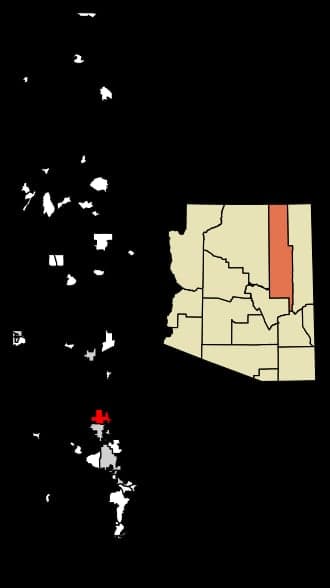
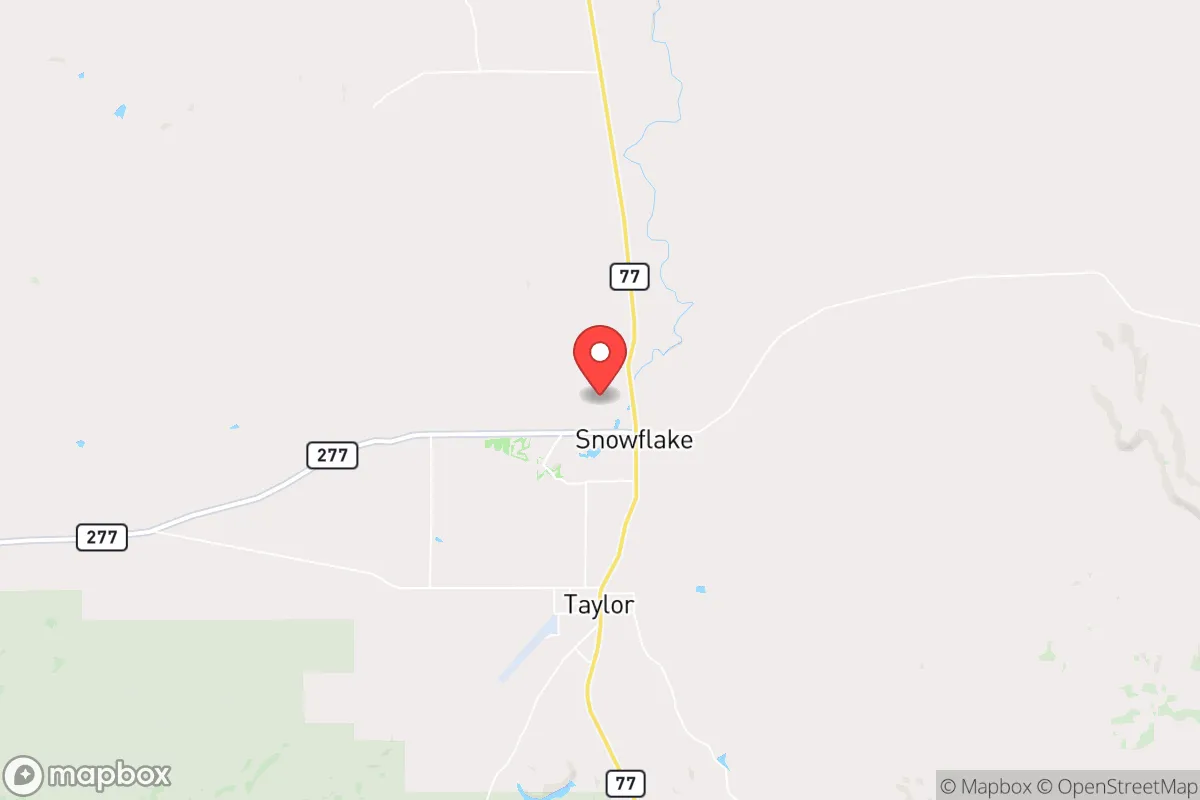
Photo: Wikipedia
Political ClimatePolitical Climate in Snowflake, AZ
District shown is the primary district for this city’s centroid. Cities may span multiple districts.
Local Political AnalysisPolitical Analysis of Snowflake, AZ
Snowflake, Arizona, leans solidly Republican, with a Cook Partisan Voting Index (PVI) of R+7, meaning it votes about seven points more conservative than the national average. This isn't a new development—the town has been a conservative stronghold for decades, rooted in its Mormon pioneer heritage and rural, family-oriented culture. The political trajectory here is steady: while Arizona as a whole has become a competitive swing state (Cook PVI: EVEN), Snowflake has only deepened its red hue, with local elections often uncontested and Republican turnout consistently high. You won't find much political flux in this high-desert community; the lean is baked into the landscape.
How it compares
The contrast between Snowflake and the rest of Arizona is stark. The state's Cook PVI of EVEN reflects a near-perfect partisan split, driven by Maricopa County (Phoenix) and Pima County (Tucson), which swing between blue and red depending on the cycle. Snowflake, by contrast, sits in Navajo County, which voted for Trump by 20 points in 2020. Nearby towns like Show Low and Taylor share Snowflake's conservative bent, but drive an hour south to Pinetop-Lakeside, and you'll find a more mixed electorate, thanks to seasonal residents from Phoenix. Head west to Flagstaff (Coconino County), and you're in a liberal island—home to Northern Arizona University and a strong Democratic base. For a Snowflake resident, the state's political divide feels less like a debate and more like two different countries: the rural, religious, and resource-extraction economy of the White Mountains versus the urban, service-driven, and diverse population of the Valley.
What this means for residents
For conservative residents, Snowflake offers a comfortable echo chamber. Local government, school board meetings, and even the chamber of commerce operate with a shared conservative ethos—low taxes, limited regulation, and a focus on family values. You can expect your neighbors to wave the same political flags, and the local church often doubles as a community organizing hub. For liberal residents, life here requires a thicker skin. You'll be in the minority, and political conversations can be tense, but it's not hostile—most folks are polite, even if they disagree. The practical impact is that progressive policy initiatives (like zoning for affordable housing or public transit expansions) rarely gain traction, while conservative priorities (like Second Amendment rights or school choice) are baked into local law. The trade-off is a slower pace of life and a tight-knit community where everyone knows your name, but you'll drive to Flagstaff or Phoenix for any political rally or diverse cultural event.
Culturally, Snowflake stands apart from the rest of Arizona in its LDS influence—the town was founded by Mormon settlers in the 1870s, and that heritage still shapes everything from Sunday closures to alcohol sales (the town is dry, though you can buy beer in nearby Taylor). This creates a distinct policy distinction: while Arizona legalized recreational marijuana in 2020, Snowflake's city council quickly banned dispensaries, reflecting local moral conservatism. The trajectory? I'd expect Snowflake to stay its course—maybe a slight shift left as Phoenix exurbs creep eastward, but not in my lifetime. For now, it's a place where the political climate is as predictable as the juniper-dotted hills: red, rooted, and resistant to change.

State Political ClimatePolitical Climate in Arizona
State Political AnalysisPolitical Environment in the State
Arizona has transformed from a reliably Republican stronghold into the nation’s premier political battleground, with a Cook Partisan Voting Index of EVEN. Over the past 20 years, the state has shifted from a solid +10 GOP lean to a pure toss-up, driven by explosive growth in Maricopa County (home to Phoenix and 60% of the state’s voters) and the influx of moderate and left-leaning transplants from California and the Midwest. The dominant coalitions are now a roughly even split between a conservative base concentrated in the exurbs and rural areas, and a coalition of suburban moderates, Latino voters, and young urbanites who have pushed the state blue in recent presidential and Senate races.
Urban vs. rural divide
The political map of Arizona is a story of two starkly different landscapes. The urban core of Phoenix and Tucson is reliably Democratic, with Tucson’s Pima County delivering margins of +15 to +20 points for Democrats in recent cycles. The real action is in the sprawling suburbs of Maricopa County: Mesa, Chandler, and Gilbert were once GOP strongholds but have shifted toward the center, with some precincts now voting blue. Meanwhile, the rural and exurban counties—Yavapai (Prescott), Mohave (Lake Havasu City), and Cochise (Sierra Vista)—vote Republican by 30 to 40 points. The key swing area is the “exurban crescent” stretching from Buckeye and Surprise in the west to Queen Creek and Florence in the southeast, where explosive housing growth has brought a mix of conservative retirees and younger families who are less reliably partisan.
Policy environment
Arizona’s policy environment is a study in contrasts. The state has a flat income tax rate of 2.5% (down from 4.5% in 2021), no estate tax, and a sales tax that varies by county but averages around 8.4%. Property taxes are low, with an effective rate of about 0.62% of home value. Regulatory posture is generally business-friendly, with right-to-work laws and minimal zoning restrictions in most rural areas. Education policy is a flashpoint: the state has one of the nation’s most expansive school choice programs (Empowerment Scholarship Accounts, or ESAs), allowing public funds to be used for private or homeschool expenses. However, per-pupil funding remains near the bottom nationally, and teacher pay has been a perennial issue. Healthcare policy is mixed—Arizona expanded Medicaid under the Affordable Care Act (AHCCCS), but the state also has some of the loosest abortion restrictions in the Sun Belt (currently legal up to 15 weeks, with a near-total ban from 1864 blocked by courts). Election laws are a battleground: the state has no-excuse mail-in voting (used by 80% of voters), but also passed voter ID requirements and a 2022 law restricting ballot drop boxes.
Recent policy direction
The last five years have seen Arizona lurch between conservative and moderate impulses. On gun and self-defense law, the state is permissive: constitutional carry (permitless carry) was enacted in 2010, and there is no waiting period or magazine capacity limit. A 2022 law prohibits local governments from banning guns in public parks. On parental and education rights, the ESA program was expanded to all students in 2022, and a 2023 law requires schools to post curriculum materials online. Speech and privacy are generally protected, though a 2022 law restricts the teaching of “divisive concepts” in schools (similar to Florida’s Stop WOKE Act). On medical and bodily autonomy, the 1864 near-total abortion ban was blocked by the state Supreme Court in 2024, leaving the 15-week limit in place; a ballot measure to enshrine abortion rights is expected in 2026. Property rights are strong, with no statewide rent control and a 2022 law limiting local governments’ ability to impose inclusionary zoning. Taxation has moved sharply right: the flat tax was phased in by 2023, and a 2024 law cut the corporate income tax from 4.9% to 4.5%. Voting and ballot access remains a tug-of-war: the 2022 law requiring proof of citizenship for federal voter registration was partially upheld, but same-day registration is still illegal, and the state’s independent redistricting commission (unique in the West) has kept maps relatively fair.
Civil unrest & political movements
Arizona has been a hotspot for political activism on both sides. The 2020 election audit of Maricopa County (the “Cyber Ninjas” audit) became a national flashpoint for election integrity activists, with months of protests and counter-protests outside the state capitol. Immigration politics are visceral: Yuma and Nogales see heavy border crossings, and the state has sued the Biden administration over border policy. The “Show Me Your Papers” law (SB 1070) from 2010 remains a cultural touchstone, though most of its provisions were struck down. On the left, the “Red for Ed” teacher walkout in 2018 drew 50,000 protesters to the capitol and led to a 20% pay raise. The state has no sanctuary city policies—Phoenix and Tucson have “welcoming city” ordinances but cooperate with federal immigration enforcement. Election integrity controversies persist: the 2022 gubernatorial race was decided by 17,000 votes, and both parties have filed lawsuits over ballot procedures. A new resident will notice the omnipresence of political yard signs, especially in Maricopa County, and the frequency of ballot measure campaigns (Arizona averages 4-6 statewide propositions per election cycle).
Projection
Over the next 5-10 years, Arizona will likely remain a toss-up, but the demographic trends favor a slight leftward drift. The state is adding about 100,000 new residents per year, with the largest share coming from California—a group that leans Democratic. The Latino population, now 32% of the state, is growing and trending more Democratic among younger voters, though older Latino voters remain competitive for Republicans. The key swing group is the “suburban mom” in Chandler and Gilbert, who is fiscally conservative but socially moderate on issues like abortion and education. The Republican Party is increasingly dominated by the MAGA wing, which could alienate these voters in close races. However, the rural and exurban counties are growing too, and the state’s independent redistricting commission means neither party can gerrymander its way to a lock. By 2030, expect Arizona to be a perennial swing state, with both parties investing heavily in Phoenix and Tucson. A new resident moving in now should expect to see close elections every cycle, with the state’s policies oscillating between conservative and moderate depending on which party holds the governor’s office and the legislature.
For a new resident, the bottom line is that Arizona offers a unique blend of low taxes, school choice, and gun rights, but with a political environment that is constantly in flux. Conservatives will find a friendly tax and regulatory climate, but should expect to share power with a growing Democratic coalition. Liberals will appreciate the state’s competitive elections and the ability to influence policy through ballot measures, but will face a legislature that is often to the right of the state as a whole. The practical takeaway: if you want a state where your vote truly matters, Arizona is one of the few places in the country where it does—every election cycle, every precinct, every ballot measure.
* Values derived from national, state, county, city and local statistics and may differ in a specific area. Last updated: 2026-08-24T17:17:43.000Z
Narrative content on this page is AI-generated and may contain mistakes. Verify any details that matter before acting on them.
ReloMaps may earn a commission from affiliate links at no extra cost to you.

