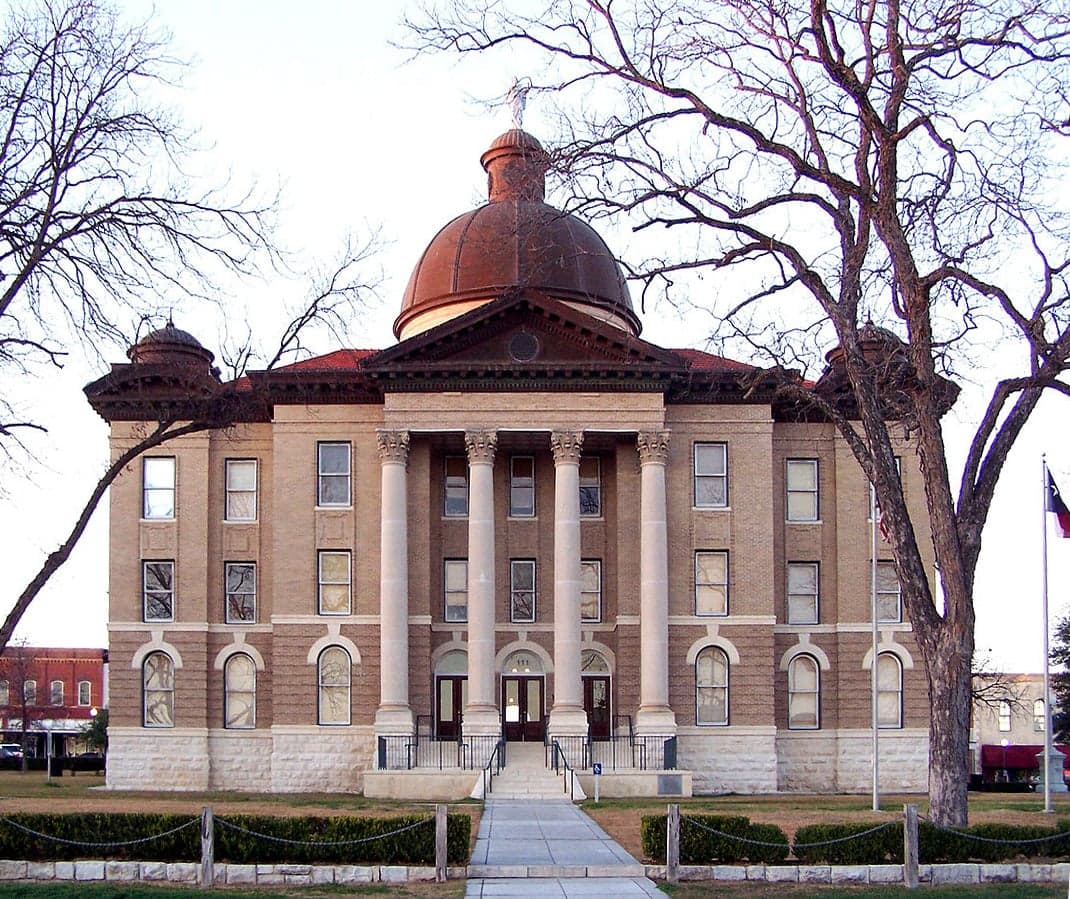
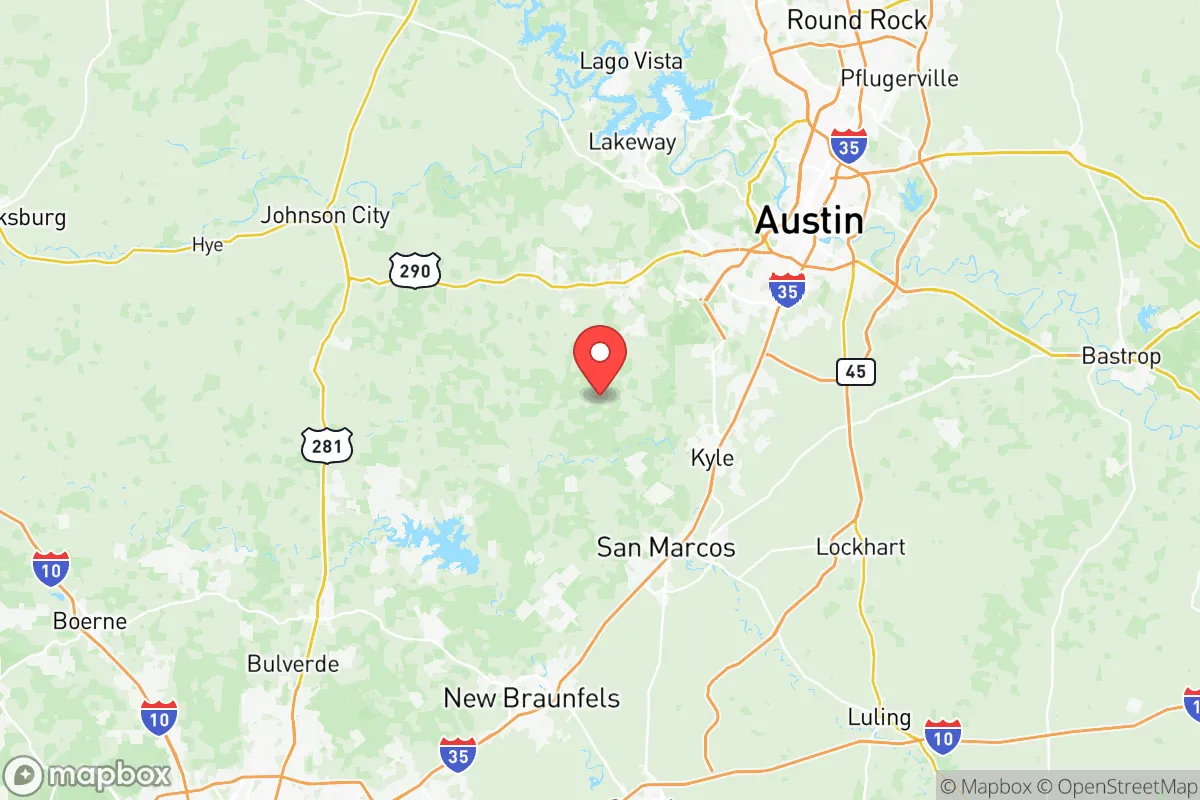
Photo: Wikipedia
Demographics of Hays County
Affluence Level in Hays County
A middle-class area roughly in line with national averages across income, home values, education, and employment.
People of Hays County
Today, the people of Hays County, Texas form a rapidly growing, politically moderate-to-conservative population of 256,429, defined by a near-even split between non-Hispanic White residents (51.3%) and Hispanic residents (39.1%), with small but growing Black (3.8%), East/Southeast Asian (1.2%), and Indian (0.6%) communities. The county’s identity is a blend of its German-Texan and Mexican-Texan heritage, centered in historic towns like San Marcos and Dripping Springs, and a newer wave of domestic migrants from California and the Rust Belt seeking lower taxes and more space. With 41.9% of adults holding a college degree, Hays County is more educated than the Texas average, driven by Texas State University in San Marcos and the influx of professionals commuting to Austin. The foreign-born population sits at just 5.3%, well below the national average, reflecting a population shaped more by domestic relocation than international immigration.
Settlement & growth (pre-1960)
Before European contact, the area now known as Hays County was home to the Tonkawa and Coahuiltecan peoples, who lived as hunter-gatherers along the Blanco and San Marcos Rivers. Spanish explorers and missionaries passed through in the 17th and 18th centuries, but no permanent Spanish settlements were established within the county’s current boundaries. The region remained sparsely populated until after Texas independence in 1836.
The first major American wave arrived in the 1840s and 1850s, primarily Anglo-American settlers from the U.S. South—Tennessee, Kentucky, and Missouri—drawn by cheap land grants from the Republic of Texas. These settlers established the county’s earliest towns: San Marcos (founded 1851), Buda (founded 1881 as a railroad stop), and Kyle (founded 1880). They were predominantly farmers and ranchers, and many brought enslaved Black people with them. By 1860, enslaved African Americans made up roughly 30% of the county’s population, concentrated on cotton plantations along the San Marcos River.
A second distinct wave came in the 1850s and 1860s: German immigrants, part of the larger German-Texan migration that settled the Texas Hill Country. Unlike the Anglo settlers, the Germans were drawn by the Adelsverein (Society for the Protection of German Immigrants) and established farming communities centered on Wimberley (settled 1848) and Dripping Springs (settled 1850s). These German settlers were largely Lutheran or Catholic, brought a tradition of stone masonry and tight-knit rural villages, and remained culturally distinct for generations. Their descendants still form a visible cultural presence in Wimberley and Dripping Springs today, evident in local festivals and architecture.
After the Civil War, emancipation freed the county’s Black population, but Jim Crow laws and economic pressures pushed many into sharecropping or tenant farming. A small but enduring Black community formed in San Marcos, centered around the Dunbar neighborhood and the Antioch Baptist Church. The late 19th and early 20th centuries saw modest growth from Anglo and German farmers, but Hays County remained overwhelmingly rural and agricultural—cotton, corn, and livestock—until the mid-20th century. The Dust Bowl of the 1930s brought a small number of displaced farmers from Oklahoma and the Texas Panhandle, but no large-scale migration occurred. By 1950, the county’s population was still under 20,000, and its character was firmly Anglo-German and Hispanic (the Hispanic population, largely descended from Mexican-Texan ranching families, had been present since the Spanish era but was concentrated in southern Hays County around San Marcos and Uhland).
Modern era (post-1965)
The 1965 Hart-Cellar Act had a limited direct effect on Hays County, as the foreign-born population remains low at 5.3%. Instead, the county’s modern transformation has been driven by domestic migration. The opening of Interstate 35 in the 1960s and the expansion of Texas State University (then Southwest Texas State) turned San Marcos into a regional hub. From the 1970s onward, Hays County began absorbing spillover growth from Austin, 30 miles north. This accelerated sharply after 2000, as Austin’s housing costs pushed families and retirees southward.
The dominant demographic shift since 1965 has been the rapid growth of the Hispanic population. In 1970, Hispanics made up roughly 15% of Hays County; by 2024, they were 39.1%. This growth came from two sources: natural increase among long-established Mexican-Texan families, and new migration from Mexico and Central America, though the latter has been modest compared to other Texas counties. Hispanic residents are concentrated in San Marcos (where they form a near-majority) and in rural communities like Kyle and Buda, where they work in construction, services, and agriculture. The Hispanic population is overwhelmingly U.S.-born and English-proficient, reflecting deep roots in the region.
The non-Hispanic White population, while still the largest single group at 51.3%, has seen its share decline from over 80% in 1980. This is not due to White out-migration but to the faster growth of Hispanic and other minority populations. The White population itself has been reshaped by in-migration: many new White residents are college-educated professionals from California, the Northeast, and the Midwest, drawn by lower taxes, warmer weather, and Austin’s tech economy. These newcomers cluster in master-planned subdivisions in Kyle and Buda, and in the exurban estates around Dripping Springs and Wimberley. They tend to be more politically conservative than Austin’s population but more moderate than rural Texas, and they have driven the county’s high college-education rate (41.9%).
Black residents make up 3.8% of the population, a share that has grown slowly from historic lows after the Great Migration drew many Black Texans to northern cities. The Black community today is concentrated in San Marcos, near Texas State University, and in Kyle, where new subdivisions have attracted middle-class Black families from Houston and Dallas. East/Southeast Asian residents (1.2%) and Indian residents (0.6%) are small but growing, largely tied to Texas State University’s faculty and student body, and to tech workers commuting to Austin. These groups are dispersed rather than forming ethnic enclaves, though a small Asian commercial corridor has emerged near the university in San Marcos.
The future
Hays County’s population is projected to exceed 350,000 by 2035, driven almost entirely by domestic in-migration from higher-cost states and from other Texas counties. The Hispanic share is likely to continue rising slowly, reaching perhaps 45% by 2040, through natural increase and continued modest immigration. The non-Hispanic White share will decline further, but the White population will remain the largest single group and will continue to be replenished by new arrivals. The Black, Asian, and Indian shares will grow incrementally but will remain small single-digit percentages.
The county is not homogenizing into a single culture. Instead, it is tribalizing into distinct enclaves: the historic German-Texan and Hispanic rural communities in Wimberley and southern San Marcos; the new suburban subdivisions in Kyle and Buda, dominated by conservative-leaning families from out of state; and the university-oriented, more diverse core of San Marcos. These groups coexist with little friction but also little integration. The cultural identity of the county is shifting from its historic German-Mexican ranching roots toward a more generic Sun Belt suburban character, though the Hill Country aesthetic and conservative values remain strong anchors.
For a newcomer, Hays County offers a place where traditional Texas values—low taxes, gun rights, religious participation—are still dominant, but where the population is becoming more diverse and more educated. The county is absorbing new people without being fundamentally transformed by them; the in-migrants tend to be people who chose Hays County precisely because of its existing character. The next decade will likely see continued rapid growth, increased traffic congestion along I-35, and a slow but steady diversification of the population, but the county’s political and cultural center of gravity will remain center-right.

* Values derived from national, state, county, city and local statistics and may differ in a specific area. Last updated: 2026-05-12T11:22:14.000Z
Narrative content on this page is AI-generated and may contain mistakes. Verify any details that matter before acting on them.
ReloMaps may earn a commission from affiliate links at no extra cost to you.

