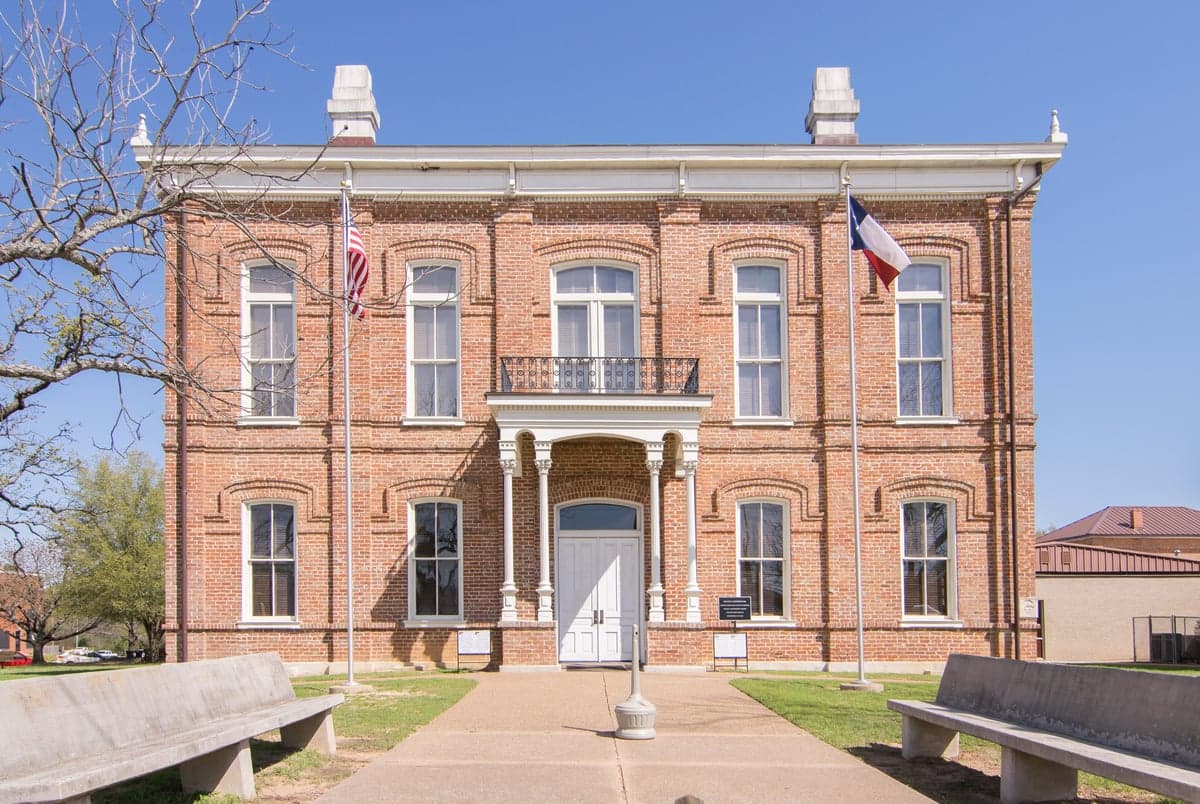
Photo: Wikipedia
Political ClimatePolitical Climate in Leon County
Showing district-level results — no local-only data available.
Local Political AnalysisPolitical Analysis of Leon County
Leon County, Texas, is a reliably conservative area with a Cook Partisan Voting Index (PVI) of R+14, making it significantly more Republican than the state of Texas as a whole (R+4). This isn't a recent shift; the county has been a GOP stronghold for decades, and the trend has only solidified in the last two presidential cycles. The rural, agricultural character of the county, combined with a strong evangelical Christian presence, creates a political environment where conservative values are the baseline, not a point of debate.
How it compares
The R+14 PVI means Leon County votes about 10 points more Republican than the statewide average. In practice, this translates to a 2024 presidential margin of roughly 75-80% for the Republican candidate, compared to about 56% statewide. The political variation within the county is subtle but real. The county seat, Centerville, is the most reliably red, with precincts routinely delivering 80%+ GOP votes. Buffalo, a smaller town to the north, is similarly conservative but shows slightly more independent voting in local races. The only precinct that ever flirts with a more moderate lean is around Oakwood, a small community on the county's eastern edge, where a handful of precincts might dip to 65-70% Republican—still deeply red, but a noticeable outlier. There are no blue towns in Leon County; the political spectrum here runs from deep red to a slightly lighter shade of red.
What this means for residents
For conservative residents, the political climate is a comfortable fit. Local government, school boards, and county commissions are uniformly conservative, and policy debates tend to focus on tax rates, road maintenance, and agricultural regulations rather than social issues. For liberal or moderate residents, the reality is more isolating. They are a clear minority, and political discussions are often avoided in public settings. There is no organized Democratic presence, and local elections are effectively decided in the Republican primary. That said, the county's small size (around 23,000 people) means that personal relationships often trump political labels in day-to-day life. A neighbor's politics rarely affects whether you get help fixing a fence or a ride to the doctor.
Culturally, Leon County is distinct from the fast-growing, diversifying parts of Texas. There is a strong emphasis on self-reliance, gun ownership is near-universal, and the local economy is driven by agriculture, timber, and oil and gas. Policy-wise, the county has been a leader in resisting state-level mandates on property taxes and land use, often pushing for more local control. The biggest political friction in recent years hasn't been between left and right, but between long-time residents and newcomers from Houston or Dallas who buy weekend ranches and sometimes push for different zoning or environmental rules. That tension—between preservation and growth—is the real political story here, not the partisan divide. If you're moving to Leon County, expect a place where the political conversation is settled, but the cultural one is still evolving.

State Political ClimatePolitical Climate in Texas
State Political AnalysisPolitical Environment in the State
Texas has been a reliably Republican state for decades, with a Cook Partisan Voting Index of R+4, but the political reality on the ground is far more complex than a simple red-state label. The dominant coalition has long been a mix of suburban conservatives, rural voters, and business interests, but explosive population growth—especially in the metroplexes of Dallas-Fort Worth, Houston, and San Antonio—is steadily shifting the state's center of gravity. Over the last 10-20 years, the GOP's grip has tightened in rural areas and the Panhandle, while the suburbs have become battlegrounds and major cities like Austin and El Paso have become Democratic strongholds, creating a state that feels like two different countries depending on where you stand.
Urban vs. rural divide
The political map of Texas is a textbook case of the urban-rural split. The state's biggest metros—Houston, Dallas, San Antonio, and Austin—are all blue-leaning or solidly Democratic, with Austin's Travis County delivering margins of +50 points or more for Democrats in recent presidential elections. Meanwhile, the vast rural expanse, from the Panhandle down through West Texas and into the Piney Woods, votes overwhelmingly Republican. The suburbs are where the real action is: Collin County (north of Dallas) was once a GOP fortress but has shifted from +30 R in 2012 to roughly +10 R in 2024, while Fort Bend County (southwest of Houston) flipped from red to blue in 2018 and has stayed there. The Rio Grande Valley, historically a Democratic stronghold, has seen a dramatic rightward shift, with counties like Zapata and Starr flipping to Trump in 2020 and 2024, driven by working-class Hispanic voters concerned about the economy and border security. This geographic sorting means that a resident of Lubbock lives in a completely different political universe than someone in El Paso, even though both are in the same state.
Policy environment
Texas's policy environment is defined by a low-tax, low-regulation posture that has been consistent for decades. There is no state income tax, which is the single biggest draw for many relocators, and property taxes are high to compensate—averaging around 1.6-1.8% of assessed value, though local rates vary wildly. The state's regulatory climate is business-friendly, with minimal red tape for industries like energy, construction, and tech. On education, Texas funds schools primarily through local property taxes, leading to wide disparities between wealthy suburbs and poorer rural districts; the school choice debate is ongoing, with a voucher-like program (Education Savings Accounts) passing in 2023 but facing legal challenges. Healthcare policy is a mixed bag: Texas has the highest uninsured rate in the nation (around 17%) because it has not expanded Medicaid under the Affordable Care Act, and abortion is effectively banned after six weeks with no exceptions for rape or incest, following the 2021 "Heartbeat Act" and the trigger law that took effect after Dobbs. Election laws have tightened: the 2021 SB 1 added ID requirements for mail-in ballots, limited drive-through voting, and gave poll watchers more access, which critics say suppresses turnout while supporters argue it secures the ballot.
Recent policy direction
The last five years have seen Texas move decisively in a conservative direction on several fronts, with the legislature passing a slate of bills that reshape daily life. On gun and self-defense law, Texas became a permitless carry state in 2021 (HB 1927), meaning anyone over 21 who can legally own a firearm can carry it openly or concealed without a license. Parental and education rights were a major focus: the 2023 "Parental Bill of Rights" (HB 900) requires schools to get parental consent before providing certain library materials, and the state banned diversity, equity, and inclusion (DEI) offices at public universities. On speech and privacy, Texas passed a law (HB 20) in 2021 that restricts social media platforms from moderating content based on viewpoint, though it's been tied up in court; the state also banned TikTok on government devices. Medical and bodily autonomy is sharply restricted: abortion is banned from conception, and the state has passed laws limiting gender-affirming care for minors (SB 14, 2023). Property rights remain strong, with no state-level rent control and a homestead exemption that protects a primary residence from creditors. Taxation is trending toward relief: the 2023 session cut property taxes by $18 billion through a mix of higher homestead exemptions and a compression of school tax rates. Voting and ballot access has tightened, as noted, but early voting remains robust and voter turnout in 2024 hit record levels.
Civil unrest & political movements
Texas has seen its share of political flashpoints in recent years. The 2020 protests following George Floyd's murder in Minneapolis sparked large demonstrations in Austin, Houston, and Dallas, with some turning violent in Austin, leading to a lasting crackdown on protest activity by state law enforcement. The border crisis has been a constant source of tension: Governor Greg Abbott's Operation Lone Star, launched in 2021, deployed state troopers and National Guard to the border, bused migrants to northern cities, and installed razor wire and buoys in the Rio Grande, sparking legal battles with the Biden administration. Organized activist movements are active on both sides: the Texas GOP's convention in 2022 included a platform plank calling for a referendum on secession, though that remains fringe rhetoric, while groups like Moms for Liberty have been influential in school board races. Election integrity remains a hot-button issue: the 2020 and 2024 elections saw no evidence of widespread fraud, but the state's GOP base remains deeply skeptical of mail-in voting, and the 2021 voting law was a direct response to those concerns. A new resident in San Antonio or Fort Worth will see occasional protests at the state capitol or city halls, but daily life is generally calm—the political tension is more of a background hum than a constant disruption.
Projection
Over the next 5-10 years, Texas is likely to become more competitive at the statewide level, but not necessarily blue. The in-migration of millions of people from California and other states—many of whom are moderate or conservative-leaning—is actually bolstering the GOP in the suburbs, while the Democratic base in cities is growing but not fast enough to flip the state. The Dallas-Fort Worth suburbs, like Frisco and McKinney, are trending left but still lean Republican, and the Rio Grande Valley shift suggests Democrats are losing ground with Hispanic voters. The state's political future likely looks like a prolonged period of R+2 to R+4, with occasional Democratic wins in down-ballot races (like the 2018 Senate race where Beto O'Rourke came within 2.6 points of Ted Cruz). The legislature will remain under GOP control for the foreseeable future, meaning the policy direction—low taxes, limited regulation, conservative social policy—will continue. A relocator moving in now should expect that Texas will remain a red state with blue cities, and that the culture wars over education, abortion, and immigration will stay front and center.
For a new resident, the bottom line is this: Texas offers a low-tax, business-friendly environment with a strong conservative tilt on social issues, but the political experience varies dramatically by location. If you live in Austin or Houston, you'll be in a blue bubble where progressive politics dominate local government, while a move to Lubbock or Midland puts you in a deeply conservative community. The state's trajectory is toward a more competitive, but still Republican-leaning, future, with the biggest practical impacts being continued property tax debates, ongoing fights over school funding and curriculum, and a constant spotlight on border policy. For a conservative-leaning family or individual, Texas is a comfortable fit; for a liberal, it's a place where you'll need to engage politically to protect your priorities, but you'll have plenty of company in the cities.
* Values derived from national, state, county, city and local statistics and may differ in a specific area. Last updated: 2026-08-02T02:03:32.000Z
Narrative content on this page is AI-generated and may contain mistakes. Verify any details that matter before acting on them.
ReloMaps may earn a commission from affiliate links at no extra cost to you.

