
Photo: Wikipedia
Political ClimatePolitical Climate in Waukegan, IL
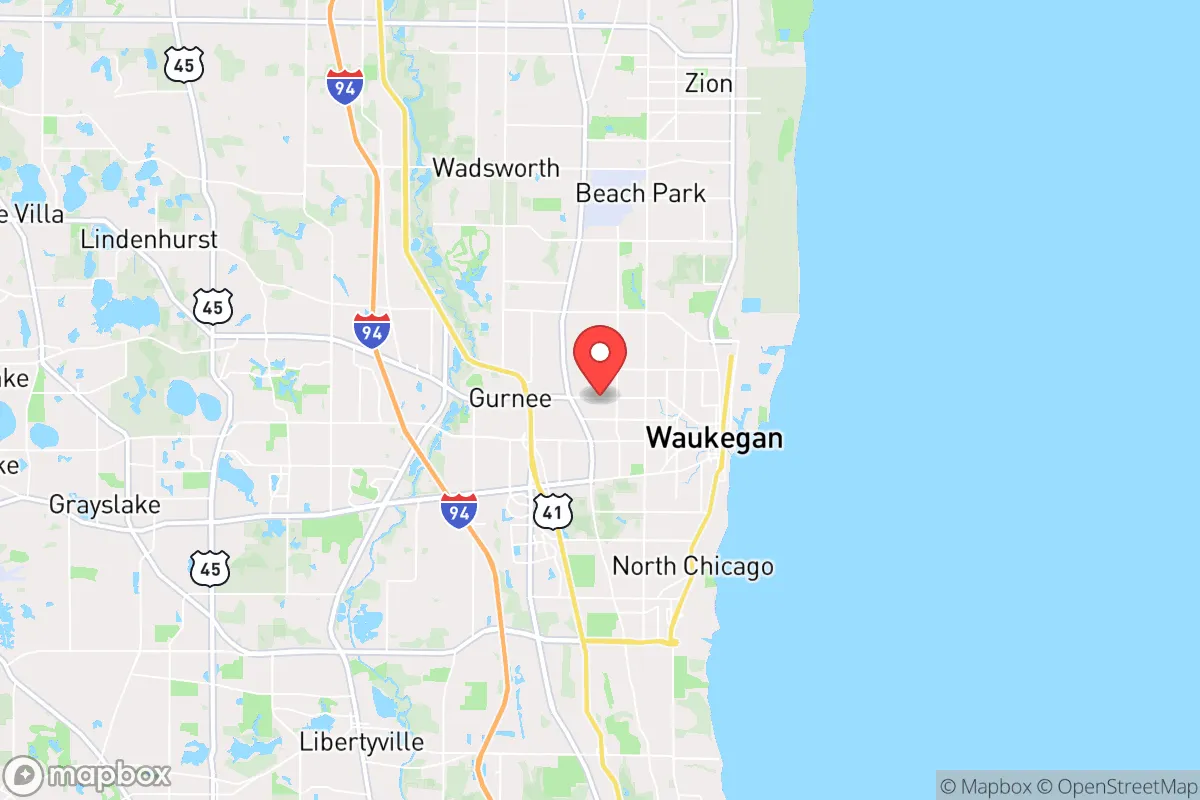
District shown is the primary district for this city’s centroid. Cities may span multiple districts.
Local Political AnalysisPolitical Analysis of Waukegan, IL
Waukegan’s political climate has shifted hard to the left over the past decade, and if you’ve lived here as long as I have, you’ve watched it happen in real time. The Cook Partisan Voting Index (PVI) for the area is D+12, meaning the city leans 12 points more Democratic than the national average—and that number has only gotten more lopsided since the 2020 redistricting. Local elections are rarely competitive anymore, and the city council and county board seats are almost entirely held by Democrats, many of whom are aligned with the progressive wing of the party. The trajectory is clear: Waukegan is becoming a one-party town, and that’s a red flag for anyone who values a balance of power or worries about government overreach into personal freedoms.
How it compares
Drive 15 minutes west to Gurnee or Libertyville, and you’ll find a noticeably different political landscape. Gurnee still has a mix of Republican and independent voices on its village board, and Libertyville’s township elections often see competitive races. Head south to Lake Forest, and you’re in a solidly Republican stronghold where property taxes are lower and zoning laws are more business-friendly. But Waukegan? It’s an island of deep-blue politics in a county that’s otherwise purple. Even neighboring North Chicago, which is also Democratic, doesn’t have the same intensity of progressive activism you see here. The contrast is stark: while surrounding towns debate fiscal responsibility and local control, Waukegan’s leadership has embraced policies that expand government’s role in daily life—from housing regulations to public health mandates.
What this means for residents
For folks who prefer to keep government out of their business, Waukegan’s political direction is concerning. The city council has passed ordinances that increase oversight on short-term rentals, impose stricter noise and nuisance codes, and expand the police department’s budget without much public debate—all under the banner of “public safety” or “quality of life.” Meanwhile, property taxes have climbed steadily, and there’s little appetite among elected officials to cut spending or reduce the tax burden. If you’re a small business owner or a homeowner who values your Second Amendment rights or wants to keep your property free from overbearing regulations, you’ll feel the squeeze. The school board has also moved left, adopting curriculum changes that emphasize social-emotional learning and diversity initiatives over traditional academics—a shift that has some parents looking at private or charter options.
On the cultural side, Waukegan has become a hub for activism around immigrant rights and environmental justice, which sounds noble on paper but often translates into policies that prioritize symbolic gestures over practical solutions. The city declared itself a “Welcoming City” for immigrants, which has created tension with federal immigration enforcement and made some residents uneasy about local law enforcement’s role. There’s also a growing push for “defund the police” rhetoric at community meetings, even though crime rates in parts of the city remain stubbornly high. The long-term outlook? Unless there’s a significant shift in voter turnout or a wave of new residents who lean conservative, Waukegan will keep moving left. If you’re thinking of moving here, just know that your vote—and your voice—will be in the minority, and the local government’s appetite for expanding its reach shows no signs of slowing down.

State Political ClimatePolitical Climate in Illinois
State Political AnalysisPolitical Environment in the State
Illinois has been a reliably blue state in presidential elections since 1992, but the picture is far more complex than a simple partisan label. The state is dominated by the Chicago metropolitan area, which accounts for roughly two-thirds of the population and drives the statewide Democratic lean. Over the last 10-20 years, the political center of gravity has shifted further left, with the Democratic Party consolidating power in Springfield and Cook County, while the rest of the state has grown increasingly Republican. For a conservative considering a move, Illinois presents a stark choice: live in a high-tax, heavily regulated environment with deep progressive roots, or find refuge in the more culturally conservative downstate regions where the fight for personal freedom is ongoing.
Urban vs. rural divide
The political map of Illinois is a textbook case of the urban-rural split. Chicago and its inner suburbs (Cook County) are the engine of Democratic power, delivering margins of 70-80% for statewide Democrats. The collar counties—DuPage, Lake, Kane, and Will—were once reliably Republican but have shifted purple or blue in recent cycles, driven by professional-class migration and changing demographics. For example, DuPage County voted for Joe Biden in 2020 after supporting Trump in 2016, a clear sign of suburban drift. Meanwhile, downstate Illinois—places like Peoria, Springfield, and the southern tip near Cairo—vote heavily Republican. The "Little Egypt" region, including counties like Williamson and Saline, often votes 70%+ Republican. The divide is so sharp that a drive from Chicago to Carbondale feels like crossing into a different country, with gun rights, church attendance, and small-town values dominating the landscape south of I-80.
Policy environment
Illinois’s policy environment is a cautionary tale for conservatives. The state has the second-highest property tax burden in the nation, with effective rates averaging over 2% of home value. The state income tax is a flat 4.95%, but combined with high sales taxes (Cook County adds a 1.75% levy on top of the state’s 6.25%), the overall tax load is punishing. In 2021, the state eliminated the flat tax via a constitutional amendment, but voters rejected a progressive income tax in 2020—a rare win for fiscal conservatives. Education policy is heavily unionized, with the Chicago Teachers Union wielding outsized influence; school choice is limited, and homeschooling regulations are moderate but not as free as in neighboring Indiana or Missouri. Illinois is a sanctuary state, with the TRUST Act (2017) limiting local law enforcement cooperation with federal immigration authorities. Election laws are among the most liberal in the Midwest: no-excuse mail-in voting, same-day registration, and automatic voter registration are all in place, which conservatives often view as undermining election integrity.
Trajectory & freedom
Over the past decade, Illinois has moved decisively toward less personal freedom in several key areas. Gun rights have been severely curtailed: the 2023 Protect Illinois Communities Act banned the sale and possession of many semi-automatic firearms and high-capacity magazines, a direct blow to Second Amendment rights. The state also requires a Firearm Owner’s Identification (FOID) card, a system critics call a de facto registry. On medical autonomy, Illinois expanded abortion access via the Reproductive Health Act (2019), which removed parental notification requirements and allowed late-term procedures—a stark contrast to neighboring states. Parental rights have taken hits too: the state mandates comprehensive sex education in public schools, and a 2023 law requires schools to allow students to use bathrooms matching their gender identity without parental consent. Property rights are under pressure from high property taxes and a strong eminent domain record, though the state has not gone as far as some coastal states on rent control. The overall trajectory is one of expanding government control over personal choices, from what you can own to how you raise your kids.
Civil unrest & political movements
Illinois has seen its share of political flashpoints. The 2020 George Floyd protests in Chicago resulted in widespread looting and property damage, with the city’s response criticized as both heavy-handed and ineffective. The state’s sanctuary policies have made it a destination for illegal immigration, with buses from Texas dropping migrants in Chicago in 2023-2024, straining city resources and sparking local backlash. On the right, the Illinois Family Institute and local gun rights groups like the Illinois State Rifle Association remain active, but they face an uphill battle in a state legislature controlled by Democrats. Election integrity is a hot-button issue: the 2020 election saw widespread use of mail-in ballots, and while no major fraud was proven, many conservatives remain skeptical of the state’s voting system. The city of Aurora, once a conservative stronghold, has seen its politics shift left as its immigrant population grows, while places like Effingham and Quincy remain bastions of traditional values. The divide is visible in everyday life: drive through Chicago and you’ll see BLM murals and pride flags; drive through downstate and you’ll see Trump signs and "Don't Tread on Me" flags.
Projection
Looking ahead 5-10 years, Illinois is likely to become even more polarized. Demographic trends favor the Democrats: Chicago’s population is slowly declining, but the suburbs are growing and becoming more diverse, while downstate counties are shrinking. The state’s fiscal situation is dire—pension debt exceeds $140 billion—which will likely force either massive tax hikes or severe service cuts, neither of which bodes well for freedom. The exodus of residents to lower-tax states like Florida, Texas, and Tennessee is accelerating, and those who remain are increasingly those who either benefit from government programs or are tied to the public sector. For a conservative moving in now, expect to see continued erosion of Second Amendment rights, higher taxes, and a political culture that views personal liberty as secondary to collective goals. The best bet for a freedom-minded resident is to settle in a downstate county like McLean (Bloomington-Normal) or Madison (Edwardsville), where local governments are more conservative, but even there, state-level policies will constrain your choices.
Bottom line: Illinois is not a state for someone who values low taxes, gun rights, or local control. If you’re a conservative considering a move here, do so only if your job or family ties make it unavoidable. The state’s political trajectory is firmly leftward, and the cost—both financial and in terms of personal freedom—is high. For parents, the education system and parental rights landscape are particularly concerning. If you do move, choose your county carefully, and be prepared to fight for your values at the local level, because the state government won’t be on your side.
* Values derived from national, state, county, city and local statistics and may differ in a specific area. Last updated: 2026-04-29T21:23:45.000Z
Narrative content on this page is AI-generated and may contain mistakes. Verify any details that matter before acting on them.
ReloMaps may earn a commission from affiliate links at no extra cost to you.

