 Popular

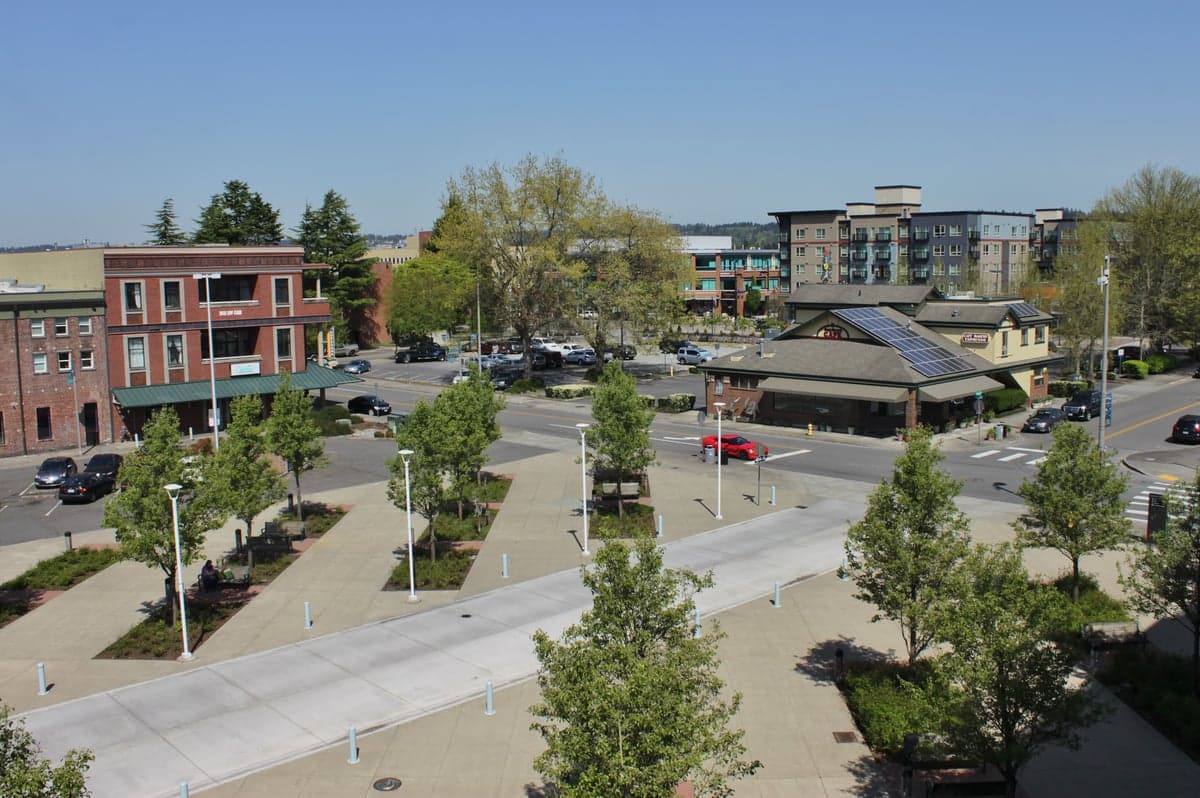
Photo: Wikipedia
Demographics of Auburn, WA
Affluence Level in Auburn, WA
A middle-class area roughly in line with national averages across income, home values, education, and employment.
People of Auburn, WA
The people of Auburn, Washington today form a working-to-middle-class, racially diverse community of 85,455 residents, characterized by a strong blue-collar identity rooted in its railroad and manufacturing past. The city is notably less white (49.0%) than the surrounding region, with significant Hispanic (18.8%), East/Southeast Asian (10.1%), and Black (7.4%) populations, plus a smaller but established Indian-subcontinent community (1.6%). Auburn feels more like a self-contained industrial town than a Seattle bedroom suburb, with a higher share of trades workers and a lower college attainment rate (27.0%) than neighboring cities like Kent or Federal Way.
How the city was settled and grew
Auburn’s population history begins with the 1883 arrival of the Northern Pacific Railroad, which established the town as a freight and repair hub. The original white settlers—mostly Northern European immigrants and migrants from the Midwest—built homes in what is now Downtown Auburn and along the railroad corridor. The city incorporated in 1891, and its early economy centered on railroad maintenance, coal mining in nearby Black Diamond, and agriculture in the fertile Green River Valley. Japanese immigrants arrived in the 1910s and 1920s to work as farm laborers, establishing a small but tight-knit community in the West Hill neighborhood, where many truck farms operated. The 1940s brought a second wave: African American families moving north for wartime manufacturing jobs at the Boeing Renton plant and the Seattle-Tacoma Shipyard, settling in North Auburn and along the Lea Hill corridor. By 1950, Auburn’s population had reached roughly 6,000, still overwhelmingly white but with visible Japanese and Black minorities.
Modern era (post-1965)
The 1965 Hart-Cellar Act reshaped Auburn’s demographics dramatically. Vietnamese refugees arrived in the late 1970s and 1980s, many sponsored by local churches, and concentrated in Downtown Auburn and the West Hill area, where they opened restaurants and grocery stores. Hispanic migration—primarily from Mexico and Central America—accelerated in the 1990s, drawn by construction, landscaping, and warehouse jobs in the Green River Valley. These families settled heavily in South Auburn and along the Valley corridor near the river. The 2000s saw a smaller but notable influx of Indian-subcontinent professionals working in tech and healthcare, who tended to locate in newer subdivisions on Lea Hill rather than older neighborhoods. By 2020, Auburn had become a majority-minority city: the white share fell from 72% in 2000 to 49% in 2024, while the Hispanic share rose from 11% to 18.8% and the East/Southeast Asian share grew from 6% to 10.1%. The Black population held steady around 7-8%, sustained by both longtime families and newer African immigrants. The foreign-born share (12.9%) is moderate for the region—lower than SeaTac or Tukwila, but higher than rural King County.
The future
Auburn’s population is trending toward further diversification, but the pace is slowing. The Hispanic share is still growing but at a decelerating rate as housing costs push new arrivals farther south to Puyallup or Graham. The East/Southeast Asian community is plateauing, with younger generations assimilating and moving to suburbs like Covington or Maple Valley. The Indian-subcontinent population, though small (1.6%), is growing steadily as tech workers seek affordable single-family homes on Lea Hill and in newer developments near the Auburn SuperMall. The white population is aging and declining in absolute numbers, as younger white families choose farther-out exurbs. The city is not tribalizing into hostile enclaves—neighborhoods like West Hill and South Auburn are genuinely mixed—but distinct ethnic clusters persist: Vietnamese businesses along Main Street, Hispanic families in the Valley, and Indian professionals on Lea Hill. The next decade will likely see Auburn become a stable, majority-minority city of 90,000-95,000, with a growing share of second-generation immigrant families who identify as simply American.
For someone moving in now, Auburn offers a genuinely diverse, working-class community where no single group dominates—a place where the railroad-era grit still shows, but the faces have changed. The city is becoming more suburban and less industrial, but it retains a blue-collar authenticity that newer planned communities lack. The key trade-off: lower housing costs than Seattle or Bellevue, but also lower college attainment and fewer white-collar jobs within city limits.

* Values derived from national, state, county, city and local statistics and may differ in a specific area. Last updated: 2026-04-21T11:11:02.000Z
Narrative content on this page is AI-generated and may contain mistakes. Verify any details that matter before acting on them.
ReloMaps may earn a commission from affiliate links at no extra cost to you.

