Photo: Wikipedia
Political ClimatePolitical Climate in Brandon, FL
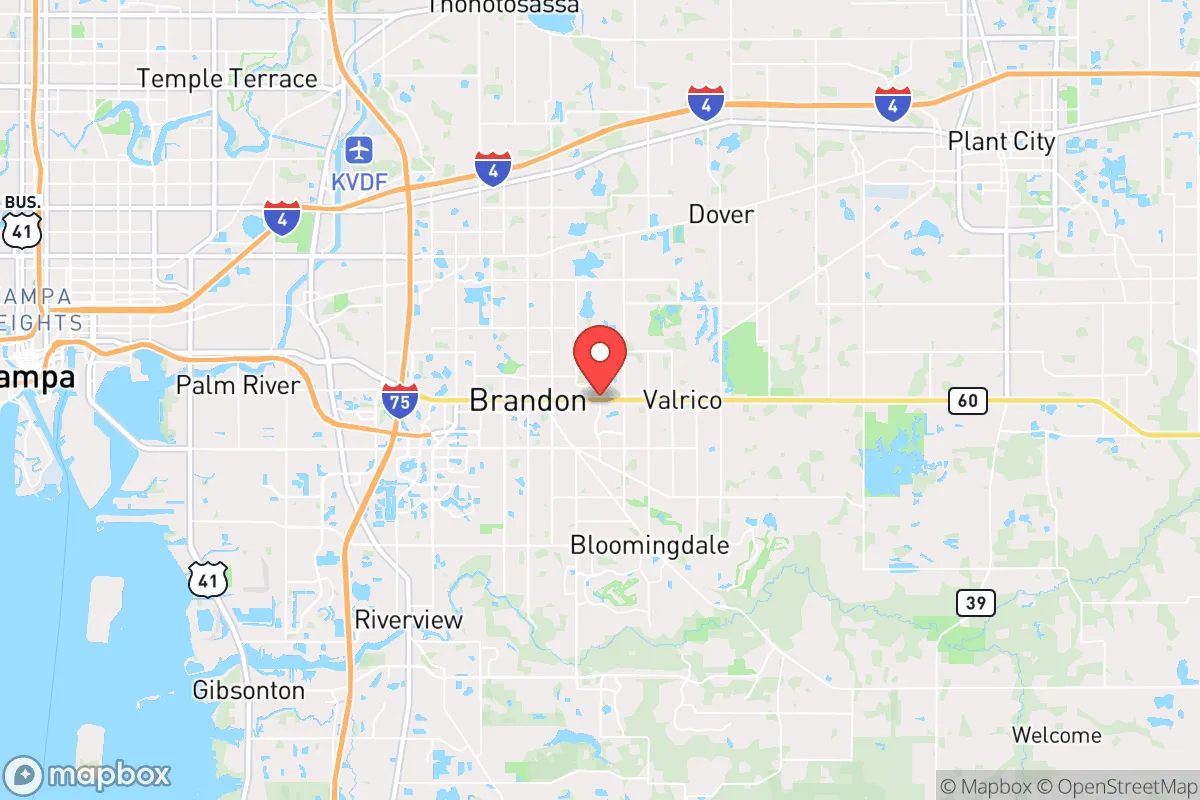
District shown is the primary district for this city’s centroid. Cities may span multiple districts.
Local Political AnalysisPolitical Analysis of Brandon, FL
Brandon, Florida, has long been a solidly conservative community, and that hasn't changed much despite the waves of newcomers flooding the Tampa Bay area. The area's Cook Partisan Voting Index (PVI) of R+7 tells the story: this is a place where traditional values and limited-government thinking still hold strong, even as the rest of Hillsborough County gets pulled in different directions. While the surrounding state of Florida as a whole sits at R+5, Brandon's numbers show it's a bit more resistant to the progressive shifts you see creeping into places like Tampa or St. Petersburg. If you've lived here a while, you've watched the strip malls and subdivisions multiply, but the political DNA—skeptical of government overreach, protective of personal freedoms—hasn't budged much.
How it compares
When you stack Brandon against the rest of Florida, the difference is subtle but real. The state's R+5 PVI reflects a mix of deep-red rural counties and increasingly purple urban centers like Miami-Dade and Orange County. Brandon, though, sits in a sweet spot: it's suburban enough to avoid the hard-left activism of downtown Tampa, but close enough to feel the pressure. Drive ten miles west into Tampa proper, and you'll hit precincts that voted for Biden in 2020; head east into rural Polk County, and you're in Trump country by 20 points. Brandon splits the difference, leaning conservative but not extreme. The real contrast is with nearby towns like Valrico or Riverview, which share a similar vibe, versus the more liberal enclaves of South Tampa or St. Pete. What keeps Brandon grounded is a strong sense of local community—folks here tend to vote with their wallets and their rights in mind, not with whatever trend is blowing through the state capital.
What this means for residents
For someone living in Brandon, the political climate translates into a daily life that feels less like a battleground and more like a stable, predictable place. You don't see the same kind of aggressive government overreach that you might in blue strongholds—no surprise mask mandates lingering on, no heavy-handed zoning fights over density. Property taxes and regulations are kept in check by a county commission that leans center-right, and the local school board has resisted the kind of curriculum battles that dominate headlines in Broward or Palm Beach. That said, there's a growing unease among longtime residents as Tampa's influence spreads. The influx of out-of-state transplants brings with it a push for more transit-oriented development and "equity" policies that feel like a foot in the door for bigger government. The concern is that Brandon's conservative character could get diluted if the county keeps tilting left, but for now, the community holds the line.
Culturally, Brandon is a place where the Second Amendment is respected, property rights are taken seriously, and the phrase "leave us alone" isn't a slogan—it's a way of life. You'll find more churches than coffee shops, more pickup trucks than Teslas, and a general attitude that government should stay out of your business. The biggest policy distinction from the rest of Florida is the local resistance to Tallahassee's occasional overreach, like when the state tried to preempt local gun ordinances a few years back—Brandon's representatives pushed back hard. Looking ahead, the long-term trend is uncertain. If the Tampa Bay metro keeps growing, Brandon could become a battleground suburb like those in Virginia or Colorado. But for now, it remains a pocket of sanity where personal freedom still comes first, and that's worth holding onto.

State Political ClimatePolitical Climate in Florida
State Political AnalysisPolitical Environment in the State
Florida is a solidly Republican state with a Cook PVI of R+5, but that number only tells part of the story. Over the past 20 years, the state has shifted from a classic swing state — where elections were decided by a few thousand votes — to a reliably red stronghold, driven by massive in-migration of conservatives from the Northeast and Midwest, and a growing Hispanic electorate that leans right in places like Miami-Dade. The dominant coalition is a mix of suburban families, retirees, and rural voters who have consistently rejected progressive overreach, though the state still has deep blue pockets in urban centers that keep things interesting.
Urban vs. rural divide
The political map of Florida is a tale of three Floridas. The I-4 corridor, running from Tampa through Orlando to Daytona, is the traditional battleground, but even that has shifted right in recent cycles. Miami-Dade County, once a Democratic stronghold, flipped hard in 2020 and 2022, with Cuban-American and Venezuelan voters rejecting socialist rhetoric and pushing the county to the right — a trend that has only accelerated. Meanwhile, Jacksonville (Duval County) and Tampa (Hillsborough County) are now purple-to-leaning-red, while Orlando (Orange County) remains the last major blue bastion, buoyed by a younger, more transient population. The rural Panhandle — places like Panama City, Pensacola, and the sprawling counties north of Gainesville — are deep red, often voting 70-80% Republican. The divide isn't just about cities versus farms; it's about culture. The urban cores have become increasingly progressive on social issues, while the suburbs and exurbs — places like St. Johns County (south of Jacksonville) and Collier County (Naples) — are among the most conservative in the nation.
Policy environment
Florida’s policy environment is a case study in conservative governance. There is no state income tax, which is a massive draw for high-earners and retirees alike. The regulatory posture is business-friendly — permitting is streamlined, and the state has preempted local governments from enacting their own rent control or minimum wage hikes. On education, Florida leads the nation in school choice, with universal Education Savings Accounts (HB 1, 2023) that let parents use state funds for private school, homeschooling, or tutoring. The state also banned Critical Race Theory in schools (HB 7, 2022) and passed the Parental Rights in Education Act (HB 1557, 2022), which prohibits classroom instruction on sexual orientation and gender identity in early grades. Healthcare policy is mixed: Florida did not expand Medicaid, keeping costs lower for taxpayers, but the state has also seen rising insurance premiums due to litigation abuse. Election laws were tightened after 2020 (SB 90, 2021), adding voter ID requirements, limiting drop boxes, and banning ballot harvesting — measures that have drawn lawsuits but remain in effect. Gun rights are robust: permitless carry was signed into law (HB 543, 2023), and the state has strong preemption laws preventing local gun control.
Trajectory & freedom
Florida is becoming more free by almost any measure, especially compared to states like New York or California. The trajectory is unmistakably toward expanding personal liberty. The permitless carry law (HB 543) was a landmark win for gun owners. The state also passed a ban on COVID-19 vaccine mandates for private employers (HB 1, 2023) and prohibited mask mandates in schools (SB 252, 2022). Property rights were strengthened with the passage of SB 250 (2023), which limits homeowners’ association fines and restricts their ability to foreclose on homes over unpaid fees. On the medical autonomy front, Florida banned gender transition procedures for minors (SB 254, 2023) and restricted puberty blockers — a move that has been controversial but popular with conservative parents. The only area where freedom has arguably contracted is in the realm of abortion: the state passed a 15-week ban (HB 5, 2022) and later a six-week ban (SB 300, 2023), which took effect after the Florida Supreme Court upheld it in 2024. For conservative families, this is a feature, not a bug. The overall direction is toward less government intrusion in daily life, lower taxes, and more parental control.
Civil unrest & political movements
Florida has seen its share of political flashpoints, but they tend to be more organized and less chaotic than in other states. The most visible movement is the Moms for Liberty chapter network, which has been highly active in school board races, particularly in Brevard County (Cocoa Beach) and Sarasota County. These groups have successfully flipped several school boards from progressive to conservative. On the left, the Dream Defenders and other activist groups have organized protests over police shootings and racial justice, but these have been smaller and less sustained than in places like Portland or Minneapolis. Immigration politics are a constant undercurrent: Florida passed the toughest anti-sanctuary city law in the country (SB 1718, 2023), requiring businesses with 25+ employees to use E-Verify and making it a felony to transport undocumented immigrants into the state. This has led to some labor shortages in agriculture and construction, but it’s popular with the base. Election integrity remains a hot topic, with the creation of the Office of Election Crimes and Security (2022) and dozens of arrests for alleged voter fraud — though critics say the cases are minor. A new resident would notice that political conversations are common and often heated, but they rarely spill into violence. The culture war is real, but it’s fought at school board meetings and in the legislature, not in the streets.
Projection
Over the next 5-10 years, Florida is likely to become even more conservative. The in-migration pattern is self-reinforcing: people moving from blue states are disproportionately conservative or libertarian-leaning, and they are settling in places like The Villages (Sumter County), Naples, and the Tampa exurbs. The Hispanic vote, especially among Cubans, Venezuelans, and Nicaraguans, is trending right, and as these communities grow, the Democratic path to winning statewide elections narrows further. The only wildcard is climate change: rising sea levels and stronger hurricanes could eventually drive up insurance costs and slow growth in coastal areas, but for now, the state is booming. Expect more preemption of local progressive ordinances, more school choice expansion, and continued tax cuts. The state may also see a push for constitutional carry (already done) and further restrictions on local government authority. For someone moving in now, the Florida of 2035 will likely feel very similar to today — just more crowded, more conservative, and more expensive.
Bottom line for a new resident: If you’re looking for a state that respects your right to live your life without government interference — whether that means carrying a gun, choosing your child’s school, or keeping more of your paycheck — Florida is one of the best bets in the country. The politics are stable, the direction is clear, and the culture war is being won by the side that values freedom over control. Just be prepared for the heat — both the weather and the political conversations at the dinner table.
* Values derived from national, state, county, city and local statistics and may differ in a specific area. Last updated: 2026-05-13T16:45:04.000Z
Narrative content on this page is AI-generated and may contain mistakes. Verify any details that matter before acting on them.
ReloMaps may earn a commission from affiliate links at no extra cost to you.

