Photo: Wikipedia
Political ClimatePolitical Climate in Carrollton, TX
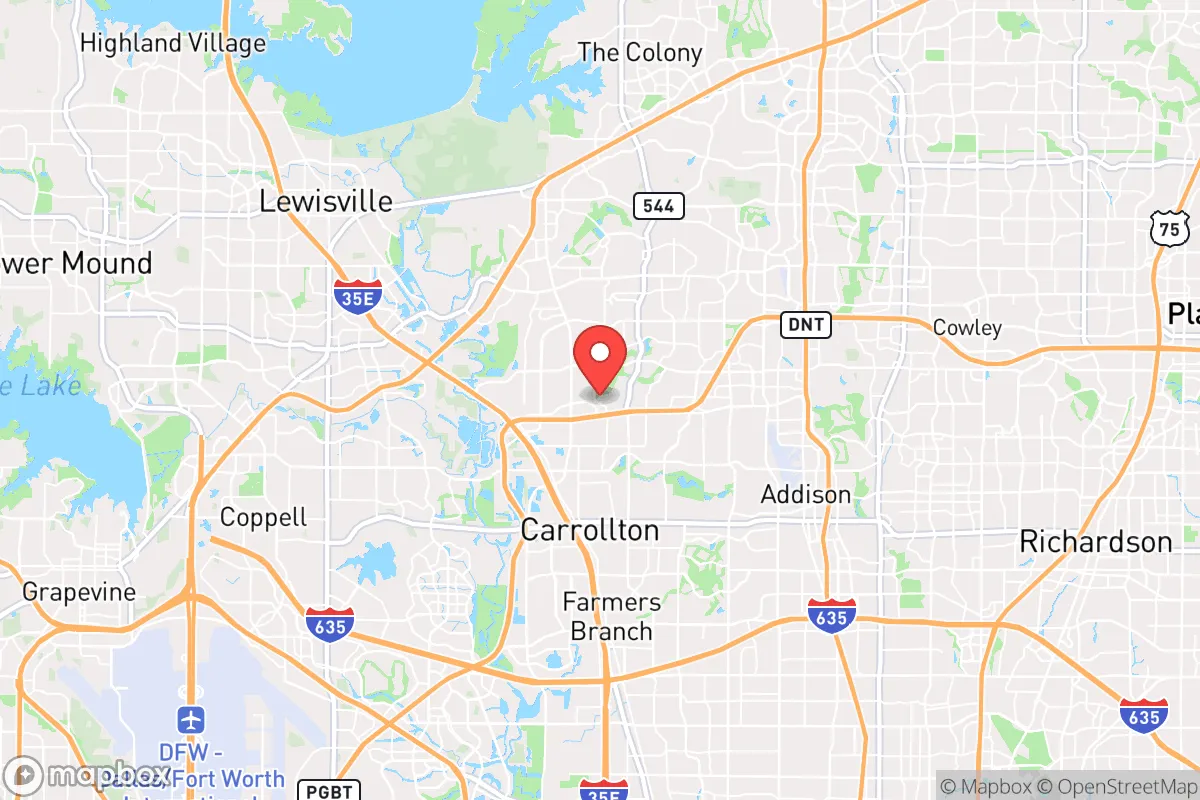
District shown is the primary district for this city’s centroid. Cities may span multiple districts.
Local Political AnalysisPolitical Analysis of Carrollton, TX
Carrollton’s political climate has shifted noticeably over the past decade, and if you’ve lived here as long as I have, you’ve felt it. The Cook PVI now sits at D+13, meaning the city leans about 13 points more Democratic than the national average—a stark contrast to the reliably conservative suburbs I grew up in. In the 2024 election, Dallas County as a whole went for Biden by a similar margin, and Carrollton’s precincts followed suit, with many voting over 60% Democratic. That’s a far cry from the 1990s and early 2000s, when this area was a solid red stronghold. The trajectory is clear: the old guard of fiscal conservatism and limited government is being replaced by a younger, more diverse population that’s increasingly comfortable with progressive policies.
How it compares
Drive ten miles north to Frisco or Plano, and you’ll find a completely different story. Frisco’s Collin County precincts voted +12 Republican in 2024, and Plano’s western neighborhoods still lean red. Even Lewisville, just west of Carrollton, has a more balanced split, with several precincts voting within 5 points of the national average. But Carrollton sits squarely in the blue bubble of Dallas County, surrounded by cities like Addison and Farmers Branch that have similar D+10 to D+15 leanings. The contrast is jarring: you can cross the county line into Denton County and feel the political atmosphere shift—more “Keep the Government Out” signs, fewer “In This House We Believe” yard signs. It’s a reminder that Carrollton’s politics are increasingly out of step with the broader North Texas suburban ethos of low taxes and personal liberty.
What this means for residents
For those of us who value limited government and personal freedoms, the local trends are concerning. The city council has pushed through zoning changes that prioritize dense, multi-family housing over single-family neighborhoods—a move that many see as government overreach into property rights. School board meetings in the Carrollton-Farmers Branch ISD have become battlegrounds over curriculum transparency and parental rights, with progressive board members often voting to limit public input. Property taxes remain high, hovering around 2.3% of assessed value, and there’s little appetite among local leaders for the kind of tax relief you’d see in nearby Coppell or Southlake. If you’re a conservative, you’ll find yourself increasingly on the defensive, watching policies that once seemed unthinkable—like sanctuary city ordinances and diversity, equity, and inclusion mandates in city hiring—become routine.
Cultural and policy distinctions
One thing that hasn’t changed is the city’s strong sense of community, but even that’s being tested. The annual Carrollton Festival at the Square used to be a non-political gathering; now you’ll see booths from activist groups pushing everything from defunding the police to climate action plans. The city’s “Welcoming Carrollton” initiative, which officially designates the city as a sanctuary for immigrants, has been a flashpoint—supporters call it compassionate, but critics see it as a direct challenge to federal law and public safety. On the bright side, the local police department still maintains a professional, non-political stance, and crime rates remain low compared to Dallas proper. But if you’re looking for a place where your vote for limited government actually counts, you might want to look north to Little Elm or Celina. Carrollton’s future is blue, and for those of us who remember when it wasn’t, that’s a tough pill to swallow.

State Political ClimatePolitical Climate in Texas
State Political AnalysisPolitical Environment in the State
Texas is a solidly Republican state at the statewide level, but the political climate is far more complex than a simple red-state label suggests. The dominant coalition is a mix of rural conservatives, suburban moderates, and a growing libertarian-leaning base, but the state has been shifting rightward on cultural issues while seeing a slow, steady Democratic creep in the suburbs. Over the past 20 years, the GOP has consolidated power in the legislature and governor’s mansion, but the margin of victory for statewide Republicans has narrowed from double digits to single digits in recent cycles—a trend driven almost entirely by explosive growth in the urban cores of Austin, Dallas, Houston, and San Antonio.
Urban vs. rural divide
The political map of Texas is a tale of two worlds. The vast rural expanse—places like Lubbock, Amarillo, and Tyler—votes overwhelmingly Republican, often by 70-80% margins. These areas are the backbone of the state’s conservative identity. Meanwhile, the major metros are the battlegrounds. Austin is the state’s progressive stronghold, with Travis County routinely voting 70%+ Democratic. Dallas and Houston are more purple, with Harris County (Houston) flipping to Biden in 2020 and Dallas County trending blue, but both still have deep-red suburbs like Collin County (north of Dallas) and Fort Bend County (southwest of Houston) that are becoming more competitive. El Paso is a Democratic bastion, but its influence is limited by geography. The real story is the suburban shift: once-reliable GOP strongholds like Williamson County (north of Austin) and Denton County are now toss-ups, with educated, moderate voters drifting away from the GOP on social issues while still favoring low taxes and business-friendly policies.
Policy environment
Texas’s policy environment is a mixed bag for conservatives. On the plus side, there is no state income tax, a constitutional cap on property tax growth (Proposition 4, 2023), and a regulatory climate that makes it easy to start a business. The state has a constitutional carry law (permitless carry, effective 2021) and strong Second Amendment protections. Education policy is a flashpoint: the state has expanded school choice through Education Savings Accounts (HB 3, 2025) and banned Critical Race Theory in public schools (SB 3, 2021). Healthcare is a sore spot—Texas has not expanded Medicaid, which keeps taxes low but leaves rural hospitals struggling. Election laws were tightened with SB 1 (2021), adding voter ID requirements and limiting mail-in ballot access, which conservatives see as integrity measures but critics call suppression. The state also passed a near-total abortion ban (SB 8, 2021) and a trigger law (HB 1280) that took effect after Dobbs. For a conservative, the policy environment is largely aligned with limited government, but the property tax burden—even with caps—remains a top complaint among homeowners.
Trajectory & freedom
On the freedom front, Texas has been a mixed bag over the last five years. On the positive side, constitutional carry (HB 1927, 2021) expanded gun rights significantly. The state also passed parental rights legislation (HB 900, 2023) that restricts sexually explicit content in school libraries and gives parents more say in curriculum. Property rights were strengthened with the Texas Property Rights Act (2021), limiting eminent domain abuse. However, there are concerning trends. The state’s COVID-era executive orders (2020-2021) saw Governor Abbott impose business closures and mask mandates, which many conservatives viewed as government overreach. More recently, the Texas Privacy Act (HB 4, 2023) created a state-level data privacy framework that, while well-intentioned, adds regulatory complexity. The biggest freedom concern is property taxes: despite caps, Texas has one of the highest effective property tax rates in the nation, and local governments continue to find ways to increase assessments. The state is also seeing a push for school choice (HB 3, 2025) that gives parents more freedom, but the fight over local control vs. state mandates remains heated.
Civil unrest & political movements
Texas has seen its share of political flashpoints. The 2020 Black Lives Matter protests in Austin, Dallas, and Houston were large and occasionally violent, leading to property damage and a lasting distrust of local law enforcement in some circles. The “Defund the Police” movement gained traction in Austin, where the city council cut the police budget by $150 million in 2020—only to reverse course after a spike in violent crime. On the right, the “Texas Nationalist Movement” (Texit) has gained some traction, with a 2022 poll showing 18% support for secession, though it remains fringe. Immigration is a constant flashpoint: Governor Abbott’s Operation Lone Star (2021-present) deployed state troopers and National Guard to the border, busing migrants to sanctuary cities like New York and Chicago. This has been popular with conservatives but has drawn lawsuits and federal pushback. Election integrity remains a live issue: the 2020 election saw Trump win Texas by 5.5 points, but conspiracy theories about fraud in Harris County persist among some activists. A new resident will notice the political signage—yard signs for local races are everywhere, and the divide between “Keep Texas Red” and “Turn Texas Blue” is visible in every suburb.
Projection
Over the next 5-10 years, Texas is likely to become more politically competitive, but not necessarily more liberal. The in-migration from California and other blue states is real—about 1,000 people move to Texas per day—but many of those newcomers are conservatives or libertarians fleeing high taxes and regulation. The suburbs of Dallas, Houston, and Austin will continue to be the battlegrounds. If the GOP can hold onto suburban voters by focusing on economic freedom and school choice while avoiding culture war fatigue, the state will remain red. However, if the party pushes too hard on social issues (e.g., further abortion restrictions or book bans), the suburbs could flip blue. The Hispanic vote is the wildcard: Texas Hispanics are trending rightward, especially in the Rio Grande Valley, where counties like Starr and Zapata shifted 10-15 points toward Trump in 2020. If that trend continues, the GOP could build a durable majority. The biggest risk is government overreach from both parties: if property taxes continue to rise and the state keeps expanding its regulatory footprint, the libertarian-leaning base may become disillusioned.
For a new resident, the bottom line is this: Texas is still a state where your personal freedoms—gun rights, low taxes, school choice—are broadly protected, but you need to be strategic about where you live. If you want a reliably conservative environment, look at the exurbs of Fort Worth or the Hill Country around San Antonio. If you want a more moderate, business-friendly atmosphere, the suburbs of Dallas and Houston offer a good balance. Avoid Austin unless you’re comfortable with progressive local governance. The political climate is shifting, but for now, Texas remains one of the best states in the country for a conservative-leaning individual or family who values freedom and wants to be left alone to live their life.
* Values derived from national, state, county, city and local statistics and may differ in a specific area. Last updated: 2026-04-22T01:57:23.000Z
Narrative content on this page is AI-generated and may contain mistakes. Verify any details that matter before acting on them.
ReloMaps may earn a commission from affiliate links at no extra cost to you.

