Photo: Wikipedia
Political ClimatePolitical Climate in Firestone, CO
District shown is the primary district for this city’s centroid. Cities may span multiple districts.
Local Political AnalysisPolitical Analysis of Firestone, CO
Firestone, Colorado, sits smack in the middle of a political tug-of-war, and if you’ve been around here long enough, you can feel the ground shifting under your feet. The Cook PVI rating of EVEN tells you everything you need to know: this town is a true battleground, and it wasn’t always that way. For years, Firestone was reliably conservative, a quiet, family-oriented community where folks minded their own business and the government stayed out of the way. But as the Front Range expands and new people pour in from places like Boulder and Denver, that old-school vibe is getting squeezed. You’re starting to see more progressive policies creep into local discussions, and it’s got a lot of us watching closely.
How it compares
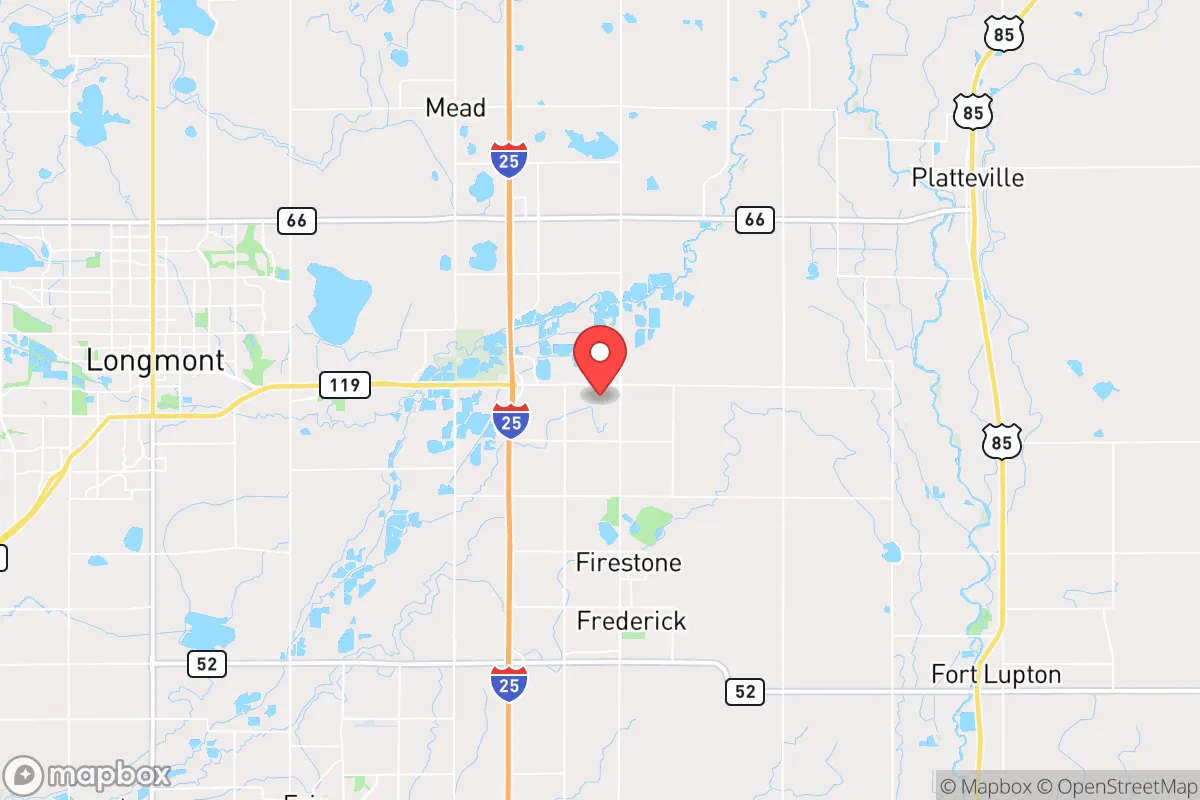
To really get Firestone’s political climate, you have to look at the neighbors. Head west a few miles to Longmont, and you’re in a solidly blue stronghold—Boulder County’s influence is strong there, with all the taxes and regulations that come with it. Go south to Frederick, and it’s a similar story to Firestone, but maybe a touch more moderate. The real contrast is north, up in places like Mead or even further to Berthoud, where the conservative roots are still deep and the pushback against progressive overreach is louder. Firestone is the awkward middle child: we’ve got the rural, pro-freedom spirit of Weld County, but we’re close enough to the Denver metro that we’re constantly fighting off the kind of zoning, spending, and policy experiments that folks out east would never tolerate. It’s a daily reminder that your vote matters more here than almost anywhere else in the state.
What this means for residents
For the average Firestone resident, this political split means you can’t take anything for granted. Property taxes and local fees are a constant point of tension, with some pushing for more “amenities” that inevitably come with higher costs and more government control. You’ll see it in the school board meetings, where battles over curriculum and parental rights are heating up. It also means your personal freedoms—like how you use your land, what you can build, or even how you run a small business—are under a microscope. The shift towards progressive ideology is concerning because it often starts with “good intentions” but ends with more red tape and less liberty. If you value being left alone to live your life without the county or state telling you how to do it, you’ve got to stay engaged. The long-term trajectory depends on whether the new arrivals adopt the local culture or try to remake Firestone in the image of the places they left.
Culturally, Firestone still holds onto some strong distinctions. You’ll find plenty of folks who fly the Gadsden flag right alongside the American one, and the local events—like the annual Firestone SummerFest—still feel more like a county fair than a city-sponsored spectacle. But there’s a growing push for things like “complete streets” and transit-oriented development that sound nice on paper but often lead to more government intrusion into daily life. The real test will be the next few election cycles. If we can keep the focus on local control, low taxes, and personal responsibility, Firestone can stay the kind of place where you can raise a family without the government breathing down your neck. If not, well, you might start seeing the same policies that drove people out of Boulder in the first place. Keep your ear to the ground and your vote ready—that’s the only way to keep this town from losing its soul.

State Political ClimatePolitical Climate in Colorado
State Political AnalysisPolitical Environment in the State
Colorado has shifted from a reliably purple swing state to a solidly blue stronghold over the past two decades, with Democrats now controlling the governorship, both U.S. Senate seats, and both chambers of the state legislature. The state voted for Hillary Clinton by 5 points in 2016, Joe Biden by 13 points in 2020, and Kamala Harris by 11 points in 2024, cementing a leftward trajectory that accelerated after 2014. While the Front Range urban corridor drives this lean, the state’s rural and exurban counties remain deeply conservative, creating a stark political geography that feels like two different Colorados.
Urban vs. rural divide
The political map of Colorado is dominated by the Denver-Boulder-Aurora metroplex, which accounts for roughly 60% of the state’s population and votes overwhelmingly Democratic. Denver County itself delivered 80% of its vote to Biden in 2020, while Boulder County hit 77%. The I-25 corridor stretching from Fort Collins down to Colorado Springs is the real battleground: Larimer County (Fort Collins) flipped blue in 2016 and has stayed there, while El Paso County (Colorado Springs) remains a conservative stronghold, voting +15 R in 2024. The Western Slope counties like Mesa (Grand Junction) and Montrose are reliably red, but their populations are too small to offset the Front Range. The real story is the suburban shift: Arapahoe and Jefferson counties, once swing areas, now vote Democratic by 8-12 points, driven by college-educated transplants from California and the Midwest. Rural counties like Baca, Kiowa, and Cheyenne routinely vote 80%+ Republican, but they’re losing population and political clout.
Policy environment
Colorado’s policy environment has become a laboratory for progressive governance, with a state income tax flat rate of 4.4% (down from 4.63% in 2020 due to TABOR refunds) and a sales tax rate of 2.9% that local jurisdictions can pile onto. The Taxpayer’s Bill of Rights (TABOR) still limits revenue growth and requires voter approval for tax increases, but Democrats have found workarounds through fee hikes and enterprise zone expansions. Education policy is dominated by the 2019 Student Success Act, which poured $1.6 billion into K-12 without meaningful accountability measures, while school choice remains strong through charter schools and open enrollment. Healthcare is heavily regulated, with a 2022 public option law (Colorado Option) that caps hospital prices and aims to reduce premiums by 15% by 2025. Election laws have moved sharply left: Colorado now has universal mail-in voting, same-day registration, and automatic voter registration, which critics argue erodes ballot security. The state also enacted a 2021 law banning private prisons and a 2023 law restricting gun magazines to 15 rounds, both of which passed on party-line votes.
Trajectory & freedom
Colorado is becoming less free by any measure of personal liberty, especially for gun owners, parents, and taxpayers. The 2013 magazine ban and universal background checks were just the start; in 2023, the legislature passed a three-day waiting period for all firearm purchases and raised the purchase age to 21, both signed by Governor Jared Polis. Parental rights took a hit with the 2019 “comprehensive sex education” law that mandates LGBTQ+ inclusive curriculum in K-12, and a 2023 law that allows minors to consent to gender-affirming care without parental notification. Medical autonomy has expanded for abortion (codified in 2022) but contracted for COVID-19 vaccine mandates, which were enforced on state employees until a 2023 repeal. Property rights are under pressure from a 2021 law that allows local governments to impose rent control, and a 2023 “land use” bill that preempts local zoning to force higher density housing near transit. The only bright spot for conservatives is the 2020 repeal of the Gallagher Amendment, which had capped residential property tax rates, though this has led to rising property tax bills in fast-growing areas like Douglas County.
Civil unrest & political movements
Colorado has seen significant civil unrest, particularly during the 2020 George Floyd protests, which turned violent in Denver with looting and fires along the 16th Street Mall. The state’s sanctuary policies are a major flashpoint: the 2019 “Safe Communities” law limits cooperation between local law enforcement and ICE, and Denver has repeatedly refused to honor ICE detainers, leading to high-profile incidents like the 2023 release of a Venezuelan gang member who was later charged with murder. Immigration politics are heating up, with Denver busing migrants to other cities and the state spending $42 million on shelter in 2024. On the right, the Colorado Republican Party has fractured between establishment and populist factions, with the 2022 convention endorsing election-denier candidates who lost winnable races. Secession rhetoric is alive in Weld County, which voted in 2013 to explore seceding from Colorado to form the “State of North Colorado,” though it remains symbolic. Election integrity remains a sore point: the 2020 election saw no major fraud cases, but the 2021 audit of Dominion voting machines in Mesa County led to the indictment of Clerk Tina Peters, a Republican who became a martyr for election skeptics.
Projection
Over the next 5-10 years, Colorado will likely become more Democratic and more progressive, driven by continued in-migration from blue states like California, New York, and Illinois. The 2024 election results show that even Colorado Springs is trending purple, with El Paso County’s Republican margin shrinking from 18 points in 2016 to 12 points in 2024. The Western Slope is growing slowly, while the Front Range adds 100,000 people annually, most of whom vote blue. Expect further gun control (assault weapon bans are on the table), tighter rent control, and a push for single-payer healthcare through a 2026 ballot initiative. The state’s energy transition away from oil and gas will accelerate, with a 2023 law banning new drilling permits within 2,000 feet of homes and schools. For conservatives, the only refuge will be rural counties and a few exurban holdouts like Douglas County, which voted +8 R in 2024 but is seeing its margins shrink as Denver commuters move in. The state’s political future is essentially locked in for at least a generation.
For a conservative relocating to Colorado, the bottom line is this: you can find like-minded communities in Colorado Springs, Grand Junction, or the rural Eastern Plains, but you’ll be living under a state government that is actively hostile to gun rights, parental authority, and fiscal conservatism. The Front Range’s political dominance means every statewide election will go blue, and the legislature will keep passing laws that feel like they’re imported from California. If you value personal freedom in the traditional sense—low taxes, minimal regulation, and the right to live your life without government interference—Colorado is no longer the place it was 20 years ago. Choose your county carefully, and be prepared to fight for your values at the local level, because the state-level battle is already lost.
* Values derived from national, state, county, city and local statistics and may differ in a specific area. Last updated: 2026-05-01T08:22:19.000Z
Narrative content on this page is AI-generated and may contain mistakes. Verify any details that matter before acting on them.
ReloMaps may earn a commission from affiliate links at no extra cost to you.

