Photo: Wikipedia
Political ClimatePolitical Climate in Grand Prairie, TX
District shown is the primary district for this city’s centroid. Cities may span multiple districts.
Local Political AnalysisPolitical Analysis of Grand Prairie, TX
Grand Prairie has historically been a bit of a purple patch in the Dallas-Fort Worth metroplex, but the numbers don't lie: with a Cook PVI of D+19, the city has shifted hard to the left over the last decade. If you've been around here since the 90s or early 2000s, you remember when this was a reliably conservative, blue-collar town where folks minded their own business and the city council wasn't pushing a progressive agenda. Today, the political climate leans heavily Democratic, and the trajectory suggests it's only going to get bluer as more people move in from Dallas proper and Arlington. It's not the same Grand Prairie I grew up in, and honestly, that's a little concerning for anyone who values limited government and personal freedom.
How it compares
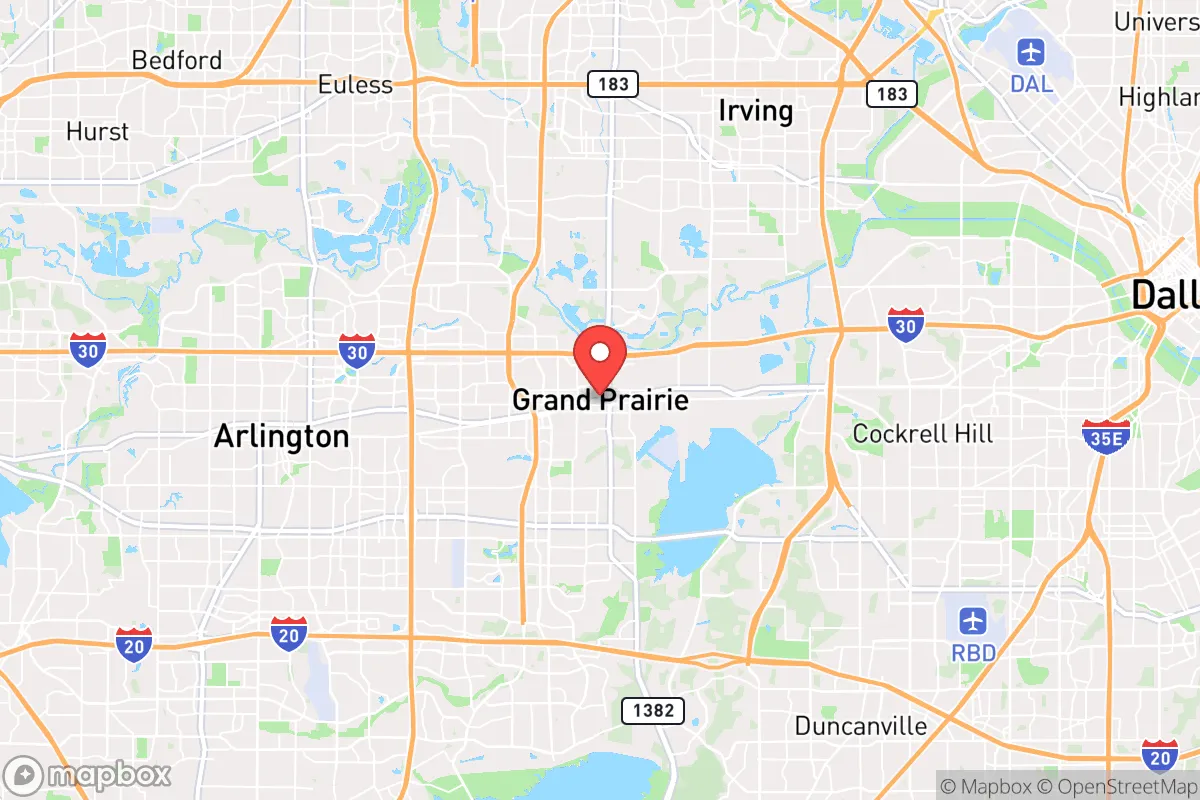
To really understand Grand Prairie's shift, you have to look at the neighbors. Head west to Mansfield or Burleson, and you'll find communities that still lean conservative—places where property taxes are a hot-button issue and the Second Amendment is respected. Drive east into Dallas proper, and you're in deep blue territory. Grand Prairie sits right in the middle, but it's increasingly mirroring Dallas rather than its western suburbs. Arlington, just to the north, is also trending left, but Grand Prairie's D+19 rating actually puts it further left than Arlington's D+14. Meanwhile, Irving to the northeast is a mixed bag, but it hasn't swung as hard. The contrast is stark: you can drive 15 minutes west and feel like you're in a different state politically, which tells you how much the local government here has embraced a more progressive, interventionist approach.
What this means for residents
For those of us who value personal freedoms, the shift in Grand Prairie's political climate has real consequences. The city council and school board have become more willing to impose regulations that feel like overreach—think mask mandates that lasted longer than necessary, zoning changes that favor dense development over single-family neighborhoods, and a general attitude that government knows best. Property taxes have crept up as the city expands services, and there's less pushback from voters because the electorate has changed. If you're a small business owner or a gun owner, you've probably noticed the local climate becoming less friendly to your rights. The long-term trend is worrying: as the city gets bluer, expect more ordinances that restrict personal choice, higher taxes to fund social programs, and a school system that prioritizes ideological conformity over academic excellence.
Culturally, Grand Prairie has always been a diverse, working-class town, and that hasn't changed. But the policy distinctions are becoming more pronounced. The city has embraced sanctuary-like policies that limit cooperation with federal immigration enforcement, which sounds compassionate but raises questions about public safety and rule of law. There's also a push for more public art and "equity" initiatives that feel like virtue signaling rather than practical governance. If you're looking for a place where the government stays out of your life and lets you live as you see fit, Grand Prairie is moving in the opposite direction. Keep an eye on the next few election cycles—if the trend holds, this city could become as progressive as Dallas within a decade, and that's a future that should give any freedom-loving resident pause.

State Political ClimatePolitical Climate in Texas
State Political AnalysisPolitical Environment in the State
Texas has been a reliably Republican state for decades, but the political climate is far from monolithic. The state's overall partisan lean is still solidly red, with Republicans holding every statewide office and both chambers of the legislature, but the margin has been shrinking. In 2024, Donald Trump won Texas by about 9 points, down from 11 points in 2020 and 16 points in 2016. The dominant coalition remains a mix of rural conservatives, suburban moderates, and business-friendly libertarians, but a massive influx of new residents from blue states and rapid urbanization in metros like Austin, Dallas, and Houston are slowly shifting the ground beneath the GOP's feet.
Urban vs. rural divide
The political map of Texas is a stark checkerboard. The big cities — Austin, Houston, Dallas, San Antonio, and El Paso — are deep blue, with Austin and El Paso being the most reliably Democratic. Harris County (Houston) and Dallas County have flipped decisively blue in presidential elections, and Tarrant County (Fort Worth), once a GOP stronghold, is now a battleground. Meanwhile, the vast rural and exurban areas — the Panhandle around Lubbock, East Texas, the Hill Country, and West Texas — vote Republican by 70-80% margins. The suburbs are the real battleground: places like Collin County (north of Dallas) and Williamson County (north of Austin) are still red but trending purple as educated professionals move in. The 2022 election saw Democrats flip a state House seat in Fort Bend County (southwest of Houston), a once-reliable GOP suburb now majority-minority. This urban-rural divide means that while the state legislature remains firmly Republican due to gerrymandering, the big cities are increasingly progressive islands.
Policy environment
Texas's policy environment is defined by its no state income tax, low property tax rates (though local rates vary wildly), and a business-friendly regulatory posture. The state has a right-to-work law, meaning union membership is optional, and it's a "tort reform" pioneer with caps on lawsuit damages. On education, the state funds public schools through a complex Robin Hood system that redistributes property tax revenue from wealthy districts to poor ones, but school choice (vouchers) remains a perennial fight — Governor Greg Abbott pushed hard for it in 2023 but failed to pass it through the House. Healthcare is a mixed bag: Texas has the highest uninsured rate in the nation because it refused to expand Medicaid under Obamacare, but it also has a robust network of community health centers. Election laws have tightened: SB 1 (2021) restricted mail-in voting, added ID requirements, and banned drive-through voting and 24-hour polling places, which were popular in Harris County. The state also has a permitless carry law for handguns (HB 1927, 2021) and a near-total abortion ban (trigger law after Dobbs). For a conservative, the policy environment is generally favorable, but the lack of school choice and high property taxes are persistent frustrations.
Trajectory & freedom
On personal liberty, Texas is a mixed bag trending in two directions. Gun rights expanded significantly with permitless carry in 2021, and the state has a strong castle doctrine and stand-your-ground law. Parental rights were bolstered by the 2023 law banning gender-transition procedures for minors (SB 14) and requiring school districts to notify parents of any changes in a child's mental health or gender expression. On medical autonomy, the state banned COVID-19 vaccine mandates for private employers (SB 7, 2023) and has a law prohibiting government vaccine passports. However, property rights took a hit with the 2023 law allowing the state to seize land for the border wall without landowner consent (SB 3). Taxation freedom is eroding: while there's no income tax, property taxes have risen sharply due to soaring home values, and the state's reliance on sales tax means lower-income residents pay a higher percentage. The 2023 property tax cut (SB 2) provided some relief but didn't cap future increases. The trajectory is toward more government intervention on social issues (protecting traditional values) but less on economic freedom (higher effective tax burden).
Civil unrest & political movements
Texas has seen significant political flashpoints. The 2020 Black Lives Matter protests in Austin and Dallas were large and sometimes violent, leading to the Austin City Council defunding the police by $150 million, which was later partially restored. On the right, the "Operation Lone Star" border security initiative, launched by Governor Abbott in 2021, has been a major political movement, deploying state troopers and National Guard to the border and busing migrants to blue cities. This has sparked legal battles with the Biden administration and created a visible, ongoing crisis in border towns like El Paso and Eagle Pass. Secession rhetoric has flared: the Texas Nationalist Movement, while fringe, has gained some traction online, and the 2022 state GOP platform included a call for a secession referendum. Election integrity remains a hot-button issue: the 2020 election saw Trump's legal challenges fail, but many Republicans remain skeptical of voting machines, and the 2022 primary saw a purge of voter rolls. A new resident will notice the border issue dominating local news, especially in the southern half of the state, and a palpable tension between the blue cities and the red state government.
Projection
Over the next 5-10 years, Texas will likely become more competitive at the statewide level but remain Republican-controlled due to gerrymandering and rural overrepresentation. The in-migration from California and other blue states is slowing but still significant, and those newcomers tend to be moderate or libertarian, not hard-left. The suburbs of Dallas-Fort Worth and Houston will continue to trend purple, while the rural areas will stay deep red. The biggest wildcard is the Hispanic vote: Texas's Hispanic population is growing fast, but it's not monolithic — border counties like Zapata and Starr have shifted right in recent elections. If Republicans can hold the Hispanic shift, they'll maintain dominance; if not, the state could be a toss-up by 2032. On policy, expect continued fights over school choice (likely to pass eventually), property tax reform, and water rights as the state grows. The border crisis will remain a top issue, and the state will likely continue to assert its sovereignty against federal mandates. For a new resident, the next decade will feel like a tug-of-war between the state's conservative DNA and the inexorable pull of urbanization.
Bottom line for a new resident: If you're moving to Texas for conservative values, you'll find a state that largely aligns with you on guns, taxes, and parental rights, but you'll need to pick your county carefully. The big cities are increasingly progressive, and the state government is in a constant battle with them. You'll pay higher property taxes than you might expect, and the school funding system is a mess. But you'll also enjoy no income tax, a booming economy, and a culture that still values individual liberty over government control. Just know that the political climate is shifting, and the Texas of 2035 may look different than the Texas of today.
* Values derived from national, state, county, city and local statistics and may differ in a specific area. Last updated: 2026-04-19T09:52:22.000Z
Narrative content on this page is AI-generated and may contain mistakes. Verify any details that matter before acting on them.
ReloMaps may earn a commission from affiliate links at no extra cost to you.

