
Photo: Wikipedia
Demographics of Honolulu County
Affluence Level in Honolulu County
An upper-middle-class area. Household wealth, education levels, and homeownership run ahead of national benchmarks.
People of Honolulu County
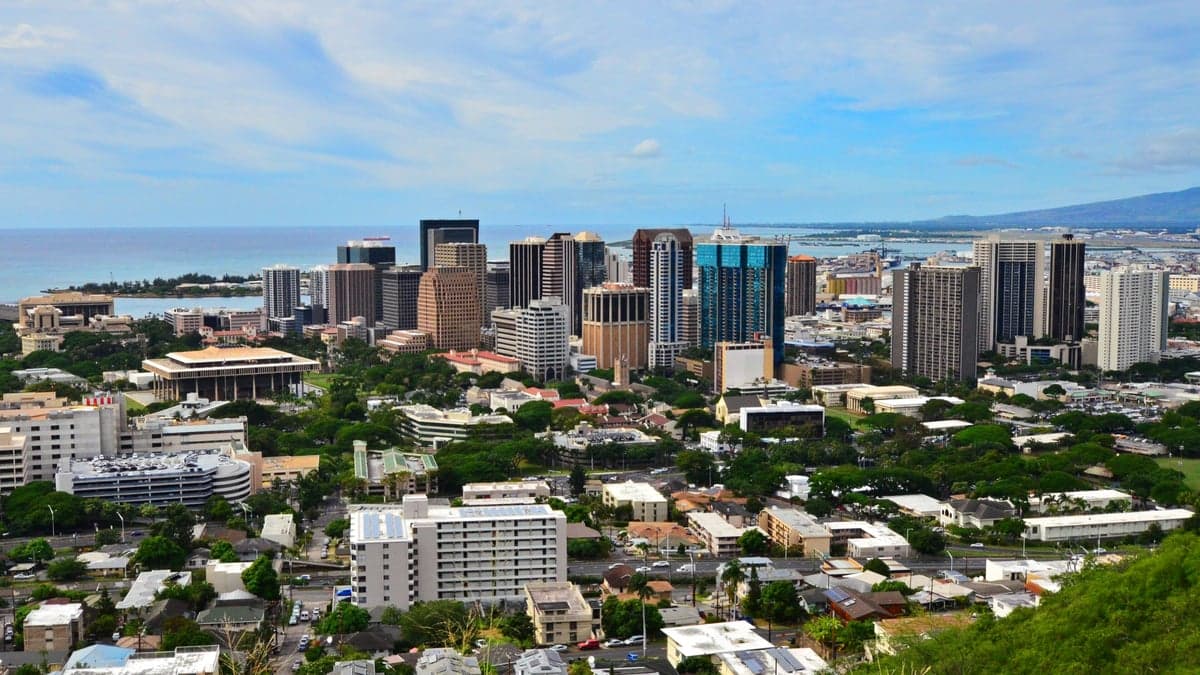
Today, Honolulu County is a densely populated, ethnically diverse urban center where no single racial group holds a majority, shaped by centuries of migration across the Pacific. With over 1 million residents concentrated on the island of Oʻahu, the county is defined by its large East and Southeast Asian population (41.7%), a significant Native Hawaiian and Pacific Islander community, and a relatively small white population (17.4%). The county’s identity is a blend of indigenous Hawaiian roots, plantation-era labor migrations, and post-1965 immigration, creating a unique cultural landscape where local customs, languages, and cuisines intermingle in a way distinct from mainland U.S. cities.
Settlement & growth (pre-1960)
The human history of Honolulu County begins with the Polynesian voyagers who settled the Hawaiian Islands around 1000–1200 CE, establishing a complex society based on ahupuaʻa (land divisions) and a chiefly system. These early inhabitants, the ancestors of today’s Native Hawaiians, lived in coastal villages like Waikīkī (then a wetland of taro fields and fishponds) and Honolulu (meaning “sheltered harbor”), which became a key port after Western contact in 1778. The arrival of British explorer Captain James Cook in 1778, followed by American missionaries in the 1820s, brought disease and cultural disruption, decimating the Native Hawaiian population from an estimated 300,000 in 1778 to roughly 40,000 by 1890.
The 19th century saw the first major foreign labor migrations, driven by the sugar and pineapple plantation economy. From the 1850s onward, Chinese laborers arrived to work the fields, settling in what became Honolulu’s Chinatown, a dense commercial district near Nuʻuanu Stream. Japanese immigrants followed in large numbers between 1885 and 1924, recruited as contract laborers; they established communities in Mānoa, Kalihi, and the plantation camps of ʻEwa and Waipahu. Portuguese workers from the Azores and Madeira arrived in the 1870s–1880s, settling in Kalihi and Kakaʻako, while smaller groups of Germans, Norwegians, and Puerto Ricans also came. By 1900, Honolulu was a multiethnic port town of roughly 40,000, with a plantation caste system that kept groups segregated but interdependent.
The 20th century brought further diversification. Koreans arrived between 1903 and 1905, many settling in the Palama and Liliha neighborhoods. Filipinos began arriving in 1906, becoming the largest plantation labor group by the 1920s; they concentrated in Waipahu, ʻEwa, and the Kalihi–Palama corridor. The U.S. annexation of Hawaiʻi in 1898 and its status as a territory (1900–1959) accelerated American military and civilian presence, especially after Pearl Harbor’s attack in 1941. Post-World War II, Honolulu County experienced a population boom: the military buildup, statehood in 1959, and the rise of tourism transformed Oʻahu. Suburban development pushed growth into ʻAiea, Pearl City, and Mililani, while Waikīkī was redeveloped from wetlands into a hotel district. By 1960, the county’s population had reached 500,000, with Japanese Americans (32%), Caucasians (31%), and Native Hawaiians/Part-Hawaiians (15%) as the largest groups.
Modern era (post-1965)
The 1965 Hart-Cellar Act fundamentally reshaped Honolulu County’s demographics by opening immigration from Asia and the Pacific. The most dramatic change was the surge of Filipino immigration: from 1970 to 2020, the Filipino population grew from roughly 40,000 to over 150,000, making them the largest East/Southeast Asian group in the county. New Filipino arrivals concentrated in Waipahu, Mililani, and Kapolei, forming dense ethnic enclaves with churches, grocery stores, and community organizations. Vietnamese refugees arrived after 1975, settling in Kalihi and later spreading to Pearl City and ʻAiea. Chinese immigration also increased, particularly from Hong Kong and Taiwan, with new arrivals favoring the upscale neighborhoods of Kahala, Hawaiʻi Kai, and Manoa.
Domestic migration from the mainland U.S. accelerated after statehood, driven by military transfers, retirement, and lifestyle seekers. The military presence—centered on Joint Base Pearl Harbor–Hickam, Schofield Barracks, and Marine Corps Base Hawaiʻi—brought a steady flow of mainland families, many of whom settled in Mililani, ʻEwa Beach, and Kapolei. This in-migration, combined with high housing costs, has pushed suburban development westward: Kapolei, dubbed the “second city,” grew from a few thousand residents in 1990 to over 50,000 by 2020. Meanwhile, the Native Hawaiian population, while growing in absolute numbers, has declined as a share of the county’s total, from roughly 20% in 1970 to about 10% today, with many Hawaiians moving to the continental U.S. for economic opportunities.
The county’s racial composition has shifted markedly. The white population fell from 31% in 1960 to 17.4% today, as Asian and mixed-race populations grew. The Hispanic population, though small at 9.3%, has grown steadily since the 1990s, driven by migration from Mexico and Central America; they are dispersed across the island, with notable clusters in Waipahu and Kalihi. The Black population remains modest at 2.3%, concentrated near military bases. The Indian subcontinent population is tiny (0.3%), with most living in Honolulu’s urban core or Kapolei. Foreign-born residents make up 7.3% of the county, a relatively low share compared to mainland gateway cities, reflecting the dominance of U.S.-born Asian Americans and Native Hawaiians in the population.
The future
Honolulu County’s population is projected to grow slowly, reaching roughly 1.1 million by 2040, constrained by limited land and high housing costs. The county is not homogenizing; instead, it is becoming more ethnically mixed, with intermarriage rates among the highest in the U.S.—over 40% of marriages in Hawaiʻi are interracial. This is creating a growing “multiracial” category (now about 20% of the county), which blurs traditional ethnic boundaries. The Filipino community is expected to continue growing, potentially becoming the largest single ethnic group, while the Japanese American population, which has low birth rates and limited new immigration, is aging and declining in share.
Suburbanization will continue to push growth westward into Kapolei, ʻEwa, and Kunia, while the urban core of Honolulu faces redevelopment pressures and gentrification. The Native Hawaiian population is likely to remain stable or grow slowly, with cultural revitalization efforts (e.g., Hawaiian language immersion schools, land trusts) potentially slowing out-migration. The military presence will remain a steady demographic anchor, though base realignments could shift local patterns. Immigration from Asia will likely moderate, as many source countries (Japan, South Korea, Taiwan) have aging populations and declining emigration rates, while Filipino immigration may plateau due to economic changes in the Philippines.
In the next 10–20 years, Honolulu County will likely become even more Asian-majority (East/Southeast Asian), with a smaller white population and a stable Native Hawaiian share. The county’s cultural identity—already a blend of Hawaiian, Asian, and American influences—will persist, but economic pressures (high cost of living, limited job growth outside tourism and government) may drive more young adults to the mainland, potentially aging the population. For a newcomer, this is a place where ethnic boundaries are porous, local identity is strong, and the pace of change is slow compared to mainland Sun Belt cities.
For someone moving to Honolulu County today, the demographic reality is a densely settled, ethnically layered island society where Asian and Pacific Islander cultures dominate public life, and where the cost of living—not cultural friction—is the primary challenge. The county is not becoming more polarized or tribalized; rather, it is evolving toward a blended, multiethnic norm that is rare in the continental U.S. New arrivals, whether from the mainland or abroad, will find a community that is welcoming but insular, where “local” identity matters more than race, and where the future is one of slow, steady demographic consolidation rather than rapid change.

* Values derived from national, state, county, city and local statistics and may differ in a specific area. Last updated: 2026-05-12T03:12:14.000Z
Narrative content on this page is AI-generated and may contain mistakes. Verify any details that matter before acting on them.
ReloMaps may earn a commission from affiliate links at no extra cost to you.

