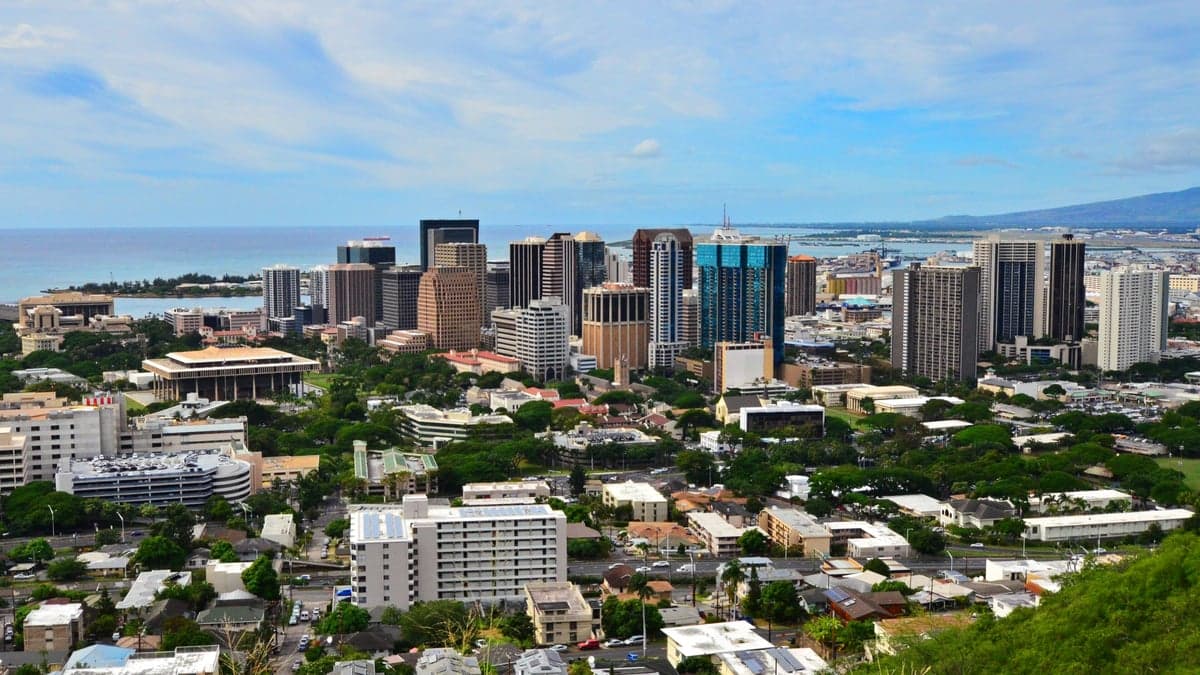

Photo: Wikipedia
Political ClimatePolitical Climate in Honolulu County
Showing state-level results — no local-only data available.
Local Political AnalysisPolitical Analysis of Honolulu County
Honolulu County leans heavily Democratic, but don't let the Cook PVI of D+12 for the state of Hawaii fool you—the political reality on the ground is more complicated than that single number suggests. The county, which covers the entire island of Oahu, has been drifting leftward for years, but the shift hasn't been uniform. Places like Kailua and Kaneohe on the windward side have become reliably blue, while areas like Mililani and Kapolei in the central and leeward parts still show some independent streak. The real story, though, is how the county's politics have moved from a pragmatic, locally-focused conservatism to a more ideologically rigid progressivism that many longtime residents find concerning.
How it compares
Compared to the rest of Hawaii, Honolulu County is the political engine of the state's Democratic machine, but it's also where the most aggressive progressive policies are tested first. The state as a whole has a D+12 PVI, but Honolulu County's influence pushes that number even further left. For example, while the Big Island and Maui still have pockets of libertarian-leaning ranchers and farmers who push back on government overreach, Honolulu County's urban core—especially downtown Honolulu and Waikiki—has embraced policies like mandatory paid family leave, strict rent control measures, and a push for single-use plastic bans that feel like they came straight from a San Francisco city council meeting. The contrast is stark: in rural parts of the county like the North Shore, you'll find surfers and farmers who just want to be left alone, but their votes are drowned out by the dense, progressive-leaning neighborhoods of the city center.
What this means for residents
For residents, the political climate translates into a growing sense that personal freedoms are being squeezed. The county government has been aggressive with zoning laws that make it nearly impossible to build a single-family home without jumping through endless bureaucratic hoops, and the push for "complete streets" initiatives has reduced car lanes in favor of bike paths and bus-only lanes—whether residents wanted them or not. Property taxes have crept up to fund social programs that many feel are mismanaged, and the county's response to homelessness has been to decriminalize camping in certain areas rather than enforce existing laws. If you value the ability to make your own choices about your property, your transportation, and your lifestyle without a government official second-guessing you, Honolulu County is becoming a tougher place to live.
The cultural and policy distinctions are most visible in the contrast between the county's urban core and its more rural edges. In towns like Wahiawa and Ewa Beach, you'll still find a more traditional, family-oriented mindset that values self-reliance and local control. But the county government, dominated by Honolulu's progressive establishment, keeps pushing policies that feel disconnected from those communities. The long-term trajectory is concerning: if the current trend continues, Honolulu County will become a place where individual rights are secondary to government-mandated outcomes, and the unique character of Oahu's diverse neighborhoods will be flattened into a one-size-fits-all progressive model. For anyone who remembers when Hawaii was more about "live and let live" than "comply and conform," the shift is hard to watch.

State Political ClimatePolitical Climate in Hawaii
State Political AnalysisPolitical Environment in the State
Hawaii is a solidly Democratic state with a Cook PVI of D+12, meaning it leans about 12 points more Democratic than the national average. For decades, the state has been dominated by a single-party system, with Democrats controlling the legislature and governorship almost uninterrupted since statehood in 1959. However, the political landscape is not monolithic—there are real geographic and cultural divides, and the trajectory over the last 10-20 years has been one of increasing progressive consolidation, particularly on Oahu, while rural and neighbor island communities have grown more resistant to that direction.
Urban vs. rural divide
The political map of Hawaii breaks down sharply between the urban core of Honolulu on Oahu and the rest of the state. Honolulu and its suburbs—places like Waikiki, Manoa, and Kailua—are the engine of Democratic dominance, with precincts routinely voting 70-80% for Democratic candidates. These areas are dense, diverse, and heavily influenced by unionized government workers, tourism industry employees, and a large military-dependent population that tends to lean moderate but votes Democratic due to local party loyalty. In contrast, the rural areas of the Big Island, Maui, and Kauai show more independence. Hilo on the Big Island is reliably Democratic but with a strong localist, anti-development streak, while Kailua-Kona and the North Shore of Oahu have pockets of libertarian-leaning voters who are skeptical of government overreach. The only reliably Republican-leaning areas are small, like Laie (Mormon community) and parts of Kahala (wealthy, conservative-leaning). No county has flipped from blue to red in recent cycles, but the rural-urban gap has widened as Honolulu’s politics have moved further left.
Policy environment
Hawaii’s policy environment is among the most progressive in the nation, with a heavy hand in personal and economic life. The state has the highest combined state and local tax burden in the country, including a general excise tax (GET) of 4.5% that applies to nearly all goods and services, plus high property taxes on non-owner-occupied homes. Income tax rates top out at 11%, and the cost of living is astronomical. Education policy is centralized and union-dominated; the state has a single, statewide school district, meaning no local control over curriculum or funding. In 2024, the legislature passed a bill requiring all public schools to provide free menstrual products in bathrooms, a small example of the state’s tendency to micromanage. Healthcare is heavily regulated, with a state-run insurance exchange and mandates that drive up costs. Election laws are among the most restrictive for ballot access: Hawaii has all-mail voting, no voter ID requirement, and same-day registration, which critics argue undermines election integrity. The state also has a “sanctuary” policy that limits cooperation with federal immigration enforcement, and in 2023, the legislature passed a law prohibiting law enforcement from inquiring about immigration status in most situations.
Trajectory & freedom
Hawaii is becoming less free by almost any measure, and the trend has accelerated since 2020. On gun rights, the state has some of the strictest laws in the nation: a permit-to-purchase requirement, a ban on “assault weapons” and large-capacity magazines, and a 14-day waiting period. In 2023, the legislature passed a law requiring gun owners to carry liability insurance, a novel restriction that has been challenged in court. On parental rights, the state has moved aggressively: in 2022, the legislature passed a law allowing minors as young as 14 to consent to gender-affirming care without parental notification, and in 2023, it banned conversion therapy for minors. On medical autonomy, Hawaii has legalized recreational marijuana (2023), but the regulatory framework is so burdensome that few dispensaries have opened. Property rights are weak: the state has a powerful land use commission that can block development, and the county of Honolulu has rent control on some units. On speech, the state has a “hate crime” law that enhances penalties for speech deemed biased, and in 2024, the legislature considered a bill to criminalize “misgendering” in public accommodations, though it did not pass. The overall trajectory is one of expanding government control over personal decisions, from healthcare to housing to what you can say.
Civil unrest & political movements
Hawaii has a history of organized protest, but it’s often more about local issues than national partisan battles. The most visible flashpoint in recent years was the Thirty Meter Telescope (TMT) protests on Mauna Kea (2019-2020), which drew thousands of Native Hawaiian activists and their allies, including some left-wing and libertarian groups, to block construction. This was a rare moment of cross-ideological unity against government and corporate overreach. On the right, there is a small but vocal movement around election integrity, particularly after the 2020 all-mail election, which saw a surge in turnout but also allegations of irregularities. The Hawaii Republican Party has filed lawsuits over ballot drop box security, but they’ve gained little traction. Immigration politics are muted because of the state’s geographic isolation, but the sanctuary policy has drawn criticism from conservatives. There is also a persistent secessionist or sovereignty movement among some Native Hawaiians, who argue the U.S. illegally annexed the kingdom in 1898. This is not a mainstream political force, but it surfaces in debates over land rights and cultural preservation. Overall, civil unrest is low compared to mainland states, but the underlying tensions—over land, cost of living, and loss of local control—are simmering.
Projection
Over the next 5-10 years, Hawaii will likely become more progressive and more expensive, driving out middle-class families and small business owners. Demographic trends are not favorable for conservatives: the state’s population is aging, with a shrinking native-born workforce, and in-migration is dominated by retirees from the mainland who tend to be liberal, plus foreign investors buying second homes. The military presence (about 40,000 active duty) provides a moderate counterweight, but it’s a small share of the electorate. The Democratic Party’s dominance is so entrenched that even a major scandal or economic crisis is unlikely to flip the legislature. The most realistic scenario is continued one-party rule with incremental leftward shifts on taxes, regulation, and social policy. Someone moving in now should expect to see higher taxes, more restrictions on housing and business, and a political culture that is increasingly hostile to traditional values. The only wild card is a potential economic collapse driven by the tourism-dependent economy—if that happens, voters might finally demand change, but it’s a long shot.
Bottom line for a new resident: If you value low taxes, local control, gun rights, parental authority, and limited government, Hawaii is a challenging place to live. The natural beauty and aloha spirit are real, but they come with a heavy price tag—both financial and personal. You’ll be paying for a government that actively works against many of your core values, and you’ll have little political power to change it. For conservatives, the best strategy is to find a niche in a rural area like the Big Island’s Puna district or the North Shore of Kauai, where localism and self-reliance still hold sway, and to engage in grassroots efforts to protect property rights and parental choice. But don’t expect the state to turn red anytime soon—it’s a blue state, and it’s getting bluer.
* Values derived from national, state, county, city and local statistics and may differ in a specific area. Last updated: 2026-05-12T03:12:14.000Z
Narrative content on this page is AI-generated and may contain mistakes. Verify any details that matter before acting on them.
ReloMaps may earn a commission from affiliate links at no extra cost to you.

