
Photo: Wikipedia
Personal Sovereignty in Honolulu County
Moderate friction. Expect trade-offs in some aspect of personal liberty and independence.
What does Personal Sovereignty tell us?
Personal Sovereignty measures your capacity for self-reliance and independence with minimal government friction. Higher scores mean fewer barriers between you and the way you want to live... but it assumes you have the space you need and good neighbors.
What does this tell us?
Personal Sovereignty measures your capacity for self-reliance and independence with minimal government friction. Higher scores mean fewer barriers between you and the way you want to live... but it assumes you have the space you need and good neighbors.
State Policy
Energy independence: Importer (2% of energy produced in-state)
Personal Liberty
Homesteading

Personal Liberty Analysis
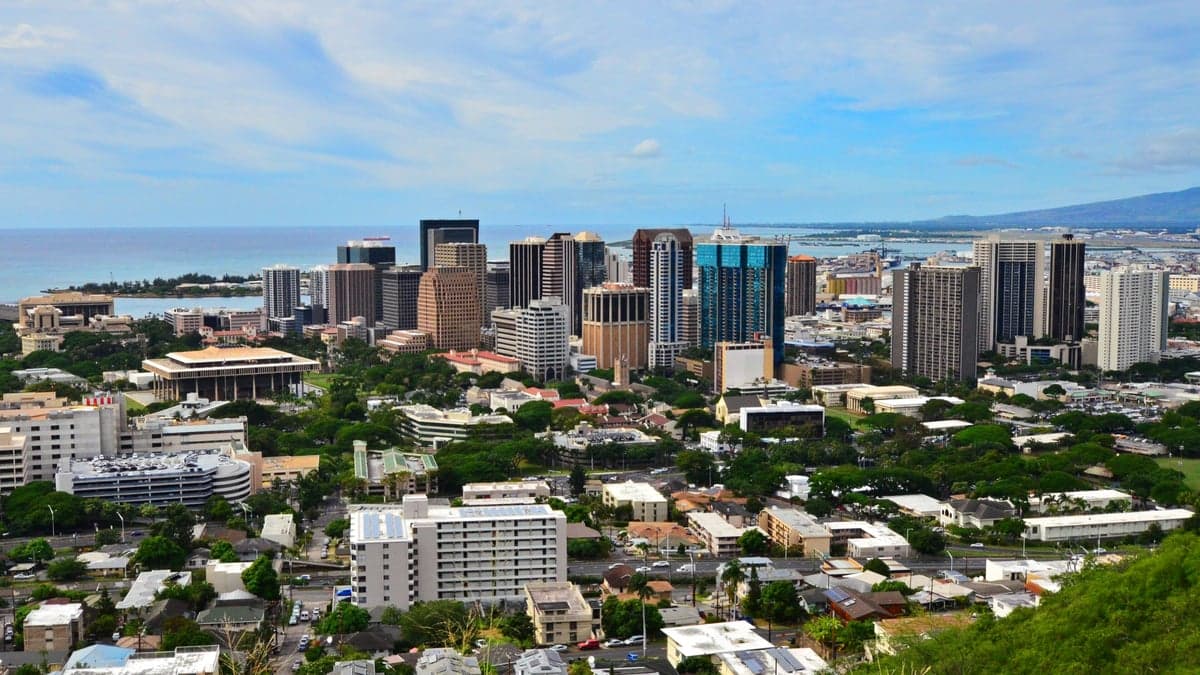
Honolulu County, encompassing the entire island of Oahu, presents a uniquely constrained environment for personal sovereignty, where state-level mandates and high-density living significantly limit individual autonomy. The county’s political landscape is dominated by a Democratic majority that has consistently prioritized collective regulation over personal freedom, creating a regulatory framework that feels more like a managed collective than a frontier of self-reliance. For the conservative-leaning individual or parent seeking to maximize personal sovereignty—whether through self-defense, economic independence, or educational choice—Oahu offers a challenging trade-off: stunning natural beauty and a strong sense of community, but at the cost of navigating some of the nation’s most restrictive laws on firearms, property use, and parental rights.
Tax burden and regulatory posture: How state and county policies limit financial autonomy
Hawaii’s tax burden is among the highest in the nation, and Honolulu County is the epicenter of that pressure. The state’s combined income tax rate, which can exceed 11% for top earners, is paired with a general excise tax (GET) of 4.5% that applies to nearly all goods and services—including groceries and rent—effectively functioning as a hidden sales tax. Property taxes in Honolulu County are relatively low compared to mainland peers (around 0.35% of assessed value), but this is deceptive: the county’s high real estate values mean annual bills can still run $5,000–$10,000 for a modest home. The regulatory posture is equally stifling. The state’s land use commission and county planning department impose strict zoning and building codes, making it difficult to add a workshop, expand a home, or even install a rainwater catchment system without months of permitting. In urban centers like Honolulu and Waikiki, homeowners associations and condo boards add another layer of rules, restricting everything from vehicle parking to exterior modifications. For the prepper mindset, this regulatory density feels like a deliberate chokehold on self-reliance—every attempt to build resilience requires government approval.
Self-defense and gun law specifics: What the Second Amendment looks like on Oahu
Hawaii’s gun laws are among the most restrictive in the United States, and Honolulu County offers no relief. The state requires a permit to acquire any firearm, a process that includes a background check, fingerprinting, and a 14-day waiting period—but in practice, the Honolulu Police Department can take months to process applications. Open carry is effectively banned, and concealed carry was virtually impossible until the 2022 Supreme Court decision in Bruen forced the state to issue permits; even then, the process remains onerous, requiring a "justifiable need" statement that is rarely approved. Magazine capacity is limited to 10 rounds, and assault weapons (defined broadly) are banned. For self-defense in the home, a handgun or shotgun is legal, but the hoops to acquire one are designed to discourage ownership. In rural areas like Waimanalo or Kahuku, where property crime and trespassing are real concerns, residents often rely on less-lethal options like pepper spray or security dogs, as the legal path to firearm ownership is too slow and uncertain. The state’s red flag law allows for temporary seizure of firearms without a criminal conviction, adding another layer of vulnerability for those who value self-defense as a fundamental right. For the survivalist, this is a red flag: in a crisis, the government controls the tools of personal protection.
Self-reliance and homesteading viability: Lot sizes, zoning, and off-grid feasibility
Homesteading on Oahu is a dream that collides hard with reality. The average lot size in Honolulu County is under 6,000 square feet, and most residential zones prohibit livestock, large gardens, or any structure not approved by the building department. In dense urban areas like Waipahu and Pearl City, backyard chickens are often banned by HOA covenants, and even vegetable gardens can be restricted if they exceed certain dimensions. Off-grid living is nearly impossible: the county requires connection to municipal water and sewer in most residential zones, and solar panels must be grid-tied unless you obtain a rare variance. Rainwater catchment is legal only in areas without municipal water access, which are few and far between. The exception is the North Shore, particularly Haleiwa and Pupukea, where larger lots (1–5 acres) and agricultural zoning allow for more self-reliance. Here, you can keep goats, grow taro, and install solar with battery backup—but even then, the county’s building codes and permitting process make it a years-long battle. For the prepper, the message is clear: Oahu is not a place to build a self-sufficient homestead. The regulatory environment is designed to keep you dependent on the grid and the grocery store.
Personal liberties: Parental rights, medical autonomy, speech, and property
Parental rights in Honolulu County are heavily circumscribed by state mandates. Hawaii has universal school choice in theory—charter schools and private schools are available—but the public school system is centralized and curriculum decisions are made at the state level, leaving parents with little say over what their children are taught. Homeschooling is legal but requires annual notification and submission of a curriculum plan, and the state can deny approval if it deems the plan insufficient. Medical autonomy is similarly constrained: Hawaii has strict vaccine mandates for school attendance, and during the COVID-19 pandemic, the state imposed some of the longest-lasting emergency orders in the nation, including mask mandates and business closures that lasted into 2022. Free speech is protected by the First Amendment, but the state’s anti-harassment laws and public nuisance statutes have been used to limit protests and leafleting in public spaces. Property rights are the weakest link: the state’s land use commission can rezone your property without your consent, and eminent domain is used aggressively for infrastructure projects. In Kailua and Kaneohe, homeowners have faced years of legal battles over beach access and setback requirements that effectively reduce usable land. For the conservative parent or individual, the message is that personal autonomy is a privilege granted by the state, not a right inherent to the individual.
Overall, Honolulu County ranks among the lowest in the nation for personal sovereignty, comparable to California’s Bay Area or New York City in its regulatory density and erosion of individual rights. The trade-off is a stable, well-funded public infrastructure and a strong sense of community, but for the survivalist or prepper mindset, the cost is too high. If you value self-defense, homesteading, or parental control over your children’s education, Oahu will feel like a cage. The only areas that offer a sliver of relief are the rural North Shore and Windward Coast—places like Laie and Hauula—where larger lots and agricultural zoning provide a taste of self-reliance, but even there, the state’s long arm reaches. For those seeking true personal sovereignty, the mainland’s interior West or rural South offers far more breathing room.

* Values derived from national, state, county, city and local statistics and may differ in a specific area. Last updated: 2026-05-12T03:12:14.000Z
Narrative content on this page is AI-generated and may contain mistakes. Verify any details that matter before acting on them.
ReloMaps may earn a commission from affiliate links at no extra cost to you.

