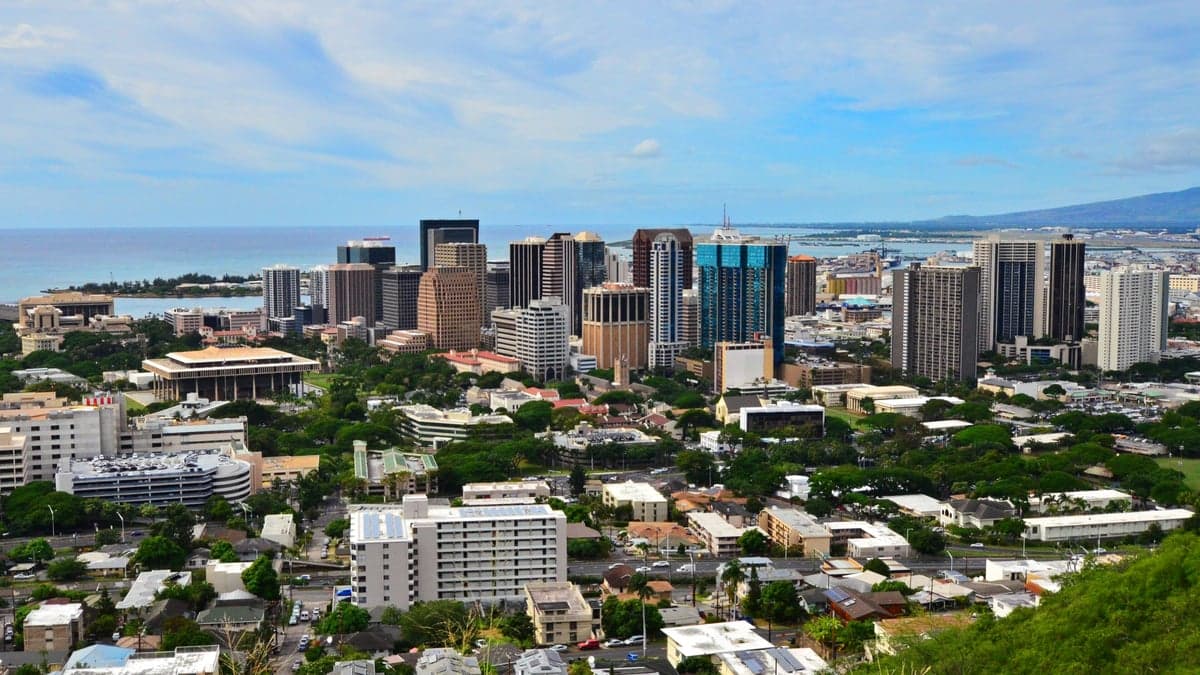
Photo: Wikipedia
Strategic Assessment of Honolulu County
Workable tactical position. Some exposure to population density or targets, but generally defensible in a crisis.
What does the Strategic Assessment tell us?
Our Strategic Assessment grades tactical survivability of an area. Major population centers, military targets, fallout zones, natural disasters, and border exposure all drive risk — lower exposure means a more defensible position in a crisis.
This is heavily inspired by Joel Skousen's Strategic Relocation book. Highly recommended you checkout the book ($)What does this tell us?
Our Strategic Assessment grades tactical survivability of an area. Major population centers, military targets, fallout zones, natural disasters, and border exposure all drive risk — lower exposure means a more defensible position in a crisis.
This is heavily inspired by Joel Skousen's Strategic Relocation book. Highly recommended you checkout the book ($)Strategic Pillars

Key Distances
Strategic Assessment Analysis
Honolulu County, encompassing the entire island of Oahu, presents a paradox for the strategic relocator. Its extreme geographic isolation offers a natural buffer against cascading continental crises, but that same isolation becomes a trap if local infrastructure fails. For those with a prepper mindset, Oahu is a fortress with a single, vulnerable supply chain—a high-risk, high-reward proposition that demands serious scrutiny before any relocation decision.
Geographic position and natural advantages for a strategic relocation
Oahu sits roughly 2,400 miles from the nearest mainland U.S. coast, making it one of the most isolated population centers on earth. This distance is a double-edged sword: it insulates the island from the immediate fallout of a continental collapse, civil unrest, or a major power grid failure on the West Coast, but it also means that any disruption to maritime shipping or air travel cuts off the island completely. The island’s interior, particularly the central plateau around Wahiawa and the windward side near Kaneohe, offers terrain that is defensible by nature—dense jungle, steep ridges, and limited road access. The Ko’olau and Waianae mountain ranges create natural barriers that would funnel any movement through a handful of chokepoints, such as the Pali Highway or Likelike Highway. For a relocator, the ability to retreat into the interior away from the coastal population centers—Honolulu, Waikiki, and Kapolei—is a genuine tactical advantage. The island’s year-round mild climate also eliminates the need for winter heating, reducing energy dependency, and the consistent trade winds provide natural ventilation and passive cooling.
Risks, exposures, and proximity to fallout-relevant landmarks
The most glaring vulnerability is Honolulu County’s extreme dependence on imported goods. Over 85% of all food consumed on Oahu arrives by ship, primarily through Honolulu Harbor and the adjacent Sand Island industrial complex. A single cyberattack, labor strike, or naval blockade at Pearl Harbor could starve the island within two weeks. The harbor is also adjacent to Joint Base Pearl Harbor-Hickam, a major military installation that would be a primary target in any state-level conflict. The Kalaeloa Airport and the nearby Barbers Point Naval Air Station (now a mixed-use development) add to the concentration of strategic assets. For the prepper, proximity to these landmarks is a negative—they are likely targets for sabotage or direct attack. Additionally, the Waipahu and Campbell Industrial Park areas host fuel storage tanks and a power plant, creating a secondary hazard zone. The island’s single major highway, the H-1, runs along the southern coast and is vulnerable to tsunami inundation, earthquake damage, or simple traffic gridlock during an evacuation. A major hurricane—rare but possible—would devastate the island’s fragile power grid and water systems, leaving residents without resources for months.
Practical resilience for a relocator: food, water, energy, and defensibility
Self-sufficiency on Oahu is possible but requires serious land and capital. The windward side, particularly around Hauula and Laie, has agricultural zones where year-round growing is feasible—taro, sweet potatoes, bananas, and breadfruit thrive with minimal input. However, fresh water is the critical bottleneck. The island’s aquifer is managed by the Honolulu Board of Water Supply, and any disruption to the electrical grid would shut down pumping stations. A relocator would need a private well or a reliable rainwater catchment system, which is legal but requires permits and maintenance. Solar panels are viable given the abundant sun, but battery storage is essential for nighttime and cloudy periods. Defensibility is best in the interior valleys—Manoa and Nuuanu offer narrow, easily guarded access points but are also close to Honolulu’s population density. The North Shore, from Haleiwa to Sunset Beach, is more remote but exposed to tsunami risk and has limited road egress. The strategic relocator should prioritize a property with its own water source, solar capability, and a defensible perimeter, ideally in the central or windward areas away from the military and industrial zones. Community resilience is mixed: many local families have deep generational ties and may view newcomers with suspicion, but there are active prepper and homesteading networks, particularly among military veterans and off-grid enthusiasts.
The overall strategic picture for Honolulu County is one of calculated risk. The island offers a genuine escape from continental chaos—no land borders, no refugee flows from Mexico, no interstate grid collapse—but at the cost of extreme supply chain fragility. For a single individual or family willing to invest in self-sufficiency and accept the isolation, Oahu can be a defensible redoubt. But for anyone expecting to rely on the existing infrastructure, the island is a trap. The smart move is to treat Honolulu County as a long-term bug-out location, not a primary residence, unless you have the resources to go fully off-grid and the discipline to maintain that posture indefinitely. The mountains and the sea give you a buffer, but the harbor and the military bases give you a target. Choose your ground carefully.

* Values derived from national, state, county, city and local statistics and may differ in a specific area. Last updated: 2026-05-12T03:12:14.000Z
Narrative content on this page is AI-generated and may contain mistakes. Verify any details that matter before acting on them.
ReloMaps may earn a commission from affiliate links at no extra cost to you.

