
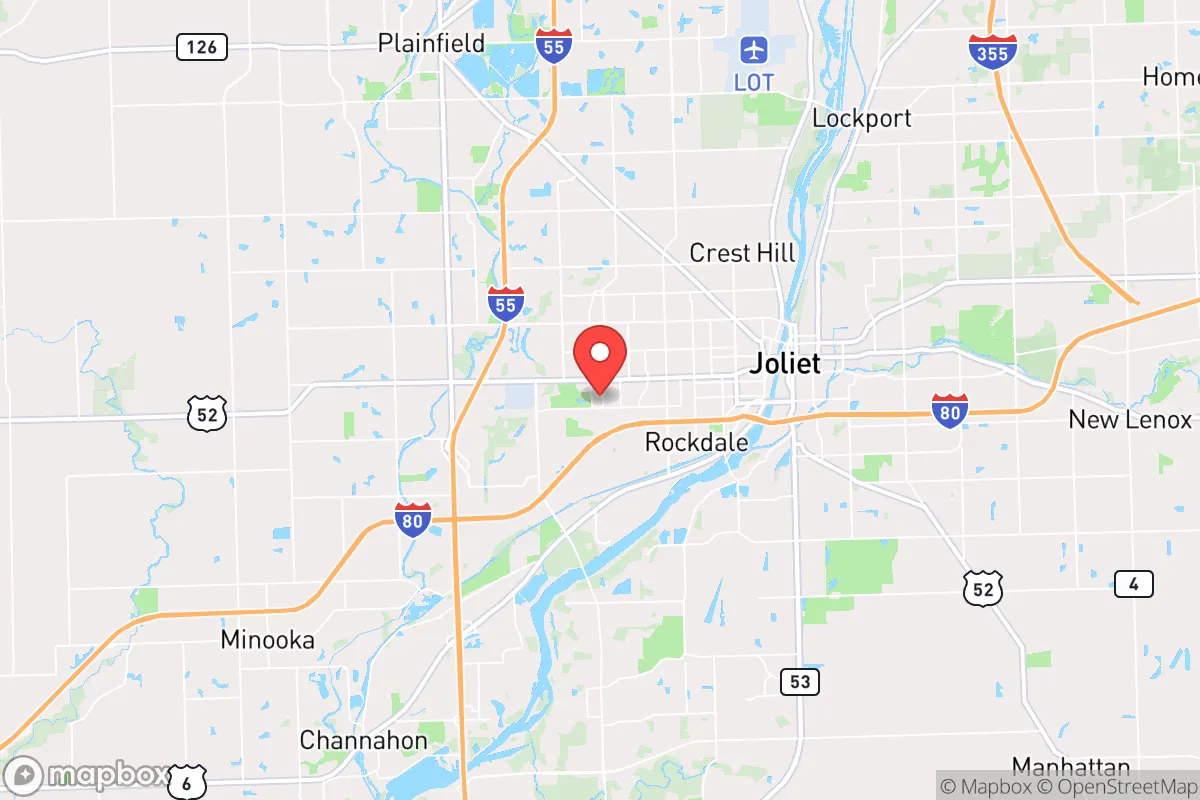
Photo: Wikipedia
Political ClimatePolitical Climate in Joliet, IL
District shown is the primary district for this city’s centroid. Cities may span multiple districts.
Local Political AnalysisPolitical Analysis of Joliet, IL
Joliet’s political climate has shifted noticeably over the past decade, and if you’ve lived here as long as I have, you can feel it. The city sits in a Cook PVI D+3 district, which means it leans Democrat by a slim margin, but that number doesn’t tell the whole story. A generation ago, Joliet was a blue-collar, union-heavy town where folks voted their pocketbooks and expected government to stay out of their backyards. Today, you’re seeing more progressive energy in city hall and the school boards, and frankly, a lot of us are watching that trend with a wary eye. The old-school common sense that kept things balanced is getting crowded out by policies that feel more about social engineering than practical governance.
How it compares
Drive ten miles in almost any direction, and you’ll hit towns that feel like a different world. Plainfield and Shorewood to the west lean more conservative, with a strong independent streak and a “leave us alone” attitude toward Springfield mandates. New Lenox and Frankfort to the east are reliably red, where property rights and Second Amendment protections are taken seriously. Meanwhile, Romeoville and Bolingbrook to the north have drifted left alongside Joliet, but they haven’t gone as far with local ordinances. The contrast is stark: Joliet’s city council has pushed through zoning changes that favor high-density development and green-energy mandates, while surrounding towns are still fighting to keep their suburban character and local control. If you value personal freedoms—like choosing your own energy source or deciding how to use your property—Joliet’s trajectory is a red flag compared to its neighbors.
What this means for residents
For the average family, the political shift translates into real-life headaches. Property taxes in Joliet are already among the highest in Will County, and the progressive push for expanded government programs—think universal pre-K, climate action plans, and diversity equity initiatives—means those costs aren’t coming down. You’re also seeing more regulations on small businesses, from paid leave mandates to strict building codes, which makes it harder for mom-and-pop shops to survive. On the plus side, the city’s infrastructure spending has improved some roads and parks, but it comes with a trade-off: less freedom to run your life without a permit or a fee. The school board has adopted curriculum changes that prioritize social-emotional learning over core academics, and that’s a concern for parents who want their kids taught how to think, not what to think.
Culturally, Joliet still has its rough edges and proud history—the old steel mills, the Route 66 charm, the riverboat casinos—but the new policies are slowly sanding away that identity. You’ll find more “slow down” traffic-calming measures than actual road repairs, and the city’s push for “equity” in housing has led to debates over rent control and inclusionary zoning that scare off private investment. Long-term, if the progressive wing keeps gaining ground, Joliet risks becoming a high-tax, low-freedom city that drives out the very people who built it. For now, it’s still a place where you can find a decent job and a reasonable cost of living, but keep an eye on the ballot box—because the next few elections will decide whether Joliet stays a working-class town or turns into another Chicago suburb with all the strings attached.

State Political ClimatePolitical Climate in Illinois
State Political AnalysisPolitical Environment in the State
Illinois is a deep blue state dominated by the Chicago metro area, which accounts for roughly 65% of the state’s population and reliably delivers Democratic majorities statewide. Over the last 20 years, the state has shifted from a purple battleground to a solidly one-party Democratic stronghold, with Republicans now largely confined to the collar counties, downstate agricultural regions, and the southwestern suburbs. For a conservative considering relocation, the state’s political trajectory is a cautionary tale of progressive consolidation, rising taxes, and eroding personal freedoms.
Urban vs. rural divide
The political map of Illinois is a stark study in contrast. Chicago and its inner suburbs (Cook County) are the engine of Democratic power, routinely delivering 75-80% of the vote for statewide Democrats. The collar counties—DuPage, Lake, Kane, and Will—have trended blue over the past decade, with DuPage flipping from +18 R in 2012 to +5 D in 2024. Downstate, places like Marion, Effingham, and Quincy remain reliably Republican, but their populations are too small to offset Chicago’s weight. The Rockford area (Winnebago County) has become a swing region, while Peoria and Bloomington-Normal lean blue due to university and healthcare employment. The most dramatic shift is in the Champaign-Urbana corridor, where the University of Illinois has turned a once-moderate area into a progressive stronghold. Meanwhile, counties like Alexander and Pulaski in the far south have flipped from blue to red as population declines and Democratic-leaning Black residents have moved north.
Policy environment
Illinois’s policy environment is defined by aggressive progressive governance. The state has the second-highest property tax burden in the nation (average 2.08% of home value) and a flat income tax of 4.95% that is effectively a regressive levy on middle-class families. In 2020, voters rejected a graduated income tax amendment, but the legislature has since found workarounds to raise revenue. Education policy is dominated by the Chicago Teachers Union, which has successfully blocked charter school expansion and secured a $350 million pension bailout in 2024. Healthcare is heavily regulated, with a state-run insurance exchange and a Medicaid expansion that covers non-citizens. Election laws are among the most liberal in the country: no voter ID requirement, automatic voter registration, mail-in ballots for all, and same-day registration. This has led to persistent concerns about election integrity, particularly in Cook County, where ballot harvesting is legal and signature verification is minimal. Gun rights are severely restricted: Illinois banned assault weapons and high-capacity magazines in 2023 (HB 5471), requires a FOID card for all gun purchases, and has a 72-hour waiting period. The state also has a sanctuary city law (the TRUST Act) that limits cooperation with federal immigration enforcement.
Trajectory & freedom
Illinois is becoming less free by nearly every metric. The 2023 assault weapons ban was the most restrictive in the Midwest, and a federal court upheld it in 2024. Parental rights have been curtailed by the 2021 repeal of the Parental Notice of Abortion Act, which eliminated the requirement that minors notify parents before an abortion. The 2024 "Gender Identity Bill" (SB 100) allows minors to access gender-affirming care without parental consent if deemed "mature" by a therapist. Medical freedom took a hit with the 2022 mandate that all healthcare workers be vaccinated against COVID-19, a policy still on the books. Property rights are under pressure from the state’s progressive property tax system, which reassesses homes annually and has led to a 30% increase in average tax bills since 2020. On the positive side for conservatives, Illinois has no right-to-work law, but it also has no state preemption on local gun laws, meaning Chicago’s strict ordinances don’t apply downstate. The state’s pension crisis—$140 billion in unfunded liabilities—is a ticking time bomb that will likely force further tax increases or service cuts.
Civil unrest & political movements
Illinois has a history of political flashpoints. The 2020 George Floyd protests in Chicago turned into widespread looting and arson, with over $60 million in damages. The city’s response—defunding the police by $80 million in 2021—was followed by a 35% increase in homicides that year. Organized left-wing activism is centered in Chicago, with groups like the Chicago Teachers Union and Black Lives Matter Chicago wielding significant influence over city policy. On the right, the Illinois Republican Party is fractured between moderates and Trump-aligned conservatives, with the latter gaining ground in downstate counties. Immigration politics are heated: Chicago’s sanctuary status has led to a surge of migrants bused from Texas, with over 35,000 arriving since 2022, straining city services and sparking backlash in working-class neighborhoods. Election integrity remains a flashpoint: in 2024, a Cook County judge ordered the release of 100,000 mail-in ballots that had been flagged for signature mismatches, a decision that outraged conservatives. Secession talk is common in downstate counties, with 33 counties passing resolutions to explore secession from Illinois since 2020, though none have legal force.
Projection
Over the next 5-10 years, Illinois will likely become even more progressive. Demographic trends favor Democrats: Chicago’s population is stabilizing after pandemic losses, while downstate counties continue to shrink. The 2024 election saw Democrats gain seats in the collar counties, and the state’s gerrymandered map (drawn by Democrats in 2021) ensures they hold 14 of 17 congressional seats. In-migration is overwhelmingly from blue states like California and New York, while out-migration is to red states like Texas and Florida. Expect further gun restrictions, possibly a state-level red flag law with no due process, and expanded healthcare mandates. The pension crisis will force either a massive tax hike or a bankruptcy-like restructuring that could hit retirees. For a conservative moving in now, the state will feel increasingly hostile to traditional values, with higher taxes, less local control, and a political culture that prioritizes Chicago’s interests over the rest of the state.
For a conservative considering Illinois, the bottom line is this: you’ll find like-minded communities in places like Marion, Effingham, or Quincy, but you’ll be fighting a losing battle at the state level. Your property taxes will be among the highest in the nation, your gun rights will be severely restricted, and your children will be exposed to a school system that prioritizes progressive ideology over academic rigor. If you value low taxes, personal freedom, and local control, Illinois is a state to avoid—unless you’re prepared to be a permanent political minority in a state that’s doubling down on progressive governance.
* Values derived from national, state, county, city and local statistics and may differ in a specific area. Last updated: 2026-04-29T23:54:42.000Z
Narrative content on this page is AI-generated and may contain mistakes. Verify any details that matter before acting on them.
ReloMaps may earn a commission from affiliate links at no extra cost to you.

