Photo: Wikipedia
Strategic Assessment of Lehi, UT
Workable tactical position. Some exposure to population density or targets, but generally defensible in a crisis.
What does the Strategic Assessment tell us?
Our Strategic Assessment grades tactical survivability of an area. Major population centers, military targets, fallout zones, natural disasters, and border exposure all drive risk — lower exposure means a more defensible position in a crisis.
This is heavily inspired by Joel Skousen's Strategic Relocation book. Highly recommended you checkout the book ($)What does this tell us?
Our Strategic Assessment grades tactical survivability of an area. Major population centers, military targets, fallout zones, natural disasters, and border exposure all drive risk — lower exposure means a more defensible position in a crisis.
This is heavily inspired by Joel Skousen's Strategic Relocation book. Highly recommended you checkout the book ($)Strategic Pillars

Key Distances
Regional Safe Places
Below is our recommended "safe zones" in Utah and the surrounding area based on our strategic heuristics. For most people, it's unrealistic to live in a “safe zone” full-time due to work, family or other personal reasons. They tend to be more rural. However, many of these areas are perfect for second homes and retreat properties that double as a vacation home or even a short-term rental.


Important Note: For informational purposes only. This does not mean nothing bad ever happens in the green zones. Please use common sense. This is based on public data and modeled with AI. We tried to take a conservative approach but mistakes happen. We update this regularly as new information becomes available.
Solar Generator Recommendations
Backup power matters more here than in safer locations. We've picked three solar generators across budgets and capacity tiers — start with the budget unit if you only need a few essentials, or step up if you want to run a fridge and HVAC for days at a time.

Jackery Portable Power Station Explorer 300
Budget OptionPower on the Go: Weighing only 11 lbs, it's convenient to set up and store with book-sized foldable solar panels

BLUETTI Portable Power Station AC180
Designed for both indoor and outdoor scenarios, AC180 is highly capable as it has a robost capacity and continuous output power.

EF ECOFLOW DELTA Pro Ultra Power Station
Upgraded PickEcoFlow DELTA Pro Ultra is a whole-home energy system designed to grow with your family. Integrated with the Smart Home Panel 2, it scales to meet your evolving energy needs — keeping your home powered, intelligent, and secure through every stage of life.
We earn a commission, at no additional cost to you.
Strategic Assessment Analysis
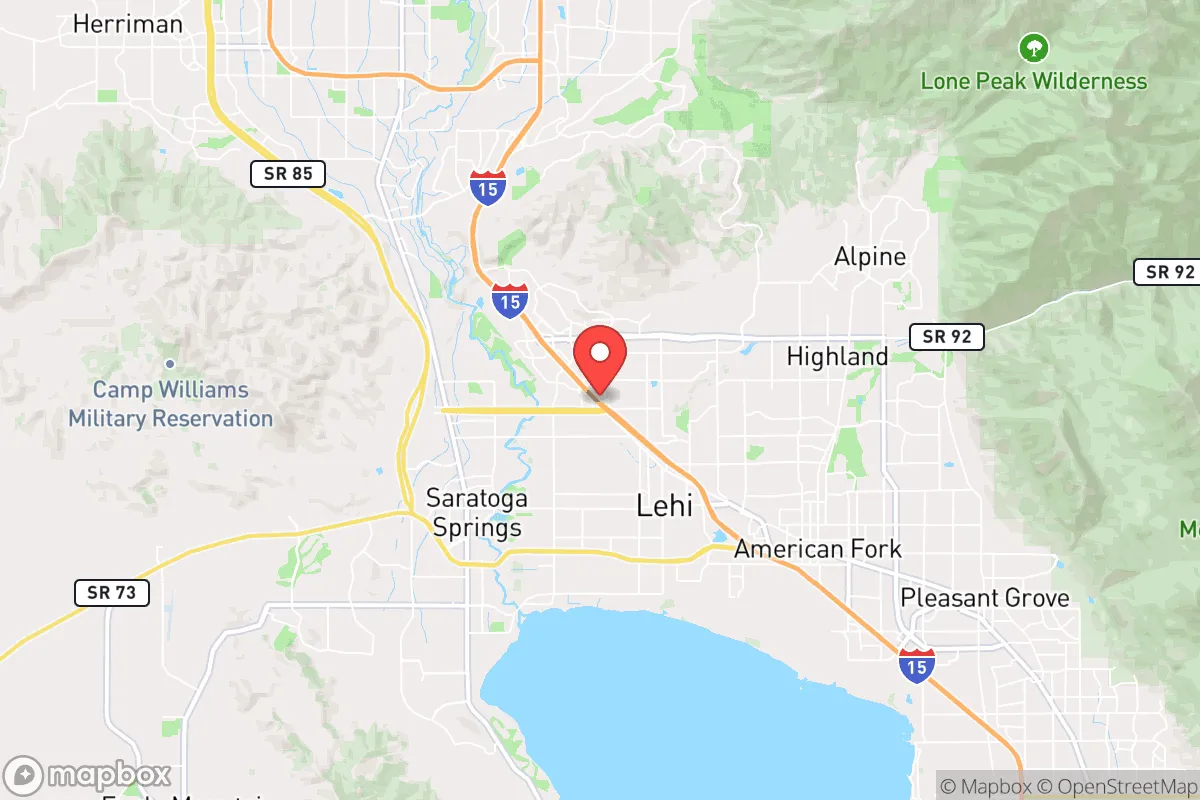
Lehi, Utah, occupies a surprisingly strong position for a relocator with a survivalist mindset, blending the economic vitality of Utah County with a geographic layout that offers genuine strategic depth. Its location at the northern end of Utah Lake and the eastern edge of the Great Basin provides natural buffers and multiple escape corridors, while its proximity to the Wasatch Front’s population centers is both an asset and a liability. For those serious about long-term preparedness—civic unrest, supply chain collapse, or a major disaster—Lehi offers a rare mix of modern infrastructure and defensible terrain, provided you understand where the risks actually lie.
Geographic position and natural advantages for long-term survival
Lehi sits at the mouth of American Fork Canyon, giving residents immediate access to the Uinta-Wasatch-Cache National Forest and the high-elevation terrain of the Wasatch Range. This is not a flat, exposed valley floor like much of Salt Lake County; the city’s eastern neighborhoods climb into the foothills, offering natural elevation advantages and multiple routes into the backcountry. To the west, Utah Lake provides a freshwater source that, while not pristine, is a significant asset for irrigation and emergency water supply. The lake’s shallow depth and large surface area mean it can be tapped with basic filtration systems, and the surrounding wetlands offer game and forage potential. Lehi’s position also places it near the convergence of I-15 and the Legacy Parkway, giving you two major north-south arteries and the ability to bypass Salt Lake City entirely if that corridor becomes compromised. The city’s elevation—around 4,500 feet—means cooler summers and a lower risk of the extreme heat events that plague lower desert areas, though winter preparedness is non-negotiable.
Risks, exposures, and proximity to fallout-relevant landmarks
The most significant vulnerability is Lehi’s proximity to the Wasatch Front’s critical infrastructure. Hill Air Force Base, roughly 40 miles north, is a primary target in any major conflict scenario, and the I-15 corridor itself is a chokepoint that could become impassable during a mass evacuation. The city is also within 30 miles of the Salt Lake City International Airport and the rail yards in Ogden, both of which are high-value targets for disruption. On the natural disaster front, the Wasatch Fault runs directly through the eastern part of Lehi. A major earthquake—the kind geologists say is overdue—would devastate the valley floor, with liquefaction risks in the low-lying areas near Utah Lake. The foothill neighborhoods are on more stable bedrock, but they face landslide risks in heavy precipitation years. Additionally, the city’s rapid growth has pushed development into wildland-urban interface zones, increasing wildfire exposure during dry summers. For the prepper, the key takeaway is that Lehi’s eastern bench and the areas east of I-15 offer far better defensibility and lower risk than the western flats near the lake or the I-15 corridor itself.
Practical resilience for a relocator: food, water, energy, and defensibility
Water is the first concern. Lehi’s municipal supply comes from a mix of groundwater wells and surface water from the Provo River and Deer Creek Reservoir. In a prolonged grid-down scenario, the city’s gravity-fed system would fail within days without power for pumps. Residents should plan for at least two weeks of stored water per person, plus a reliable filtration system for Utah Lake or local streams. The good news is that the American Fork River runs through the city’s eastern edge, providing a year-round surface water source that can be filtered with a quality ceramic or UV system. Food resilience is mixed. Utah County has a strong agricultural tradition, and Lehi is surrounded by working farms in Saratoga Springs, Eagle Mountain, and the Cedar Valley. Local farmers’ markets and CSAs are plentiful in season, but winter food security depends on your own storage. The city’s zoning allows for backyard chickens and small livestock in most residential areas, and the soil in the foothills is workable for gardening with irrigation. Energy is a bright spot. Utah’s grid is relatively stable, but Lehi’s elevation and southern exposure make solar a viable option for off-grid backup. Many newer homes in the Traverse Mountain and Suncrest areas are built with energy efficiency in mind, and the local building codes are favorable for adding battery storage. Defensibility varies by neighborhood. The older, grid-style streets near downtown are less defensible, while the cul-de-sac developments on the east bench offer natural chokepoints and limited access. The Suncrest neighborhood, perched on the mountain above Lehi, is particularly well-suited for a small group or family looking to control access—but it’s also a high-value target for looters in a collapse scenario. A better bet for the serious prepper is a property on the eastern slopes of the Traverse Mountains, where you have line of sight to the valley and multiple escape routes into the national forest.
The overall strategic picture for Lehi is one of calculated trade-offs. It is not a remote bunker location—it is a suburban city with all the vulnerabilities that entails—but it offers a rare combination of economic opportunity, natural resources, and geographic defensibility that few other Wasatch Front communities can match. For the conservative relocator who wants to maintain a professional career while building a resilient homestead, Lehi is one of the best options in the Intermountain West. The key is to buy on the east bench, invest in water storage and solar, and build relationships with the local farming community before the crisis hits. If you do that, you’ll be in a position to ride out most scenarios while still being close enough to the valley’s resources to trade and gather intelligence. If you don’t, you’re just another suburbanite hoping the government shows up. Lehi gives you the tools to choose which one you are.

* Values derived from national, state, county, city and local statistics and may differ in a specific area. Last updated: 2026-04-21T13:19:19.000Z
Narrative content on this page is AI-generated and may contain mistakes. Verify any details that matter before acting on them.
ReloMaps may earn a commission from affiliate links at no extra cost to you.

