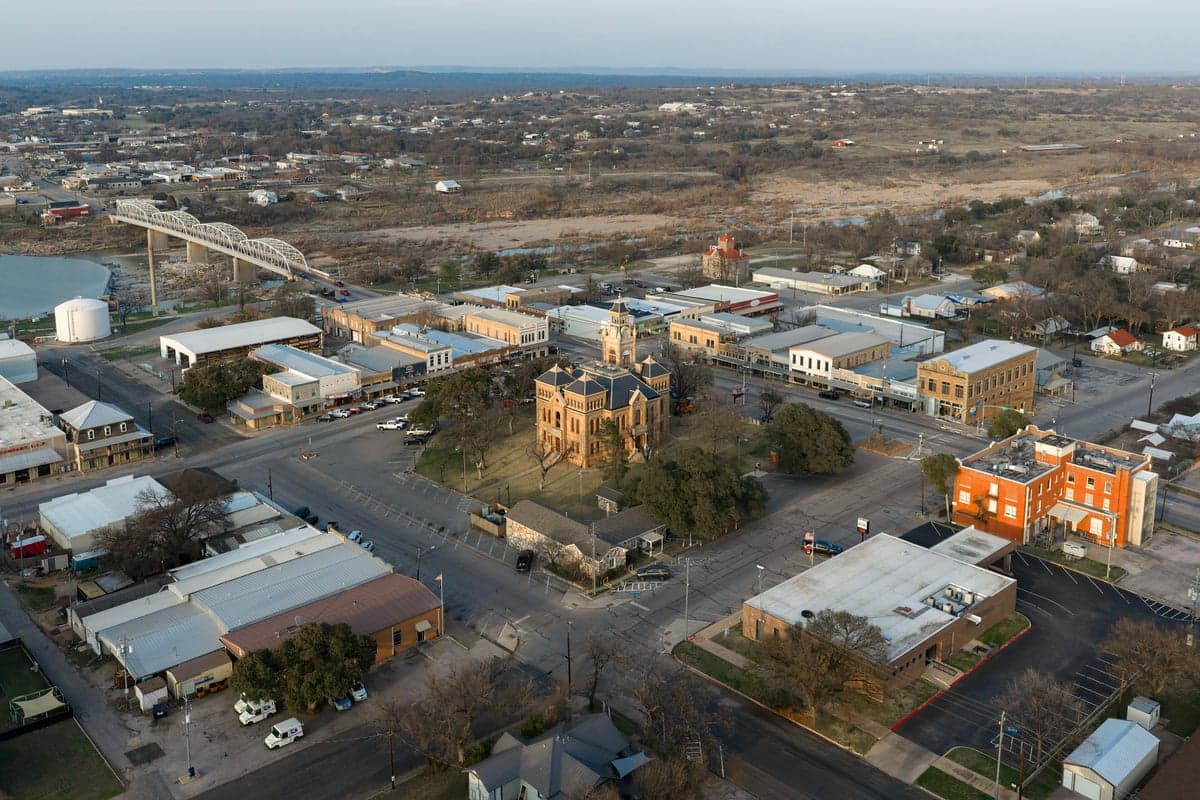
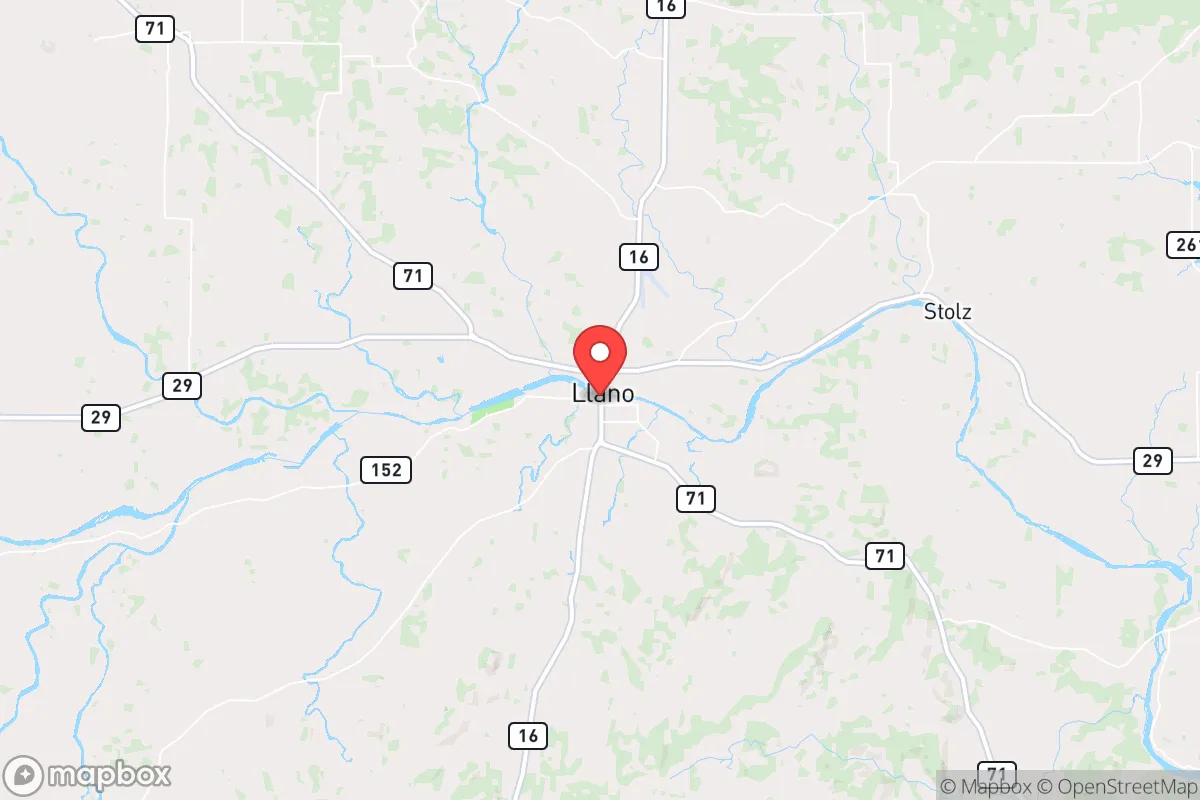
Photo: Wikipedia
Political ClimatePolitical Climate in Llano, TX
District shown is the primary district for this city’s centroid. Cities may span multiple districts.
Local Political AnalysisPolitical Analysis of Llano, TX
Llano, Texas, is about as conservative as it gets in the Lone Star State, with a Cook PVI of R+22 — a full 18 points more Republican than Texas as a whole (R+4). I’ve lived here long enough to remember when the county courthouse was the center of everything, and not much has changed politically. The area has stayed reliably red for decades, and while you’ll see a few new faces from Austin or Dallas trickling in, the voting patterns haven’t budged. If anything, the trajectory is a slow, stubborn resistance to the leftward drift you see in bigger cities.
How it compares
Compared to the rest of Texas, Llano is a conservative stronghold. The statewide R+4 rating reflects a state that’s still red but getting purple around the edges — places like Austin, Houston, and Dallas-Fort Worth are pulling the needle left. Llano, by contrast, sits in the Hill Country where folks take their Second Amendment rights and local control seriously. Neighboring towns like Marble Falls (Burnet County) lean red but are more moderate, and Fredericksburg (Gillespie County) is also conservative but with a stronger tourism-driven economy. Drive an hour east to Austin, and you’re in a completely different world — a deep-blue city where property taxes and regulations are climbing fast. Llano residents see that and want no part of it. The political contrast isn’t subtle: Llano votes like Texas did in the 1990s, before the urban boom reshaped the state.
What this means for residents
For folks living here, the conservative climate means lower taxes, fewer zoning headaches, and a general hands-off approach from local government. You can build a shed without three permits, and nobody’s coming after your hunting rifles. That said, there’s a growing concern about state and federal overreach — mandates from Austin or Washington that try to impose progressive policies on rural counties. The recent push for statewide property tax reform was welcome, but any talk of gun control or environmental regulations that limit land use raises red flags. Residents value personal freedom above all, and they’re watching closely as the state legislature debates school curriculum and energy policy. The local school board and county commission are still solidly conservative, but the worry is that outside money and activism could shift things if we’re not paying attention.
On a cultural level, Llano stands apart from much of Texas. Church attendance is high, the local diner still serves chicken-fried steak with gravy, and the biggest event of the year is the Llano County Rodeo. Policy-wise, the county has resisted mask mandates, vaccine passports, and any form of lockdown that smacks of government overreach. The long-term outlook? As long as the Hill Country stays rural and folks keep voting their values, Llano will remain a pocket of old-school Texas conservatism. But with Austin’s sprawl creeping west, the pressure is real. The key is keeping local government accountable and making sure newcomers understand that this isn’t a place for big-government solutions.

State Political ClimatePolitical Climate in Texas
State Political AnalysisPolitical Environment in the State
Texas has long been a red state, but you wouldn't know it from the headlines. The Cook Partisan Voting Index sits at R+4, meaning the state leans Republican by a moderate margin, but that number has been shrinking over the past two decades as blue voters pour in from California, New York, and Illinois. The dominant coalition is still the GOP, anchored by rural and exurban conservatives, but the battle for the soul of the state is real. Over the last 10–20 years, Texas has gone from a solid red lock to a competitive battleground — Republicans still hold every statewide office and both legislative chambers, but the margins have tightened, and the culture war is now fought block by block in the suburbs.
Urban vs. rural divide
The political map of Texas is a tale of two worlds. The big metros — Austin, Houston, Dallas, San Antonio, and El Paso — are deep blue or trending that way. Austin is the progressive capital, with a city council that has pushed defund-the-police rhetoric and homeless camping legalization. Houston and Dallas are reliably Democratic, driven by diverse, younger populations. El Paso is a Democratic stronghold, heavily Hispanic and union-influenced. Meanwhile, the rural and small-town expanse — places like Lubbock, Midland, Tyler, and the Panhandle — votes Republican by 70% or more. The real action is in the suburbs: Collin County (Plano, Frisco) and Fort Bend County (Sugar Land) were once GOP bastions but have shifted purple as educated professionals and minorities move in. In 2020, Biden nearly won Texas, losing by only 5.6 points — a far cry from the 16-point Romney win in 2012. The urban-rural divide isn't just geographic; it's a cultural chasm that defines every statewide election.
Policy environment
Texas's policy posture is still unmistakably conservative, but with some cracks. The state has no personal income tax, which is a huge draw, though property taxes are among the highest in the nation — a trade-off that frustrates many homeowners. The regulatory climate is business-friendly, with minimal red tape and a right-to-work law that keeps unions weak. On education, the state has expanded charter schools and is debating school vouchers, but the public school funding formula remains a perennial fight. Healthcare: Texas famously refused Medicaid expansion under Obamacare, leaving nearly a million low-income adults uninsured. Election laws tightened with SB 1 in 2021, which banned drive-through voting, restricted mail-in ballot applications, and empowered poll watchers — a response to 2020 controversies in Harris County. On social issues, the legislature passed a heartbeat abortion ban (SB 8) in 2021 and a near-total trigger ban in 2023. Parental rights were strengthened with laws requiring schools to get parental consent for sex education and restricting gender transition procedures for minors (SB 14). The policy environment is a mixed bag: low taxes and gun-friendly, but high property taxes and a growing regulatory appetite in some areas.
Trajectory & freedom
Is Texas becoming more free or less? It depends on the issue. On gun rights, the state expanded freedom with permitless carry (HB 1927) in 2021, allowing adults to carry a handgun without a license. That's a clear win for personal liberty. On parental rights, the state has pushed back against federal overreach in education and medical decisions. But on property rights, the picture is murkier: property taxes keep climbing, and the state's use of eminent domain for private development projects has raised eyebrows. During COVID, Governor Abbott issued executive orders that both restricted and later prohibited mask mandates — a confusing back-and-forth that frustrated both sides. The legislature also passed a law banning vaccine mandates by private employers, which was a strong stand for medical freedom. However, the state's heavy-handed approach to immigration — Operation Lone Star, busing migrants to blue cities, and the new law allowing state police to arrest illegal border crossers (SB 4, currently tied up in court) — shows a government willing to flex its muscle. Overall, Texas is trending more free on guns and parental rights, but less free on taxes and some civil liberties. The trajectory is toward a more assertive state government that picks its battles carefully.
Civil unrest & political movements
Texas has seen its share of flashpoints. The 2020 George Floyd protests in Austin, Dallas, and Houston turned violent, with property damage and clashes with police. Austin's city council later decriminalized low-level marijuana possession and cut the police budget, sparking a backlash that led to a 2021 ballot measure restoring police funding. On the right, the Texas Nationalist Movement (Texit) has gained some traction, though it remains fringe. Immigration politics are front and center: the border crisis has turned communities like El Paso and the Rio Grande Valley into staging grounds for busloads of migrants sent to Washington, D.C., and New York. The sanctuary cities ban (SB 4, 2017) made it a crime for local officials to refuse cooperation with federal immigration enforcement, and it's been upheld in court. Election integrity remains a hot-button issue: after the 2020 election, Harris County (Houston) was accused of irregularities, leading to SB 1 and a subsequent takeover of the county's elections by the state. You'll see "Keep Texas Red" signs in rural areas and "Defend the Border" rallies in places like Midland. The political temperature is high, and a new resident will notice the polarization in local news and even casual conversation.
Projection
Over the next 5–10 years, Texas is on a trajectory toward becoming a true swing state. The in-migration from blue states is accelerating — roughly 1,000 people move to Texas every day, many from California and the Northeast. These newcomers tend to be younger, more diverse, and more liberal, especially in the suburbs. The Hispanic population, traditionally more conservative on social issues, is trending Democratic as younger generations align with national party cues. Republicans are responding with aggressive gerrymandering and voter ID laws to hold onto power, but demographic math is unforgiving. By 2030, Texas could have a competitive Senate race and maybe even a presidential flip. However, the state's conservative infrastructure — low taxes, gun rights, parental rights — will remain a powerful draw for conservatives fleeing blue states. The wild card is the border: if the federal government fails to secure it, Texas's state-level enforcement could become a model for other red states, further entrenching the GOP's base. For
* Values derived from national, state, county, city and local statistics and may differ in a specific area. Last updated: 2026-05-14T18:25:51.000Z
Narrative content on this page is AI-generated and may contain mistakes. Verify any details that matter before acting on them.
ReloMaps may earn a commission from affiliate links at no extra cost to you.

