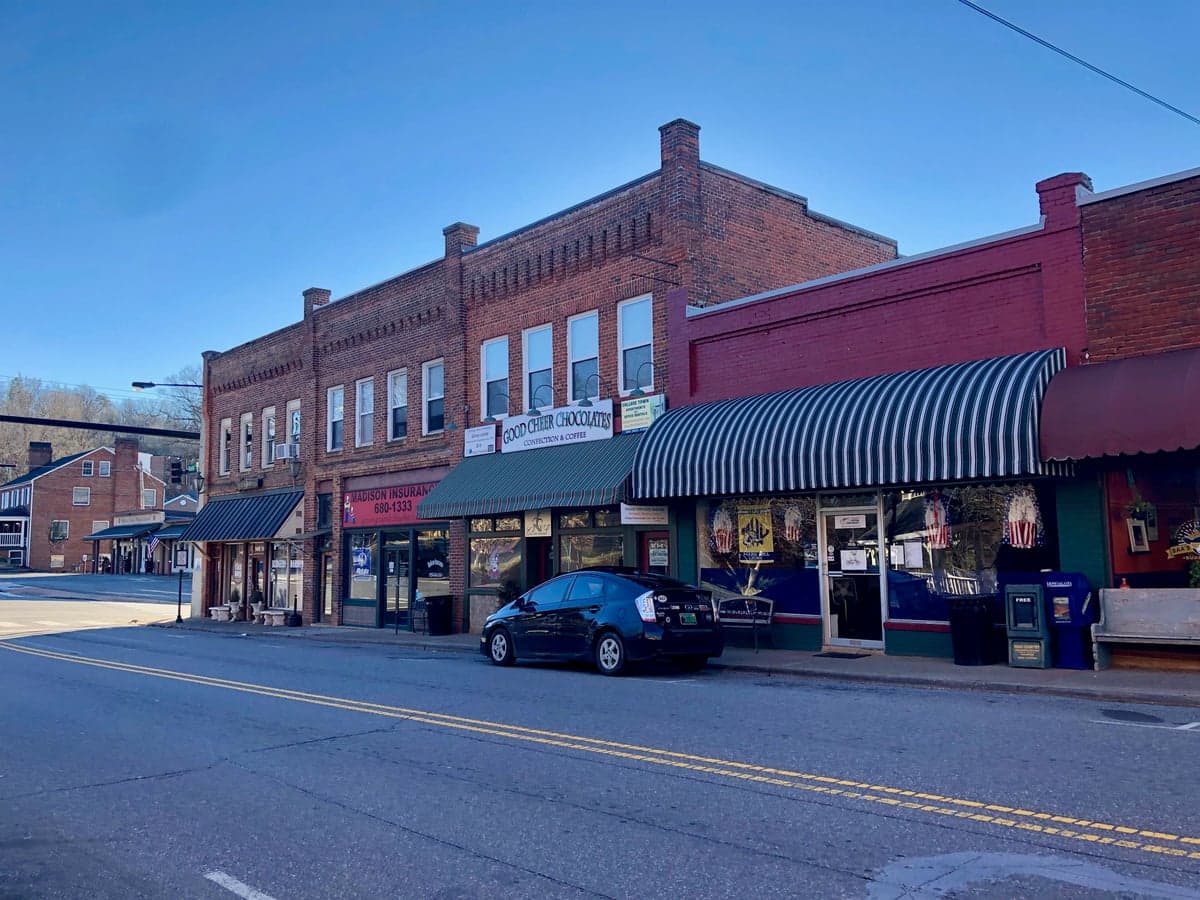
Photo: Wikipedia
Political ClimatePolitical Climate in Mars Hill, NC
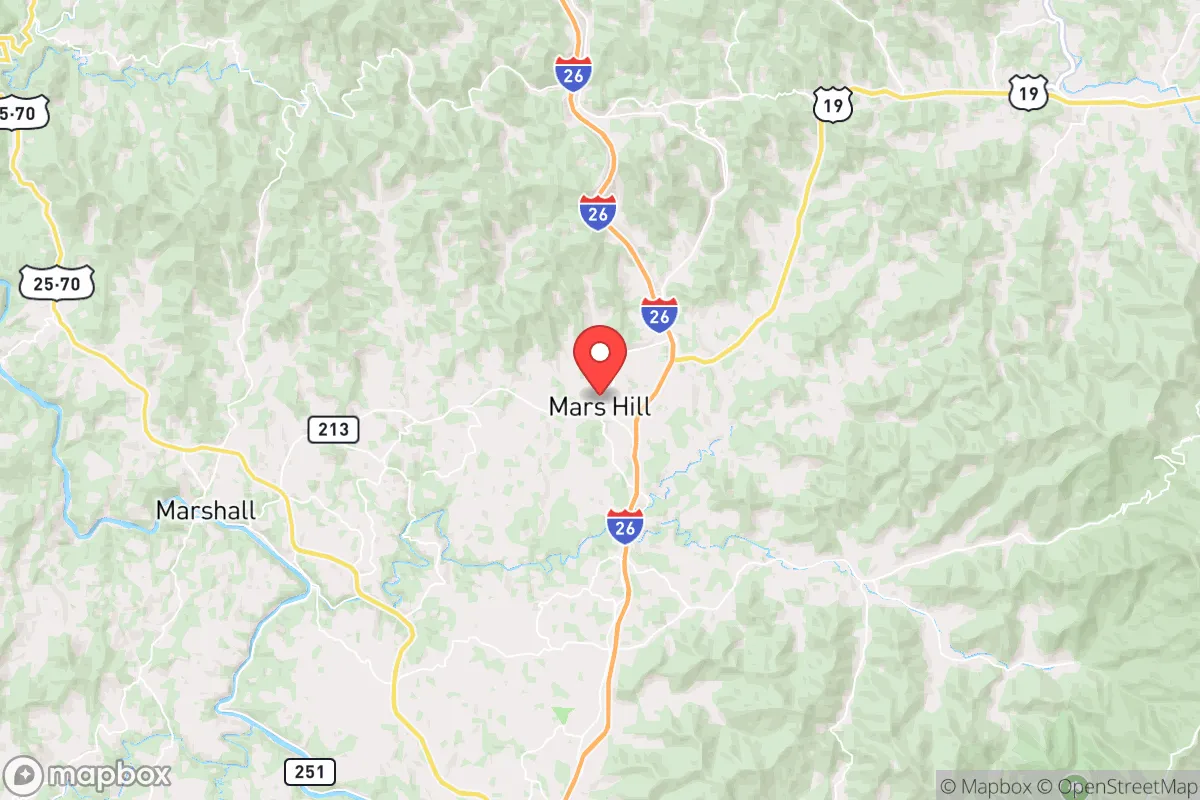
District shown is the primary district for this city’s centroid. Cities may span multiple districts.
Local Political AnalysisPolitical Analysis of Mars Hill, NC
Mars Hill leans reliably Republican, with a Cook PVI of R+5 that makes it measurably more conservative than the state of North Carolina as a whole, which sits at R+1. This isn't a new development — the town and surrounding Madison County have voted red in every presidential election since 2000, though the margins have tightened slightly in recent cycles as Asheville's liberal influence creeps northward up the I-26 corridor. If you're looking at the long-term trajectory, Mars Hill is holding steady as a conservative stronghold, but the growing presence of retirees and remote workers from more progressive areas is slowly nudging the local Overton window.
How it compares
Drive 20 minutes south to Asheville and you're in a deep-blue bubble (Buncombe County went +17 Democratic in 2024), while 30 minutes north into Tennessee's Unicoi County you'll find an even redder R+12 environment. Mars Hill sits right in that tension zone. The town itself is more moderate than the surrounding rural parts of Madison County — the presence of Mars Hill University brings in faculty and students who tend to lean left, creating a noticeable split between the campus community and the long-time farming and manufacturing families. Statewide, North Carolina's R+1 rating reflects its status as a true purple state, but Mars Hill's R+5 puts it in the same ballpark as places like Mooresville or Gastonia — reliably red but not deep-red. The county voted 62% for Trump in 2020, compared to the state's 49.9%, so the gap is real but not extreme.
What this means for residents
For conservative residents, life in Mars Hill means local government and school board elections tend to reflect their values without much drama — the county commission has been Republican-majority for decades, and property taxes remain among the lowest in the region. For liberal residents, it's not hostile territory, but you'll need to be comfortable being in the minority. The university provides a natural social buffer, and many progressive-leaning folks find community through the arts scene or local food co-ops. What's interesting is that the political divide here is less about shouting matches and more about quiet coexistence — people tend to keep politics out of casual conversation at the hardware store or the post office. The real friction point is growth and development: conservatives generally favor limited regulation and low taxes, while newer arrivals push for more environmental protections and affordable housing mandates. That tension plays out in town council meetings, not on front lawns.
Culturally, Mars Hill retains a distinct Appalachian identity that transcends party lines — there's broad support for local music traditions, outdoor recreation access, and small business independence. The biggest policy distinction from the state at large is the county's strong resistance to any form of public transit expansion or density zoning, which keeps the area feeling rural and spread-out. For both sides, the practical takeaway is that Mars Hill offers a slower, more neighborly pace of life where your political sign matters less than whether you show up to help with a barn raising or a community clean-up. The trajectory over the next decade likely sees a slow drift toward purple as Asheville's exurbs expand, but don't expect Mars Hill to flip blue anytime soon — the R+5 lean has deep roots in the soil and the culture.

State Political ClimatePolitical Climate in North Carolina
State Political AnalysisPolitical Environment in the State
North Carolina is a classic swing state that has been trending rightward in presidential elections even as its growing urban centers pull left, creating a political landscape that feels like it’s holding its breath. The Cook PVI of R+1 tells the story: it’s a state that went for Trump in 2024 by about 3 points, after going for Trump in 2020 and 2016, and for Romney in 2012. But that’s a shift from the Obama years, when the state went blue in 2008 and was a nail-biter in 2012. Over the last 15 years, the dominant coalition has been a mix of rural and exurban conservatives, suburban moderates, and a rapidly growing urban liberal base in the Research Triangle and Charlotte. The trajectory is a slow, grinding polarization: the cities get bluer, the countryside gets redder, and the suburbs in between decide every election.
Urban vs. rural divide
The political map of North Carolina is a textbook case of the urban-rural split. The big three metros—Charlotte, Raleigh-Durham, and Asheville—are solidly Democratic. Mecklenburg County (Charlotte) went for Biden by 30 points in 2020, and Wake County (Raleigh) by 25. These are professional-class, college-educated hubs with booming tech, finance, and healthcare sectors. The Research Triangle, anchored by Raleigh, Durham, and Chapel Hill, is the bluest region in the state outside of the mountain enclave of Asheville. Meanwhile, the rural east—places like Robeson, Duplin, and Pitt counties—and the rural west—like Haywood, Rutherford, and Cleveland counties—are deeply Republican. The real battleground is the exurban and suburban ring counties: Cabarrus, Union, Johnston, and Brunswick. These are fast-growing areas where transplants from the North and Midwest are moving in, and they’re often more moderate than the rural core. In 2024, Trump won Union County by 20 points, but that’s down from 30 points in 2016, a sign that the suburbs are slowly shifting. The state’s political future hinges on whether these exurbs stay red or turn purple.
Policy environment
North Carolina’s policy environment is a mix of conservative governance and pragmatic moderation, shaped by a Republican-controlled General Assembly and a Democratic governor (Josh Stein, elected in 2024, following Roy Cooper). The state has a flat income tax rate of 4.5%, which is scheduled to drop to 3.99% by 2027, making it one of the more tax-friendly states in the Southeast. There’s no state property tax, and sales tax is capped at 7.5% in most counties. The regulatory posture is business-friendly, with right-to-work laws and a low corporate tax rate of 2.5%. Education policy is a flashpoint: the state has a robust charter school system and a voucher program (the Opportunity Scholarship Program) that now covers all income levels, which conservatives love and liberals decry as draining public schools. Healthcare is a mixed bag—the state expanded Medicaid in 2023 under a bipartisan deal, covering about 600,000 new enrollees, but it’s still a state where rural hospitals struggle. Election laws have been tightened: voter ID is required (passed in 2018, implemented in 2023), and early voting remains generous with 17 days of in-person early voting. The state is also a national leader in gerrymandering, with both congressional and legislative maps drawn to favor Republicans, though courts have occasionally intervened.
Recent policy direction
The last five years have seen a clear conservative shift on several fronts. On gun rights, North Carolina is a shall-issue state for concealed carry, and in 2023, the legislature passed a law allowing permitless concealed carry (HB 189), effective immediately. On parental and education rights, the state passed the Parents’ Bill of Rights in 2023, requiring schools to notify parents about instructional materials involving sexuality and to get parental consent for changes to a student’s name or pronouns. On speech and privacy, the state has no broad shield law for journalists, but it does have a strong public records law. On medical and bodily autonomy, abortion is banned after 12 weeks (with exceptions for rape, incest, and fetal anomalies), a law passed in 2023 that overrode Governor Cooper’s veto. Property rights are strong—the state has a robust eminent domain standard and no statewide rent control. On voting and ballot access, the state has tightened absentee ballot rules and requires ID, but early voting remains popular. The overall direction is toward more conservative governance on social issues, while maintaining a business-friendly tax and regulatory environment. A relocator should know that the state is not a libertarian free-for-all—it’s a place where the government is active on social issues, especially around education and abortion.
Civil unrest & political movements
North Carolina has a history of visible political activism, but it’s not a state known for widespread civil unrest. The most notable flashpoint in recent years was the 2020 protests in Charlotte and Raleigh following George Floyd’s murder, which saw some property damage but were largely peaceful compared to Portland or Seattle. The state has an active progressive movement centered in the Triangle and Asheville, with groups like the NC NAACP and Democracy NC pushing for voting rights and criminal justice reform. On the right, the state has a strong grassroots conservative movement, particularly around gun rights and parental rights in education. The “Moms for Liberty” group has a significant presence in Wake and Mecklenburg counties, and the state’s Republican Party is dominated by the more conservative wing, with figures like Lt. Gov. Mark Robinson (who lost the 2024 governor’s race) representing the populist, culture-war faction. Immigration politics are relatively muted compared to border states—North Carolina has no sanctuary cities, and the state passed a law in 2015 requiring sheriffs to cooperate with ICE. There’s no serious secession or nullification rhetoric, but election integrity remains a hot topic: the 2020 election saw Trump’s campaign challenge the results in court, and the state’s voter ID law was a major point of contention. A new resident would notice that political signs are everywhere in the fall, and that local news is dominated by school board and county commission races, which are often more contentious than the national ones.
Projection
Over the next 5-10 years, North Carolina is likely to remain a competitive swing state, but the demographic trends favor a slow shift toward the center or even left. The state is growing fast—it added over 1 million people between 2010 and 2020, and the growth is concentrated in the urban and suburban counties that lean Democratic or are trending that way. The Research Triangle and Charlotte are attracting young, college-educated transplants from the Northeast and California, who tend to vote blue. Meanwhile, the rural counties are losing population and aging, which reduces their electoral weight. However, the Republican-controlled General Assembly has shown a willingness to gerrymander aggressively, which could offset some of the demographic shifts. The wild card is the exurbs: places like Johnston County (south of Raleigh) and Cabarrus County (north of Charlotte) are growing fast, and their political lean will determine whether the state stays R+1 or moves to D+1. If the GOP continues to push culture-war issues like abortion restrictions and education battles, they may alienate the suburban moderates who are key to winning statewide. A new resident moving in now should expect to live in a state where every election is a toss-up, where the governor’s mansion and the legislature are often controlled by different parties, and where the political conversation is dominated by education, taxes, and growth management.
For a new resident, the bottom line is that North Carolina offers a politically balanced environment where your experience depends heavily on where you live. If you’re conservative, you’ll find a state government that generally aligns with your views on taxes, guns, and education, and you’ll feel at home in the rural and exurban counties. If you’re liberal, you’ll find vibrant, progressive communities in the cities and a governor who can veto the most extreme legislation, but you’ll also face a legislature that is often hostile to your priorities. The practical takeaway is to choose your county carefully—the difference between living in Wake County and Johnston County is the difference between a blue bubble and a red stronghold, and that affects everything from school board policies to property taxes to the vibe at the local coffee shop. North Carolina is a state that rewards political engagement, because your vote actually matters here, and the direction of the state is still very much up for grabs.
* Values derived from national, state, county, city and local statistics and may differ in a specific area. Last updated: 2026-10-20T17:07:26.000Z
Narrative content on this page is AI-generated and may contain mistakes. Verify any details that matter before acting on them.
ReloMaps may earn a commission from affiliate links at no extra cost to you.

