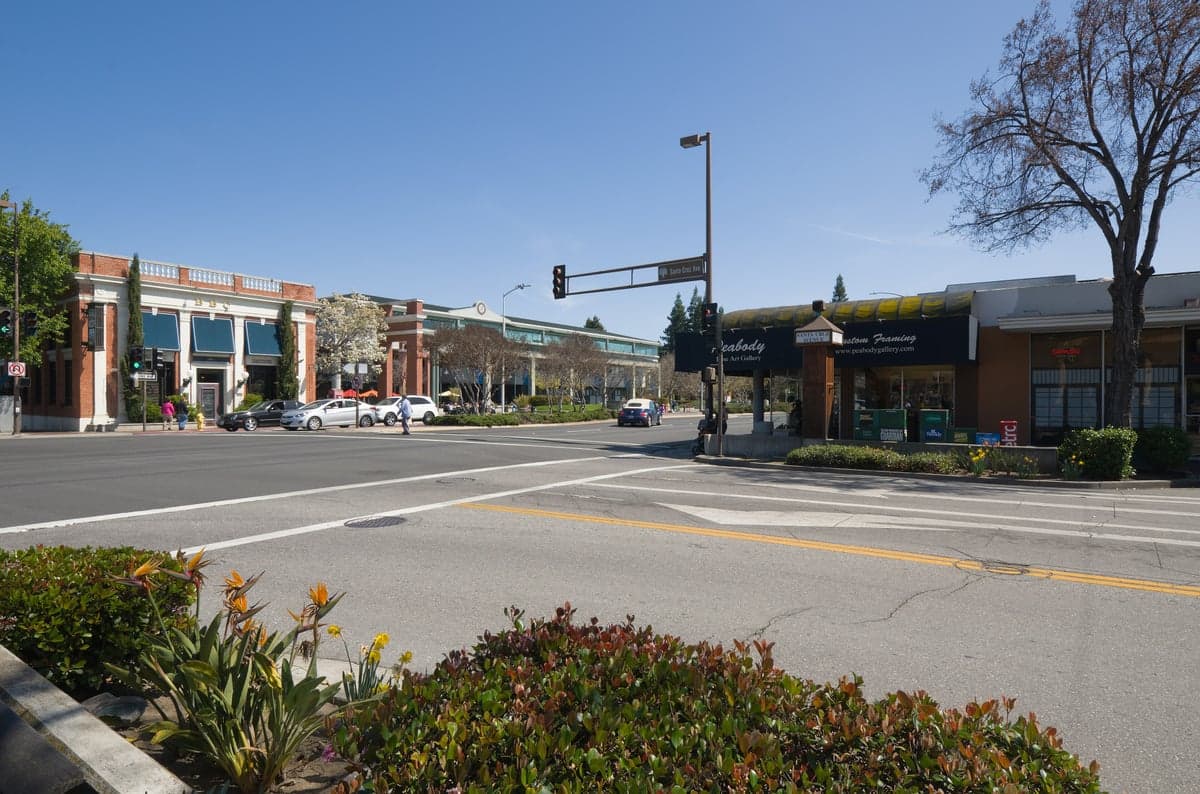
Photo: Wikipedia
Strategic Assessment of Menlo Park, CA
Multiple tactical vulnerabilities. Population density, target proximity, or disaster risk are likely compounding. A retreat property and exit planning is required.
What does the Strategic Assessment tell us?
Our Strategic Assessment grades tactical survivability of an area. Major population centers, military targets, fallout zones, natural disasters, and border exposure all drive risk — lower exposure means a more defensible position in a crisis.
This is heavily inspired by Joel Skousen's Strategic Relocation book. Highly recommended you checkout the book ($)What does this tell us?
Our Strategic Assessment grades tactical survivability of an area. Major population centers, military targets, fallout zones, natural disasters, and border exposure all drive risk — lower exposure means a more defensible position in a crisis.
This is heavily inspired by Joel Skousen's Strategic Relocation book. Highly recommended you checkout the book ($)Strategic Pillars

Key Distances
Regional Safe Places
Below is our recommended "safe zones" in California and the surrounding area based on our strategic heuristics. For most people, it's unrealistic to live in a “safe zone” full-time due to work, family or other personal reasons. They tend to be more rural. However, many of these areas are perfect for second homes and retreat properties that double as a vacation home or even a short-term rental.

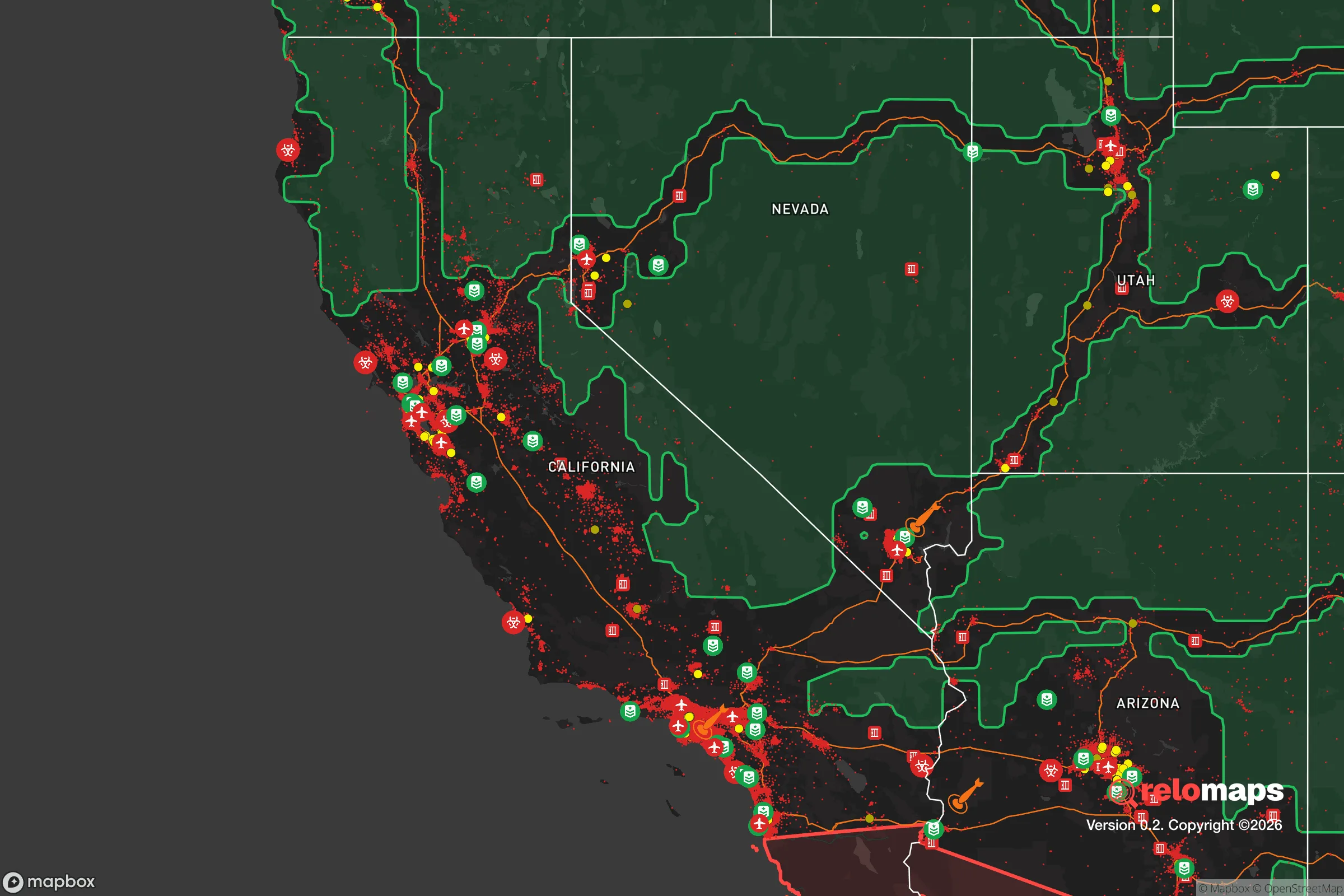


Important Note: For informational purposes only. This does not mean nothing bad ever happens in the green zones. Please use common sense. This is based on public data and modeled with AI. We tried to take a conservative approach but mistakes happen. We update this regularly as new information becomes available.
Solar Generator Recommendations
Backup power matters more here than in safer locations. We've picked three solar generators across budgets and capacity tiers — start with the budget unit if you only need a few essentials, or step up if you want to run a fridge and HVAC for days at a time.

Jackery Portable Power Station Explorer 300
Budget OptionPower on the Go: Weighing only 11 lbs, it's convenient to set up and store with book-sized foldable solar panels

BLUETTI Portable Power Station AC180
Designed for both indoor and outdoor scenarios, AC180 is highly capable as it has a robost capacity and continuous output power.

EF ECOFLOW DELTA Pro Ultra Power Station
Upgraded PickEcoFlow DELTA Pro Ultra is a whole-home energy system designed to grow with your family. Integrated with the Smart Home Panel 2, it scales to meet your evolving energy needs — keeping your home powered, intelligent, and secure through every stage of life.
We earn a commission, at no additional cost to you.
Strategic Assessment Analysis
Menlo Park, California, presents a paradox for the strategic relocator: it sits in the heart of one of the world’s most politically and economically volatile regions, yet its specific geography offers a handful of genuine resilience advantages that are often overlooked by the prepper community. Located on the San Francisco Peninsula, roughly 30 miles south of San Francisco and 15 miles north of San Jose, the city is embedded in the dense urban corridor of Silicon Valley. For a conservative-minded individual or family concerned with civic unrest, mass casualty events, and systemic collapse, this location is a double-edged sword. The immediate proximity to major tech headquarters—including Meta’s global headquarters—makes it a high-value target for both cyber and physical disruption, but the area’s microclimate, water access, and relative wealth of open space provide a baseline of survivability that many denser urban cores lack. The key is understanding that Menlo Park is not a retreat; it is a forward operating base with specific, calculable risks and rewards.
Geographic position and natural advantages for long-term survival
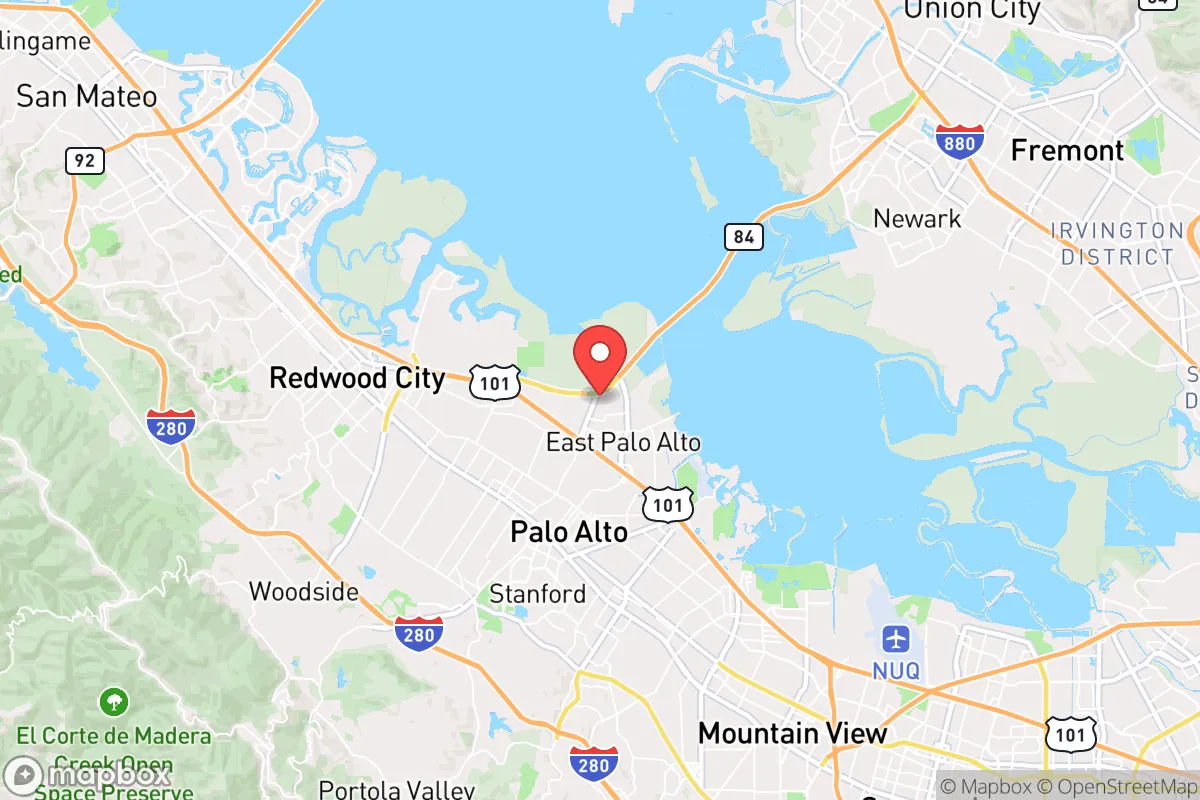
Menlo Park’s geographic position is defined by its location on the western edge of the San Francisco Bay, with the Santa Cruz Mountains rising immediately to the west. This creates a natural barrier that separates the city from the Pacific coast and the more remote, defensible terrain of the Santa Cruz Mountains. The city itself sits on a relatively flat alluvial plain, but within a 15-minute drive, a relocator can reach the foothills of the Santa Cruz range, offering escape routes into the redwood forests and rural areas of San Mateo County. The Bay itself provides a significant water resource—though it is saltwater and requires desalination or purification—and the nearby Crystal Springs Reservoir, located just west of Interstate 280, is a major freshwater source for the region. For a prepper, the ability to access fresh water without relying on municipal infrastructure is critical. The reservoir is protected by the San Francisco Public Utilities Commission and is surrounded by watershed land, which limits development and provides a buffer zone. Additionally, the area’s Mediterranean climate means mild, wet winters and dry summers, reducing the risk of extreme weather events like hurricanes or blizzards, though wildfire risk is elevated. The natural advantages here are real but localized: defensible terrain exists, but it is not contiguous, and the urban sprawl of the Peninsula means that any retreat into the mountains would require navigating choke points like Highway 84 or Skyline Boulevard, which could become impassable during a mass evacuation.
Risks, exposures, and proximity to fallout-relevant landmarks
The most significant risk for a relocator in Menlo Park is its proximity to high-value, high-target infrastructure. Meta’s headquarters at 1 Hacker Way is less than two miles from downtown Menlo Park, and the surrounding area is dense with data centers, venture capital firms, and research facilities that are prime targets for cyberattacks, civil unrest, or even kinetic strikes in a worst-case scenario. The city is also directly adjacent to the Dumbarton Bridge, a critical transportation link connecting the Peninsula to the East Bay, which would become a bottleneck during any evacuation or disruption. Furthermore, the San Francisco International Airport is just 12 miles north, and the Port of Oakland—a major shipping hub—is roughly 25 miles northeast. In a mass casualty event or large-scale disaster, these landmarks would likely be focal points for chaos, drawing both emergency response and opportunistic actors. The area’s political climate is overwhelmingly progressive, which means that during periods of civil unrest, Menlo Park itself could become a flashpoint. The 2020 protests in nearby Palo Alto and San Francisco demonstrated how quickly tensions can escalate in this corridor. For a conservative-leaning individual, the social environment may feel hostile, and the risk of being targeted for political beliefs is non-trivial. Additionally, the region sits on the San Andreas Fault, with the main trace running just west of the city in the Santa Cruz Mountains. A major earthquake (7.0+) would likely sever transportation routes, damage gas and water lines, and trigger landslides in the hills, isolating the Peninsula for days or weeks.
Practical resilience for a relocator: food, water, energy, and defensibility
For a relocator serious about practical resilience, Menlo Park offers a mixed bag. Water is the strongest asset: the Crystal Springs Reservoir holds over 20 billion gallons of freshwater, and while it is controlled by a public utility, a determined individual with proper filtration and a vehicle could access it in an emergency. The city’s water supply is also supplemented by the Hetch Hetchy system, which originates in Yosemite and is gravity-fed, meaning it could continue flowing even without power for a period. Food security is weak: the city has no significant agricultural land, and the local grocery supply chain is entirely dependent on trucking from the Central Valley. A collapse of the transportation network would lead to empty shelves within 72 hours. However, the nearby farmers’ markets and the presence of community gardens offer limited local food production, and the coastal fog zone allows for year-round vegetable growing in small plots. Energy resilience is moderate. The region has high solar potential, and many homes already have rooftop solar, but net metering policies and grid dependency mean that without battery storage, a blackout leaves you in the dark. Natural gas is the primary heating fuel, and the local gas lines are vulnerable to earthquake damage. Defensibility is the weakest link. Menlo Park is a suburban grid with multiple entry points, no natural defensive perimeter, and a dense population of roughly 33,000 people. During a breakdown of civil order, the city would be difficult to secure. The best strategy for a prepper is to treat Menlo Park as a temporary base with a pre-planned bug-out route into the Santa Cruz Mountains, where rural properties in areas like La Honda or Pescadero offer better defensibility and water access. Stockpiling supplies for at least 30 days is essential, as is having a reliable vehicle with off-road capability to navigate blocked roads.
The overall strategic picture for Menlo Park is one of calculated risk. It is not a survivalist’s paradise, nor is it a complete dead zone. The city’s location offers genuine advantages—freshwater access, a mild climate, and proximity to defensible terrain—that are rare in the Bay Area. But those advantages are offset by extreme vulnerability to social and political instability, proximity to high-value targets, and a lack of natural defensibility. For a conservative relocator who values preparedness, Menlo Park could serve as a viable waypoint or a short-term base for those who need to remain in the region for work or family obligations. The key is to never become complacent. Assume that the grid will fail, that civil order will break down, and that the city will become a liability within 48 hours of a major event. Build your plan around extraction, not endurance. If you can secure a property with solar, battery storage, a well, and a defensible perimeter in the nearby hills, you can mitigate many of the risks. But if you are looking for a true retreat where you can ride out the storm in place, Menlo Park is not that place. It is a forward position—useful, but dangerous. Treat it accordingly.

* Values derived from national, state, county, city and local statistics and may differ in a specific area. Last updated: 2026-05-02T04:55:45.000Z
Narrative content on this page is AI-generated and may contain mistakes. Verify any details that matter before acting on them.
ReloMaps may earn a commission from affiliate links at no extra cost to you.

