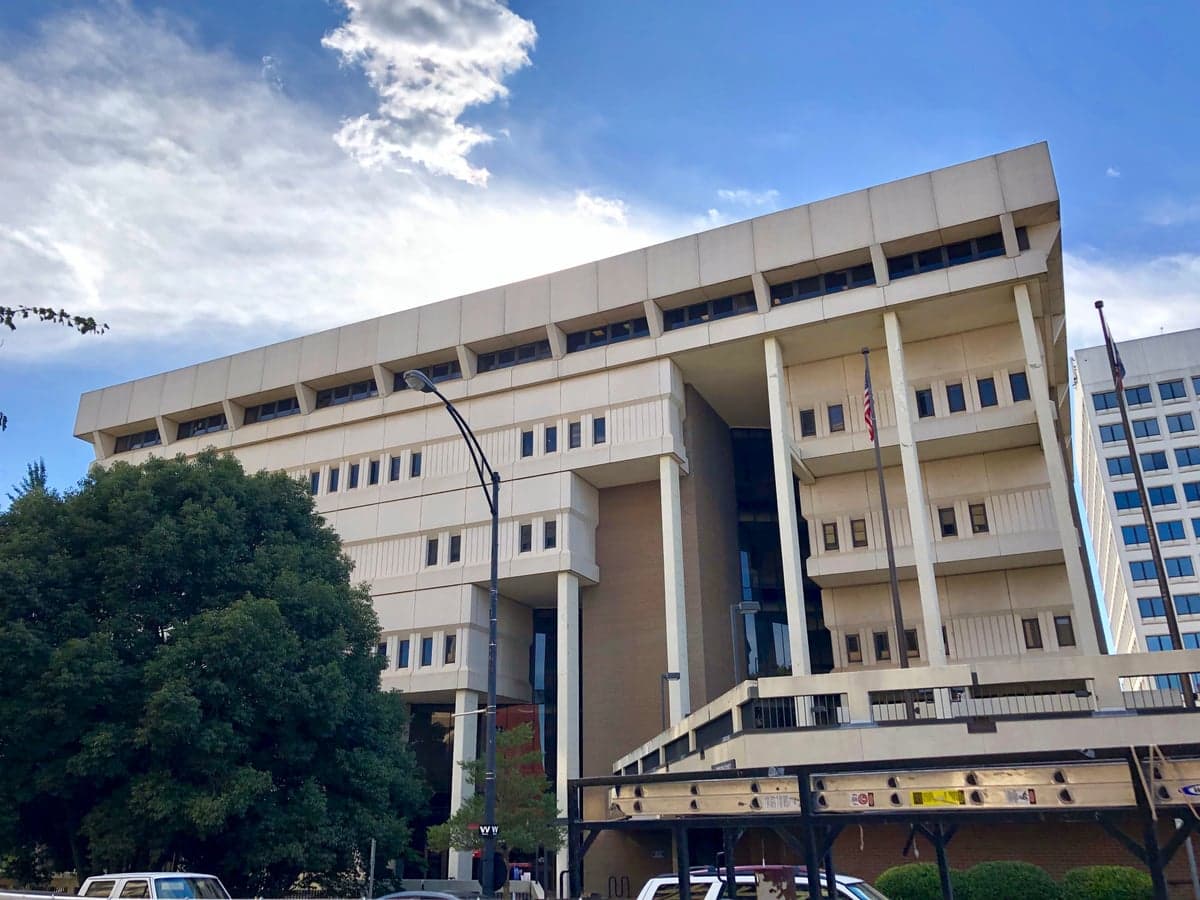
Photo: Wikipedia
Political ClimatePolitical Climate in Forsyth County
Showing district-level results — no local-only data available.
Local Political AnalysisPolitical Analysis of Forsyth County
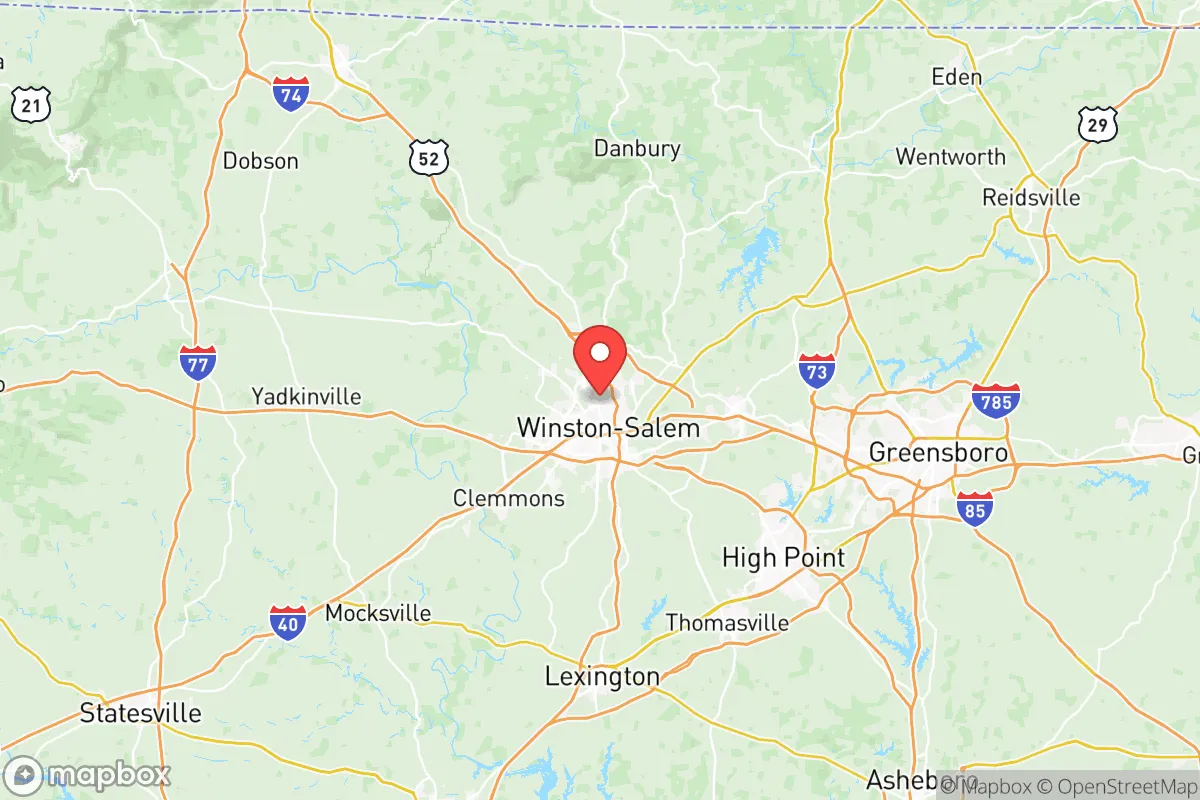
Forsyth County, anchored by Winston-Salem, is a classic purple-to-light-red county in a state that's become the ultimate battleground. The Cook PVI of R+9 tells you the county leans Republican overall, but that number masks a deeply divided electorate. In 2024, Donald Trump carried the county by roughly 10 points, but that margin has been shrinking for years. The real story is the urban-rural split within the county: Winston-Salem itself is a blue island, while the surrounding towns and unincorporated areas are solidly red. This isn't a place where one party dominates the conversation; it's a place where the two sides live in different worlds, often just a few miles apart.
How it compares
Compared to North Carolina as a whole (Cook PVI R+1), Forsyth County is significantly more Republican-leaning. The state is a true toss-up, with a razor-thin margin in presidential elections. Forsyth, however, has a built-in Republican advantage of about 8 points over the state average. That gap is driven by the county's large rural and exurban areas. Towns like Kernersville and Lewisville are reliably red, often voting 60-70% Republican. Clemmons is a swing town, but leans right in most cycles. Meanwhile, Winston-Salem's core precincts, especially around Wake Forest University and the downtown arts district, vote 70-80% Democratic. The county's political center of gravity is shifting, though. The growth of Winston-Salem's urban core and the influx of younger, more diverse residents are slowly pulling the county leftward, but the rural precincts still turn out in high numbers, keeping the overall lean red.
What this means for residents
For a conservative resident, Forsyth County is a comfortable place to live. The county commission and most local school board seats are held by Republicans. You'll find plenty of conservative churches, gun clubs, and civic groups. For a liberal resident, it's more of a mixed bag. You'll have a strong community in Winston-Salem, with progressive city policies and a vibrant cultural scene, but you'll feel the conservative majority at the county level, especially on issues like land use, taxes, and public health mandates. The practical effect is that local elections matter a lot. The county commission controls the budget for schools, libraries, and social services, and those decisions often split along party lines. The city of Winston-Salem has its own council and mayor, which gives progressives a real voice, but countywide issues can feel like a constant tug-of-war.
Culturally, the divide is visible. Winston-Salem's downtown is a hub of craft breweries, art galleries, and foodie spots, while the outlying towns are more oriented toward family-owned restaurants, big-box retail, and church life. The county's policy distinctions are most apparent in zoning and development. The rural areas resist high-density housing and public transit expansion, while the city pushes for more urban infill and bike lanes. The result is a county that feels like two different places under one government. The long-term trajectory is toward a tighter purple, as the city's growth slowly outpaces the rural vote, but that shift will take another decade or more to fully play out. For now, Forsyth remains a place where you can find your tribe, but you'll have to live with the other side having real power.

State Political ClimatePolitical Climate in North Carolina
State Political AnalysisPolitical Environment in the State
North Carolina is a classic purple state that has been trending rightward in recent cycles, with a Cook PVI of R+1, but it remains deeply competitive and politically divided. The state’s overall lean is driven by a coalition of rural and suburban conservatives, while the fast-growing urban centers of Charlotte, Raleigh-Durham, and Asheville pull the other direction. Over the past 10-20 years, North Carolina has shifted from a reliably red state to a true battleground, with presidential margins often within 1-3 points, and state-level control seesawing between parties. For a conservative-leaning relocator, this means a state where your vote matters, but where policy outcomes can change dramatically depending on which party holds the governor’s mansion and the General Assembly.
Urban vs. rural divide
The political map of North Carolina is a textbook study in urban-rural polarization. The major metros—Charlotte (Mecklenburg County), Raleigh-Durham (Wake and Durham Counties), and Asheville (Buncombe County)—are solidly Democratic, with Mecklenburg and Wake each delivering 60-65% of the vote for Democratic presidential candidates in 2024. These areas are powered by finance, tech, and education sectors, and they attract a diverse, college-educated population that leans left on social issues. In contrast, the vast rural and exurban counties—places like Gaston County (west of Charlotte), Johnston County (southeast of Raleigh), and Buncombe’s rural fringes—vote Republican by 20-30 points. The Sandhills region around Fayetteville and the Piedmont Triad (Greensboro, Winston-Salem, High Point) are more mixed, with suburban counties like Guilford and Forsyth trending blue while their rural outskirts stay red. The coastal counties from Wilmington to the Outer Banks are a patchwork: New Hanover County (Wilmington) is a swing county, while rural counties like Brunswick and Pender lean Republican. This divide means that a resident’s political experience depends heavily on whether they live inside the I-440 beltline in Raleigh or on a farm in Duplin County.
Policy environment
North Carolina’s policy environment is a mix of conservative fiscal governance and moderate-to-liberal social policies, depending on the issue. The state has a flat income tax rate of 4.5% (down from 5.25% in 2023, with a path to 3.99% by 2027), a corporate income tax of 2.5% (phasing down to 0% by 2030), and no state tax on Social Security benefits. Sales tax is 4.75% state-wide, with local add-ons up to 2.5%. The regulatory posture is business-friendly, with right-to-work laws and a low unionization rate (around 3% private sector). Education policy is a flashpoint: the state has a robust school choice program (Opportunity Scholarships) that now covers all income levels, and charter schools are plentiful, but public school funding has been a perennial court battle (the Leandro case). Healthcare is mixed—the state expanded Medicaid in 2023 under a bipartisan deal, but abortion is banned after 12 weeks (with exceptions for rape, incest, and fetal anomalies), and the state has a 72-hour waiting period. Election laws have been tightened: voter ID is required (with limited exceptions), early voting is 17 days, and same-day registration is available during early voting. The state also has a constitutional carry law (permitless concealed carry) since 2023.
Recent policy direction
Over the past five years, North Carolina has moved decisively right on several fronts. The 2023 budget and tax cuts accelerated the income tax phase-down and eliminated the corporate income tax entirely by 2030. The 12-week abortion ban (SB 20, 2023) replaced a previous 20-week limit, and the state has not expanded exceptions. On guns, HB 189 (2023) eliminated the requirement for a permit to purchase a handgun and allowed permitless concealed carry. On education, the Opportunity Scholarship program was expanded to universal eligibility in 2023, and the state has banned teaching of certain concepts related to race and sex in K-12 classrooms (the “Parents’ Bill of Rights,” SB 49, 2023). On property rights, the state has a strong right-to-farm law and limits on eminent domain. On voting, the Voter ID law (SB 824, 2018, implemented in 2023) was upheld by the state Supreme Court after a partisan flip. On privacy and surveillance, the state has no comprehensive data privacy law, but it does have a biometric privacy law (2024) regulating facial recognition. On medical and bodily autonomy, the state has a medical marijuana law (SB 3, 2023) that is still being implemented, but recreational cannabis remains illegal. The overall direction is toward lower taxes, expanded school choice, tighter abortion restrictions, and broader gun rights.
Civil unrest & political movements
North Carolina has a history of visible political activism on both sides. The Moral Monday protests (2013-2015) were a major left-wing movement against Republican policies on voting rights, education, and healthcare, drawing thousands to the state legislature. More recently, the 2020 protests in Charlotte and Raleigh over George Floyd’s death saw some property damage and clashes, but were smaller than in other states. On the right, the “We the People” rallies and Trump rallies in places like Wilmington and Fayetteville have drawn large crowds. Immigration politics are less heated than in border states, but there is a sanctuary city debate: Durham and Orange County have “trust policies” limiting cooperation with ICE, while the state legislature has passed laws (HB 10, 2019) requiring sheriffs to honor ICE detainers. Election integrity has been a major flashpoint: the 2020 election saw a recount in the presidential race (Trump won by 1.3 points), and the 2024 election saw lawsuits over absentee ballot rules. The “Stop the Steal” movement had a presence, but no major violence. A new resident would notice that political signs and bumper stickers are common, and that local news covers partisan battles intensely, but daily life is generally civil.
Projection
Over the next 5-10 years, North Carolina is likely to remain a competitive purple state, but with a slight rightward tilt at the state level. In-migration from blue states (New York, New Jersey, California) is concentrated in the urban metros, which will continue to push Charlotte and Raleigh-Durham leftward. However, these new arrivals are often fiscally conservative and socially moderate, and they tend to settle in exurbs like Wake Forest or Fort Mill (South Carolina, but functionally part of Charlotte’s metro), which can shift suburban counties from red to purple. The rural counties are losing population and aging, which will slowly erode the Republican base, but the GOP’s advantage in the General Assembly is protected by gerrymandered maps that are likely to persist. The state Supreme Court flipped back to Republican control in 2022, and that is unlikely to change soon. Expect continued battles over abortion, school choice, and tax policy, with incremental conservative wins at the state level. A new resident moving in now should expect a state where their vote matters, where policy can change with each election, and where the political culture is more polarized than the friendly “Southern hospitality” stereotype suggests.
For a conservative-leaning relocator, North Carolina offers a favorable tax environment, strong gun rights, school choice, and a business-friendly climate, but with the understanding that urban areas are increasingly liberal and that state-level policy can shift if Democrats win the governorship or the legislature. For a liberal relocator, the state offers vibrant cities, a growing economy, and a competitive political landscape, but with the reality that conservative policies on abortion, voting, and education are likely to persist. The bottom line: North Carolina is a state where you can find your political tribe, but you’ll have to live with the other side having real power. If you want a reliably red state, look to Tennessee or South Carolina; if you want a reliably blue one, look to Virginia. But if you want a place where your vote matters and where the political future is still being written, North Carolina is it.
* Values derived from national, state, county, city and local statistics and may differ in a specific area. Last updated: 2026-06-12T18:23:59.000Z
Narrative content on this page is AI-generated and may contain mistakes. Verify any details that matter before acting on them.
ReloMaps may earn a commission from affiliate links at no extra cost to you.

