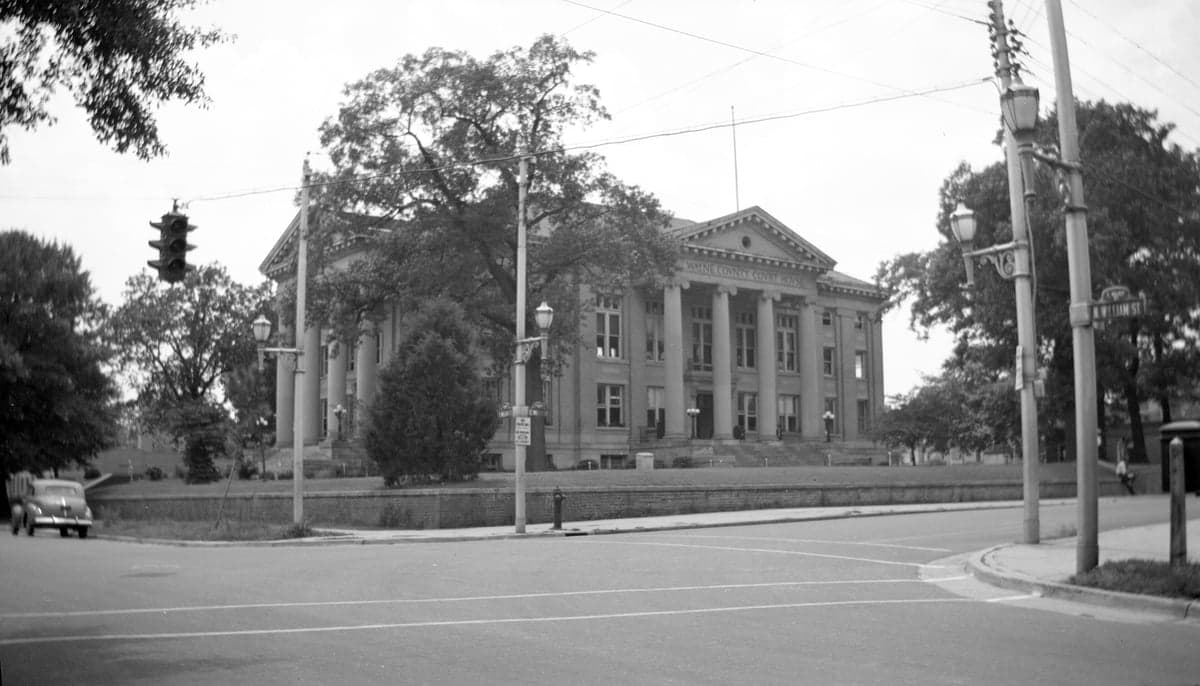
Photo: Wikipedia
Political ClimatePolitical Climate in Wayne County
Showing district-level results — no local-only data available.
Local Political AnalysisPolitical Analysis of Wayne County
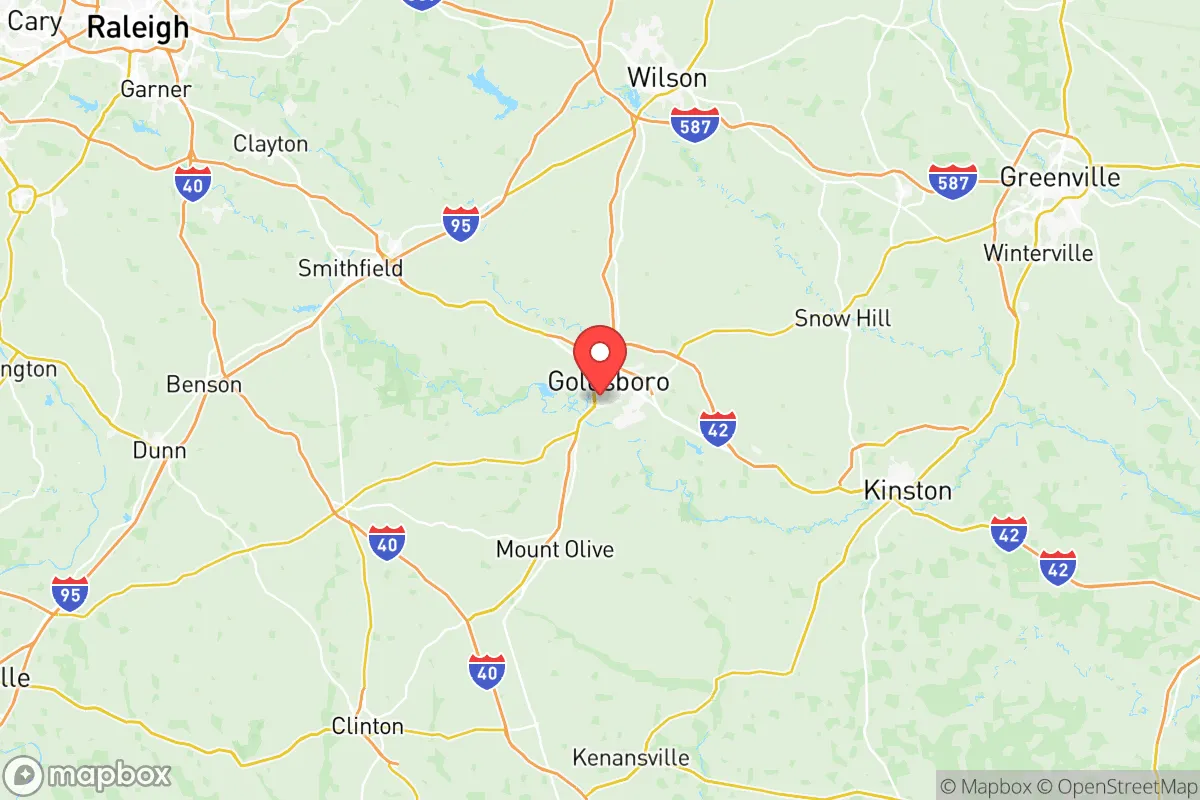
Wayne County, anchored by Goldsboro, has long been a bellwether in North Carolina politics, and its current Cook PVI of R+1 tells you it’s a true toss-up county that leans just slightly Republican. That R+1 rating is identical to the state’s overall PVI, meaning Wayne County mirrors the statewide political divide almost perfectly. In 2020, the county went for Donald Trump by about 1.5 points, but in 2024, that margin widened to roughly 4 points for Trump—a rightward shift that tracks with rural and exurban trends across eastern North Carolina. But don’t let the county-level numbers fool you: the political reality here is far from monolithic, and the precinct-level map tells a more interesting story.
How it compares
Wayne County’s R+1 PVI puts it in the same category as the state as a whole, but the internal dynamics are distinct. The city of Goldsboro itself is a Democratic stronghold, with precincts like the ones around the historic downtown and near Seymour Johnson Air Force Base often voting 60-65% blue. In contrast, the rural towns of Mount Olive and Fremont lean heavily red, with precincts there regularly hitting 70-75% for Republican candidates. The swing precincts—the ones that decide elections—are in the suburban fringe of Goldsboro, places like the Grantham area and the Pikeville precincts, where independent voters and military families from the base create a volatile mix. Compared to neighboring counties like Johnston (R+12) to the west or Duplin (R+18) to the east, Wayne is noticeably more competitive. It’s closer in profile to Pitt County (home of Greenville) but with a slightly more conservative tilt.
What this means for residents
For conservative residents, Wayne County’s lean means you’ll find a comfortable majority in county commission and school board races, but you can’t take it for granted—the Goldsboro city council often flips between parties, and local bond referendums can be tight. Liberal residents, especially in Goldsboro’s core, have real political influence: they consistently elect Democrats to the state legislature from the 10th and 11th House districts, and the county’s swing nature means their votes matter in statewide races. Practically, this creates a political culture where both sides have to show up. You won’t see the deep-red dominance of, say, rural Johnston County, but you also won’t find the deep-blue insulation of Durham. It’s a place where a Republican sheriff and a Democratic mayor can coexist, and where debates over economic development—like the future of the former Seymour Johnson Air Force Base expansion—cut across party lines.
Culturally, Wayne County’s political climate is shaped by its military presence and agricultural roots. Seymour Johnson Air Force Base is the county’s largest employer, and its active-duty and veteran population tends to lean conservative on national security but can be more moderate on local issues like infrastructure and education. The county’s policy distinctions are subtle but real: Goldsboro has a higher minimum wage ordinance for city contractors, while the county government has resisted similar measures. You’ll see more Confederate monument debates in the rural towns than in Goldsboro proper, and the local Democratic Party is more focused on economic populism than cultural wars. Looking ahead, the county’s trajectory depends on growth—if the suburban sprawl from Raleigh reaches deeper into Wayne, the R+1 could shift toward blue; if the rural base holds firm, it stays red-leaning. Either way, it’s a place where your vote genuinely counts, and both parties know it.

State Political ClimatePolitical Climate in North Carolina
State Political AnalysisPolitical Environment in the State
North Carolina is a classic swing state with a slight Republican lean, currently rated R+1 by the Cook Political Report, but the real story is how that lean has narrowed and shifted over the past two decades. From 2008 through 2024, the state voted for a Republican president in every election except 2008 (Obama won it by a razor-thin 0.3%), yet Democrats have won eight of the last ten gubernatorial elections and control the state Supreme Court as of 2025. This split-ticket reality means the state is genuinely competitive, but the underlying coalition is changing: the old Democratic stronghold of rural eastern North Carolina is shrinking, while the booming Research Triangle and Charlotte metros are pulling the state leftward, and the exurban and mountain counties are digging in deeper red. For a relocator, this translates into a state where policy outcomes depend heavily on which party holds the legislature—and right now, Republicans have supermajorities in both chambers, giving them effective control over most state-level decisions.
Urban vs. rural divide
The political map of North Carolina is a textbook case of the urban-rural split. The three major metros—Charlotte (Mecklenburg County), Raleigh-Durham (Wake and Durham Counties), and Greensboro-Winston-Salem (Guilford and Forsyth Counties)—are the Democratic engine, collectively delivering margins of 200,000+ votes in statewide races. Mecklenburg alone went +27 points for Biden in 2020, while Wake went +25. These metros are growing fast, driven by tech, finance, and biotech transplants, and they’re pulling the state’s overall lean leftward. In contrast, the rural east—places like Robeson County (historically Democratic but now trending Republican), Duplin County, and the northeastern coastal plain—has shifted hard right, with many counties flipping from blue to deep red since 2012. The mountain counties in the west, like Watauga (home to Boone and Appalachian State) and Buncombe (Asheville), are blue islands surrounded by red: Watauga went +18 for Biden, while neighboring Avery County went +48 for Trump. The exurban ring around Charlotte—Union County, Cabarrus County, Iredell County—is reliably Republican and growing fast, creating a donut of red around the blue metro core. The net effect is a state where the rural vote still outweighs the urban vote in statewide races, but the gap is closing every cycle as metros add population.
Policy environment
North Carolina’s policy environment is defined by Republican legislative control and a Democratic governor with veto power, creating a constant tug-of-war. The state has a flat income tax rate of 4.5% as of 2025, down from 7% in 2013, with a scheduled phase-down to 3.99% by 2027—a clear win for conservatives. The corporate income tax is 2.5%, among the lowest in the Southeast. There is no state-level property tax; property taxes are set locally, and the statewide average effective rate is about 0.78%, below the national average. Education policy is a major battleground: the Leandro court case has ordered the state to fund a “sound basic education” for all children, but the Republican legislature has resisted full compliance, leading to a $1.7 billion funding gap as of 2024. School choice is robust—North Carolina has one of the largest voucher programs in the country (the Opportunity Scholarship Program), with no income cap as of 2024, and over 200 charter schools. Healthcare is mixed: the state expanded Medicaid in 2023 under a bipartisan deal, covering roughly 600,000 new enrollees, but abortion is banned after 12 weeks (with exceptions for rape, incest, and fetal anomalies) under the 2023 law that overrode Governor Cooper’s veto. Election laws have been tightened: voter ID is required (implemented in 2023 after years of litigation), early voting is 17 days, and same-day registration is available during early voting. The state does not have a “stand your ground” law, but it does have a Castle Doctrine and a permitless carry law for concealed handguns (passed in 2023).
Recent policy direction
The last five years have seen North Carolina move decisively right on most fronts, driven by Republican supermajorities that can override gubernatorial vetoes. In 2023, the legislature passed a 12-week abortion ban (SB 20), overriding Cooper’s veto, and also enacted permitless carry of concealed handguns (HB 189). The same session saw a major tax cut package (HB 259) accelerating the income tax rate reduction and eliminating the corporate tax entirely by 2030. On education, the legislature expanded the Opportunity Scholarship voucher program to universal eligibility, meaning any family can use public funds for private school tuition, regardless of income. On parental rights, the state passed the “Parents’ Bill of Rights” (HB 755) in 2023, requiring schools to notify parents of any changes to a child’s health or well-being and restricting instruction on gender identity and sexuality in K-4 classrooms. On voting, the 2023 omnibus election law (SB 747) shortened the absentee ballot return window, banned private funding of elections, and made it harder for third parties to conduct voter registration drives. On property rights, the state has not passed a broad “takings” reform, but it did enact a law in 2024 limiting local governments’ ability to regulate short-term rentals like Airbnb. On medical and bodily autonomy, the 12-week abortion ban is the most significant restriction, but the state also passed a law in 2023 banning gender-affirming care for minors (HB 808), overriding Cooper’s veto. On speech and privacy, the state has not enacted a comprehensive data privacy law, but it did pass a law in 2024 restricting TikTok on state devices. The overall direction is clear: the legislature is pushing a conservative agenda on guns, abortion, education, and taxes, while the courts and governor provide occasional brakes.
Civil unrest & political movements
North Carolina has a history of visible political activism on both sides, but the intensity has cooled since the 2020 protests. The 2020 George Floyd protests in Charlotte and Raleigh saw significant property damage and National Guard deployment, but subsequent years have been quieter. The state has a strong organized left, particularly around the Moral Monday movement (led by the NAACP), which has held regular protests at the legislature since 2013 over voting rights, education funding, and abortion. On the right, the Carolina Journal and the John Locke Foundation are influential think tanks pushing limited government, while grassroots groups like Moms for Liberty have been active in school board races, particularly in Wake County and Union County. Immigration politics are less heated than in border states: North Carolina has no sanctuary cities, and the 2023 budget included $2 million for local law enforcement to cooperate with ICE. The state has seen a rise in “constitutional sheriff” rhetoric in rural counties, with some sheriffs in Stokes County and Yadkin County publicly refusing to enforce certain gun laws. Election integrity remains a flashpoint: the 2020 election was closely contested, with Trump losing by 1.3 points, and the state GOP has pushed for audits and tighter rules, leading to the 2023 law. A new resident would notice that political signs and bumper stickers are common, but the state is generally civil—people disagree without the open hostility seen in some other swing states.
Projection
Over the next 5-10 years, North Carolina is likely to become more competitive, not less, as in-migration from blue states continues to fuel the Charlotte and Raleigh metros. The state added over 400,000 residents between 2020 and 2024, and most of that growth is in Democratic-leaning urban and suburban areas. If current trends hold, the state could flip to a lean-Democratic or toss-up status by 2030, especially if the Republican legislature continues to push culturally conservative policies that alienate suburban moderates. However, the rural vote is not collapsing—it’s just shrinking slowly—and the exurban ring around Charlotte is growing fast and voting red. The key variable is the legislature: Republicans have gerrymandered the state House and Senate maps to maintain supermajorities even if they lose statewide races, so policy direction will remain conservative even if the state’s presidential vote flips. A new resident moving in now should expect to see continued fights over abortion, school choice, and taxes, with the legislature pushing right and the governor (likely a Democrat in 2028) vetoing. The state’s economic growth will continue to attract both conservatives and liberals, creating a politically diverse but generally civil environment.
For a new resident, the bottom line is that North Carolina offers a conservative policy environment on taxes, guns, and education, with a liberal counterweight in the governor’s office and the metros. If you’re a conservative, you’ll find a state that has been moving your direction for a decade, with low taxes, school choice, and permitless carry. If you’re a liberal, you’ll find strong communities in Charlotte, Raleigh, and Asheville, but you’ll need to accept that state-level policy will be conservative for the foreseeable future. The practical takeaway: your daily life will be shaped more by your local county than by the state—live in Wake County and you’ll have blue policies on schools and housing; live in Union County and you’ll have red ones. Choose your county carefully, and you’ll find a place that fits your politics.
* Values derived from national, state, county, city and local statistics and may differ in a specific area. Last updated: 2026-06-11T18:20:02.000Z
Narrative content on this page is AI-generated and may contain mistakes. Verify any details that matter before acting on them.
ReloMaps may earn a commission from affiliate links at no extra cost to you.

