
Photo: Wikipedia
Political ClimatePolitical Climate in Washington County
Showing district-level results — no local-only data available.
Local Political AnalysisPolitical Analysis of Washington County
Washington County, Oregon, has shifted hard to the left over the past decade, and if you’re a conservative, it’s getting harder to recognize the place I grew up in. The Cook Partisan Voting Index (PVI) now sits at D+20, meaning the county votes 20 points more Democratic than the national average. That’s a massive jump from where we were even 15 years ago, and it’s a full 12 points bluer than the state of Oregon as a whole, which sits at D+8. The trend line is clear: the old moderate, live-and-let-live spirit is being replaced by a one-size-fits-all progressive agenda that’s creeping into every corner of daily life.
How it compares
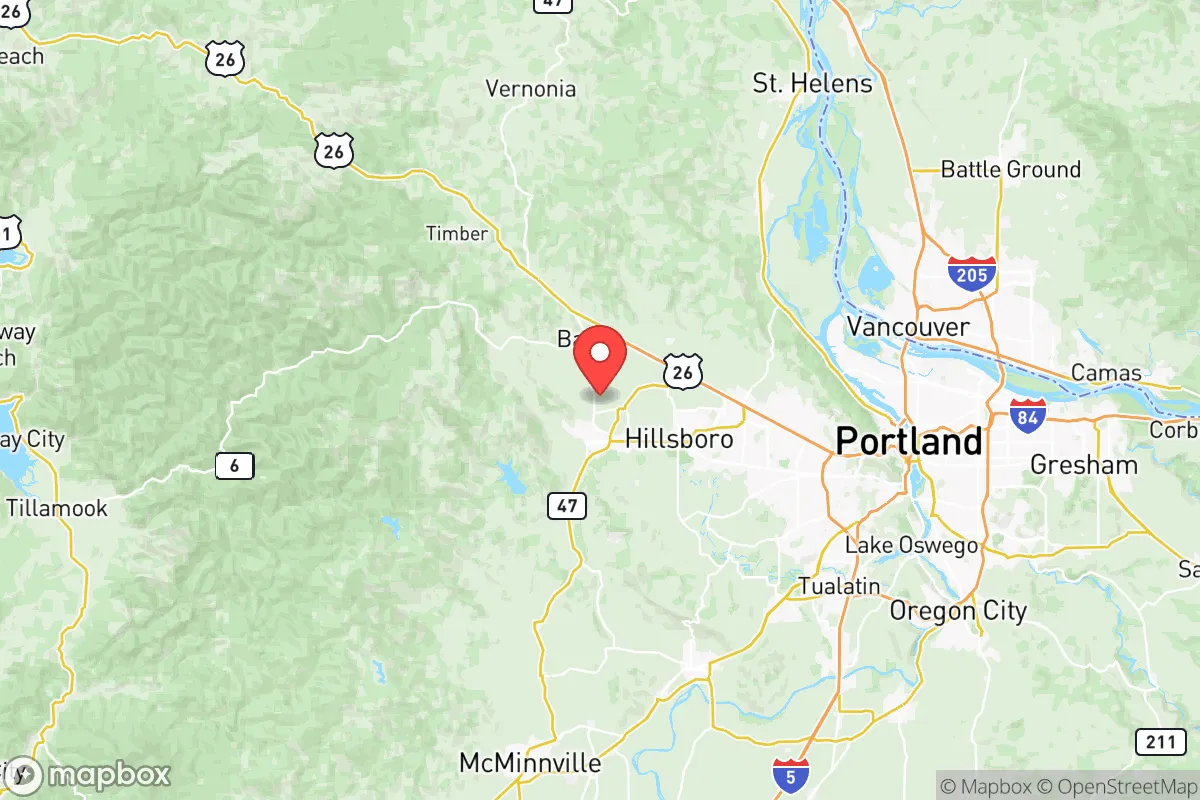
When you compare Washington County to the rest of Oregon, the difference isn’t subtle. The state as a whole is already reliably blue, but Washington County is in a league of its own—think of it as the engine room for the state’s progressive machine. The urban core, especially Beaverton and Hillsboro, are deep blue strongholds where you’ll find the highest concentration of tech transplants and government workers who vote straight-ticket Democrat. But it’s not all uniform. Head east toward Sherwood or south to Gaston, and you’ll still find pockets of red—precincts where folks remember when the county was more about farming and family than bike lanes and housing mandates. Even Tigard and Tualatin have swing precincts, though they’re getting squeezed every election cycle. The rural fringe is holding on, but the urban growth boundary keeps pushing out, and with it comes the voting patterns of Portland’s spillover.
What this means for residents
For those of us who value personal freedoms—like deciding what’s best for our kids’ education or how to run our small businesses—the political climate here feels increasingly hostile. The county government has embraced a laundry list of progressive policies: strict land-use regulations that make it nearly impossible to build a workshop on your own property, zoning rules that prioritize high-density apartments over single-family homes, and a school board that’s more focused on equity training than reading and math. Property taxes keep climbing to fund these pet projects, and there’s a growing sense that your voice doesn’t matter unless you’re on the right side of the cultural divide. The local elections are often decided in the primary, where the most activist voters show up, so by the time the general rolls around, the choice is usually between a progressive and a more progressive candidate.
Cultural and policy distinctions
One of the biggest cultural shifts is the erosion of local control. The county has adopted statewide mandates on everything from gas stoves to homeless camping policies, and there’s little room for towns like North Plains or Banks to chart their own course. The urban-rural split is real: drive 20 minutes west of Hillsboro, and you’ll hit Forest Grove, where the vibe is still semi-rural, but the county commission keeps pushing urban-style density there too. The old Washington County was a place where you could buy a few acres, keep some chickens, and mind your own business. Now, it feels like every square inch is being planned, permitted, and policed by people who think they know better than you do. If you’re looking for a place where personal liberty still means something, you might want to keep an eye on the eastern edge of the county—or start looking farther out.

State Political ClimatePolitical Climate in Oregon
State Political AnalysisPolitical Environment in the State
Oregon has a Cook PVI of D+8, meaning it leans about eight points more Democratic than the national average, but that number hides a deeply fractured political landscape. The state’s blue hue is driven almost entirely by the Portland metro area—Multnomah, Washington, and Clackamas counties—which together cast roughly half the state’s votes. Over the past 20 years, the rural-urban chasm has widened dramatically: in 2000, Oregon was a classic swing state (Bush lost it by just 0.4%), but by 2024 it had become a solidly Democratic stronghold at the presidential level, even as many inland counties moved sharply right. A conservative moving here needs to understand that Oregon is not one state but two—a coastal, urbanized, progressive west and a rugged, libertarian-leaning east—and the policy battles reflect that split.
Urban vs. rural divide
The political map of Oregon is a study in contrasts. The Portland tri-county area (Multnomah, Washington, Clackamas) and the Willamette Valley corridor—including Eugene, Salem, and Corvallis—are the engine of Democratic dominance. Multnomah County alone gave Biden 78% of the vote in 2020. Meanwhile, the rest of the state is deeply red: Lake County voted 80% for Trump, Grant County 79%, and Malheur County 76%. The I-5 corridor is the blue spine; everything east of the Cascades is solidly Republican. Even within the Portland metro, there are pockets of conservatism: Oregon City and Canby in Clackamas County lean right, and Hillsboro’s western edge has a growing conservative suburban base. But the urban core—Portland proper, Beaverton, Gresham—is overwhelmingly progressive, with city councils pushing policies like defunding police and rent control that would never fly in Bend or Medford.
Policy environment
Oregon’s state-level policies reflect its urban majority, and they’re a mixed bag for a conservative. On the plus side, there is no state sales tax—a major draw for many—but property taxes are moderate and income taxes are high, with a top marginal rate of 9.9% on income over $125,000 (single filers). The regulatory posture is aggressive: Oregon has some of the strictest land-use laws in the nation (the 1973 Senate Bill 100), which limits housing supply and drives up costs. Education policy is dominated by teachers’ unions and progressive curriculum mandates; in 2023, the state passed a law requiring ethnic studies in all K-12 schools. Healthcare is heavily regulated, with a state-run insurance marketplace and Medicaid expansion under the Oregon Health Plan. Election laws are among the most liberal: automatic voter registration, same-day registration, and vote-by-mail (since 1998) are the norm. There’s no voter ID law, which concerns many conservatives about election integrity. The state also has a sanctuary law (ORS 181A.820) that prohibits state and local law enforcement from using resources to enforce federal immigration law—a flashpoint for those worried about border security.
Trajectory & freedom
Over the past decade, Oregon has moved decisively toward less personal freedom in several key areas. Gun rights took a major hit with Measure 114 (passed in 2022), which requires a permit to purchase a firearm, a criminal background check for all transfers, and bans magazines over 10 rounds. It’s currently tied up in court, but the trend is clear. Parental rights have eroded: in 2023, the state passed a law (HB 2002) that allows minors 15 and older to access gender-affirming care without parental consent, and another (SB 3) that prohibits schools from notifying parents if a child changes their gender identity or pronouns. Medical autonomy was curtailed during COVID with some of the longest-lasting mask and vaccine mandates in the country, though those have since expired. Property rights are constrained by the aforementioned land-use laws and a rising trend of rent control in Portland and other cities. On the plus side, Oregon has no sales tax and no personal property tax on vehicles, which keeps some economic freedom intact. But the overall trajectory is toward more state control, not less.
Civil unrest & political movements
Oregon has been a national flashpoint for political unrest. The 2020 Portland protests—lasting over 100 consecutive nights—saw federal agents deployed, buildings burned, and a city government that largely refused to intervene. The Pacific Northwest Youth Liberation Front and Antifa have a visible presence in Portland, while the rural east has seen the rise of People’s Rights (the Ammon Bundy-affiliated group) and Oregonians for Firearms Safety on the right. The Greater Idaho movement—which proposes moving 13 eastern Oregon counties into Idaho—has gained real traction, with 11 counties voting to explore the idea. Immigration politics are tense: the sanctuary law means Portland and Multnomah County refuse to cooperate with ICE, while border-state concerns are minimal (Oregon is far from the southern border). Election integrity remains a hot-button issue: the 2020 election saw no major fraud, but the vote-by-mail system and lack of voter ID have fueled persistent distrust among conservatives. A new resident will notice the stark contrast between Portland’s activist energy and the quiet, self-reliant culture of places like John Day or Burns.
Projection
Over the next 5-10 years, Oregon is likely to become more polarized, not less. In-migration patterns are a double-edged sword: California transplants (the largest source of new residents) tend to be moderate-to-liberal, reinforcing the blue lean in the Willamette Valley. But remote work is also drawing conservatives to cheaper, rural areas like Klamath Falls and La Grande, where housing is affordable and politics are red. The Greater Idaho movement could gain legislative traction if rural frustration continues to boil over, but a border change is unlikely without federal approval. The Democratic supermajority in the legislature (as of 2024) means more progressive policies are coming: expect a push for a state-level wealth tax, stricter environmental regulations on agriculture and timber, and further erosion of parental rights. The 2026 gubernatorial race will be a bellwether—if a moderate Republican like Christine Drazan (who nearly won in 2022) can break through, it might signal a shift. But realistically, Oregon’s urban centers will continue to dominate, and the state will remain a blue island in a red inland West.
Bottom line for a conservative moving to Oregon: You can find a community that shares your values—especially east of the Cascades or in the southern Oregon towns like Grants Pass and Roseburg—but you’ll be fighting state-level policies that are increasingly hostile to gun rights, parental authority, and economic freedom. The lack of sales tax is a real benefit, but the high income tax and regulatory burden are significant costs. If you value local control and want to live somewhere with a strong sense of personal responsibility, Oregon’s rural areas offer that—but be prepared for a state government that sees you as a problem to be managed, not a citizen to be trusted.
* Values derived from national, state, county, city and local statistics and may differ in a specific area. Last updated: 2026-05-20T08:20:59.000Z
Narrative content on this page is AI-generated and may contain mistakes. Verify any details that matter before acting on them.
ReloMaps may earn a commission from affiliate links at no extra cost to you.

