Photo: Wikipedia
Political ClimatePolitical Climate in Surprise, AZ
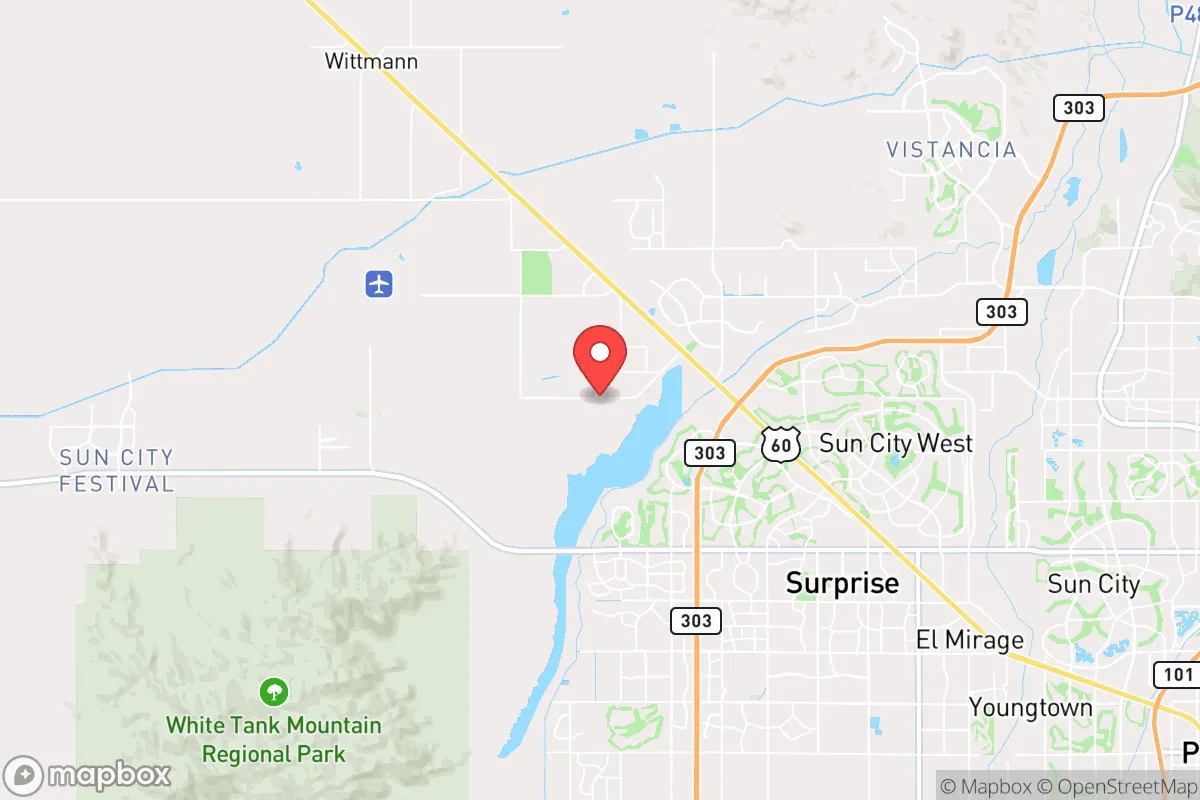
District shown is the primary district for this city’s centroid. Cities may span multiple districts.
Local Political AnalysisPolitical Analysis of Surprise, AZ
Surprise, Arizona, has long been a reliably conservative stronghold, and that’s not changing anytime soon. With a Cook Partisan Voting Index (PVI) of R+15, this city leans heavily Republican, and you can feel it in the local culture and voting patterns. In the 2024 election, Maricopa County as a whole shifted right, but Surprise was a standout—its precincts consistently delivered double-digit margins for conservative candidates, reflecting a deep-rooted preference for limited government and personal responsibility. The trajectory here is steady: while some nearby areas like Phoenix or Temecula have seen progressive inroads, Surprise has held firm, with new residents often drawn by the promise of lower taxes and fewer regulations.
How it compares
Drive 20 minutes east to Glendale or Peoria, and you’ll notice a slightly different vibe—those cities have pockets of purple politics, especially near the Westgate Entertainment District, where younger voters lean more moderate. But Surprise is a different animal. It’s more akin to Buckeye or Goodyear to the south, where conservative values are the baseline. The contrast is sharpest with Tempe or Scottsdale, where progressive policies on housing and environmental regulations have taken hold. In Surprise, you won’t see the same push for density or green mandates; instead, the focus stays on property rights and keeping government out of your backyard. The R+15 rating isn’t just a number—it reflects a community that votes its conscience on issues like school choice, Second Amendment protections, and resisting state-level overreach.
What this means for residents
For folks living here, the political climate translates into a daily life with fewer headaches from government interference. You won’t find the same kind of zoning battles or business mandates that plague cities like Tucson or Flagstaff. Property taxes stay manageable, and the city council has historically pushed back against state-level attempts to impose stricter water use rules or housing quotas. That said, there’s a growing concern among long-time residents about the influx of Californians and other transplants who might bring different ideas. If you’re worried about creeping progressivism, keep an eye on local school board races and city council elections—those are the battlegrounds where the fight for Surprise’s character plays out. The good news is that most newcomers seem to adapt to the local ethos rather than change it, but it’s worth staying engaged.
Culturally, Surprise stands out for its strong sense of community rooted in traditional values. You’ll see this in the popularity of churches, veteran organizations, and events like the Surprise Fine Arts Festival, which emphasize local participation over government funding. Policy-wise, the city has been a leader in resisting overreach: it was one of the first in the Valley to pass a resolution opposing unfunded state mandates on local police, and it’s consistently voted against county-level mask or vaccine requirements. Looking ahead, the biggest test will be water management—Surprise relies on the Colorado River and groundwater, and there’s pressure from state officials to adopt stricter conservation rules. The hope here is that the city can find a balance that protects personal freedoms while being responsible stewards of resources, without letting bureaucrats dictate how you use your own land. For now, Surprise remains a place where you can live your life with minimal government interference, and that’s exactly how most residents want it.

State Political ClimatePolitical Climate in Arizona
State Political AnalysisPolitical Environment in the State
Arizona has transformed from a reliably Republican stronghold into one of the nation’s premier political battlegrounds, a shift that accelerated dramatically after 2016. The state’s overall partisan lean is now a razor-thin toss-up, with Democrats winning the presidency in 2020 and both Senate seats in 2018 and 2020, while Republicans hold the governorship and control of the state legislature as of 2025. Over the last 15 years, the dominant coalition has moved from a solidly conservative, McCain-era Republican base to a fractured landscape where Maricopa County’s explosive suburban growth, combined with an influx of out-of-state transplants, has diluted the GOP’s historical advantage. The 10-20 year trajectory shows a state that was once a lock for Republicans now swinging wildly between cycles, with no clear long-term dominance in sight.
Urban vs. rural divide
The political map of Arizona is a textbook study in the urban-rural chasm. Maricopa County, home to Phoenix and its sprawling suburbs, contains over 60% of the state’s population and is the ultimate swing county—it voted for Biden by 2 points in 2020 after going for Trump by 3 in 2016. The core of Phoenix itself leans Democratic, but the critical suburbs tell a more nuanced story. Mesa and Gilbert, once deep-red bedroom communities, have shifted purple, with Gilbert voting for Biden in 2020 by a narrow margin. Scottsdale remains reliably Republican but with a growing moderate wing. Meanwhile, Tucson (Pima County) is a Democratic stronghold, driven by the university and a large Hispanic population, while Flagstaff (Coconino County) is a liberal mountain enclave. The rural counties—Yavapai (Prescott), Mohave (Kingman, Lake Havasu City), and Pinal (Casa Grande)—are deeply conservative, often voting 70-30 or more for Republicans. The divide is stark: the urban core and college towns drive the blue shift, while the vast, sparsely populated rural expanse anchors the red base.
Policy environment
Arizona’s policy environment is a mixed bag that reflects its battleground status. On taxes, the state is relatively friendly: it has a flat income tax rate of 2.5% (passed in 2021 under Governor Doug Ducey), and no estate tax. Property taxes are below the national average. The regulatory posture is generally pro-business, with right-to-work laws and limited zoning in many areas. However, education policy is a flashpoint. The state has a robust school choice system, including Empowerment Scholarship Accounts (ESAs) that allow parents to use public funds for private or homeschool expenses—a major win for parental rights. But public school funding remains low, and teacher strikes in 2018 (#RedForEd) forced a 20% pay raise, signaling organized labor’s power. Healthcare is a mixed bag: Arizona expanded Medicaid under the Affordable Care Act (AHCCCS), which many conservatives view as government overreach. Election laws have been a hotbed of controversy. After 2020, the GOP-controlled legislature passed stricter voter ID laws and banned ballot harvesting, but also faced a failed “audit” of Maricopa County’s ballots that became a national spectacle. The state also has a near-total abortion ban from 1864 that was briefly reinstated in 2024 before being repealed, creating chaos. For a conservative, the policy environment offers tax advantages and school choice, but the constant political volatility is exhausting.
Trajectory & freedom
The trajectory of personal freedom in Arizona is concerning for conservatives. On the positive side, gun rights remain strong: Arizona is a constitutional carry state (no permit needed to carry concealed), and preemption laws prevent local governments from enacting their own restrictions. The 2021 law banning “sanctuary cities” (SB 1070’s legacy) remains in effect, though enforcement has waned. However, recent trends are alarming. In 2024, a ballot measure (Proposition 139) enshrined a “fundamental right” to abortion in the state constitution, overriding the legislature’s near-total ban. This was a clear expansion of government-mandated access that many conservatives see as a loss of life protection. Parental rights have been under assault: in 2023, the state’s Democratic attorney general, Kris Mayes, refused to defend a law requiring schools to notify parents if a child requests a name or pronoun change. Meanwhile, COVID-era mandates left a bitter taste—Governor Ducey’s 2020 executive orders closing businesses and mandating masks were seen by many as government overreach, though he later banned vaccine mandates. Property rights are generally respected, but the influx of Californians has driven up housing costs, creating de facto economic pressure. The net trend: Arizona is becoming less free on social issues (abortion, parental rights) while maintaining economic and gun freedoms—a tension that will define the next decade.
Civil unrest & political movements
Arizona has been a flashpoint for political movements on both sides. The 2020 election aftermath saw massive protests in Phoenix, with “Stop the Steal” rallies drawing tens of thousands at the state capitol, while counter-protests from Antifa and BLM groups led to clashes. The Maricopa County ballot audit in 2021 became a national circus, with cyber ninjas and conspiracy theories dominating headlines. Immigration politics remain explosive: the legacy of SB 1070 (2010) still resonates, and border communities like Nogales and Yuma are ground zero for the ongoing crisis. In 2024, Governor Katie Hobbs deployed the National Guard to the border, but also rescinded the state’s “Operation Secure Arizona” task force. Sanctuary city debates rage in Tucson and Phoenix, where city councils have passed non-cooperation ordinances. On the right, the Arizona Freedom Caucus is a powerful force in the legislature, pushing for election integrity and school choice. On the left, groups like LUCHA (Living United for Change in Arizona) organize for immigrant rights and progressive policies. A new resident will notice the constant political tension—yard signs, bumper stickers, and heated local news coverage are inescapable.
Projection
Over the next 5-10 years, Arizona is likely to become more competitive and more purple, with a slight leftward tilt. Demographic shifts are the key driver: the state is growing rapidly, with many newcomers from California and the Midwest who bring moderate-to-liberal views. The Hispanic population, which leans Democratic but is not monolithic, is growing as a share of the electorate. Maricopa County will continue to be the epicenter, and its suburbs—Chandler, Peoria, Surprise—will determine the state’s future. If Republicans can hold the line on economic and gun freedoms while moderating on social issues, they can remain competitive. But the 2024 abortion ballot measure showed that progressive ballot initiatives can bypass the legislature. Expect more fights over school choice, election laws, and water rights (a looming crisis). For a conservative moving in now, the next decade will feel like a constant defensive battle—holding ground on taxes and guns while losing ground on cultural issues.
Bottom line for a new resident: Arizona offers low taxes, strong gun rights, and school choice, but you’re moving into a state that is politically volatile and shifting left. If you value economic freedom and a pro-business environment, you’ll find a lot to like. But be prepared for a culture war that plays out in every election, with no clear winner in sight. Choose your county carefully—rural areas like Prescott or Lake Havasu City offer a conservative haven, while Phoenix suburbs are a toss-up. It’s a great place to live, but it’s not the Arizona your grandparents moved to.
* Values derived from national, state, county, city and local statistics and may differ in a specific area. Last updated: 2026-05-01T10:07:37.000Z
Narrative content on this page is AI-generated and may contain mistakes. Verify any details that matter before acting on them.
ReloMaps may earn a commission from affiliate links at no extra cost to you.

