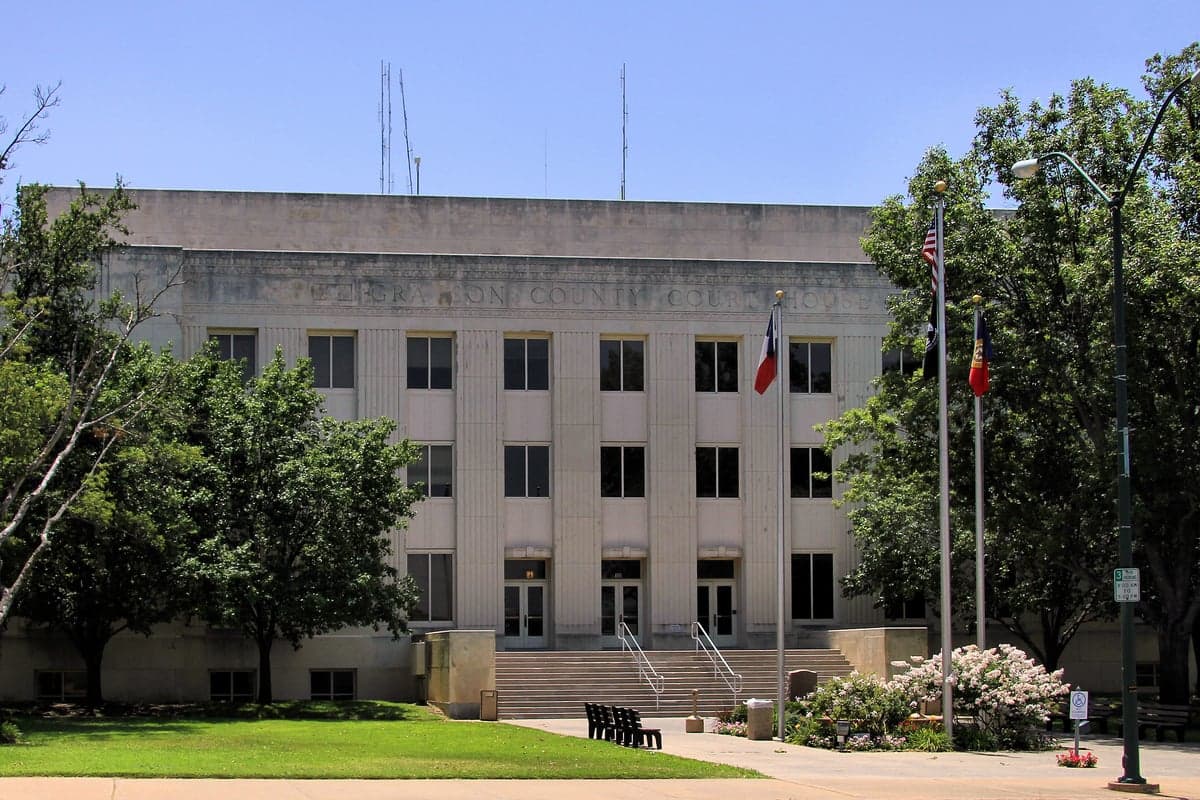
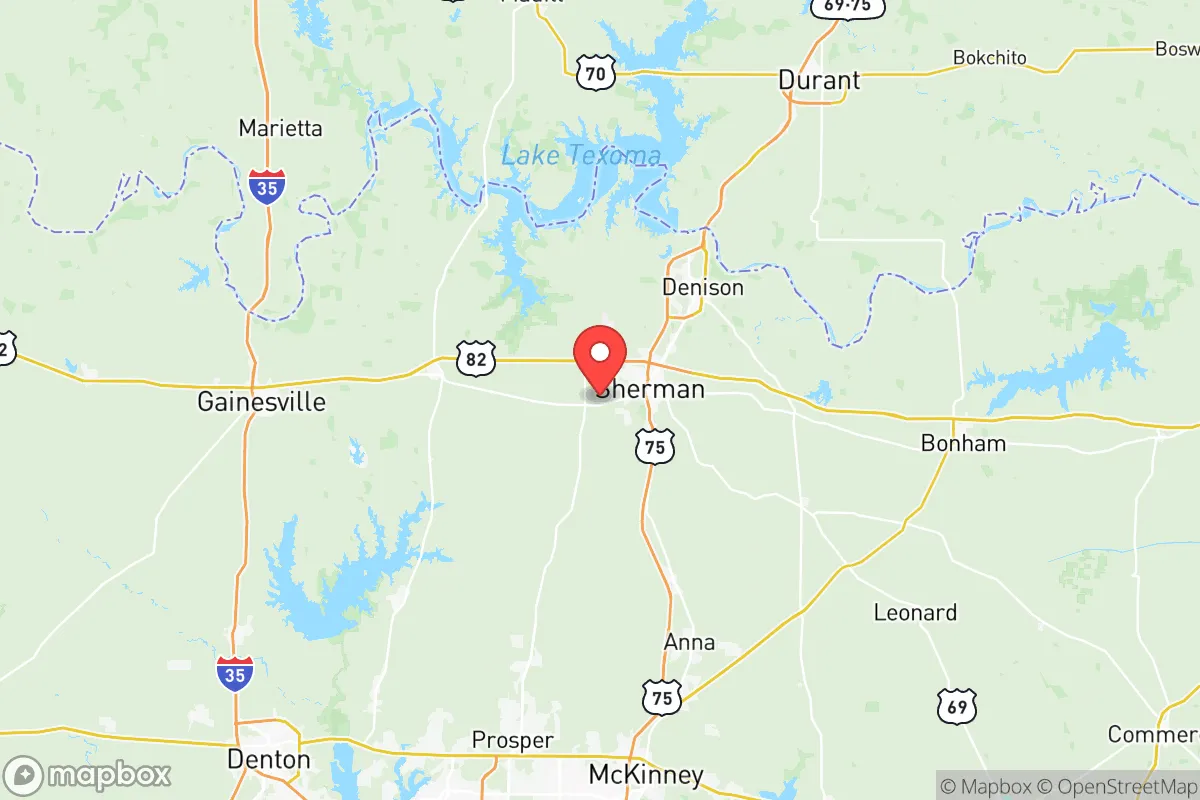
Photo: Wikipedia
Political ClimatePolitical Climate in Grayson County
Showing district-level results — no local-only data available.
Local Political AnalysisPolitical Analysis of Grayson County
Look, if you're asking about the political climate in Grayson County, I'll tell you straight up: this is about as solid a red county as you'll find in North Texas, and it's been that way for as long as I can remember. The Cook PVI sits at a strong R+16, which means Republicans have a sixteen-point built-in advantage over the national average—that's not just a lean, that's a lock in most races. But here's the thing: it's not completely uniform across the county, and there are a few spots where you'll see a different shade of blue creeping in, especially around Sherman's Austin College area and some of the newer subdivisions near the Lake Texoma corridor. Overall though, the trajectory is still firmly conservative, even as parts of the state shift faster than most of us are comfortable with.
How it compares
Compared to the state of Texas as a whole—which has a Cook PVI of R+4—Grayson County is in a whole different league politically. The state's R+4 means it's still red, but it's competitive enough that statewide races can get tight. Not here. In Grayson, Republicans usually win by double digits, no sweat. The difference comes down to where you're standing inside the county. Denison and Sherman are the population centers, and while both are reliably red in federal and state races, Sherman has a few precincts near the college that trend more moderate or even blue on down-ballot issues. Pottsboro and Whitesboro on the other hand—those are deep red, the kind of towns where you know your neighbors and everyone's on the same page about personal freedoms and limited government. Van Alstyne is growing fast and still leans red, but some of the new folks coming in from the Metroplex bring attitudes that don't always fit the local way of thinking. That's the biggest difference with the state: Texas has urban centers like Houston, Dallas, and Austin that pull the state toward the middle, but Grayson County doesn't have that kind of population weight tipping the scales.
What this means for residents
For people living here, the political climate means most local policies stay aligned with traditional conservative values—low taxes, Second Amendment protections, and a general hands-off approach from the government. You don't see the kind of overreach you hear about in cities like Austin or Dallas. The county commissioners and city councils in places like Sherman and Denison have historically been reluctant to impose heavy regulations on businesses or property owners. But there are warning signs: as the county grows, especially around the Lake Texoma area and along the US-75 corridor, some of those progressive ideas are getting a foothold. I've seen zoning debates and mask mandate discussions that would have been unthinkable here ten years ago. It's not an invasion, but it's a slow shift, and it's worth keeping an eye on if you value local control and don't want some bureaucrat telling you what to do with your land or your money.
What makes Grayson County unique
One thing that sets Grayson apart from the rest of Texas is the strong sense of community self-reliance. People here don't look to the state or federal government to solve their problems—they handle things at the local level, through churches, volunteer fire departments, and civic groups. The county's proximity to Oklahoma also gives it a bit of a borderland culture, where folks are practical and independent. You won't find the same kind of urban progressive activism you see in Denton or Collin County just to the south. That said, the southern part of the county near Howe and Van Alstyne is feeling more pressure from the Dallas-Fort Worth sprawl, and with that comes changing politics. If you're looking for a place that still values personal responsibility and limited government, Grayson County is one of the last strongholds in North Texas—but it's not immune to the trends that are reshaping the whole state.

State Political ClimatePolitical Climate in Texas
State Political AnalysisPolitical Environment in the State
Texas has been a reliably Republican state for decades, with a Cook Partisan Voting Index of R+4, meaning it leans about four points more Republican than the national average. The dominant coalition is a mix of rural conservatives, suburban families, and business-minded professionals who favor limited government and low taxes. Over the past 10-20 years, the state has shifted slightly toward the center as explosive growth in the Dallas-Fort Worth metroplex, Houston, and San Antonio has brought in a wave of new residents, many from blue states, who have softened the GOP’s margins but not flipped the state. The last Democrat to win statewide office was in 1994, and while presidential races have tightened — Trump won Texas by 5.6 points in 2024, down from 9 points in 2016 — the state’s overall trajectory remains conservative, with Republicans holding every statewide office and both legislative chambers.
Urban vs. rural divide
The political map of Texas is a classic story of deep red rural areas versus deep blue urban cores, with the suburbs acting as the battleground. The major metros — Austin, Dallas, Houston, San Antonio, and El Paso — are Democratic strongholds. Austin, in particular, is a progressive island in a conservative sea, with Travis County voting +42 for Biden in 2020. El Paso, heavily Hispanic and union-influenced, is reliably blue. Meanwhile, rural West Texas, the Panhandle, and East Texas are deeply Republican. Lubbock and Amarillo are GOP anchors, often voting +40 or more for Republican candidates. The real story is the suburbs: counties like Collin (north of Dallas), Denton, and Fort Bend (southwest of Houston) were once solidly red but have shifted purple. Collin County, for example, went from +27 for Romney in 2012 to +14 for Trump in 2020. These areas are where the state’s political future will be decided, as in-migration from California and Illinois brings more moderate and left-leaning voters into formerly conservative neighborhoods.
Policy environment
Texas’s policy environment is defined by a low-tax, low-regulation posture that appeals to conservatives. There is no state income tax, and property taxes are high but capped at 10% annual growth for homesteads. The regulatory climate is business-friendly, with minimal red tape for industries like energy, tech, and construction. On education, the state has embraced school choice, with the 2023 passage of a universal education savings account program that lets parents use state funds for private or homeschool expenses. Healthcare policy is a mixed bag: Texas refused Medicaid expansion under Obamacare, leaving roughly 1.5 million uninsured, but it has also passed laws protecting medical freedom, such as a 2021 ban on vaccine passports. Election laws tightened after 2020 with SB 1, which restricted mail-in voting, added ID requirements, and banned 24-hour and drive-through voting. The state also passed a near-total abortion ban (SB 8) in 2021, with no exceptions for rape or incest, which remains a flashpoint. For conservatives, the policy environment is largely favorable, but the lack of Medicaid expansion and rising property taxes are persistent grievances.
Trajectory & freedom
On the freedom front, Texas has moved in two directions simultaneously. On the positive side for conservatives, the state has expanded Second Amendment rights with permitless carry (HB 1927, 2021), allowing any law-abiding adult to carry a handgun without a license. Parental rights were strengthened with the 2023 passage of the “Parental Bill of Rights,” which requires schools to notify parents about curriculum changes and medical services. Property rights were bolstered by a 2023 law limiting eminent domain for private development. However, there are concerning trends. The state’s response to COVID-19 included mask mandates and business closures in some cities, though Governor Abbott later banned vaccine mandates and mask requirements. More troubling is the growing influence of progressive prosecutors in blue cities — Dallas County DA John Creuzot and Harris County DA Kim Ogg (until her 2024 defeat) implemented policies like no-cash bail and reduced prosecution for low-level offenses, which critics say undermined public safety. The state legislature has pushed back with laws like SB 6 (2021), which bans cities from defunding police, and a 2023 law allowing the state to remove district attorneys who refuse to enforce certain laws. Overall, Texas remains freer than most states, but the battle between state preemption and local progressive control is intensifying.
Civil unrest & political movements
Texas has seen its share of political flashpoints. The 2020 Black Lives Matter protests in Austin and Houston were large and sometimes violent, leading to property damage and a lasting rift between activists and law enforcement. The “Defund the Police” movement gained traction in Austin, where the city council cut the police budget by $150 million in 2020, only to restore it after a crime spike. On the right, the “Constitutional Carry” movement succeeded in 2021, and the “Save Our Children” rallies against critical race theory and transgender policies in schools drew thousands to the state capitol in 2022 and 2023. Immigration is a constant flashpoint: Governor Abbott’s Operation Lone Star has bused over 100,000 migrants to Democratic cities, and the state has sued the Biden administration over border policies. The “secession” rhetoric, while mostly symbolic, has grown louder, with the Texas Nationalist Movement gaining some traction, though polling shows only about 15% of Texans support it. Election integrity remains a hot-button issue: the 2020 election in Texas was clean, but SB 1 was passed in response to concerns about mail-in ballot fraud, and some counties like Harris and Travis have faced lawsuits over ballot access. A new resident will notice the tension between the state’s conservative laws and the progressive activism in its major cities.
Projection
Over the next 5-10 years, Texas is likely to remain Republican but with a narrower margin. The key demographic shift is the continued influx of out-of-state residents, many from California, New York, and Illinois. These newcomers tend to be more moderate or left-leaning, especially in the suburbs of Dallas, Houston, and Austin. If current trends hold, the state could become a true swing state by 2032, similar to Georgia or Arizona today. However, the rural vote remains deeply entrenched, and the state’s legislative and congressional maps are heavily gerrymandered to favor Republicans. The biggest wildcard is the Hispanic vote: while traditionally Democratic, Hispanic voters in South Texas and the Rio Grande Valley shifted toward Trump in 2020 and 2024, with counties like Starr and Zapata flipping red. If that trend continues, it could offset losses in the suburbs. For a new resident, expect the state to remain a conservative stronghold on policy — low taxes, school choice, gun rights — but with increasing political tension as the urban-rural divide widens. The state will likely pass more preemption laws to override local progressive ordinances, and the fight over abortion and immigration will continue to dominate headlines.
For someone moving to Texas, the bottom line is this: you’ll enjoy low taxes, strong property rights, and a government that largely stays out of your personal life, especially on guns and education. But you’ll also encounter a state that is politically polarized, with blue cities that feel like a different country from the red countryside. If you’re a conservative, you’ll find your values reflected in state law, but you’ll need to be strategic about where you live — a suburb like Frisco or Katy will feel much more aligned with your worldview than Austin or El Paso. The state is not becoming more progressive overall, but the battle for its soul is far from over.
* Values derived from national, state, county, city and local statistics and may differ in a specific area. Last updated: 2026-05-28T05:42:02.000Z
Narrative content on this page is AI-generated and may contain mistakes. Verify any details that matter before acting on them.
ReloMaps may earn a commission from affiliate links at no extra cost to you.

