
Photo: Wikipedia
Political ClimatePolitical Climate in Val Verde County
Showing district-level results — no local-only data available.
Local Political AnalysisPolitical Analysis of Val Verde County
Val Verde County leans solidly Republican with a Cook PVI of R+7, making it notably more conservative than Texas as a whole, which sits at R+4. The county has been trending redder over the past decade, driven largely by population growth in the unincorporated areas and a steady influx of retirees and remote workers from more liberal parts of the state. Del Rio, the county seat and only major city, still shows some blue-leaning precincts, particularly around the downtown core and near the San Felipe Creek area, but the rural precincts—especially those around Laughlin Air Force Base and the Amistad National Recreation Area—have become reliably Republican strongholds.
How it compares
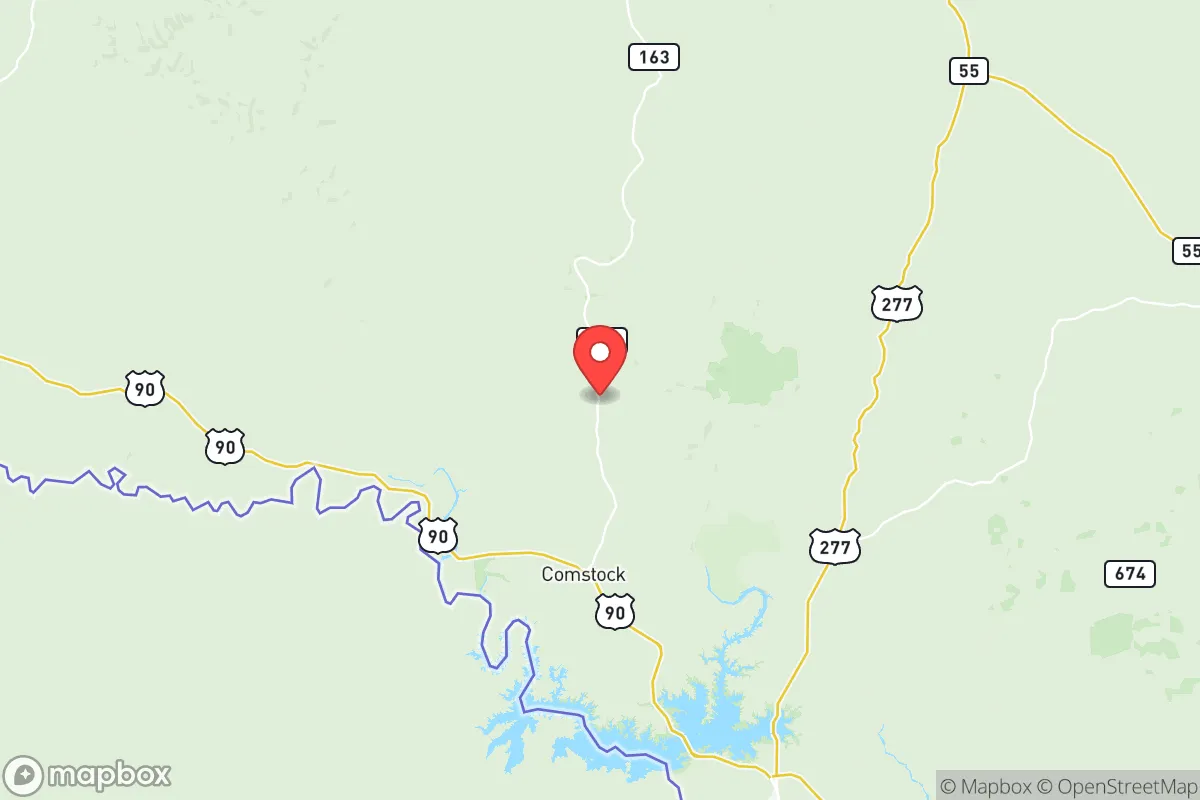
Val Verde County's R+7 rating places it about three points to the right of Texas's statewide R+4, a gap that has widened since 2020. In the 2024 presidential election, the county voted for Donald Trump by a margin of roughly 58% to 40%, while Texas overall split about 52% to 46%. The difference is most visible in the county's rural precincts: places like the small community of Comstock, which sits just north of the Amistad Reservoir, voted over 70% Republican in 2024, while the precincts around Del Rio's downtown and the San Felipe area—where a higher concentration of Hispanic and working-class voters live—came in closer to 55% Democratic. The swing precincts are the newer subdivisions on the outskirts of Del Rio, like those along Highway 277 North, where the vote has shifted from about 50-50 in 2016 to roughly 60-40 Republican in 2024. This is a faster rightward shift than the state average, which has moved only about two points in the same period.
What this means for residents
For conservative residents, the county's Republican lean means local policies tend to align with their values: the county commissioners court is majority Republican, and the Del Rio City Council has a conservative majority as well. Property taxes are relatively low compared to the state average, and there is little appetite for new local regulations on businesses or gun ownership. For liberal residents, the political climate can feel isolating, especially in the rural precincts where Democratic candidates rarely campaign. However, Del Rio's downtown precincts and the San Felipe area still provide a small but active Democratic base, and local elections—especially for city council and school board—are often competitive. The county's Hispanic population, which makes up about 75% of residents, does not vote as a monolith: older Hispanic voters in the rural areas tend to lean conservative, while younger Hispanic voters in Del Rio are more likely to vote Democratic. This split means that neither party can take the county for granted in local races, even if the national trend is clearly red.
Culturally, Val Verde County stands apart from much of Texas due to its strong border identity and the influence of Laughlin Air Force Base. The base brings in a transient population of military families from across the country, which moderates some of the local conservatism on issues like immigration and education. The county also has a higher-than-average rate of bilingualism, and Spanish is commonly heard in public spaces, which is less typical in the more Anglo-dominated parts of West Texas. Policy-wise, the county has been a testing ground for state-level border security initiatives, with local law enforcement cooperating closely with the Texas Department of Public Safety on Operation Lone Star. This has created a distinct political dynamic where national border debates play out in very local ways, from checkpoints on Highway 90 to the presence of state troopers in Del Rio's downtown. For residents, this means politics is not just about voting—it's a daily reality that shapes how they interact with law enforcement, cross the border for shopping or family visits, and navigate the local economy.

State Political ClimatePolitical Climate in Texas
State Political AnalysisPolitical Environment in the State
Texas has been a reliably Republican state for the past three decades, with a Cook Partisan Voting Index of R+4, but that label masks a dramatic and ongoing shift. The state’s dominant coalition has long been built on rural and suburban conservatives, but explosive population growth in the major metros — especially the Austin-San Antonio corridor, Dallas-Fort Worth, and Houston — is steadily eroding the GOP’s margin. In 2024, Donald Trump carried Texas by roughly 9 points, down from 19 points in 2012, and Democrats have flipped several state House seats in suburban districts around Dallas and Houston. The long arc is clear: Texas is becoming more competitive, but it remains a solidly red state in statewide elections, with a Republican trifecta in state government that has only tightened its grip over the last decade.
Urban vs. rural divide
The political map of Texas is a study in extremes. The state’s five largest counties — Harris (Houston), Dallas, Tarrant (Fort Worth), Bexar (San Antonio), and Travis (Austin) — cast about a third of all votes and lean heavily Democratic, with Travis County delivering over 70% for Joe Biden in 2020. Meanwhile, the vast rural and exurban expanse runs deep red: counties like Loving, King, and Roberts routinely vote 90%+ Republican. The real battleground is the suburbs. Places like Collin County (north of Dallas) and Williamson County (north of Austin) were once GOP strongholds but have shifted noticeably. Collin County voted for Trump by 15 points in 2020, down from 27 points in 2016. Fort Bend County, southwest of Houston, flipped to Biden in 2020 and has stayed blue, driven by a diverse, college-educated population. The Rio Grande Valley — historically Democratic but trending right — saw significant shifts toward Trump in 2020 and 2024, with counties like Starr and Zapata flipping red for the first time in generations. This urban-rural split means that a resident’s political experience depends heavily on where they live: a liberal in Austin lives in a deep-blue bubble, while a conservative in Lubbock or Amarillo experiences a uniformly red environment.
Policy environment
Texas’s policy environment is defined by a low-tax, low-regulation posture that has been consistent for decades. There is no state income tax, which is the single biggest draw for relocators, and property taxes are among the highest in the nation to compensate — averaging about 1.6% of home value. The regulatory climate is business-friendly, with minimal zoning in many cities and a right-to-work law that limits union power. Education policy is a flashpoint: the state funds schools largely through local property taxes, leading to wide disparities between wealthy and poor districts, and the 2023 school voucher battle (Senate Bill 2) failed in the House but remains a top priority for Governor Greg Abbott. Healthcare policy is notably limited — Texas has the highest uninsured rate in the country at around 17%, and the state has refused to expand Medicaid under the Affordable Care Act. Election laws have tightened: Senate Bill 1 (2021) restricted mail-in voting, added ID requirements, and limited drive-through and 24-hour voting options, particularly affecting Harris County. Abortion is effectively banned after the 2021 trigger law and the 2023 ruling in Zurawski v. Texas, with no exceptions for rape or incest. Gun laws are permissive: permitless carry was enacted in 2021, and the state has strong preemption laws that prevent cities from enacting their own firearm ordinances.
Recent policy direction
The last five years have seen a sharp rightward turn in state policy across multiple fronts. On guns, the 2021 permitless carry law (House Bill 1927) allows most adults to carry a handgun without a license or training, overriding local restrictions. On education, the 2023 “Parental Bill of Rights” (House Bill 900) restricted what books can be in school libraries and required parental notification of certain classroom discussions, while the 2024 school choice push (Senate Bill 2) would have created education savings accounts but failed in the House. On speech and privacy, the 2023 law banning TikTok on government devices and the 2024 “Digital Bill of Rights” (House Bill 4) imposed new data privacy requirements. On medical and bodily autonomy, the 2021 Heartbeat Act (Senate Bill 8) banned abortion after six weeks and created a private enforcement mechanism, effectively ending most abortion access in the state. On property rights, the 2023 “Texas Property Tax Relief” package (Senate Bill 2) increased the homestead exemption and compressed school tax rates, but property values continue to rise sharply in metros like Austin and Dallas. On voting, Senate Bill 1 (2021) remains the most consequential election law in decades, adding ID requirements for mail ballots and limiting early voting hours. The overall direction is toward more state preemption of local control, particularly on issues like policing, environmental regulation, and public health mandates.
Civil unrest & political movements
Texas has seen significant political activism from both sides in recent years. The 2020 protests following George Floyd’s murder in Minneapolis sparked large demonstrations in Austin, Houston, and Dallas, with some turning violent in Austin and leading to a controversial police budget cut that was later partially restored. On the right, the “Constitutional Carry” movement successfully pushed permitless carry through the legislature, and the “School Choice” coalition remains highly organized, with groups like the Texas Public Policy Foundation and the Texas Home School Coalition lobbying heavily. Immigration politics are a constant flashpoint: Governor Abbott’s Operation Lone Star, launched in 2021, deployed state troopers and National Guard to the border, bused migrants to New York and Chicago, and led to legal battles over state immigration enforcement. The “sanctuary city” ban (Senate Bill 4, 2017) remains in effect, prohibiting local governments from adopting policies that limit cooperation with federal immigration authorities. Secession rhetoric has flared among a small but vocal faction of the Texas Nationalist Movement, but it has no serious political traction. Election integrity controversies have been persistent, with the 2020 and 2024 cycles seeing lawsuits over mail-in ballot procedures and voter roll maintenance, particularly in Harris County. A new resident would notice the visible presence of political signage, the frequency of campaign mailers in competitive districts, and the strong partisan identity of local media outlets.
Projection
Over the next 5-10 years, Texas will continue to trend purple, driven by in-migration from blue states and the natural growth of diverse, college-educated populations in the suburbs. The 2024 election results suggest that the GOP’s margin in statewide races will continue to shrink, and Democrats are likely to flip a few more state House seats in the Dallas and Houston suburbs. However, the state’s political geography still favors Republicans: rural and exurban areas are growing faster than deep-blue urban cores, and the Rio Grande Valley shift suggests that Hispanic voters are not a monolithic Democratic bloc. The legislature will remain under Republican control through at least the 2030 redistricting cycle, meaning the policy direction — low taxes, limited regulation, restrictive abortion laws, permissive gun laws, and school choice — will continue. A new resident moving in now should expect a state that is politically competitive but still governed by a conservative majority, with the most intense political battles playing out at the local level in suburban school boards and city councils.
For a new resident, the bottom line is that Texas offers a low-tax, high-property-tax environment with a conservative policy framework that is unlikely to change dramatically in the next decade. Liberals will find safe havens in Austin, Houston, and Dallas, but will face a state government that is actively hostile to many of their priorities. Conservatives will find a friendly state government but may be surprised by the rapid demographic and political changes in the suburbs around the major metros. The practical takeaway: choose your city carefully, because your day-to-day political experience in Texas depends far more on your county than on the state as a whole.
* Values derived from national, state, county, city and local statistics and may differ in a specific area. Last updated: 2026-08-08T13:18:40.000Z
Narrative content on this page is AI-generated and may contain mistakes. Verify any details that matter before acting on them.
ReloMaps may earn a commission from affiliate links at no extra cost to you.

