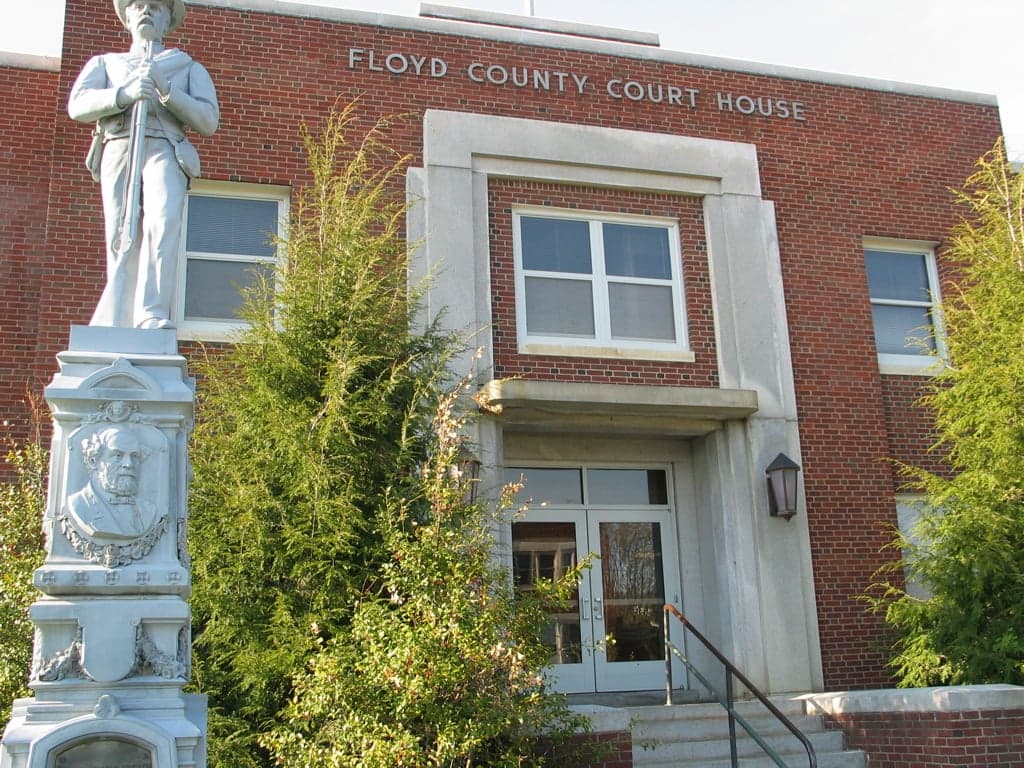
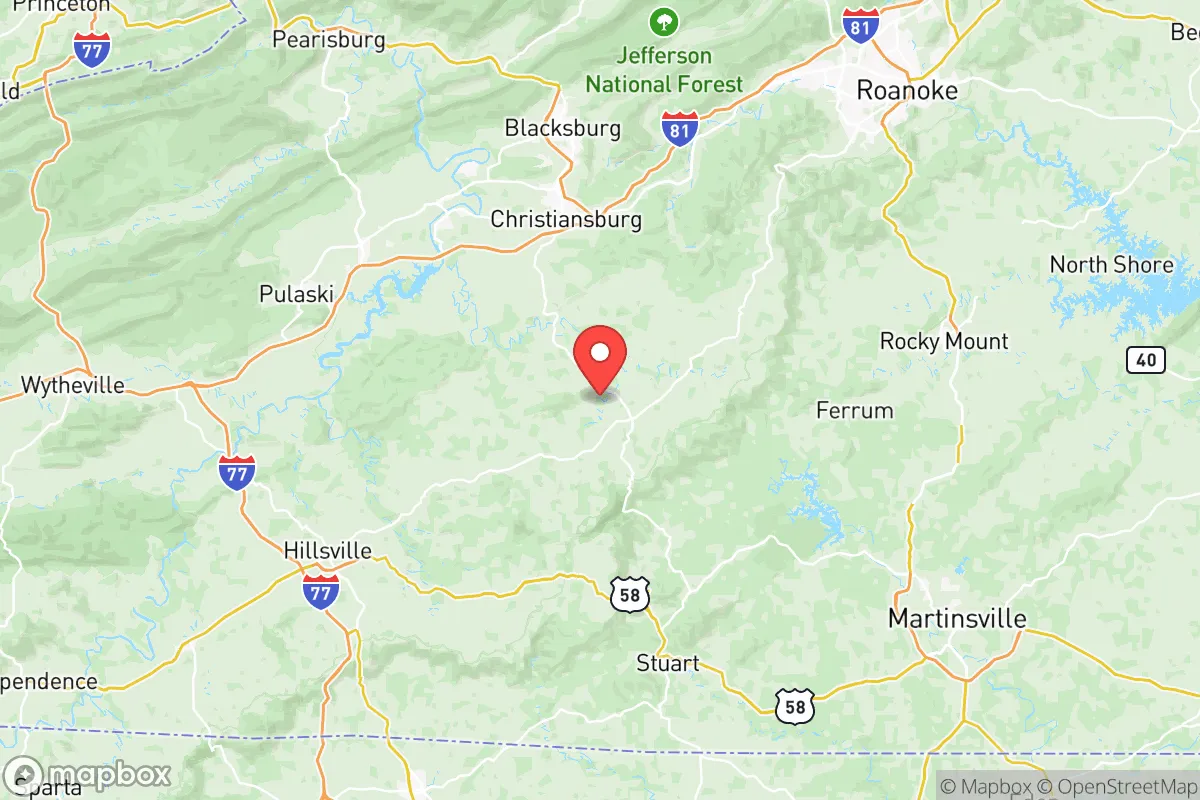
Photo: Wikipedia
Demographics of Floyd County
Affluence Level in Floyd County
A middle-class area roughly in line with national averages across income, home values, education, and employment.
People of Floyd County
Floyd County, Virginia, is home to 15,560 residents who form one of the most ethnically homogeneous populations in the Blue Ridge region, with 92.4% identifying as White, 3.0% as Hispanic, 2.8% as Black, and less than 1% combined East/Southeast Asian and Indian subcontinent residents. The county’s character is defined by its rural, small-town identity centered on the county seat of Floyd, a strong agricultural and craft heritage, and a distinctive cultural mix of traditional Appalachian values and a notable influx of back-to-the-land homesteaders since the 1970s. With only 1.1% foreign-born and a college attainment rate of 23.0%, Floyd County remains a place where generational family roots run deep, and newcomers are often drawn by land, affordability, and a slower pace of life rather than urban employment. The population is aging slightly, but the county has seen modest growth through domestic migration, particularly from other parts of Virginia and the Mid-Atlantic seeking rural retreat.
Settlement & growth (pre-1960)
Before European settlement, the area now known as Floyd County was part of the homeland of the Tutelo and Saponi peoples, Siouan-speaking tribes who lived in small villages along the Blue Ridge foothills and used the higher elevations for seasonal hunting. By the mid-1700s, these tribes had been largely displaced or absorbed by the Iroquois Confederacy to the north and by encroaching English colonists. No permanent European settlements existed in what is now Floyd County until after the American Revolution.
The first permanent settlers were Scots-Irish and English pioneers who crossed the Blue Ridge from the Piedmont in the 1780s and 1790s, following the Great Wagon Road south from Pennsylvania. They were drawn by the promise of cheap, fertile land in the valleys and hollows of the Blue Ridge, particularly along the Little River and its tributaries. These early families—names like Weddle, Reed, and Akers—established farms and small hamlets such as Floyd (originally called Jacksonville), Check, and Willis. Floyd County was officially formed from Montgomery County in 1831, and the town of Floyd was designated the county seat in 1832. The economy was almost entirely subsistence agriculture, with corn, wheat, and livestock as mainstays, supplemented by apple orchards and timber.
Unlike much of the South, Floyd County had very few enslaved people; the 1860 census recorded only about 200 enslaved individuals out of a total population of roughly 8,000, reflecting the county’s small-scale, family-farm character. After the Civil War, the Black population remained small and concentrated in a few rural pockets, particularly near Copper Hill and Indian Valley, where some families acquired small plots of land. The late 1800s saw the arrival of a small number of German and Irish immigrants who worked on the railroad lines that reached Floyd in the 1880s, but these groups largely assimilated into the existing White population within a generation.
The early 20th century brought little demographic change. The county’s population peaked at around 12,000 in 1910 and then declined as young people left for industrial jobs in the Piedmont and Midwest. The Great Depression hit hard, but the New Deal’s Rural Electrification Administration brought electricity to many farms in the 1940s. World War II accelerated out-migration, and by 1960 the population had fallen to about 10,000. The dominant cultural identity remained Scots-Irish Appalachian, with strong Baptist and Methodist church traditions, a reputation for independence, and a dialect and music style distinct from the lowland South.
Modern era (post-1965)
The most significant demographic shift in Floyd County’s modern history began not with the 1965 Hart-Cellar Act—which had almost no direct effect on this overwhelmingly native-born population—but with the countercultural back-to-the-land movement of the 1970s. Young, educated whites from cities like Washington, D.C., Richmond, and Roanoke began buying cheap farmland in Floyd County, attracted by the beauty of the Blue Ridge, the low cost of land, and the desire for self-sufficient living. These newcomers, often called “hippies” or “homesteaders” by locals, settled primarily in the Check and Willis areas, as well as along the Buffalo Mountain ridge. They brought with them organic farming, craft traditions, and a progressive political outlook that created a cultural tension with the conservative, traditionalist locals that persists in milder form today.
This influx was small in absolute numbers—perhaps a few hundred families by 1990—but it had an outsized impact on the county’s identity. The newcomers founded the Floyd Country Store as a hub for old-time music, started the Floyd Farmers Market, and helped establish the county’s reputation as a destination for artists, musicians, and artisans. By the 1990s, Floyd County had become known for a unique blend of Appalachian traditionalism and countercultural creativity, a mix that continues to define the town of Floyd itself, where conservative farmers and liberal potters share the same sidewalks on Friday night for the weekly “Friday Night Jamboree.”
Since 2000, domestic migration has been the primary driver of population growth, which reached 15,560 by the 2020 census. New residents are predominantly white, middle-aged or older, and often moving from Northern Virginia, the Washington D.C. suburbs, and the Roanoke Valley. They are drawn by lower housing costs, scenic views, and a perceived escape from urban problems. The Hispanic population has grown from negligible to 3.0%, largely through agricultural labor in the apple orchards and Christmas tree farms around Floyd and Copper Hill, as well as construction work. The Black population remains small at 2.8%, concentrated in the same historic rural communities near Indian Valley and Alum Ridge. East/Southeast Asian residents (0.4%) and Indian subcontinent residents (0.1%) are almost entirely professionals associated with Virginia Tech in nearby Montgomery County, commuting from rural Floyd County for the land and quiet.
The future
Floyd County’s population is projected to grow slowly, perhaps reaching 17,000 by 2040, driven entirely by domestic migration from other parts of Virginia and the Mid-Atlantic. The county will likely become slightly more diverse, with the Hispanic share potentially rising to 5-6% as agricultural and service-sector jobs attract more families, and with a small but steady influx of remote workers and retirees from more expensive urban areas. However, the foreign-born share will remain very low, likely below 3%, as there is no industrial or institutional draw for large-scale immigration. The cultural divide between old-timers and newcomers will continue to soften as intermarriage and shared community institutions—schools, churches, the Floyd Country Store—blend the two groups. The biggest demographic challenge will be an aging population: the median age is already above 45, and younger adults continue to leave for college and urban jobs, returning only occasionally. The county’s school-age population has been declining, and this trend is unlikely to reverse without a significant economic shift.
For someone moving in now, Floyd County offers a rural, predominantly white, culturally conservative environment with a distinctive artistic and musical overlay. It is not a place of rapid change or high diversity, but rather a community where land, tradition, and a measured pace of life remain the central draws. The population is stable, rooted, and welcoming to newcomers who respect the local ways—whether those ways are the old-time fiddle tunes at the Floyd Country Store or the Sunday morning sermons at a Primitive Baptist church in Check.

* Values derived from national, state, county, city and local statistics and may differ in a specific area. Last updated: 2026-10-20T09:03:01.000Z
Narrative content on this page is AI-generated and may contain mistakes. Verify any details that matter before acting on them.
ReloMaps may earn a commission from affiliate links at no extra cost to you.

